To understand the context of Roma begging in Florence's streets,
bulldozed out of their makeshift camps, sleeping under the Loggia
of the Innocenti for six years with no roof, no access to water,
no education, no training, no work, no health care, see Michelle
Kelso's 'Hidden Sorrow' https://www.youtube.com/watch?v=qQNhSQemCzo
Before that they were the slaves of the monasteries and the nobles
in Romania from the fourteenth to the nineteenth centuries, longer
than were Blacks in America, and they were only freed when Harriet
Beecher Stowe's Uncle Tom's Cabin was translated into
Romanian in 1853. They still, scandalously, do not have Civil
Rights, are denied access to the infrastructure necessary for
survival in modern society, and their children are snatched away
from them by force in ethnic cleansing by Social Assistance to be
brought up, removed from their Romanian Orthodox faith and their
language of Romany, the Sanskrit language that is the ancestor of
ours. Yet they are European Citizens.
See
Michelle Kelso,'s documentary ‘Hidden
Sorrows’ on deportation to Transnistria of
Romania Roma and its genocide of them, the
Porajmos of Romanian Roma.
Our Romanian
Roma families lost these members there:
Veta
Curte, Constantin Durac, della famiglia di Daniel-Claudiu
Dumitrescu
Panta
Danila, Margica Danila, Verda Danila, Caizer Mundeanu,
Lenuta Danila, Bicusa Danila, Tiberean Danila, Ivanciu
Danila, della famiglia di Diamanta Danila
Sofia Copalea, Sivirino
Copalea, Verige Copalea, Dod Copalea, Duga Copalea, Cosia
Copalea, Bisa Copalea, Cristi Copalea, Hortanza Copalea,
Pomelnic Copalea, Grafian Copalea, Grecu Copalea, Madita
Copalea, della famiglia di Ionel, Mihai, Gheorghe Copalea.
POLITICS
The
European Commission, Parliament and Council of Europe,
cognisant of the Holocaust's inclusion of the Roma and the
denial to them of reparation payments, intently worked on
solutions to Roma poverty, but are blocked at local
government levels which discriminate against Roma.
In particular, in Italy, Roma are barred from having a legal
roof over their heads, access to water or electricity, and
consequently from work. A prisoner-of-war in international law
has more rights than does a Roma who is a European Citizen.
In Italy and England, planning permission is used against
Roma from living on land they have bought and own. In Romania,
where land has been legally bought, and a house built by
themselves and legally registered, even that will be taken
from a Roma family. The poverty from lack of power for Roma is
expressed in poor housing, poor health, high illiteracy, and
blocks against employment, which results in high infant
mortality and a shockingly low life expectancy.
WORK SKILLS
Roma have
excellet traditional skills with metal, stone, wood, cloth and
earth, being blacksmiths, stonemasons, carpenters,
seamstresses, embroiderers, gardeners and cooks. Given
sufficient funding for materials they can rebuild their
housing with windows against the prevailing tuberculosis, with
adequate roofing and guttering against water and snow damage,
with handcrank/solar loght, radio and cellphone rechargers,
with wells and latrines, to be self-sufficient.They learn
these skills from the earliest age working alongside their
parents. Daniel-Claudiu Dumitrescu,
President of Asociația 'Agrustic Somnacuni-Inel de Aur',
is the grandson of the most famous coppersmith in his part
of Romania and has inherited his tools. He learned all
these traditional skills as a boy as well as having
attended school and attaining the technical diploma. He is
now working with leading restorers in Florence, restoring
the famous anti-slavery 'English' Cemetery, including the
CNR project of restoring the Odoardo Fantacchiotti
sculpture of 'Hope', Speranza, and the Donatello pulpit in
Prato for Pope Francis' blessing. Later: Daniel helped
restore Donatello's pulpit in Prato because of the
excellence of his skills.
EDUCATION
Roma
often cannot afford to pay for schooling for their children in
Romania. But children learn from their parents important
skills useful for survival, how to work with metal, stone,
wood and earth. They work collaboratively in families with
great courtesy towards each other. Taking the children from
their parents at an early age to teach them Gadje (non-Roma)
'socialization' and intellectual skills is not necessarily the
answer. In America 'socialization skills' translate into
unethical competitiveness, the Orwellian opposite of what the
word seems to imply. Instead there should be projects of
alphabetization of all ages, for women and men, which include
practical hands on information for better health, nutrition
and housing, so that children are not alienated from their
parents by education. Statistically it has been found that
where schools are held in Romani far better retention results.
At the same time attention paid to the health, nutrition
and housing of young children in families results in better
academic work. Ideally Roma can be encouraged to retain their
traditional manual skills while learning our intellectual
ones, and even teaching their excellent skills to our young
people who are in such great need of them. Our own education
system has divorced us from centuries of traditions of manual
skills' learning and teaching and has consequently caused
children to despise their parents to the point where they now
cannot work manually and are afraid for their survival in our
current economic collapse. We can learn much from the Roma;
our children could learn to work manually, gainfully
and joyfully alongside of Roma. That
is how Roma work.
Haiti as paradigm English
HEALTH
Among our
prejudices against the Roma is the belief are that they
are dirty. Instead they have strict rules from their
Indian origins about the need to wash in running water
frequently, about not washing the top part of the body
with the same soap that is used for the bottom part of the
body (a good recipe against cholera), about washing hands
very thoroughly (including the backs of hands, the wrists,
etc., as our surgeons are taught to do), about not
dressing in dirty clothes (if they are denied access to
water they will throw dirty garments away rather than
continue to wear them, to prevent diseases like typhus
from lice). Their most serious health problems come about
from the denial to them of water, of adequate housing with
windows (leading to tuberculosis), lack of employment
(meaning they cannot pay for medical care), lack of
education, particularly amongst women (resulting in being
unable to read medical information or to limit the size of
their families), intermarriage and environmental
pollutiion causing genetic defects, and alcohol and
tobacco abuse, typical amongst oppressed groups kept in
poverty, Native Americans, Irish, Blacks, Aborigine
(leading to liver diseases and cancers). A major reason for the
reluctance to send their children to Gadje schools is
their exposure there to drugs. But when it is explained to
women that where they become educated life expectancy
increases and infant mortality drops they are eager to
learn.
Daniel-Claudiu Dumitrescu, Vandana Culea Doctor Visit Romanì, Romanian,
Italian and English, with drawings by Daniel
Dumitrescu Charles Kemp, Baylor University Medical
School Doctors and the Roma
English
Lancet article on early childhood
health and education English
FAMILY
The
greatest value to Roma is the family. They marry young, are
faithful, and care for their children. One can be in a Roma
camp filled with babies, and not one of them crying. Often,
Social Assistance desires to remove the babies from the
parents because of their poverty, or at least the father from
the child and mother, but better and less costly would be
giving the father a job so he can support his family. Roma,
lacking the right to work, are further handicapped in the
modern economy by the high cost of disposable diapers and the
premature births of their babies resulting in their being
bottle instead of breast fed, both expenses they cannot
afford. Enormous sums will be spent on funerals out of respect
for the dead, a family even selling their home for the
culturally required rites. We have much to learn from Roma
about the care, nurturing and education of babies and children.
CULTURE
Roma love
beauty. Roma are deeply religious, whether they are Orthodox,
Catholic or Muslim. A Romanian Orthodox Roma nursing mother
will not drink milk on Friday nor will Roma touch iron on that
day. Their music combines joy and sorrow.
The Stories Exchange Project §http://www.stories-exchange.org
Funded by the World Bank, The Stories Exchange Project is
an experiment in generating global dialogue about the
Romany experience and tensions between the Roma and the
white majority worldwide. Visitors to the site are invited
to comment on articles and discussions and to share their
own stories. Available in English and Cesky, the site
offers summaries of workshop discussions, text excerpts
from dramatic performances, video clips of the film
Stories Exchange Project, as well as poignant passages
from interviews of project participants.Website no longer active
Elizabeth
Barrett Browning's other heroine in Aurora Leigh, Marian Erle, is Roma, who
travels from England, to France, to Florence. For the book see Elizabeth
Barrett Browning, Aurora Leigh and Other Poems (ISBN
0-14-043412-7) from: http://www.penguinclassics.com
;
Their
royalties can purchase books and materials for the the
Biblioteca and Bottega Fioretta Mazzei and can help Rom
families' house-buying and repairing. For further items, texts
and textiles, see Florin
and Shop .
Relevant Books in the
Mediatheca 'Fioretta Mazzei', Florence's 'English'
Cemetery, where we have taught Roma parents to write their
names so they will not lose their children
Alla perifera
del mondo: Il popolo dei rom e dei sinti escluso dalla
storia. Ed. Isabella D'Isola, Mauro Sullam, Guido
Baldoni, Giulia Baldini, Gabriele Frassanito. Milano:
Fondazione Roberto Franceschi, 2003. With CD. Università di
Firenze, 2003.
Isabel Fonseca. Bury
Me Standing: The Gypsies and their Journey. New York:
Random House, 1996. Father Matthew Naumes, 2001.
Gianni Berengo
Gardin. La disperata allegria: Vivere da zingari a Firenze.
Firenze: Centro Di, 1994. Paola Cecchi, Firenze, 2003.
Jean-Pierre
Liégeois. Gypsies: An Illustrated History. Trans. Tony
Berrett. London: Al Saqi Books, 1986. Jane and Philip Weller,
Hampshire, 2003.
Le strage
nazifasciste a Firenze e Provincia: Trasmettere la memoria.
Catalogo della mostra fotografica 27 gennaio-10 febbraio
2002, Gallera Via Larga, Via Cavour, 7r, Firenze.
Firenze: Amministrazione Provinciale di Firenze, Istituto
Storico della Resistenza in Toscana, 2002. Michele Gesualdi,
Firenze, 2003.
Romano Lil
4 (2001). Roma
William M.
Sloane. The Balkans: A Laboratory of History. New
York: Eaton and Mains, 1914. Syracuse University, Florence,
2005.
Antonio Tabucchi.
Gli Zingari e il Rinascimento: Vivere da Rom a Firenze.
Firenze: Feltrinelli, 1999. JBH
Portfolio on
Hedera, etc.
Brian
Vesey-Fitzgerald. Gypsies of Britain: An Introduction to
their History. London: Chapman and Hall, 1946. Jane and
Philip Weller, Hampshire, 2003.
Duncan
Williamson. Fireside Tales of the Traveller Children.
Twelve Scottish Stories. Illustrated, Alan B. Herriot.
New York: Harmony Books, 1983. Arizona State University/Mesa
Public Library, Tempe, 2004.
Our
Mediatheca in Florence will always welcome further materials
concerning the Roma
And on the
Victoria Discussion List the following suggestions were made
for leads for research:
The list of
material about the Victorian Roma/Gypsies is long, indeed, but
it's a rich and fascinating topic. If you want
contemporary accounts, the second half of the century saw the
advent of the "Gypsyologists." You might start with The
Journal of the Gypsy Lore Society. It started in
1888, I think.
You might also
look at some of the individual C19 Gypsy Scholars/Scholar
Gypsies like George Borrow (The Zincali [1841], Lavengro
[1851], and The Romany Rye [1857]), Richard Burton (The
Jew, The Gypsy, and El Islam [1898]), Francis Hindes
Groome, Charles Godfrey Leland, et al.
For more recent
examinations of the "Gypsy Problem" in the century, see David
Mayall, Gypsy-Travellers in Nineteenth-Century Society
(Cambridge: Cambridge UP, 1988) and Gypsy Identities,
1500-2000: From Egipcyans andMoon-men to the
Ethnic Romany (London: Routledge, 2004); George K.
Behlmer, "The Gypsy Problem in Victorian England," Victorian
Studies 28 (1985): 231-53; Brian Vesey-Fitzgerald, Gypsies
of Britain: An Introduction toTheir History
(London: Chapman & Hall, 1944); Thomas Acton, Gypsy
Politics and Social Change: The Development of Ethnic
Ideology and Pressure Politics among British Gypsies from
Victorian Reformism to Romany Nationalism (Boston:
Routledge & Paul, 1974).
The book-length
studies are quite good and offer longer, more nuanced
considerations, but if you want a shorter and quite
informative introduction to the subject, the Behlmer article
is a fine place to start.
The past 10-15
years have also seen a handful of doctoral dissertations on
the subject, including those by Audrey Shields, Michelle
Mancini, Mary Burke, and myself.
I don't think
it's out yet, but Deborah Nord's Gypsies in the British
Imagination, 1807-1930, is listed as forthcoming this
year from Columbia UP (I think), and based on an excerpt I
heard her read at NAVSA, it promises to be intriguing.
Lance Wilder,
Victoria List
And Gipsy
Smith, His Life and Work (New York: Fleming H. Revell,
1901). was also suggested. While the discussion list went on
to mention Elizabeth Barrett Browning's Marian Erle in Aurora
Leigh, Robert Browning's Pied Piper, George
Eliot and Matthew Arnold.
Florence's Swiss-owned so-called 'English'
Cemetery has Orthodox as well as Protestant burials. Amongst
its Russian tombs in Sector D
are the tombs of two Romanian nobles, Joan Kantakezin,
descended from the Emperor of Constantinople, and Paul
Ventura, a child, both of the slave-owning aristocracy.
These tombs were impossible to visit - until Daniel-Claudiu
Dumitresch built the terraced path by them. He also
identified these tombs for me as Romanian. At the beginning
of that path is that of Theodore Parker, the Unitarian who
preached eloquently against slavery. Frederick Douglass, the
formerly illiterate ex-slave, came from America and visited
the tombs of Elizabeth Barrett Browning (Sector B)
and Theodore Parker to honour them for their work against
slavery. Elizabeth Barrett Browning's other heroine in Aurora Leigh, Marian Erle, is Roma. Also buried in our
Cemetery are Frances Trollope (Sector B), who wrote the first
anti-slavery novel, and Richard Hildreth (Sector D), who wrote the second
anti-slavery novel. Harriet Beecher Stowe copied both of
them to create her Uncle
Tom's Cabin. The Roma in Romania were the slaves of
the nobles and the monasteries from the Middle Ages until
the nineteenth century, when Uncle Tom's Cabin was translated into
Romanian.
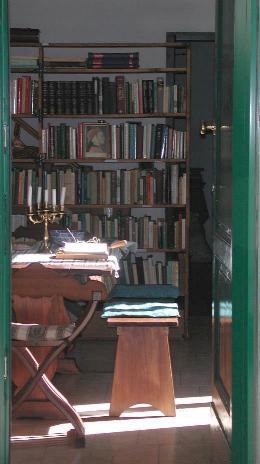
Our archives document these burials. Our library collects
these books.
As were Black slaves in America, the Roma in Romania are
kept in illiteracy. They may not legally work unless they
have a decent and registered house and the diploma. Lacking
work, they cannot afford the materials for their roofs or
the payment to the schools for heating and books. They come
to Florence, where again they may not work from lacking a
legal address, and beg in the streets, annoying tourists and
citizens. They have no country, no army, no power. They came
from India a thousand years ago and speak an Aryan language.
Their flag is green for the earth, blue for the sky with a
red wagon wheel. They are no longer allowed their
traditional caravans. But I have found that they are skilled
and excellent craftspeople, both women and men, as
blacksmiths, stonemasons, carpenters and gardeners. They
restore the 'English' Cemetery, repairing and cleaning its
tombs under expert supervision, and planting and weeding its
garden. To teach literacy they are encouraged to explore the
books in the Mediatheca, such as the intermediate technology
shown in the engravings of Diderot's Encylopedie, to marble
paper, to hand-bind books, and to use the computer.
Daniel-Claudiu Dumitrescu, who has the diploma, writes
booklets in four languages, Romanì, Romanian, Italian and
English, with his drawings, on how to rebuild roofs, with
drainage for storing water and with solar panels for
electricity, which are placed on the website, http://www.ringofgold.eu.
Daniel has also conserved all the nineteenth-century cast
and wrought iron work in the Cemetery and built the shelving
for the Cemetery's Swiss archives, many of the library's
bookshelves, and also many wooden rocking cradles, one for
his own new-born daughter, another for the Cemetery's
library, where it mirrors photographs on the walls of Roma
families, one of which shows such a rocking cradle with a
child asleep in it. I have said on Easter Day on Rai Uno
(Italian national television) that to bring Roma into a
library is to bring them into the world of the book, to give
them literacy. In this library we teach Roma how to sign
their names, so they may become members of our Aureo Anello
Associazione, and the alphabet. With that membership it is
legal for them to work for us. We have formed a sister
association in Romania of which Daniel is President which is
called Asociația 'Agrustic Somnacuni' (like 'Aureo Anello',
meaning 'Golden Ring') and whose mission is to preserve Roma
families and the Romanì language with mutual help in roof
building with drainpipes and windows, and with schooling for
adults as well as children.
All donations made
to Aureo Anello on behalf of Agrustic Somnacuni will benefit
these Roma families participating in work/study in Florence.
Please specify 'Agrustic Somnacuni' in the description box.
If you are buying a copy of 'Romany Vocabulary' send an e-mail
to Julia Holloway,
giving her your snail-mail address and she will post it to you.
Or acquire a copy from Karen Graffeo in
the States. Thanks.
'The world of the poor teaches us that liberation
will arrive only when the
poor are
not simply on the receiving end of handouts from government or
from
churches, but when they themselves are the master and
protagonists
of their own struggle for liberation'




 Library Webpages: Bibliography
|| Biblioteca e
Bottega Fioretta Mazzei ||
Library
Catalogue || Suggestions on
How to Run a Library ||
Manuscript
Facsimile Publishing Houses || Manuscripts
|| Museum Thoughts
|| Florentine
Libraries and Museums ||
How to
Build Cradles and Libraries || Bottega|| Publications|| Limited
Edition || Libreria
Editrice
Fiorentina || SISMEL Edizioni
del Galluzzo || Fiera del Libro
|| Florentine
Binding || Calligraphy
Workshop || Bookbinding
Workshop
Library Webpages: Bibliography
|| Biblioteca e
Bottega Fioretta Mazzei ||
Library
Catalogue || Suggestions on
How to Run a Library ||
Manuscript
Facsimile Publishing Houses || Manuscripts
|| Museum Thoughts
|| Florentine
Libraries and Museums ||
How to
Build Cradles and Libraries || Bottega|| Publications|| Limited
Edition || Libreria
Editrice
Fiorentina || SISMEL Edizioni
del Galluzzo || Fiera del Libro
|| Florentine
Binding || Calligraphy
Workshop || Bookbinding
Workshop 


