AGRUSTIC
SOMNACUNI || ROMANY || CRADLE || LET US PRAISE
THE ROM || CHUPPA || MEDIATHECA 'FIORETTA
MAZZEI' || 'ENGLISH'
CEMETERY || AUREO
ANELLO || Daniel-Claudiu
Dumitrescu/Julia Bolton Holloway
© 2017
Versione in italiano
AN APPEAL TO ITALY'S CONSCIENCE
Ah, you who make iniquitous decrees,
who write oppressive statutes,
to turn
aside the needy from justice
and to
rob the poor of my people of their rights,
that
widows may be your spoil,
and that you make the orphans your prey!
Isaiah 10.1-2
We are in the grips of control by 'shock'. For which see
Naomi Klein: http://books.guardian.co.uk/video/2007/sep/07/naomiklein.
We are returning to the partnered tactics of Hitler and
Mussolini. The use of a scapegoat.
I speak for the Human - and the European - Rights of the Roma.
And in particular for the European Rights of the Roma from
Romania.
The Roma from Romania are Christian, Romanian Orthodox. They
were the slaves of the monasteries from the Middle Ages to the
nineteenth century. They reached Europe from India centuries
ago. Their language is Indo-European.
For seven years (2001-2008), I have worked with families of
Romanian Roma who attend the Mass for the Poor established by
Giorgio La Pira, the saintly Mayor of Florence, and continued by
his saintly friend Fioretta Mazzei in the Badia of Florence. I
visited these families to whom I listened and whom I have come
to know and love in Romania at the end of July 2008. I met there
also with Gruia Bumbu, President, and his Roma associates, of
the Romanian Government's National Agency for the Roma in
Bucharest. They spoke of the need for housing, education,
medical care for their people. All of these needs can be met
themselves by the Roma themselves - if they can be allowed
legally to work here in Italy, there in Romania. To be allowed
legally to work they must legally be allowed an address.
Something that seems so simple. But which we found to be almost
impossible the prejudice and discrimination against them being
so very intense.
I believe our fear of the Roma, and especially of those of
Romania, is because we have not understood their culture. And
that we are afraid that their poverty might be our own future.

The Roma are matriarchal, based on the family. They have no
country, no army. Their flag, modeled on India's, is of the blue
sky, the green land, and the red wagon wheel, the Wheel of Life.
Their criminality is the same as for other groups, but they are
at the margins of society, their children starving. They are not
allowed an official address. A baracca they build themselves from
scrap
no
one
else
wants and which costs nothing is bulldozed over and over again.
It does not count as an official address. Without an official
address they are not allowed to work. Without work, though they
are European Citizens, they are considered criminal. To survive,
they can only beg. Or worse, steal.

A five room baracca
built by a Romanian Roma family of seven persons that was then
bulldozed three times by the Italian police. It was
constructed from materials no one else wanted, on land that
was not being used. Both these sisters, when clearly pregnant
were threatened by the police for living here and both
consequently gave birth prematurely. In Romania this family
sleeps twelve, children and adults together, in one room next
to a horse's stall.
The Romanian Roma leave their children with their grandparents
while trying to seek work in Italy. From which they are blocked
and forced into the undesired begging. But I have found that the
women tell of what they most need, roofs over their houses that
are not leaking letting in the snow and rain, education for
their children, medical care, and that they then organize their
families into work groups, men and women together, their sons
and their daughters, their husbands, their in-laws, friends and
acquaintances. And that they work together admirably as
families. Our laws do not allow this. We create their poverty.
When we have visited Muslim Roma families in Poderaccio
we observed the same cleanliness, the same courtesy that we find
with the Roma from Romania. Outside there is rubbish. But,
inside, the houses are spotless and beautiful. Often we have
seen the only piece of furniture is the ancestral wooden rocking
cradle, with colourful carpets and hangings, the family sleeping
and sitting on the floor, after taking their shoes off on
entering. The carpets are constantly washed.
We have taught parents who cannot read or write to
write their names to get their baby back from the hospital where
it was born, instead of being placed for adoption by an Italian
family. (I quoted in this case to the judge Roman Polanski's
statement that it was worse to be an orphan than to be poor). They
don't steal our babies. We may be stealing theirs. I fear the
latest proposals in Italy concerning Roma children, first
being fingerprinted, then taken from their parents as Italian
Citizens and educated, will be akin to Australia's and
Canada's 'Lost Generations'. I sometimes give these families
alphabet and number cards:
On one side:
A B C D E F G
H I J K L M
N O P Q R
S T
U V W X Y Z
On the
other:
1 . 6 ......
2 .. 7 .......
3 ... 8 ........
4 .... 9 .........
5 ..... 10 ..........
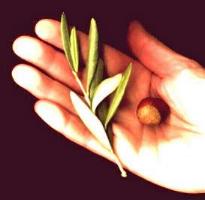
Florence had been a most beautiful city. I said to the Mayor's
office that these are what now make Florence ugly: the selling
of globalized junk to the tourists, instead of Florentine
handcrafts; the American students, particularly sloppy drunk
women students, at night rowdily breaking glass bottles in the
street; the graffiti painted by young Florentines on the
buildings around the Liceo Classico Michelangelo; the Roma who
beg. Of these, only the last play snatches of music or show
patches of beauty with their colourful skirts. If they could
work they would. They could paint over
the graffiti, if they were paid, or sell postcards
of Florence's great art, if they were allowed, instead of
begging. They could contribute to Florence and, if
allowed to work legally upon being allowed a legal address, pay
their taxes to Italy.
The Romanian Roma have saved the Swiss-owned so-called 'English'
Cemetery in Florence. First by rebuilding the dry walls that had
collapsed in ruins in the rains of 1966. They reconstructed
these walls expertly, the women holding their babies sitting at
the iron railing, telling their husbands and brothers where to
place the stones, the men first cleaning out the earth, then
throwing and catching the stones and putting them in place, in
two hours building many metres of wall expertly as well as
preparing for us a banquet at which they played their music.
That was seven years ago and I next was told it was illegal for
them to work to finish the job and had to send them away. In
return for it though I bought that family a house in Romania.
Since their work no tomb has slid downhill.
Then, last year, a young Roma woman organized her mother, her
brothers, her sister, her sister-in-law into restoring the
garden the Cemetery had once had. This family lived in a baracca
outside Florentine city limits that they built themselves out of
scrap materials no one else wanted. Everything in the Cemetery
had been put to weed killer for many years and it was grey and
ugly and dead. We forbade the weed-killer. They weeded, planted
bulbs, separated irisis and the Cemetery became again the dream
landscape it had been.
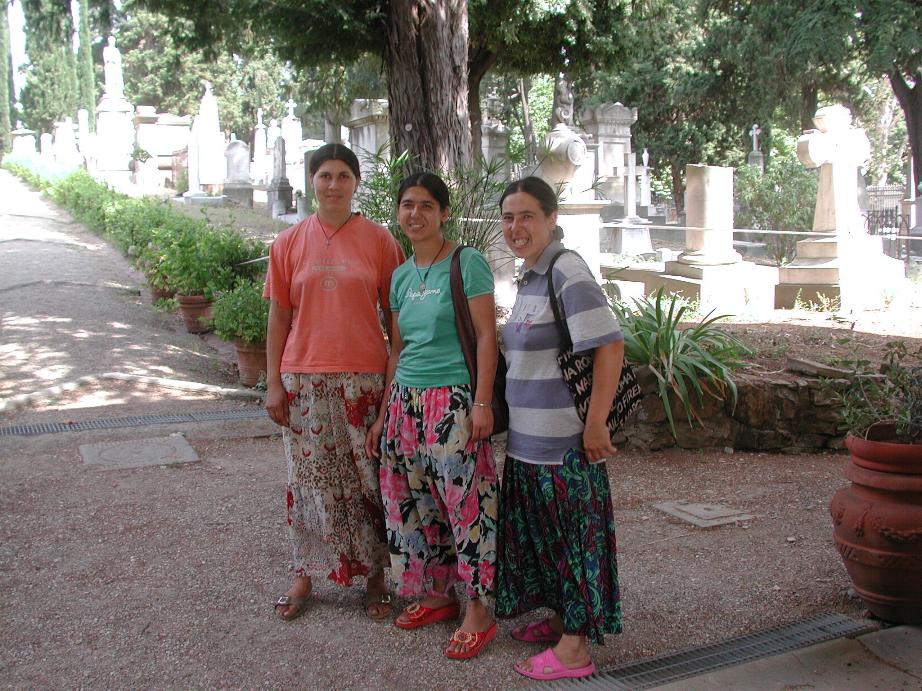
The 'English'
Cemetery's apprentice gardeners, two sisters and a
sister-in-law

Seeing Karen Graffeo's
photograph exhibition, 'Now Let Us Praise the Roma', in the
Mediatheca 'Fioretta Mazzei'. Their marbled paper.

Posing as
artists' models. For which they insist on being fully
dressed and chaperoned.

With Jill Hammer's finished drawing

Building book shelves for
the Mediatheca 'Fioretta Mazzei' and a cradle for their
brother's baby.
This year
Vandana returned with her husband, asking that he work in the
Cemetery. They are both 23. She became pregnant with their third
child. They were living in the baracca they had re-built in
an open field outside the city limits of Florence as
the police had bulldozed the earlier one. They had already
bought land in Romania on which they hope to build their house.
They came every day at 8:00 a.m., even on May 1st when they
walked for four hours to be here on time and returned to their
baracca on my bicycle, there being no bus service that holiday.
Later, Vandana was taken by the Carabinieri in their car and
threatened with expulsion if she did not leave their baracca.
That night she lost her waters and Daniel had to call the
ambulance. Their baby Gabriela was born after a week, premature
by two months, weighing 1 kilo 200 grammes. We took them in
under our roof, denouncing them to the police as living with us
as required by Italian law. With that legal address (they
already had their 'codice fiscale' numbers) we were able to
write a work contract for Daniel and pay his contributions to
the state. Daniel in these two months, waking at dawn each day,
conserved the iron, brass and copper of 87 tombs in the English
Cemetery. The difference is tremendous and appreciated by all,
by experts in restoration, by international visitors, by our
neighbours. I hired Daniel as my domestic, but he worked as a
volunteer member of our Aureo Anello Association through the
writing, together with Vandana, of a book he also illustrated, a
vocabulary in four languages, Romany, Romanian, Italian and
English: http://www.umilta.net/Romany.html,
and in return we donated to them the funds for them to build
their house on their land in Romania. In Romania, if the Roma
have a registered decent house and a diploma they can legally
work, not otherwise.
Here are some pages from the book they wrote and illustrated,
and which we have also recorded:
Familia, Familie, Famiglia, Family

Gajo
Lomni
Cāzai
Phral
Bārbat
Femeie
Copil Frate
Uomo
Donna
Bambino Fratello
Man
Woman
Boy
Brother
Baba
Dai
Ciai
Phen
Tată
Mamă
Fată
Soră
Padre
Madre
Bambina Sorella
Father
Mother
Girl
Sister
Instrumentuea, Instrumente, Utensili,
Tools


Sui
Cichci
Cat
Ac
Ciocan
Foarfecă
Ago
Martello
Forbice
Needle
Hammer
Scissors

Sapa
Cosoi
Carfi
Patentos Ferestreos
Sapǎ
Seceră
Cui
Patent
Ferestreu
Zappa
Falce
Chiodo
Pinza
Sega
Hoe
Sickle
Nail
Pliers
Saw


Șpaclos
Galeata
Furcoi
Cazmaua
Șpaclu
Gāleatā
Furcā
Cazma
Cazzuola
Secchio
Forcone
Vanga
Trowel
Bucket
Fork
Spade
Costruzioni, Constructions


Cangheri
Cher
Biserică
Casǎ
Chiesa
Casa
Church
House
Per
edificare una casa/ For building a house:
Acoperişos
Acoperiş
Tetto
Roof
Sanzi
Scandură
Trave
Plank
Tiglá
Ţiglă
Tegola
Tile
Carfi
Cui
Chiodo
Nail
|
 |
Fereastra
Fereastră
Finestra
Window
Grinda
Grindă
Asse
Rafter
Bolţari
Bolţar
Blocco
Block made from
earth and cement
Cimentos
Ciment
Cemento
Cement
|
Both Romanian Roma families who stayed under our roof were
the cleanest house guests we have ever had, conscientious,
courteous, with dignity, and grateful. They observe strict
ancestral hygienic precepts (which go back beyond their arrival
in Europe in the Middle Ages, for they are from north India and
Aryan, their Romany language Indo-European), seeing us as
unclean. In seven years nothing has ever been stolen from us by
them. We give them and other Roma families used clothing and
share meals. We invite them to our library. We find them
eminently educable. For instance, they love Dante being read
aloud with Botticelli's illustrations to the Commedia. We build wooden
rocking cradles together: http://www.umilta.net/cradle.html.

Daniel and Vandana
building the cradle for their baby Gabriela
We find it is crucial in dealings with the Roma to centre on the
women, on the family, remembering they are a matriarchy. At the
same time taking away from the men that despair that commonly
drives oppressed males in minorities to selfish anodynes like
cigarettes, alcohol, drugs, cars (Native Americans, Blacks,
Aborigine, Irish, etc.). We stress economies like
breast-feeding, cloth diapers, bicycles and home schooling. The
Roma want to work. But are forbidden by law to have work unless
they have a legal address and sufficient literacy. The Roma
marry very young in arranged marriages and are faithful to their
spouses. That faithfulness is enforced by internal tribunals
among their people. I have seen excellent, loving marriages
among them and the joint caring for their babies who never cry,
being always held and nursed, rocked in their cradles and
swaddled, therefore beginning their lives with a sense of great
security and of being loved. Our first Roma mother's ninna nana, her lullaby to
her baby, was 'Alleluia'. I
recorded it and it was played during the RAI 1 Easter Sunday
2008 broadcast on hermits as background to the Mass for the Poor
at the Florentine Badia this mother attended. Our own children
no longer receive that child-rearing. We can learn from them and
they can teach us.
In the midst of Daniel's work in our 'English' Cemetery I
visited the Roma families that we know in Florence in Romania. I
discovered that Vandana and Daniel when in Romania sleep with
other members of their family in one small room, twelve people
all told, children and grown ups together next to a stall with a
horse in it. This is why this couple works so hard here to build
their own house there for their three daughters. Another family
is headed by a widow with her four children, one adopted, their
three spouses, and her four grandchildren, their house having a
leaking roof with holes in it. We are helping them repair their
roof and the adopted eighteen-year-old son is now studying in a
six-month programme for his diploma. He had been first in his
class the one year he had in school, his family being too poor
to continue his schooling. The family that restored the dry
walls seven years ago is now prosperous from having earned the
house to replace their baracca where twelve had been sleeping.
Schooling is said by the government to be free but the parents
are billed for heating, books, and must buy clothing which they
cannot afford. Medical care must be paid for after 18 by those
who do not have work, particularly the grandparents caring for
grandchildren. Relatives visiting hospitals must pay to enter.
Water even from a tap a distance down the road is billed highly,
failure to pay carrying a prison sentence. The families go
hungry and lack clothing. I saw our family cook in a pot on an
open fire outdoors their lunch of just potatoes. We have found
that when we pay money in Florence it is immediately sent back
to Romania to feed the children. I found in these families that
despite their great poverty they generously adopt orphaned Roma
babies or unwanted Romanian babies.
My first Romanian Roma mother, who is illiterate, one day told
the story of 'Cristos who was so poor he was born in a baracca
with the animals, the horses. And the people were hungry so he
gave them bread and fish and potatoes. And then the envious
killed him'. I came to understood her telling more truly when I
saw the animals' rooms beside the humans' room and the cooking
of a pot of potatoes over an open fire outdoors in Romania.
Families cannot afford to send their daughters to school when
everyone is hungry. They can barely send the boys and for a few
years only, not to the level of the diploma which is needed for
work.
We suggest to our families that they work together in
solidarity, helping each other rebuild their roofs. When they
help each other in Romania we are more willing to reward them
with seasonal work in Florence. We suggest these families come
together as a building and learning association, the families
together thus strengthening each family within it. The name in
Romany for the Association, 'Agrustic Somnacuni', is the same as
ours, 'Aureo Anello', 'Golden Ring'. This is a part of our
project to be submitted to the European Union called 'From
Graves to Cradles'.
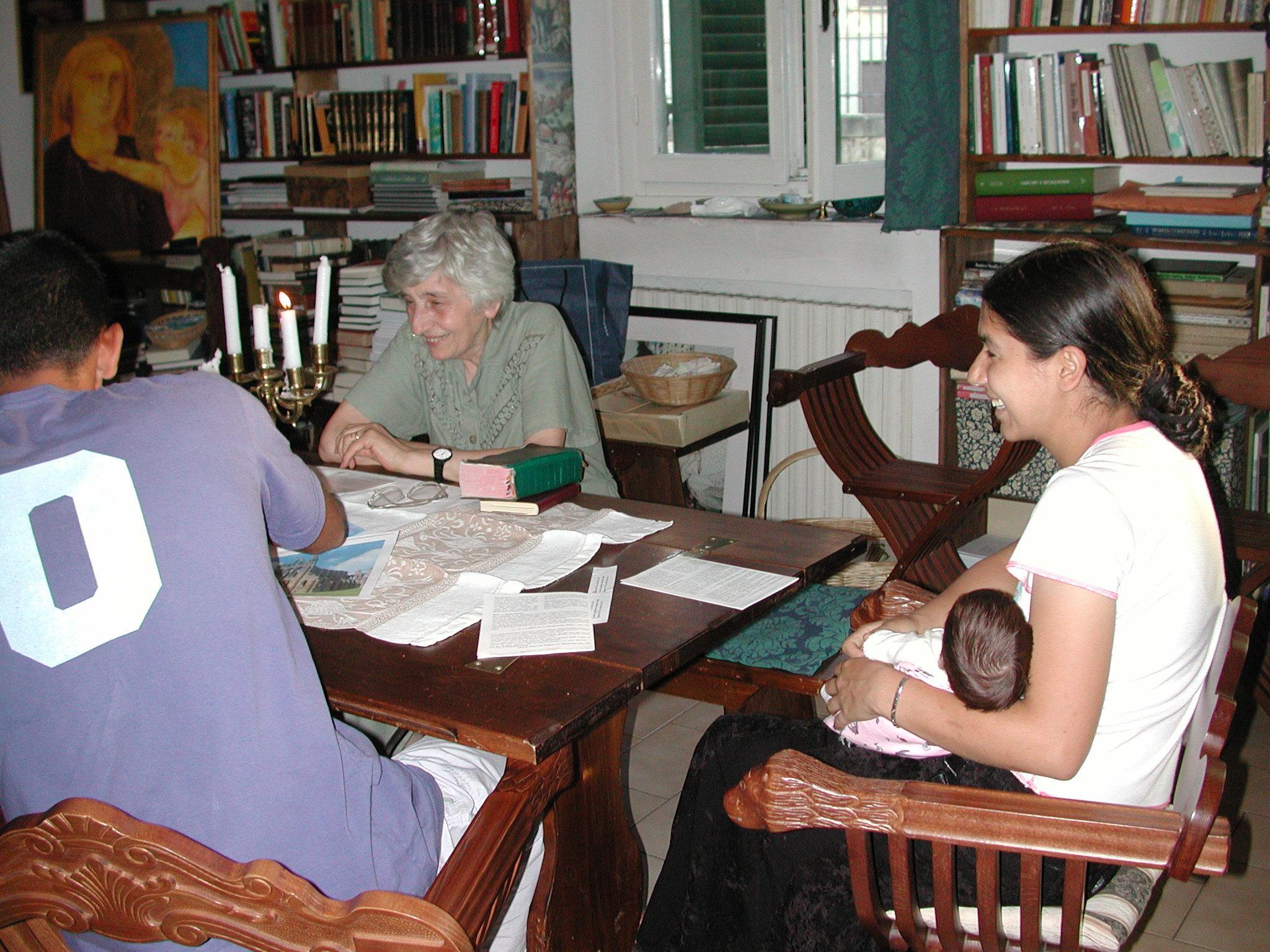
Daniel, Giovanna,
Gabriela, Vandana in the Mediatheca 'Fioretta Mazzei'
The answer to the problem of the poverty of the Roma is to
permit them a legal address so they can have legal work. Italian
Roma, Romanian Roma all should have this right to exist. The
Romanian Roma only ask for seasonal work here in Italy, for
labour-intensive work Italians no longer want. They can rebuild
dry walls, they can gather the olives, the grapes. They can
garden expertly. They can restore cemeteries. They
are fine carpenters, even the women. They sew and embroider,
even the men. A project the Muslim Roma have carried
out for a friend is to embroider the ancestors' names of Jewish
families in gold thread onto the white silk of two
chuppas. With giving Roma honest legal work
that we need done the poverty, the begging, the stealing, and
our fear of them would be alleviated. The Romanian Roma want to
return to their own most beautiful country. Its agriculture is
splendid, the land fertile, no petroleum fertilizers or
pesticides being used. They are skilled workers in metal and
agriculture, and their poverty has them be resourceful and not
wasteful. They are the florists in the streets of Bucharest.
They make the farm tools of wood and iron used by the Romanians.
They work for Romanians and then are not paid. They are
intelligent and love beauty. Victims of the Holocaust, they
received no reparations. The least we can do in reparation is
allow them and their families to survive. They are not nomads.
They are not dirty. They are no more criminal than are others.
They are under greater provocation to resort to illegal
behaviour because they are illegally treated as being outside
the laws of the land. They have been in Europe for centuries.
They are most truly Citizens of the World, Citizens of Europe,
gifted in our many languages as well as their own - which is
Indo-European. They are not rubbish. They are a great treasure
we are rubbishing.
See http://www.umilta.net/cradlelibrary.html
http://www.umilta.net/cradle.html
http://www.umilta.net/karengraffeo.html
http://www.umilta.net/chuppa.html
Versione in italiano
OLIVELEAF WEBSITE || UMILTA WEBSITE
|| OLIVELEAF
WEBSITE || JULIAN
OF NORWICH, TEXT AND CONTEXTS, WEBSITE || BIRGITTA OF
SWEDEN, REVELATIONES, WEBSITE || CATALOGUE AND
PORTFOLIO (HANDCRAFTS, BOOKS ) || BOOK REVIEWS ||
BIBLIOGRAPHY
|| FLORIN WEBSITE
©1997-2008 JULIA
BOLTON HOLLOWAY
Press Release follows.
PRESS RELEASE: AN APPEAL TO ITALY'S CONSCIENCE
(http://www.umilta.net/scapegoat.html,
Julia Bolton Holloway, P.le Donatello, 38, 50132 Florence,
Italy)
We are in the grips of undemocratic control by the
scapegoating of the most vulnerable. We are returning to the
partnered tactics of Hitler and Mussolini. I speak for the Human
- and the European - Rights of the Roma. In particular for the
European Rights of the Roma from Romania. The Roma from Romania
are Christian, Romanian Orthodox. They were the slaves of the
monasteries from the Middle Ages to the nineteenth century. I
believe our fear of the Roma, and especially of those of
Romania, is because we have not understood their culture. And
that we are afraid that their great poverty might be our own
future. Poverty is not, in itself, a crime.
For seven years, 2001-2008, I listened to
families of Romanian Roma who attend the Mass for the Poor
established by Giorgio La Pira, the Mayor of Florence, and
continued by Fioretta Mazzei in the Badia of Florence. I visited
these families in Romania at the end of July 2008. I met there
also with Gruia Bumbu, President, and his Roma associates, of
the Romanian Government's National Agency for the Roma in
Bucharest. They all spoke to me of the need for housing,
education, medical care for their people. All of these needs can
be met by the Roma themselves - if they can be allowed legally
to work here in Italy, there in Romania.
I listened first to the women, finding that
the Roma are matriarchal, based on the family. They have no
country, no army. They are at the margins of society, their
children starving. Yet, despite their poverty, they generously
adopt other orphaned Rom babies, or unwanted Romanian babies.
The women wear graceful, colourful skirts, not trousers.Their
babies can be taken from them and given in adoption to Italians
when born here if they cannot show they have a cradle, bus
tickets to return, travelling documents for the child, and
decent housing, none of which they can afford. They do not steal
our babies, we may be stealing theirs. They leave their children
with grandparents in Romania. Many Roma are illiterate as their
families cannot afford the extra expenses of their clothes,
books and heating expenses for Romanian schools. They are not
allowed an official address. A baracca they build in an open
field outside the city limits of Florence from scrap no one else
wants and which costs nothing is bulldozed over and over again.
It does not count as an official address. Without an official
address they are not allowed to work. Without work, though they
are European Citizens, they are considered criminal.
Italian Roma, Romanian Roma all should have
the right to exist. The answer to the problem of the poverty of
the Romanian Roma is to permit them a legal address so they can
have legal work. If they could have access to a dormitory in an
abandoned factory on a bus line that they could use as an legal
address and a roof this solution would suffice to lift their
families out of poverty. They only ask for seasonal work here in
Italy, for labour-intensive work Italians no longer want. Our
experience of them is that they work best as families, the women
organizing the work group. They can rebuild dry walls, they can
gather olives, grapes. They can garden expertly. They can work
with iron and stone. They are fine carpenters, even the women.
They sew and embroider, even the men. With giving them work that
we need done the poverty, the begging, the stealing, and our
fear of them would be alleviated. The Romanian Roma want to
return to their own most beautiful country. Its agriculture is
splendid, the land fertile, no petroleum fertilizers or
pesticides being used. They are skilled and their poverty has
them be resourceful and not wasteful. They are the florists in
the streets of Bucharest. They make the farm tools of wood and
iron used by the Romanians. They work for Romanians and often
are not paid because of Romania's poverty. Victims of the
Holocaust, they received no reparations. The least we can do in
reparation is allow them and their families to survive. They are
not nomads. They are not dirty. Inside their homes are spotless.
They are intelligent and love beauty. They marry young and are
faithful to their spouses. Their babies are raised lovingly and
almost never cry. It is this child-raising, despite their
poverty, that gives the Roma the inner strength to survive.
However, their life expectancy, because of that great poverty,
is shockingly low. They are no more criminal than are others.
They are under greater provocation to resort to illegal
behaviour because they are illegally treated as being outside
the laws of the land. Instead, they are most truly Citizens of
Europe, gifted in its many languages as well as their own. They
are not rubbish. They are a great treasure we are rubbishing.
AGRUSTIC SOMNACUNI || ROMANY || CRADLE || LET
US PRAISE THE ROM || CHUPPA || MEDIATHECA 'FIORETTA
MAZZEI' || 'ENGLISH'
CEMETERY || AUREO
ANELLO || Daniel-Claudiu
Dumitrescu/Julia Bolton Holloway
© 2017