ARABESQUING
THE UNIVERSITY
OR
CRADLES IN LIBRARIES
This paper discusses the milieux for
learning: the Monastery, the University, the Library, the
Family.
Introduction: Before the University, learning in
Christendom took place in monasteries, which demanded
celibacy, a separate but equal gendering. Women such as
Hrotswitha and Hildegard could be and were learned in
monastic settings. Women, later, though excluded from
universities, could and did teach themselves if they had
access to books, to libraries, among them Christine de
Pizan, Mary Somerville, Elizabeth Barrett Browning.
Alongside of monasteries was the more natural father-son
continuum of the botteghe, of the notarial chambers, such as
we see with the family of Brunetto Latino, which cultivated
Cicero and Aristotle, Latin and Greek, in the thirteenth
century, before the Medici family was heard of. Florence
then did not yet have a university. Brunetto, when in exile
following the Battle of Montaperti, carried on his store
front/ notarial chambers teaching activities in Arras,
returning to Florence to do the same following the Battle of
Benevento, teaching his own sons and others, including
Dante.
I. The University: To understand our predicament today
– and our likely failure if we competitively modernize and
annihilate an understanding of our past -- we need to know
this history. Aristotle entered the west by way of the
Arabs, where the Koran and Aristotle could be studied in
mosques by masters and disciples. For in times of war
adversaries become uniform, at the Crusades the West
adopting Arabic learning and Gothic architecture. Aristotle,
from pagan Athens, is more Pauline than Christian,
considering women to be less than slaves.


The story of Abelard and Heloise
furthered this attitude and shut out the presence of women
from university lecture halls from the twelfth to the
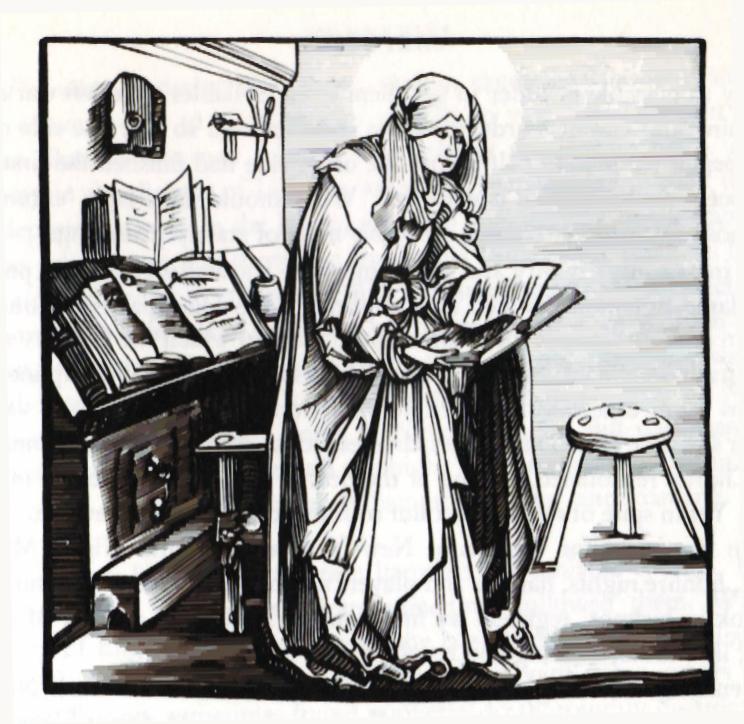
twentieth centuries. She famously told him that cradles had
to be kept out of libraries, distaffs not be mixed with
ink-wells, [Ut autem hoc philosophici
studii nunc omittam impedimentum, ipsum consule honeste
conversationis statum. Que enim conventio
scolarium ad pedissequas, scriptoriorum ad cunabula,
librorum sive tabularum ad colos, stilorum sive
calamorum ad fusos? Quis denique sacris vel
philosophicis meditationibus intentus, pueriles vagitus,
nutricum que hos mittigant nenias, tumultuosam familie tam
in viris quam in feminis turbam sustinere poterit? Que
etiam inhonestas illas parvulorum sordes assiduas tolerare
valebit? Id, inquies, divites possunt, quorum palatia vel
domus ample diversoria habent, quorum opulentia non sentit
expensas nec cotidianis sollicitudinibus cruciatur. Sed
non est, inquam, hec conditio philosophorum que divitum,
nec qui opibus student vel secularibus implicantur curis
divinis seu philosophicis vacabunt officiis], subalternizing herself
and their child, so aptly named ‘Astrolabe’, the Arabic
computing machine. Women are present with men in Christian
churches, and equal, though apart from men, in Christian
monasteries. With the establishing of universities as the
official centres for the study of theology, the ‘Queen of
Sciences’, a gender apartheid now took place that distorted
Christianity away from being the religion of ‘women and
slaves’. (We recall that in the Canon of the Mass the first
woman named is the slave Felicity, murdered before her
mistress, Perpetua, at Carthage.) The adoption, likewise, of
the Syrian imposter Pseudo-Dionysius as Apostolic Father,
who had invented the word ‘hierarchy’ and who is quoted by
Thomas Aquinas more than a thousand times as authority,
despite Abelard seeing him as fraudulent, also bent the
universities from the true of the Gospel. Exacerbating these
problems has been their Napoleonic secularization.
My own experience confirms this history. As a girl I
had dreamed of reading history at Oxford. But the money was
only for my brother’s schooling and I was sent to America at
16. There, history began with the Mayflower, so I switched
to English Literature which at least commenced with Chaucer.
In graduate school with three small children to raise I was
told scholarships only went to young unmarried men as they
would be a credit to the university. However, I experienced at Berkeley the great
English historian Sir Richard Southern coming as visiting
professor and admitting 50 students to his Seminar on the
Twelfth Century, not our usual 12, and then having all of us
collaborate in our research topics, on women, on Jews, on
outsiders, on Heloise and Abelard, working with each other.
The members of our seminar continued collaborating after he
left, a brilliant Berkeley generation.
Teaching at Princeton, I had a Hopi student chosen
when he was a toddler to inherit all the Hopi sacred lore.
Neither Hopi nor Navaho are competitive, to them this being
an evil. He drew a large C- on his blue book for the Chaucer
mid-term examination. I said I would sadly accept his
self-evaluation until the final examination and suggested
for an A+ he not only answer our standard questions on the Canterbury Tales but also give the Hopi
analogues. He did – and his grade certainly was A+. When
applying to graduate school he asked me to write letters of
recommendation. To my horror these were government forms for
American Indian students asking me to rate how competitive
he was. He was also turned down by most universities on the
basis that he lacked a second language. The rare Hopi
language, because it was only oral, not written, did not
count. His dream was to give his people their written
language. Now, he tells me, the government is even taking
away the little water their sacred city has, a city they
believe to be the world’s centre, whose ceremonies are
crucial for maintaining the world’s peace and its survival.
I taught first at the University of California at
Berkeley, then at Franciscan Quincy University, then at
Princeton University, then at the University of Colorado,
Boulder, where I became Director of Medieval Studies. But
always my pay as a woman was too low to educate my three
sons. I loved teaching, loved research, loved languages, and
brought many grants to my universities. I met with jealousy
from women, negation by men, and hostility from both in
secular universities where religion is scorned. The
competitive managerial style steadily became worse. I
published and perished. While colleagues who were male made
fabulous salaries for arabesquing Marx, indulging
ephemerally in Theory, etc.

II. The Monastery: To
edit Julian of Norwich, I renounced the University, entered
my convent, then became a hermit, sensing the need to
balance body, mind and soul, in work, study, prayer, in the
love of God and neighbour, returning to the older paradigm,
rather than specializing only in the intellect while
assaulting pyramids. I am now shut out of academic
privileges if I ever had them. I cannot access Questia or
MUSE or JSTOR, even to read my own books pirated there or
reviews of them. I cannot access refereeing structures.
Which I consider a sham since the day I had a colleague at
Boulder announce he would see to it that junior women, my
graduate students, would not get their papers refereed
favourably because of their gender. So I published them –
open access – on the Web: http://www.umilta.net/terence.html.
I chose the earlier model of the monastery which
continues through time. As I now compile a vast bibliography
around Julian of Norwich and which includes the Friends of
God and your Jan van Ruusbroec I find that this was the
model that strips away the agenda of egoism and
competitiveness, that it is what Catherine of Siena and
Julian of Norwich call the ‘cell of self-knowledge and of
God’, Virginia Woolf, the ‘room of one’s own’, that shuts
out the over-stimulation by the ephemera of consumerism and
money, for a dialogue on love transcending time and death.
Interestingly I find that the deepest readings of Julian
come from those with OSB, OP, O.Carm, and O.Cart, following
their names, those who live in community and in silence, in
collaboration and peace. These are the productive scholars
rather than those of the academy forever struggling up
self-aggrandizing ladders of the tenuring pyramid.
Many of the Contemplatives title their treatises with
the word ‘Perfection’. Writing on how to become perfect, how
to fulfil one’s gifts and talents to the utmost. But both
models, the university for centuries, and the monastery
still, are supposedly celibate models, divorced from
families. My Anglican bishops next bulldozed and sold my
convent when they had to convert the red ink the Church of
England accumulated back into black from their property
speculation. So I came to Florence seeking to further
perfect how to learn, how to teach, without money. I suppose
one could call this present model I have chosen that of the
‘beguine’, the solitary woman who binds books, the model
Belgium gave us.
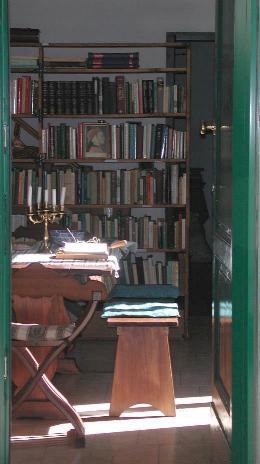
III. The Library: Our
models are co-operative, not competitive. Women have become
fine writers through having been in great libraries,
Christine de Pizan having the run of the library of the King
of France when she was a mere child,

likewise Elizabeth Barrett Browning
having the rich library her father assembled in Malvern with
his wealth from slaves, she abhorring slavery, both women
writing for Europe and for freedom. I owe my own academic
foundation to my writer father’s library in which I read
obsessively as a child. He was Gandhi’s friend and
biographer.
Now with just a library, a computer and a bicycle, I
live and study on my small pension, for exercise weeding the
cemetery I tend, and daily saying the Offices, finding in
this way great productivity and joy, using the mind with the
body and the soul. ‘Use it or lose it’. In diaspora from the
Academy, from the convent, I can and do edit manuscripts,
self-archiving my research on the Internet to the benefit of
colleagues and the public, networking this material
globally; I can and do organize international conferences in
Florence on ‘The City and the Book’, publishing their
Proceedings on the web; I can and do have the library I have
formed open to all, to Roma, learning to write their names,
to scholars from Princeton’s Institute for Advanced Study.
In eight years of running the historic Swiss-owned so-called
‘English’ Cemetery in Florence I have succeeded in
researching, writing and publishing eight scholarly books.
I recommend
these maverick open-access alternatives to universities,
where outsiders can become insiders, where money is not of
importance but where love and knowledge are, where learning
can be placed on the Web for all, for our physical, mental
and spiritual health and well-being. Our library flourishes,
without money, from its rule that to be a reader one gives
it a book a year, thus doubling its holdings in eight years.

We also restore, hand-bind and publish
books, having learned how to do so from a great Florentine
book-binder whose own modern children no longer want his
craft passed down through five generations. Our hand-bound
limited editions of Elizabeth Barrett Browning and Julian of
Norwich, for which the Roma families marble the paper, earn
the funds for restoring the tombs.
Our library works seamlessly with our website on
Florence: http://www.florin.ms, our website on the Contemplatives http://www.umilta.net,
and our newest website, on the Roma, http://www.umilta.net,
our one expense, apart from paper and ink, being web space,
TALKING BOOKS
DANTE ALIGHIERI: File
Audio in italiano:
Lettura di Carlo Poli, Inferno I,
Inferno
II, Inferno
III, Inferno
IV, Inferno
V, [VI-VII], Inferno
VIII, Inferno IX, Inferno X,
[XI], Inferno XII, Inferno
XIII, [XIV], Inferno
XV, Inferno
XVI,[XVII-XXXII], Inferno
XXXIII, Inferno
XXXIV
Purgatorio
I, Purgatorio
II, Purgatorio
III, Purgatorio
IV, Purgatorio
V, Purgatorio
VI, Purgatorio
VII, Purgatorio
VIII, Purgatorio IX], Purgatorio
X, Purgatorio
XI, Purgatorio XII, [XIII-XIX], Purgatorio
XX, Purgatorio
XXI, [XXII-XXVII], Purgatorio
XXIX, Purgatorio
XXX, Purgatorio
XXXI, Purgatorio
XXXII, Purgatorio
XXXIII
Paradiso
I, Paradiso
II, Paradiso
III, Paradiso
IV, Paradiso
V, Paradiso
VI, Paradiso
VII, Paradiso
VIII, Paradiso IX, [X-XI], Paradiso
XII, [XIII-XXXII], Paradiso
XXXIII
Padre
Nostro, Vergine
Madre
Carlo Poli was born in the Mugello, where Giotto was born. He is dedicating the rest
of his life to reciting and recording Dante.


Here we publish oral readings in mp3
recordings of Dante’s Commedia, that reach
even the Italian diaspora in Australia, and of Elizabeth
Barrett Browning’s poetry,


as well as electronic texts of
Brunetto Latino’s writings, and of Birgitta of Sweden’s and
Julian of Norwich’s theology, in five languages, both
Brunetto and Birgitta writing for all Europe.
A major theme of our library and of our websites is
of indigenous and nomadic peoples and their languages,
excluded from dominant cultures but worthy of being studied
and nurtured: Roma (whose Indo-European Romany language is
not even counted amongst the European Union’s languages,
though they are our largest minority and whose illiteracy,
because of their poverty, is very high), Rumantsch,
Australian Aborigine, African American, American Indian,
etc.
|
On one side: A B C
D E F G H I J K
L M N O P Q
R S T U V W
X Y Z |
On the other: 1 . 6 ......
|
IV. The Family: I
give alphabet and number cards to Roma families, adults and
children both needing these. Our library departs from the
plea by Heloise and Abelard to separate cradles from books.


Together we and the Roma build their cradles and house their families with us, the ‘cradle in the library’, while they restore our tombs, and then return to Romania to build or repair their houses with their earnings.

Gabriela in her cradle

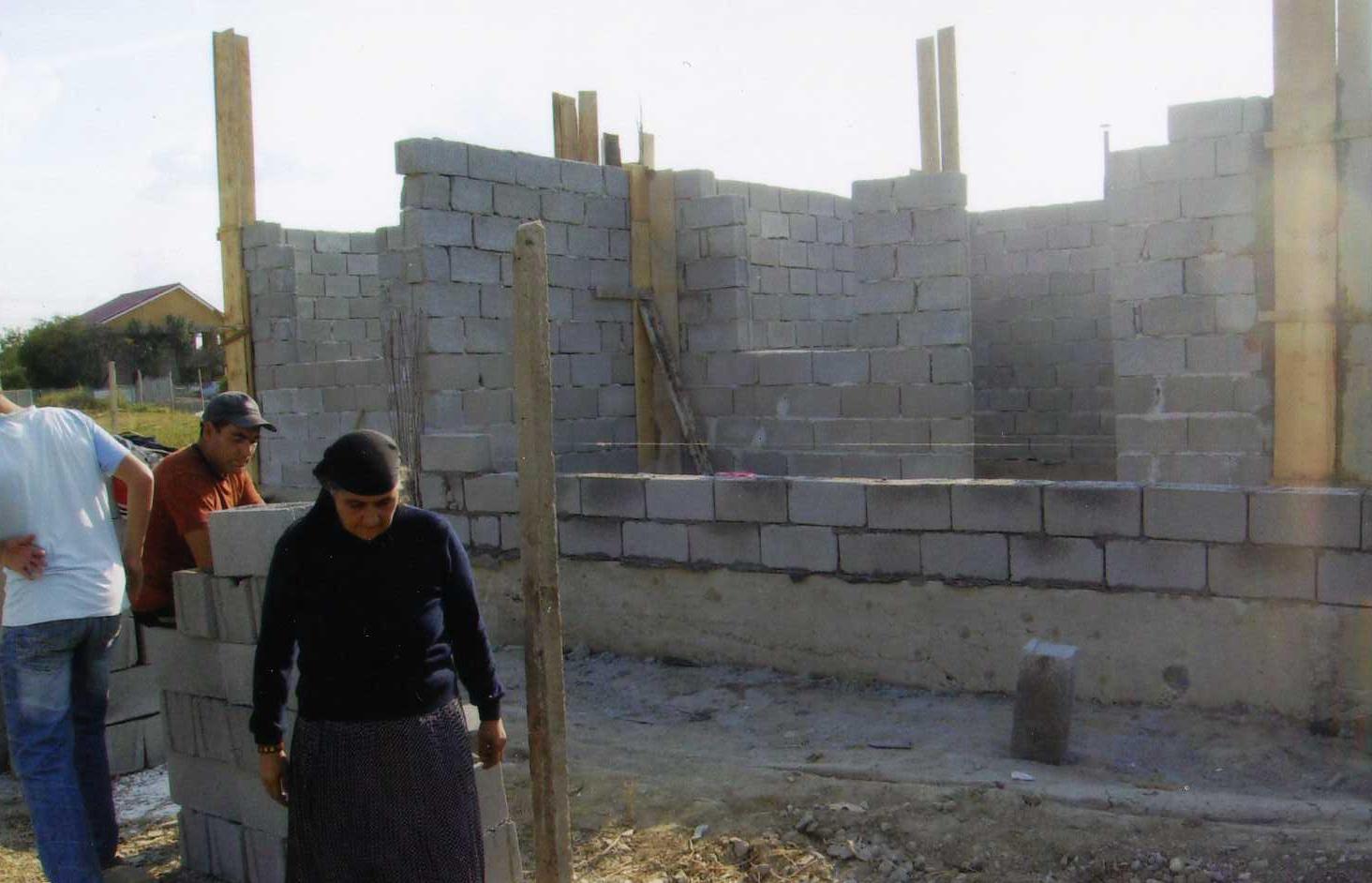

The house-building in Romania, even
Gabriela’s grandmother helping.
DIZIONARIO LINGUA ROMANI, CON PAROLE IN RUMENO, ITALIANO, E INGLESE
Drawings by/Disegni di Daniel Dumitrescu, Words by/Parole di Vandana Culea e Daniel Dumitrescu
Familia, Familie, Famiglia, Family

Gajo
Lomni
Cāzai
Phral
Bārbat
Femeie
Copil
Frate
Uomo
Donna
Bambino Fratello
Man
Woman
Boy
Brother
Baba
Dai
Ciai
Phen
Tată
Mamă
Fată
Soră
Padre
Madre
Bambina Sorella
Father
Mother
Girl
Sister
Daniel and Vandana, parents of
Gabriela, our fourth Roma family, are writing books in our
library for their people and for us. These
hand-bound
books are in four languages, in Romany, Romanian, Italian
and English, for instance, on Roma culture,
Costruzioni,
Constructions


Cangheri
Cher
Biserică
Casǎ
Chiesa
Casa
Church
House
On house construction,
Per edificare una casa/ For building a house:
| Acoperişos Acoperiş Tetto Roof Sanzi Scandură Trave Plank Tiglá Ţiglă Tegola Tile Carfi Cui Chiodo Nail |
 |
Fereastra Fereastră Finestra Window Grinda Grindă Asse Rafter Bolţari Bolţar Blocco Block made from earth and cement Cimentos Ciment Cemento Cement |
JAUA CO DOCTOROS


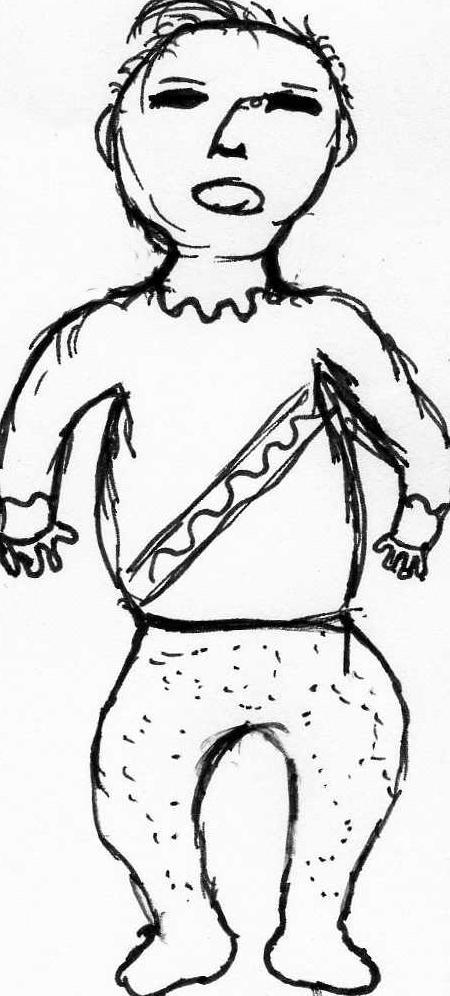
O VIZITA LA DOCTOR
UNA VISITA DAL MEDICO
A VISIT TO THE DOCTOR
and on family health care, in our
project on family preservation and language preservation in
the face of their slavery by the monasteries from the Middle
Ages to the nineteenth century and their genocide within
living memory for which no reparations have been paid.
Our project ‘From Graves to Cradles’
is for their home-schooling each other, while they restore
tombs and build cradles in Florence and buy, build or
restore their homes in Romania, until they can climb out of
their illiteracy and poverty and enter schools and
universities. We now dream of it as also including their
making their traditional caravans as libraries, travelling
from camp to camp, in Italy and in Romania, to function as
intergenerational schools, on the order of Ethiopia's
similar project for children with donkey cart libraries. Our
sense is that Florence is the world’s university, that can
be open to all, not as a corporate Medici fiefdom, but as a
global Republic of Letters in which contadini
(peasants) and artigiani (craftspeople),
children, women and men, above all, families, participate
and share. These are concepts of openness, of enabling, that
we need for our new Europe, beyond its Bologna Process,
beyond its Lisbon Strategy.

Conclusion: For the model of the new university,
open accessing the ivory tower academy to the monastery, the
library and, above all, the family, I suggest we hold in
mind Jan van Ruusbroec and his community writing their many
and lovely contemplative books under the trees of
Groenendaal. Because of whom the President of Beijing’s
Global Village, the ecologist Sheri Liao Xiaoyi, visited
both me and Groenendaal, our making these contacts through
the Web and her seventeen-year-old daughter filming our
conversation about Florence’s history on the steps of the
Ospedale degli Innocenti. We are women and men working
together as is done in the Roma families. We are Europe. We
are the Global Village.

Our fourth Roma family,
Daniel, Gabriela, the baby for whom our tenth cradle was
built, and Vandana, in our library, which is also theirs.
For it is ‘Everybody’s Library.’
Julia Bolton Holloway,
Professor Emerita, Mediatheca Fioretta Mazzei, ‘English’
Cemetery, Piazzale Donatello, 38, 50132 FIRENZE, ITALY,
Telephone: 39 055 582608, e-mail: holloway.julia@tiscali.it
Paper read with Power
Point slides at the ‘Beyond Bologna: Rethinking the
University’ International Conference, Antwerp, 12 December,
2008.
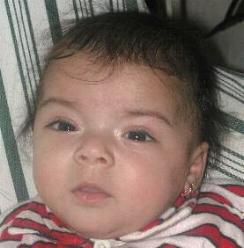
Gabriela's
Passport Photograph
European Citizen

 |
If you have used and enjoyed this page please
consider donating to the research and restoration of
Florence's formerly abandoned English Cemetery by the Roma and its Library through our Aureo Anello Associazione's account with PayPal: Thank you! |
AUREO ANELLO || AGRUSTIC SOMNACUNI || ROMANY || CRADLE || MEDIATHECA 'FIORETTA MAZZEI' || 'ENGLISH' CEMETERY || LET US PRAISE THE ROM || CHUPPA ||