JULIAN OF NORWICH, HER SHOWING OF LOVE
AND ITS CONTEXTS ©1997-2024
JULIA BOLTON
HOLLOWAY ||
JULIAN OF
NORWICH || SHOWING OF LOVE || HER TEXTS || HER
SELF || ABOUT HER TEXTS || BEFORE JULIAN || HER CONTEMPORARIES || AFTER JULIAN || JULIAN IN OUR TIME || ST BIRGITTA OF SWEDEN
|| BIBLE AND WOMEN || EQUALLY IN GOD'S IMAGE || MIRROR OF SAINTS || BENEDICTINISM || THE CLOISTER || ITS SCRIPTORIUM || AMHERST MANUSCRIPT || PRAYER || CATALOGUE AND PORTFOLIO (HANDCRAFTS, BOOKS )
|| BOOK REVIEWS || BIBLIOGRAPHY ||
'COURTESY' AND 'HOMELINESS' IN THE REVELATIONS
OF JULIAN OF NORWICH
SISTER ANNA MARIA REYNOLDS, C.P.
 n his stimulating book on Jane
Austen's language, Mr Norman Page writes, 'Surely the colour
and flavour of a text are determined not by the exceptional
words, unless these words taken together form a large class,
but in the main by the common words used by the author, the
words used by him over and over again?'(1) The remark serves
as an apt introduction to the purpose of this essay, in
which I intend to look closely at two sets of words used by
Julian of Norwich. My aim is to recapture what Mr Page
describes as 'the precise sense of the meaning carried by
these words for the writer and her contemporaries,' and in
the light of this knowledge to identify our responses to the
truth which they enshrine.
n his stimulating book on Jane
Austen's language, Mr Norman Page writes, 'Surely the colour
and flavour of a text are determined not by the exceptional
words, unless these words taken together form a large class,
but in the main by the common words used by the author, the
words used by him over and over again?'(1) The remark serves
as an apt introduction to the purpose of this essay, in
which I intend to look closely at two sets of words used by
Julian of Norwich. My aim is to recapture what Mr Page
describes as 'the precise sense of the meaning carried by
these words for the writer and her contemporaries,' and in
the light of this knowledge to identify our responses to the
truth which they enshrine.
Even a casual reading of Julian's book makes one
aware of the frequency with which the words courtesy
and homeliness, with their derivatives, are used in
the Revelations: their constant recurrence indicates
that these two sets of words, the warp and the woof of her
writing, express key-concepts in the anchoress' experience of
God.
The provenance of the two qualities is very
different. Courtesy is a word whose ramifications and
overtones embrace the social, moral and literary history of
Western Europe from the twelfth to the fifteenth century: the
world of troubadors, minnesingers and writers of romance, the
world of the Roman de la Rose and the Courts of Love.
It was a leisurely, aristocratic world, where courtoisie
governed the whole pattern of social intercourse and
relationships between men and women and between men and men.
During the twelfth and thirteenth centuries
courtoisie had been closely connected with the convention of
Courtly Love. According to Richard Barber:
Any love worth his salt was at once cortes,
a word that meant both 'courteous' and 'courtly' and implied a
knowledge of the conventions. Certain things were not
cortes: Falsehood in love, miserliness, infidelity and
lack of restraint or secrecy.(2)
By the end of the thirteenth century the Minnesang
had disappeared into contests of technique on the one hand and
social satire on the other. The amours which had inspired the
lyric poetry of chivalry and the social convention of love
attached to it, were becoming discredited. But the idea of
'love-service' survived well into the fifteenth century, long
after the social and poetic impulses which gave it life, had
died out. The decline was so slow, almost imperceptible, so
that accepted ideas of knightly society as to love in 1250
would have been perfectly understood in 1450.
Towards the middle of the fourteenth century in
England, chivalric fashions were set almost entirely by the
French, and the virtues of prowess, loyalty, largesse,
franchise and courtesy were held above all to mark the good
knight.(3)
Courtoisie, the attainment of all
worldly virtues, becomes the keynote of chivalry. Much of courtoisie
was concerned with questions of manners: hospitality and a
warm welcome; debonairte or gaiety and openheartedness
seemed to be as essential as loyalty, and generosity is as
vital as compassion.(4)
Its characteristic and permanent traits are listed
as follows by a modern scholar:
Observation du salut, du baiser et du congeé,
pratique de l'acceuil et de l'hospitalité, soyauté et
fidelité, bonté et pitié, douceur, liberalité et largesse,
joie, souci de la renommée, mesure, amour et, dans l'amour
même, application des vertues courteoises s'ils n'en sont pas
l'achèvement.(5)
By the fourteenth century courtoisie had
become synonomous with curialitas, the nobilitas
morum , 'the cardinal virtue, so to speak, of the
chevalier, the embodiment of the social and ethic ideal of
chivalry.'(6)
This aristocratic genealogy of courtesy, with all
its associations and resonances, is clearly brought out in the
fourteenth-century English alliterative romance (whose author
was a contemporary of Julian) Sir Gawain and the Green
Knight. In this poem, according to one critic, 'the
central interest is not the Green Knight but Gawain and the cortays
Arthurian civilization he represents'.(7) Gawain is shown to
be not only a brave man but one who is invariably well bred,
polite and urbane in conversation and behavior, deferential to
all women, tactful, gentle, modest and self-effacing. His cortayse
is implicitly contrasted with vilaynye, the behaviour
appropriate to a vilain or peasant. Indeed, the courtly code
is so important to Gawain that he goes against his conscience
rather than rebuff a lady - noblesse oblige.
Julian's use of the courtesy concept subsumes and
sublimates all these earlier connotations: lordship, prowess,
fidelity, gentleness, generosity, and service. The Christ of
her experience is Lord, All-Mighty, All Wisdom, All Love:
See, I am God; see, I am in all things: see, I
do all things: see, I never lift my hands off my works, nor
ever shall, without end: see, I lead all thing to the end that
I ordain it to, from without-beginning, by the same might,
wisdom and love that I made it with. How should anything be
amiss?(8)
He is the glad giver who, with supreme tact,
ever taketh but little heed of
the thing that he giveth . . . And if the receiver take the
gift gladly and thankfully, then the courteous giver
setteth at nought all his cost and all his woe, in return for
the joy and delight that he hath; for he hath pleased and
solaced him that he loveth.
He is the knight par excellence, who, deprecating
his great deeds,
of his great courtesy . . . doeth away all
our blame, and beholdeth us, with ruth and pity, as children
innocent and loveable.
He manifests the welcoming joyfulness characteristic
of the perfection of chivalry:
Then our courteous Lord sheweth himself to
the soul cheerfully with glad countenance, with a friendly
welcome.
There is a divine munificence in his working:
Grace worketh with mercy, by
lifting up, rewarding, endlessly surpassing all that our
loving and our travail deserveth, spreading abroad and making
plain the high abundance and largesse of God's royal Lordship
in his marvellous courtesy.
Knightly pity is transformed into divine compassion:
I saw that only pain blameth and punisheth; but our
courteous Lord comforteth and soccoureth.
And again:
Our Lord of his mercy sheweth us our sin and our
feebleness, by the sweet gracious light of himself. For our
sin is so foul and so horrible that he, of his courtesy,
willeth not to show it us except by the light of his mercy.
He is the personification of fidelity and
trustiness:
Also, our courteous
Lord, in that same time, shewed full sweetly and full mightily
the endlessness and immutability of his love.
But this courteous Lord of might and majesty is also
the Lord who condescends to treat with his own creatures as
with an equal:
The place that Jesus taketh in
our soul-he shall never remove therefrom without end. For in
us is his homeliest home and his endless dwelling.
Homely and homeliness
have no such distinguished and scintillating history as
courteous and courtesy: their associations, literary
and social, are at the opposite end of the knightly spectrum -
the equivalent, in fact, of vylanye in knightly
estimation.
The words derive, of course, from home, of Old
English origin, and though in modern English homely and
homeliness convey a mild suggestion of patronage and in
their meaning of 'plainness ', and 'simplicity', in Julian's
day the usual meaning of homely was 'familiar'; or
'intimate'. The word homeliness occurs in Rolle and is used
of Christ by Wyclif with
the sense 'familiar'. Significantly, these words do not occur
in Sir Gawain and the Green Knight. Indeed, there
appears to be no literary precedent for Julian's coupling of homeliness
with that of courtesy ; the words belonged to
different worlds and had less in common that have the
connotations of 'nature' and 'nurture' for present-day
readers.
The homeliness of God is a paradox which
filled Julian with astonishment and delight:
For truly, it is the greatest
joy that could be, as I see it, that he who is highest and
mightiest, noblest and worthiest, is the lowest and meekest, homeliest
and most courteous .
What this homeliness of our Lord involves is
carefully explained by Julian:
He cometh down to us, to the
lowest part of our need. For he despiseth nothing of what he
hath made. And he disdaineth not to serve us in the simplest
offices that belong, in kind, to our body, for love of the
soul that is made to his own likeness. For as the body is clad
in clothes, and the flesh in skin, and the bones in flesh, and
the heart in the breast, so are we, soul and body, and more
homely: for they all vanish, wasting away. But the good of God
is ever whole and most neart to us, without any compassion.
Homeliness, therefore, implies nearness -
more, an active, loving presence to us and in us on God's
part; not the aloofness, formality and reverence of the
courteous knight, but the closeness, warmth and tenderness of
the loving mother whose service is always 'nearest, readiest
and surest'.
Julian actually uses the words 'God is our Mother'
and expounds the implications of this (ultimately scriptural)
image with a wealth of detail:
This office no one might nor
could ever do to the full, except he alone. We know that all
our mothers bear us to pain and dying; a strange thing, that!
But our true Mother, Jesus, he alone beareth us to joy and to
endless living . . . Thus he sustaineth us within him in love
and in travail, unto the full time in which he willed to
suffer the sharpest throes and most grievous pains that ever
were, or ever shall be; and he died at the last. Yet all this
might not fully satisfy his marvellous love.
The fusion is complete. Courtesy and homeliness
become one in the single daring image, 'our true Mother,
Jesus'. Only in Christ, Redeemer as well as Creator, can the
qualities both of the perfect knight and of the perfect mother
be combined.
It remains now to see what the
response of good souls should be to the courteous and
homely action of God in Julian's words:
It is his office to save us. It
is his worship to do it and it is his will that we know it.
For he willeth that we love him sweetly and trust in him
meekly and mightily. And this showed he in these gracious
words 'I keep thee full surely'.
Early on in her book Julian had
given us a reason for this trust in God, his courtesy
and homeliness :
He will be trusted, because he
is full courteous and homely. Blessed may he
be.
Later, she makes clear that our attitudes to God
should also reflect the courtesy and homeliness
with which he treats us:
And thus we shall, in love, be homely and
near to God, and in dread, gentle and courteous to God
both qualities united equally.
She goes on to say:
For our courteous Lord willeth that we be as
homely with him as heart can think or soul desire.
She adds, however, a timely
warning:
But we must beware lest we take
this homeliness so recklessly as to forsake courtesy.
Our Lord Himself is sovereign Homeliness. But as homely
as he is, even so courteous he is; for he is very
Courtesy.
Such loving, reverent dependence is very pleasing to
God:
The highest wisdom is for a
creature to do according to the will and counsel of his
highest sovereign Friend. This blessed Friend is Jesus; it is
his will and counsel that we hold us with him, and fasten us,
homely, to him evermore, in what state so ever we be.
In other words, to quote a modern spiritual writer,
we must be willing to live the following truth:
The daily life of the Christian is summed up
in the word receive. Every challenging thing that God demands
of me - long-suffering, meekness, humility, goodness,
holiness, joy - is not something I am or something I do, or
some virtue I acquire or attain to. It is Christ in me. Each
is the manifestation of Him. (9)
When we are weak, then we are strong, provided
we are firmly fastened to God: this is the supreme message of
the Revelations. Characteristically, Julian expresses
it in concrete terms which recall the 'unless you become as little children . . . ' of the Gospel:
And I understood that there is no higher
stature in this life than childhood-in the feebleness and
failing of might and understanding-until the time that our
gracious Mother hath brought us up to our Father's bliss. And
there shall truly be made known to us his meaning, in the
sweet words where he saith: 'All shall be well; and thou shalt
see it thyself that all manner of thing shall be well'.
We have come a long way from the convention of the
Courts of Love and the sophistication of the Roman de la
Rose; yet Julian was a product of the age and of the
culture which revelled in both. She understood her world,
however, saw what was good in it but realized, too, that it
had gone astray in divorcing human from divine love.
Julian's special blessedness lies in this, that she
learnt from experience that Divine Love embraces, enriches and
ennobles human love:
God is all that is good, as I see it. And God
hath made all that is made; and God loveth all that he hath
made. Thus he that loveth the whole - all his even-christians
- for God, loveth all that is. (For in mankind that shall be
saved is comprehended all, that is to say, all that is made,
and the Maker of all. For in man is God, and in God is all.)
He that loveth thus, loveth all.
Perhaps this message too, is of particular
significance for our own day: 'He
that has ears to hear, let him hear'.
Sister Anna Maria Reynolds, C.P.
Cross and Passion Convent
22 Griffith Avenue
Marino, Dublin 9
EIRE
Notes
This essay was first published in the Fourteenth-Century
English Mystics Newsletter, 2 (1979), 12-20, and is
republished with the kind permission of that Journal's editors
and of the author.
1. Norman Page, The
Language of Jane Austen (Oxford, 1972), p. 56.
2. Richard
Barber, The Knight and Chivalry (London, 1970), p. 78.
3. Gervase
Matthew, 'Ideals of Knighthood in Late Fourteenth-Century
England', Studies in Medieval History , ed. R.W. Hunt
(Oxford, 1948), p. 360.
4. Barber, p.
148.
5. Quoted, A.J.
Denomy, 'Courtly Love and Courtliness', Speculum 28(1953),
48.
6. Denomy, p. 48.
7. A.C. Spearing,
Criticism and Medieval Poetry (London, 1964), 38. See
also J. Lafitte-Houssat, Troubadours et Cours d'Amours (Paris,
1966), Ch. IX, 'L'Amour courtois: ses caractères'.
8. Quotations
from the Orchard edition of the Revelations, ed. James
Walsh, S.J. (London, 1961); Penguin edition, ed. C. Wolters
(London, 1966), offers a completely modernized text.
9. Watchman Nee,
Changed Into His Likeness (London, 1971), p. 82.
See also:
Sister Anna Maria Reynolds,
C.P., Some Literary Influences in
Julian of Norwich;
Sister Anna Maria Reynolds,
C.P., The Passion in Julian of
Norwich;
and The
Julian Summit

Julian of
Norwich, Showing of Love , definitive edition
and translation, Firenze: SISMEL, 2001, available from SISMEL or from Julia Bolton
Holloway. Scholar/ Contemplative/ General/
To see
an example of a page inside with parallel text in Middle English
and Modern English, variants and explanatory notes, click here.
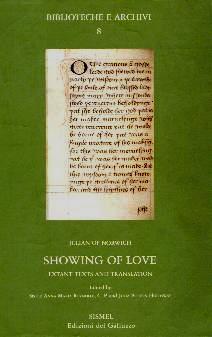
To Julian of Norwich, Showing of Love: Extant
Texts and Translation, ed.
Sister Anna Maria Reynolds, C.P. and
Julia Bolton Holloway (ISBN 88-8450-095-8), 848 pages,
18 full colour plates of the manuscripts, from University of
Florence, SISMEL Edizioni del Galluzzo, 2001, 191 euro, e-mail
galluzzo@sismel.itaor Julia
Bolton Holloway
 Sister
Anna Maria Reynolds C.P. is the greatest editor Julian ever
had. During the war years she was transcribing the extant
microfilms with a microscope, a word at a time, for her Leeds
University MA and Ph.D. theses. Subsequent editions are based
on her meticulous work. Now in her nineties, blind, frail, she
has created a fine CD in which she discusses Julian with total
recall of the text. It can be obtained for 12 euro from her at
Cross and Passion Convent, 22 Griffith Avenue, Marino, Dublin
9, EIRE.
Sister
Anna Maria Reynolds C.P. is the greatest editor Julian ever
had. During the war years she was transcribing the extant
microfilms with a microscope, a word at a time, for her Leeds
University MA and Ph.D. theses. Subsequent editions are based
on her meticulous work. Now in her nineties, blind, frail, she
has created a fine CD in which she discusses Julian with total
recall of the text. It can be obtained for 12 euro from her at
Cross and Passion Convent, 22 Griffith Avenue, Marino, Dublin
9, EIRE.
Indices to Umiltà
Website's Essays on Julian:
Preface
Influences
on Julian
Her Self
Her
Contemporaries
Her Manuscript
Texts ♫
with recorded readings of them
About Her
Manuscript Texts
After Julian,
Her Editors
Julian in our
Day
Publications related to Julian:


Saint
Bride and Her Book: Birgitta of Sweden's Revelations
Translated from Latin and Middle English with Introduction,
Notes and Interpretative Essay. Focus Library of Medieval Women. Series Editor,
Jane Chance. xv + 164 pp. Revised, republished,
Boydell and Brewer, 1997. Republished, Boydell and Brewer,
2000. ISBN 0-941051-18-8
 To see an example of a page inside with
parallel text in Middle English and Modern English, variants
and explanatory notes, click here. Index to this book at http://www.umilta.net/julsismelindex.html
To see an example of a page inside with
parallel text in Middle English and Modern English, variants
and explanatory notes, click here. Index to this book at http://www.umilta.net/julsismelindex.html
Julian of
Norwich. Showing of Love: Extant Texts and Translation. Edited.
Sister Anna Maria Reynolds, C.P. and Julia Bolton Holloway.
Florence: SISMEL Edizioni del Galluzzo (Click
on British flag, enter 'Julian of Norwich' in search
box), 2001. Biblioteche e Archivi
8. XIV + 848 pp. ISBN 88-8450-095-8.
 To see
inside this book, where God's words are in red, Julian's
in black, her editor's in grey, click here.
To see
inside this book, where God's words are in red, Julian's
in black, her editor's in grey, click here.
Julian of
Norwich. Showing of Love. Translated, Julia Bolton
Holloway. Collegeville:
Liturgical Press;
London; Darton, Longman and Todd, 2003. Amazon
ISBN 0-8146-5169-0/ ISBN 023252503X. xxxiv + 133 pp. Index.
 To view sample copies, actual
size, click here.
To view sample copies, actual
size, click here.
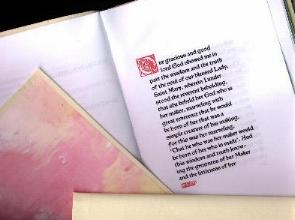
Julian of
Norwich, Showing of Love, Westminster Text, translated into
Modern English, set in William Morris typefont, hand bound
with marbled paper end papers within vellum or marbled paper
covers, in limited, signed edition. A similar version
available in Italian translation. To order, click here.

'Colections'
by an English Nun in Exile: Bibliothèque Mazarine 1202.
Ed. Julia Bolton Holloway, Hermit of the Holy Family. Analecta
Cartusiana 119:26. Eds. James Hogg, Alain Girard, Daniel Le
Blévec. Salzburg: Institut für Anglistik und Amerikanistik
Universität Salzburg, 2006.

Anchoress and Cardinal: Julian of
Norwich and Adam Easton OSB. Analecta Cartusiana 35:20 Spiritualität
Heute und Gestern. Salzburg: Institut für Anglistik und
Amerikanistik Universität Salzburg, 2008. ISBN
978-3-902649-01-0. ix + 399 pp. Index. Plates.
Teresa Morris. Julian of Norwich: A
Comprehensive Bibliography and Handbook. Preface,
Julia Bolton Holloway. Lewiston: Edwin Mellen Press, 2010.
x + 310 pp. ISBN-13: 978-0-7734-3678-7; ISBN-10:
0-7734-3678-2. Maps. Index.

Fr Brendan
Pelphrey. Lo, How I Love Thee: Divine Love in Julian
of Norwich. Ed. Julia Bolton Holloway. Amazon,
2013. ISBN 978-1470198299

Julian among
the Books: Julian of Norwich's Theological Library.
Newcastle upon Tyne: Cambridge
Scholars Publishing, 2016. xxi + 328 pp. VII Plates, 59
Figures. ISBN (10): 1-4438-8894-X, ISBN (13)
978-1-4438-8894-3.

Mary's Dowry; An Anthology of
Pilgrim and Contemplative Writings/ La Dote di
Maria:Antologie di
Testi di Pellegrine e Contemplativi.
Traduzione di Gabriella Del Lungo
Camiciotto. Testo a fronte, inglese/italiano. Analecta
Cartusiana 35:21 Spiritualität Heute und Gestern.
Salzburg: Institut für Anglistik und Amerikanistik
Universität Salzburg, 2017. ISBN 978-3-903185-07-4. ix
+ 484 pp.
JULIAN OF NORWICH, HER SHOWING OF LOVE
AND ITS CONTEXTS ©1997-2024
JULIA BOLTON
HOLLOWAY ||
JULIAN OF
NORWICH || SHOWING OF LOVE || HER TEXTS || HER SELF || ABOUT HER TEXTS || BEFORE JULIAN || HER CONTEMPORARIES || AFTER JULIAN || JULIAN IN OUR TIME || ST BIRGITTA OF SWEDEN
|| BIBLE AND WOMEN || EQUALLY IN GOD'S IMAGE || MIRROR OF SAINTS || BENEDICTINISM || THE CLOISTER || ITS SCRIPTORIUM || AMHERST MANUSCRIPT || PRAYER || CATALOGUE AND PORTFOLIO (HANDCRAFTS, BOOKS
) || BOOK REVIEWS || BIBLIOGRAPHY ||


