BOOK REVIEWS: JULIAN OF NORWICH
Christopher Abbott || David
Aers and Lynn Staley || Wendy Love
Anderson || Denise Nowakowski Baker
|| Frances Beer || Ritamary
Bradley || Martin Buber || Robert H. Calderwood || Cloud of Unknowing, ed. Gallacher || Marion Glasscoe || Walter
Hilton, ed. Bestul || Julia Bolton
Holloway, ed. St Bride || Julia Bolton
Holloway, ed. Julian || Rosemary Horrox,
ed. || Jarena Lee in Spiritual Narratives || Deeana Copeland Klepper, ed. || M. Diane F. Krantz || C.S.
Lewis || Asphodel P. Long || Sandra J. McEntire, ed. || Ralph Milton || Bridget
Morris || Edward Peter Nolan || William F. Pollard, ed. || Ambrose Tinsley, O.S.B. || Lynn Staley || Karen
Sullivan || Sheila Upjohn || Vadstena Customary || Rosalynn
Voaden || Rosalynn Voaden,
ed || Nicholas Watson
Christopher Abbot. Julian of Norwich: Autobiography and Theology. Cambridge: D.S. Brewer, 1999. Studies in Medieval Mysticism 2. xiv + 197 pp. Bibliography, index. ISSN 1465-5683
When Catholic Sister Ritamary Bradley titled her book, Julian's Way: A Practical Commentary on Julian of Norwich, she called attention to the need to not only study, but live, Julian's contemplative life, not only to analyse, but to practice it. On the other hand, Anglican Sister Benedicta Ward proclaimed that Julian was never a nun. Christopher Abbott has bravely sailed into the eye of this storm and written an academic book that overflows narrow boundaries, bringing to it his sharing of Julian's contemplative life, himself knowing both worlds, of the university and of the monastery. He reads Julian in lectio divina and his reading is wide and deep.
Much Julian scholarship is secondary, scholars quoting scholars, and thus building upon faulty premises. The major fault of most of these studies is the commonly believed ordering of the texts, the Short Text first, the Long Text later, and the Westminster Text ignored. A thorough study of all the Julian of Norwich, Showing of Love, manuscripts and their true ordering, garnered from primary research, is about to be published. Christopher Abbot has mercifully not set about proving the progress from one text to the other, but instead has sought to understand Julian.
On page 8, Christopher Abbot queries 'xxx' as being 'yowth'. But in the Lynn, Norfolk, Promptorium Parvulorum (Early English Text Society, Extra Series 102, 'Agis sevyn', column 7), we are given the Roman sense of youth as up to fifty, certainly beyond thirty, years of age. In his careful reading of her text he becomes aware that she is speaking of an earlier time and desire, prior to her vision and her writing of the Showing. He parallels her autobiographical strategy to John in his Gospel. He notes parallels also to Catherine of Siena and Birgitta of Sweden 's writings. And he speaks of Benedict's Rule, Guigo II's Scala, Augustine's Confessions, Bernard's On the Song of Songs, Aelred's De Institutione Inclusarum, Catherine of Siena's , on contemplative lectio divina .
Especially fine is his perception, albeit pretentiously worded, p. 45, 'The mystical coinherence through Christ of the personal and the ecclesiological implies a dissolution of the gap between Julian as differentiated subject of religious experience and the total community of her fellow Christians'. His chapters on Incarnation I. the Lord and the Servant, use Anselm and Augustine, and are especially illuminating on the slade as also the Virgin's womb, as Julian states, and II. The City of God, enclosing Adam/Christ. 'Human nature was/is created in a primary sense for Christ himself so as to be shared with all human beings, the adopted children of the Father and Christ's own brothers and sisters', p. 114, then citing Julian, 'Thus our lady is our moder in whome we are all beclosid and of hir borne in Christ; for that she is moder of our savior is moder of all that shall be savid in our savior', p. 160. He continues by saying, 'much more imporant to Julian than the details of Mary's appearance are "the wisedam and the trueth of hir soule', for she is 'fulfillid of grace', translating Gabriel's words 'Ave Maria, gratia plena', p. 161. He ends with the womb image, the birthing, the beginning, citing the work of my former colleague, Edward P. Nolan .
This book is highly recommended for all
Julian scholars and lovers.
David Aers and Lynn Staley. The Powers of the Holy: Religion, Politics and Gender in Late Medieval English Culture. University Park: Pennsylvania State University Press, 1996. ISBN 0-271-01542-X. 310 pp. Bibliography, index.
A English Marxist and an American Feminist come together to do Theory upon Wyclif, Piers Plowman, Julian of Norwich and Chaucer. The Powers of the Holy: Religion, Politics and Gender in Late Medieval English Culture is thus an important, and deeply scholarly, book. But excised from it is the Power of the Holy, the reason for being of medieval literature, architecture and art, which then so clearly transcended merely mortal authority that it has now become suppressed everywhere. Today's fashionable academic discourse upon Julian is clearly uncomfortable with theology, and struggles, paradoxically, to win authorized approval through having co-opted Marxism, while obliterating its Gospel, and Feminism, while obliterating its Liberation. Nevertheless, in the final pages of this book all these obtain a shadow victory.
What is especially interesting in many of the scholarly books that follow in these review pages, by Baker, Beer, Glasscoe, is their thesis that the Short Text is earlier than the Long Text. Nicholas Watson in two brilliant Speculum articles has argued for the Short Text as later, but still earlier than the Long Text. In Aers and Staley there is uneasiness about the accepted paradigm, but not yet a willingness to shift, this anxiety being particularly noted in the footnote to p. 79, where they take issue with Watson's pushing of the dating of the Long Text into the reign of Henry V. Far better would be for all concerned to returned to what Julian's texts and manuscripts themselves say, that the Long Text was originally finished 20 years after the 1373 Revelation, in 1393; and that the Short Text was originally finished when Julian was still alive, 'yet on live', the manuscript's text giving that year as 1413. That date accords with everything that Watson has demonstrated concerning the anxiety of that period. While the Long Text accords with everything that Watson says about the halcyon confidence of the earlier period about 1393. Had this brilliant pair worked with the other, and historically likely, ordering they could have carefully demonstrated the suppression that takes place, in lieu of 'development', within Julian. And they could have celebrated Julian's courageous St Cecilia-like compliance/countering even of that suppression. The paradox is that it is in countering that censorship against women doing theology that Julian autobiographically enters the foreground of her text as visionary, as censored, as gendered. She is seventy. She will not be silenced. She speaks like Anna in the Temple, like Magdalen in the Garden.
David Aers, p. 95, rightly senses Julian's use of Piers Plowman's allegorical mode of thought in her Chapter 51 on the Lord and the Servant. Both texts are seeped in Wyclif's milieu. (Lynn Staley will note the relation to orthodox Thomas Brinton's Sermons 99, 100, pp. 151-152.) He also brilliantly notes how Julian counters other women's feminist use of milk and blood in relation to Christ. Lynn Staley begins her Julian chapter discussing the chronology of the writing of the various layers of the Showings, again with the premise that the Short Text is early. As before, Watson is discussed, pp. 110-112. By p. 126, Staley states correctly that the Long Text is clearly of the fourteenth, rather than the fifteenth, century, in so doing disagreeing with Watson, because its serenity would not be appropriate to the tensions of the Lancastrian period. On pp. 118-120 she falls into the slade of misreading 'soul' as 'soil', excrement. There is only one reading in the Middle English Dictionary of 'soul' in any way connected with filth, where 'foul' was written of a festering wound, but where the 'f' failed to get crossed, leaving it a long-tailed 's'. This accident has given rise to a generation of textual misreading that fall foul of the substance of what Julian wrote. Staley is particularly good on the context of the 'Lord and Servant' Parable. Indeed, throughout, the pairing of their work is always complementary one to the other.
Aers and Staley are correct in their dating
of the Long Text's composition, Watson, in his of the Short
Text. However, the proof of this ordering is given in the
publication of the 2001 edition and translation of Julian of
Norwich's Showings.
___________________________________________________________________________________________________________________________________________________
Anderson, Wendy Love.
<i>The Discernment of Spirits. Assessing Visions and
Visionaries in the Late Middle Ages</i>. Series:
Spätmittelalter, Humanismus, Reformation/Studies in the Late
Middle Ages, Humanism and the Reformation 63. Tübingen, Germany:
Mohr Siebeck, 2011. Pp. x, 266. EUR 89.00. ISBN-13:
9783161516641.
Reviewed by Debra L. Stoudt Virginia Polytechnic Institute and
State University dstoudt@vt.edu
The discernment of spirits is central not only to the experience
of the visionary but also to that of the prophet, the reformer,
the magician--and occasionally the heretic. Identified by St.
Paul in his first letter to the Corinthians (12:10) as a gift of
the Holy Spirit, the ability to discern spirits serves as a
token of divine favor, one bestowed on a variety of individuals
throughout history. These men and women, clerics and laypersons
are remarkable not only for the gift they have received but for
its unique manifestation in their lives. In her engaging study
Wendy Love Anderson traces how prophecies and visions are
"received and understood by the visionaries themselves and by
the people around them between the twelfth and the fifteenth
centuries in Christian Europe" (2). The examination is an
outgrowth of Anderson's 2002 University of Chicago dissertation,
the title of which, "Free Spirits, Presumptuous Women, and False
Prophets: The Discernment of Spirits in the Late Middle Ages,"
draws attention to the marginal role in society played by many
recipients of the gift. The revised title and the study itself
give precedence to the historical context of the experiences and
the tradition of commentary that evolved concerning the
<i>discretio spirituum</i>.
The introduction begins with the response of delight by
Christina of Markyate around 1115 to a vision of the Virgin Mary
alongside the skeptical reaction of Veronica Binasco in the
second half of the fifteenth century to a similar experience.
What transpired in the intervening centuries? What
criteria merged by which true revelations could be distinguished
from false ones? What authority did religious and secular
powers wield concerning such matters? In the subsequent
chapters Anderson undertakes a contextualization of the
responses to these queries, linking the responses of succeeding
generations to explain the remarkable shift over time.
Anderson proposes the rediscovery of prophecy by European
Christians in the twelfth century as the impetus for change. The
visionary experiences of Franciscan clerics stimulate debate on
the topic in the thirteenth century, and by the fifteenth
century it is the visionary experiences of lay women take center
stage. The shift attests to the gendering of theological
discernment discourse and results in a multifaceted discourse on
the <i>discretio spirituum</i> in terms of gender,
ecclesiastical status, and the struggle for symbolic power by
the early fifteenth century (11). Anderson argues that the
question of authority maintains preeminence over that of gender
with regard to the gift of discernment (7), but it might be
contended as well that the two are inextricably intertwined.
In a section on the visionary context of discernment (4-8)
Anderson references recent literature, including Nancy Caciola's
<i>Discerning Spirits: Divine and Demonic Possession in
the Middle Ages</i> (2003)
and Dyan Elliott's <i>Proving Woman: Female Spirituality
and Inquisitional Culture in the Later Middle Ages</i>
(2004). She identifies the scholarly niche her study fills,
namely that "[t]he late medieval discourse on the discernment of
spirits was a visionary project (in both senses), a series of
reactions to key events in the history of Christianity, and a
dynamic conversation across several centuries addressing widely
diverse claims to religious authority within late medieval
Christendom" (8).
The first chapter outlines the biblical and patristic origins of
the Christian characterization of the discernment of spirits,
with its occasional exhortations to beware of false prophets and
claims that the clergy possess the gift <i>ex
officio</i>. Augustine's tripartite understanding of
visions--corporeal, spiritual, and intellectual--remains an
essential concept through the Middle Ages, but the advent of the
monastic tradition introduces a difference nuance to
<i>discretio spirituum</i>, one that reflects
"communal moderation" (36). The chapter concludes with the
advice of Bernard of Clairvaux on the subject and a brief
examination of the reception of the visionary
experiences of Hildegard of Bingen, Joachim of Fiore and
Elisabeth of Schönau at the end of the eleventh and the
beginning of the twelfth century, focusing on the question of
whether each is expected to prove her or his prophetic status
and how each understands that status.
Chapter 2 explores the impact of the new order and
the new mysticisms on discernment in the thirteenth century.
What proof is needed to confirm an individual's status as
prophet and who evaluates that proof become central themes of
papal letters and canon law. The diverse opinions within the
Franciscan Order are exemplified by the skeptical stance of
David of Augsburg toward the trustworthiness of revelations and
visions as well as the more defensive posture of Peter of John
Olivi. In the course of the fourteenth century Olivi's writings
are interpreted by other authors, e.g., Arnald of Villanova and
Augustinus of Ancona. Anderson situates the writings of this
time in the context of the historical ages set forth by Joachim
of Fiore at the close of the twelfth century and the growing
instability of the Church that culminated in the Avignon papacy
of the fourteenth century.
The focus of Chapter 3 lies squarely on the writings of a number
of Germanic theological figures. Henry of Friemar "the Elder"
sets forth criteria for the discernment of the spirits in the
tradition of the medieval scholastics. However, his critique of
the "philosophers" in favor of the holy men inspired by grace
serves as a precursor to the mystically informed writings of a
number of Dominicans, especially Henry Suso and John Tauler.
Suso uses the Middle High German
<i>underscheit/d</i> to translate Latin
<i>discretio</i> as well as
<i>distinctio</i> and touts the potential role of
visionary experiences in the spiritual guidance he offers. In a
similar vein, Tauler provides homiletic advice as to how to
distinguish the divine from the diabolic. The Dutch mystical
tradition is exemplified by Jan Ruusbroec, who examines
discernment as part of the inward life, providing direction for
those who might be tempted to spiritual error. Anderson
underscores the didactic nature of the writings of these figures
and examines the impact of the pronouncements in light of the
Free Spirit heresy, which she links to the "misapplication of
reason" in understanding spiritual teachings (122).
Chapter 4 is concerned with three individuals caught up in the
historico-religious events of the time: Birgitta of
Sweden, Pedro of Aragon, and Catherine of Siena. All are
advocates of the return of the papacy to Rome, and their
influence is examined in view of their authority as shaped by
"the proper place of revelation within the institutional Church"
(126). In all three cases the experiential relationship with
Christ serves a pivotal function. Anderson ascertains a shift to
a post-Schism idea of discernment, in which an outside authority
is called upon to validate the visionary experience.
Chapter 5 explores the role of medieval universities during the
years of the Great Western Schism in the debate regarding
discernment. Most prominent reformers are university-based
theologians eager to participate in church affairs. Drawing on
the commentary of previous, they conclude that the right to
determine the authenticity of visions and revelations is indeed
their prerogative (189). In this regard Anderson examines the
influential comments of Pierre d'Ailly on the question of true
and false prophecy as well as the doctrine of discernment of
Henry of Langenstein, who identifies false prophets as those who
lack <i>ratio</i> as well as
<i>discretio</i> (175). It is left to the pupil of
both men, Jean Gerson, to champion their ideas. The chapter
concludes with an excursus on critiques by various scholars of
the last century concerning the writings of the above- mentioned
theologians and reformers, with a focus on medieval women's
spirituality and the gendering of discourse. There have been
similar debates regarding the central figures in other chapters,
and one may wonder why only in this particular case the topic is
explored in depth.
Anderson's argument for a nuanced understanding of Gerson's
ideas and their evolution over time provides the context for the
first part of Chapter 6. The mature Gerson is convinced that
theologians must not
only be educated, they must also have an "ineffable encounter
with the divine" in order to provide guidance regarding
<i>discretio spirituum</i> (224). He becomes
increasingly moralistic as he compares theologians and
visionaries and ever more systematic as he establishes authorial
hierarchies for discerning spirits. Anderson interprets Gerson's
disparaging comments toward visionary women as more of a
critique of male confessors and the institutional church than of
the females themselves (213). However, at this time the topic of
female visionaries is a contentious one--as it has been
throughout history-- exemplified by the case of Joan of Arc,
whom Gerson defends in <i>Super facto puellae</i>,
although his arguments are misrepresented at her trial two years
after his death. The concluding pages review the salient points
of the study. Anderson also offers a glimpse into the "Future of
Discernment," with references to Savonarola as well as
Reformation and post-Reformation debates on the subject.
Anderson's presentation of the topic is even-handed, but any
study is selective by necessity. Women's spirituality is
explored at various points but seldom takes center stage.
Although devils are given their due, the topic of witchcraft is
avoided. Notably absent from discussion are representatives of
the English mystical and theological tradition, aside from the
introductory reference to Christina of Markyate. Likewise the
voices of female spiritual charges of the German Dominicans of
the Rhineland might have been heard or evidence from their
writings presented to support (or refute) the efficacy of the
spiritual advisors' guidance. Given the introductory chapter
summaries (13-16), there may have been the expectation of more
extensive commentary regarding certain topics, e.g., the choice
of vernacular languages among German and Dutch writers in the
thirteenth
century. However, these <i>desiderata</i> do not
detract from the argument the author sets out to make. Anderson
achieves her stated goal: she succeeds in neatly fitting
together selected pieces of the history of discernment of
spirits to provide a valuable, readable description of the
contours of its evolution in the late Middle Ages.
_________________________
<i>Responsiones Vadstenenses: Perspectives
on the Birgittine Rule in Two Tracts from Vadstena and Syon
Abbey. A Critical Edition with Translation and
Introduction</i>. Ed. Elin Andersson. Stockholm: Acta
Universitatis Stockholmiensis/ Studia Latina Stockholmiensis LV,
2011. Glossary, Index, Bibliography, Abbreviations, 3 b/w
Manuscript Plates. vi + 260 pp. SEK 375. ISBN 078-91-86071-59-2
I had earlier reviewed <i>Liber usuum fratrum monasteri
Vadstenensis/ The Customary of the Vadstena Brothers: A Critical
Edition with an Introduction</i>, edited by Sara Risberg
(Stockholm: Almqvist & Wiksell International, 2003). Both
these books are of great usefulness for a study of London's Syon
Abbey, for the pair, Julian of Norwich and Margery Kempe of
Lynn, and for the cross currents of contemplative manuscript
compilations between Syon and Vadstena, between England and
Sweden..
<i>Responsiones Vadstenenses</i> at first hand
documents the resolution of tensions between the Brigittine
monasteries of Vadstena in Sweden, founded by Saints Birgitta
and Catherine, her daughter, and Syon Abbey in England, desired
by Henry IV and founded by HenryV in 1415. The 60 Sisters of
each house were intensely cloistered, the 25 Brothers not so
much and able to travel from one monastery to another and to
Rome. The Abbess, Christ tells Birgitta
[<i>Revelaciones</i> X Latin text: Sancta Birgitta,
<i>Opera Minora</i> I: <i>Regvla
Saluatoris<i/>, ed. Sten Eklund (Stockholm: Almqvist &
Wiksells, 1975); electronic version:
http://www.umilta.net/bk10.html], represents Mary, the Confessor
General, Christ. Two Syon brothers, one of them the future
Confessor General, Robert Bell, the other, Thomas Steryngton,
present their written questions to the Vadstena brothers who
respond to them, likewise in writing, keeping copies for their
own later use with the <i>Liber usuum</i>, etc. Two
years later than these documents, Syon was to absent itself from
the 1429 Brgitine General Chapter at Vadstena amicably but in
deference to the consecrated women's inability to travel and to
participate in the deliberations.
The Annales school and the work of André Vauchez on
canonizations have taught us upstairs/ downstairs history. James
Hogg at the University of Salzburg tirelessly and usefully
published texts and studies on monasticism, particularly
Carthusian, but also Brigittine. Roland Barthes' 1980
<i>Sade, Fourier, Loyola</i>, focussed on human
group constructs. <i>Responsiones Vadstenenses</i>
is a splendid book, combining textual editing with a window onto
international formation taking place through the universality of
the Latin language for western Europe. As with
<i>Revelaciones</i> V, the book in which Birgitta
resolves Magister Mathias’ theological doubts with questions and
answers in her vision while on horseback to the Castle of
Vadstena King Magnus granted her for her abbey, this book is in
the form of Latin questions and answers, in this case on how
best to interpret the Rule Christ gave Birgitta in visions while
she and her husband were at the Cistercian monastery of
Alvastra, despite the complications that Popes only allowed it
as a customary alongside the Augustinian Rule, and at times
officially ruled against the Brigittine espousal of the double
monastery form. During this international and friendly dialogue
between persons who have not met each other, references are made
to the libraries which both possess, copies of the Rule and the
<i>Revelaciones</i>, comments made on these by Prior
Petrus Olavi (<i>Addiciones</i>, often derived from
the <i>Extravagantes</i>) and by Bishop Hermit
Alphonso of Jaén (<i>Declarationes Dominorum</i>),
and even giving descriptions of his magnificently illuminated,
now lost, <i>Liber Alfonsi</i> codex, that Vadstena
had possessed before the Reformation, as well as to the papal
documents, <i>Mare Magnum</i> (1413) and
<i>Mare Anglicanum</i> (1425), concerning the
Brigittine abbeys and their indulgences. There were later to be
the Syon Additions, of which the nuns of Syon Abbey showed me
Tudor fragments they discovered in their attic at Totnes, these
likewise seeking to return to the charisma of their Mother
Foundress Birgitta and her Regula Salvatoris.
Though this is a conversation, an international written Latin
dialogue between men, it is carried out on behalf of the women
they serve, the Abbess and the nuns of the respective
communities of Vadstena in Sweden and Syon in England and
consequently it is women-centered, even feminist. It emphasizes
the architecture, the women’s choir above, the men’s beneath,
how communion is given to the nuns, to whom they confess, how
they profess, how they are buried, all this in relation to the
carefully planned Brigittine architecture. A later parallel to
such concerns can be seen in American Shaker architecture where
women are separate from men but equal if not higher in rank.
Conversations are to be held to a minimum, whether within
community or with outsiders, and to be opened with 'Benedicite'
with the response, 'Dominus', as with Benedictines (important in
Julian of Norwich), or with 'Ave Maria'. Both men's and women's
communities were bookish, the extensive catalogue of the men's
library surviving, though not that of the nuns'; however there
was to be no discrimination against an illiterate nun. Vincent
Gillespie and Christopher De Hamel have studied the men's
library survivals. I have instead been interested in those of
the women, finding that the <i>Revelaciones</i>, the
<i>Liber Celestis</i>, the <i>Orcherd of
Syon</i> and the <i>Myroure of oure Ladye</i>
(Early English Text Society O.S. 291, 178, 258, E.S. 19), as
well as early Julian of Norwich manuscripts, were treasured and
in some cases edited and prepared for publication by the
Sisters. While Uppsala University now has Vadstena manuscripts
confiscated at the Reformation where Katillus Thorberni and
others copied out texts from England: Richard Rolle, Mechtild of
Hackeborn, Walter Hilton, Adam Easton, etc (C1, C17, C159, C519
C621, C631).
The <i>Responsiones Vadstenensis</i>, written dually
by the Syon and Vadstena monks is accompanied in the volume by a
'Collacio' on the text, 'Vide, Domine et considera',
written by the Abbot of St Albans, John Whethamstead ('Excerpta
paucula de prima part Granarii Johannis de Loco Frumenti'), for
Syon's first acting Confessor General, Thomas Fishbourne, and
presented to Vadstena, likewise commenting on the Brigittine
Rule, attacking the corrupting indulgences, but written in such
a florid aureate Latin that it conceals more than it reveals of
community life. Both works are given in parallel text with
translation into English (rather than Swedish), and with textual
and explanatory notes, after an excellent introduction. The
source manuscripts are Uppsala University Library C74, C363 for
the <i>Responsiones</i> and British Library Arundel
11 for the <i>Collacio</i>.
Sadly, during the writing of this review I received a letter
from the former Abbess of Syon, explaining they are now closed
as an Abbey, the three remaining Sisters living quietly
elsewhere, their marble gatepost on which a part of St Richard
Reynolds’ quartered body had been placed, given away. Younger
branches of Brigittines, nuns and monks, however, continue
worldwide.
Reviewed by Julia Bolton Holloway
University of Colorado, Boulder
holloway.julia@tiscali.it
Denise Nowakowski Baker. Julian of Norwich's Showings: From Vision to Book. Princeton: Princeton University Press, 1994. ISBN 0-691-03631-4. xi+215 pp. Bibliography, Index.
A young scholar's book, and perhaps the one which most profoundly discusses the influence of Pseudo-Dionysius and other Patristic material upon Julian of Norwich's Showings. Yet its thesis could have benefitted from even greater scholarship, combining its theological study with that of paleography and codicology, questioning its own thesis about the development of 'From Vision to Book'. An investigation of the Amherst, Westminster, Paris, Sloane and Stowe Manuscripts themselves of Julian's text of the Showings, or of their contexts, or of both, seriously undermines the standard assumption of Julian's textual development, of Vision, then Short Text, then Long Text, all of which is the premise of this particular book. Princeton University Press 'spams' the Internet with this book rather annoyingly!
One hopes Denise Baker will continue to write on Julian of Norwich, deepening her insight through the study of Julian in her medieval context, as well as that of the patristic world.
Frances Beer. Julian of Norwich: Revelations of Divine Love, Translated from British Library Additional MS 37790; The Motherhood of God, an Excerpt, Translated from British Library MS Sloane 2477, with Introduction, Interpretive Essay and Bibliography . Cambridge: D.S. Brewer, 1998. The Library of Medieval Women. ISBN 0 85991 453 4. viii + 93 pp. Bibliography and index.
Frances Beer had already edited the Amherst Manuscript Short Text of Julian of Norwich's Showings, from British Library Additional Manuscript 37,790, excellently, publishing that work in 1978, with Carl Winter of Heidelberg. This introduction and translation gives both that text and an excerpt from British Library Sloane 2477 on the Motherhood of God. Throughout, Frances Beer acknowledges the pioneer editing carried out by Sister Anna Maria Reynolds, C.P. She observes that the Short Text is a fine introduction to Julian studies.
Like most modern scholars, though not earlier ones, Frances Beer considers the Short Text early, the Long Text late and the work of Julian's 'greater spiritual maturity'. (Yet she puts the XVI Showings of the Long Text, into the Short Text's 25 chapters, indicating these in square brackets, as if the XVI Showings' structure already existed at the time of the supposed earlier writing.) She adheres to Julian as having participated in Benedictine contexts, which Sister Benedicta Ward, S.L.G., denies. She carefully notes Augustine and Dionysius on mystical experiences as used by Julian. She also discusses the Ancrene Wisse cluster of texts, Richard Rolle, Walter Hilton and the Cloud of Unknowing cluster of texts in relation to Julian. (In this last instance the bracketed citation to 'Johnston' has one hunt in the Bibliography to find 'Johnson' given as translator of The Cloud of Unknowing, the reference being to William Johnston, S.J.; likewise 'Sara McNamer' p. 74, versus 'McNamer, Sarah', p. 86, both of which can be corrected in a subsequent printing. ) She discusses the careful attention given to autobiographical detail characteristic of the Short Text, and elaborately plots out the correspondences between the two versions. But she does not mention or study the second earliest Julian manuscript, that of Westminster , which again is different from the Short or Long Texts, and likewise a fine introduction for students to Julian, concise, yet giving the hazel nut/Nativity/Annunciation scene, God in a circle and as 'I it am' and the entire presentation of Jesus as Mother.
Francis Beer's translation begins with the head note about Julian being alive in 1413 at the time of the text's writing. She footnotes that statement to say it is not the date of composition but the year in which this copy was made. Yet the Amherst Manuscript begins, in the same hand, with texts dated as written in 1434 and 1435, and which are Richard Misyn's translations of Richard Rolle for the anchoress Margaret Heslyngton. The possibility Julian could have written or dictated this text when she was seventy is not entertained at all. The next footnote is to the 'paintings of crucifixes', noting that Norwich had fine wall paintings, but not discussing Archbishop Arundel's stress upon worshiping painted rood screens in churches as indicative of orthodoxy in this later period. The footnote to St Cecilia could have noted that the Norwich Benedictine, Adam Easton, friend of Birgitta of Sweden and Catherine of Siena, was Cardinal of the Basilica of St Cecilia in Rome, and by 1413, buried near St Cecilia's tomb. It was in this period also that Archbishop Arundel sternly forbade laypeople, especially women, from teaching theology and reading the Bible in the vernacular. In a note Frances Beer discusses Nicholas Watson's arguing for a later date for the Short Text.
The translation is excellent and a labour of love. As one reads it one is struck again by Julian's brilliance and compassion. A similar note to 'I it am', here translated 'It is I', could have been given on the order of that for 'reparation' as having been 'aseth'. For Julian's 'I it am' transcends gender yet stresses presence, oneness; the modern rendition changing the 'I am' of God into 'it is' thus branching away from Julian's stress upon the Hebrew meaning of God's name.
This shall be a fine volume to put into
students' hands. But could Boydell and Brewer reconsider the
cover? It presents four faces taken from different periods and
different countries, one an angel, the others of women, as a
quatrefoil upon black. Excellent for the Short Text would have
been the Crucifixion from the Despenser Retable in Norwich
Cathedral. It and Julian's coeval writing belong together.
I remember first reading Julian's Way: A Practical Commentary on Julian of Norwich in St Deiniol's Library in Wales and being entranced by it. In my poverty I am afraid I shamelessly begged Sister Ritamary Bradley for a copy. I here attempt to repay a debt
Ritamary Bradley, having given on its cover a painting of a wise woman, book and medicinal jars at hand, begins with the paradox that the practical mystic is the one who is the real mystic, while the one who studies mysticism theoretically remains outside of its hermeneutic circle of meaning.
Ritamary Bradley brings to her reading of
Julian profound depths of theology and poetry, ancient and
contemporary. A subtle, unacknowledged, and splendid agenda is,
of course, that in Julian's Way we have a woman writing
on a woman writing on God. Because the context of both women,
the one in the fourteenth, the other in the twentieth, is that
of monasticism, being oned with God, the first as authorial
anchoress, the second as professor and nun, this subtle
awareness works. It has all the openness and humility of Mary at
prayer, and of her Magnificat. Quietly, the title takes over as
Julian and Ritamary together live theology, not merely study it,
and with their words the reader too is swept up into the circle
of Wisdom.
Martin Buber. Ecstatic Confessions: The Heart of Mysticism. Ed. Paul Mendes-Flohr. Trans. Esther Cameron. Syracuse: Syracuse University Press, 1996. The Martin Buber Library. ISBN 0-8156-0422-X. xxxv + 160 pp. Bibliography.
I am asked to review this book for 'Mystic-L: Academic Discussion of Mysticism', and I realize that in that context both this book and I transgress boundaries. In Academicism the first person is expunged as being too emotionally involved to see issues objectively and clearly, and such writing, such study, is condemned as the 'personal heresy'. In my work on medieval pilgrimage poets I have discussed how the presence within the poem of the poet as pilgrim, as with Brunetto Latino, Dante Alighieri, Juan Ruiz, William Langland, Geoffrey Chaucer, Christine de Pizan, creates a sacred paradigm in which what is said in the first person of the poet is mirror-reflected within the soul of the reader of the poem, engendering mystical experiences shared by writer and reader. Similarly, for this ecumenical collection of first person mystical experiences collected and introduced by Martin Buber, the reader finds him/herself gazing into first the kindly eyes of the editor himself, pictured on the paperback cover, then into the souls of the writers whom he bares in this text. This book is a living confession with God and neighbour, of 'I and Thou', across time, space, religion, gender, death itself.
Paul Mendes-Flohr's brilliant introduction tells us that Martin Buber's Ekstatische Konfessionen was first published in an exquisite art volume in 1909. Martin Buber's doctoral dissertation had been on individuation in Nicholas of Cusa and Jakob Böehme, then, following a study of Jewish mysticism, he had also worked in Chinese, Finnish and Welsh literatures, including the Kalevala, the Mabinogion. Martin Buber in general translated his selections himself, Esther Cameron translating these likewise from his German into our English. Martin Buber's own introduction interrupts itself with the story of St Bernard's sermon interrupting itself while it was being preached, to confess in first-person ectasy, '"When I gazed out, I found it beyond all that was outside me; when I looked in, it was further in than my most inward being. And I recognized that what I had read was true: that we live and move and are in it; but he is blest in whom it lives, who is moved by it.'"
Martin Buber's Selections from Ecstatic Confessions, which repeat in a myriad ways Bernard's ecstatic confession, begin with Indian mystics, then Sufi, for whom the only example is the woman Rabi'a, Greek, then European monastic mystics, such as Hildegard von Bingen, the Franciscans, Mechtild von Magdebourg, Mechtild von Hackeborn, Gertrud von Helfta, Heinrich Seuse (Suso), Cristina and Margareta Ebner, Adelheid Langmann, a song attributed to John Tauler, entries from the German Sister Books, many of these from the convent of Töss written by Elsbeth Stagel, Suso's friend and supporter, Birgitta of Sweden, Julian of Norwich, Gerlach Peters, Angela of Foligno, Catherine of Siena, Catherine of Genoa, Maria Maddalena de' Pazzi, Teresa de Jesus, Anna Garcias, Armelle Nicolas, Antoinette Bourignon, Jeanne Marie Bouvieres de la Mothe Guyon, Elie Marion, Jakob Boehme, Hans Engelbrecht, Hemme Hayen, Anna Katharina Emmerich, with a Supplement of selections from the Mahabharatam and from Chinese and Jewish mystics, from the Church Fathers as mystics, and from the 'Sister Katrei' ascribed to Meister Eckhart. That the entries may be so heavily overweighted on the distaff side is likely due to women's exclusion from university training, and thus, as with monastic men, being drawn more purely from lectio divina , from contemplative practices. Strangely the volume lacks the major exemplar, Augustine's Confessions. But then so does Dante's Commedia.
Though first published almost a hundred years ago this book is both mint-new and transcends beyond the bounds of time. Unerringly Martin Buber has chosen the best passages both for himself and for us, in a marvellous generosity. Let me select from his selections from Julian of Norwich's Showings:
Because of the great, infinite love which God has for all humankind, he makes no distinction in love between the blessed soul of Christ and the lowliest of the souls that are to be saved . . . . We should highly rejoice that God dwells in our soul and still more highly should we rejoice that our soul dwells in God. Our soul is made to be God's dwelling place, and the dwelling place of our soul is God who was never made. [XIV.liv.113]
God is much closer to us than our own soul, for he is the ground in which our soul stands. [XIV.lvi.118]
Our Lord
opened my spiritual eye and showed me my soul in the middle of
my heart, and I saw the soul as wide as if it were an infinite
world, and as if it were a blessed kingdom. [XVI.lxviii.143v]
Robert H. Calderwood. Julian's Challenge. New York: Vantage Press, 1995. ISBN 0-533-11143-9. 102 pp. Appendices, Bibliographies.
This book came to me from Stella Maris, from two Anglican Hermits closely associated with Roman Carmelites, in the wilds of Canada.
The book is written by a male Anglican clergyman who delights in Julian's Wisdom of God as Mother and Wisdom and in her cherishing of the sacredness of the 'person' in relation to the cosmos. He places Julian of Norwich in the context of modern feminist theology and current issues, such as abortion, and he employs strategies similar to Julian's own, presenting arguments 'doubly', giving both what is acceptable and what is challenging, allowing the two sides of the debate full play against each other, while omitting his own determination concerning them, a strategy Julian had needed to employ in her day.
I was concerned to find on page 75 that Rev. Robert H. Calderwood gives the Hebrew for Wisdom as 'Hokinah'. Had he given his printer or typist a manuscript with 'Hokmah ' and not adequately proofread the text? Or is the error his own? I quibble over these jots and tittles, because he is right where he sees that Julian had had 'well-learned cleric tutor', p. 2. Julian's Master and Rabbi was likely the Norwich Benedictine, Oxford Master, and Roman Cardinal Adam Easton, whose Hebrew was better than that of St Jerome, the translator of the Vulgate Bible from Hebrew and Greek into Latin. For the Lady Julian displays a better knowledge of the Hebrew Bible than does the clerical writer of this book. This is not Rev. Robert H. Calderwood's fault so much as it is that of the Church of England, which is the one Lutheran Church that has officially abandoned the study of Hebrew and Greek for priestly ordination.
The author of this study is right to see that 'shalom' in its sense of wholeness, wellness, peace, is a concept in Julian's vocabulary of ideas. With only a little further study the book's author could have recognized that phrase, 'Shalom' 'All is well', 'And all shall be well, and all manner of thing shall be well' as from 2 Kings 4. 23, 26, where it is used concerning Elisha and the raising of the dead child of the Shunamite woman, at first with the greatest sarcasm, then the word coming into its true and peaceable meaning.
I had treasured that use by Julian of 'Shalom', for it embodies the grief, then joy, not only of the Shunamite, but of her Syro-Phoenician counterpart, and of the widowed mother of the dead son at Nain, and of Mary's own loss of her cherished son to the Roman soldiery's cruelty in Jerusalem, followed by Easter joy. Then, the other day, at an old Carmelite monastery here, now inhabited by Australian nuns, I looked at the frescoes, realising that one is of Mount Carmel and of Elisha and his raising of the dead child. We know that Julian not only had Benedictine associations but that also Margery visits her straight after talking with a saintly Carmelite in Norwich, William Southfield, who had likely sent Margery on to Julian for counselling and consoling.
Though Rev. Robert H. Calderwood's book is somewhat loose in its structure, and perhaps too careful in not giving an opinion to issues that it raises, it does point to another area in which Julian's wisdom can console: to the parents of dead, even aborted, children, who carry with them a haunting burden of guilt, blame, and sorrow. In this Rev. Calderwood is not unlike his predecessor, the saintly Norwich Carmelite William Southfield, who understood that women are in need of the wise counsel of women.
The Cloud of Unknowing. Ed. Patrick J.
Gallacher. Kalamazoo, Michigan: Western Michigan University,
1997. TEAMS: Middle English Texts. ISBN 1-879288-89-3. ix + 132
pages. Introduction, Bibliography, Text with Textual Gloss,
Notes, Glossary.
The Middle English Texts Series is designed for classroom use, making available texts adjacent to the readily available classics by Chaucer, Langland, the Pearl Poet and Malory. The Cloud of Unknowing is already available in an excellent edition by Phyllis Hodgson for the Early English Text Society, Original Series, 218, and thus shelved in most academic libraries. But the present edition has an excellent introduction placing the Middle English text in the context of mystical theological writings, Augustine, Pseudo-Dionysius the Areopagite , the Victorine, Thomas Gellus and the Carthusian, Hugh of Balma, an up-to-date, though brief, bibliography. Its text, presented without the Middle English manuscripts' thorns, yochs, and italicized contractions, makes for easier reading for the undergraduate student. It is pleasing that the editor chose to bold the chapter headings, which the EETS editor had not done. Medieval manuscript scribes took care to differentiate their scripts by engrossing, bolding or rubricating in this manner.
Phyllis Hodgson consulted all manuscripts but chose as base text one that did not reflect East Anglian/Scandinavian area characteristics. Similarly the three manuscripts Gallacher consulted do not come from those families. The manuscripts of those families tend also to include 'doctrine schewyde of god to seynt Kateryne of seene [Catherine of Siena ]. Of tokynes to knowe vysytacions bodily or goostly vysyons whedyr thei come of god or of the feende'. Neither Hodgson nor Gallacher comment on the probable gender of the recipient of this and its related texts. A lively literature had grown up in the British Isles and elsewhere in which men counseled women how to live the anachoritic or enclosed life. Where they did so to fellow men they wrote in Latin. But to women they wrote generally in the vernacular, referred to both 'men and women' in their examples, and cited scriptural texts concerning women. All this the Cloud Author likewise does in his texts. The Cloud Author is himself shrouded in a cloud of unknowing. But there was a Norwich Benedictine, Adam Easton , who taught at Oxford University, became Cardinal of St Cecilia in Trastevere, defended St Birgitta of Sweden' s canonization on the basis of her visionary writings, the Revelationes, who also knew St Catherine of Siena and the spiritual director to both women, the Bishop Hermit, Alfonso of Jaén, whose text on spiritual discernment was copied out in its own right into Middle English in a Norfolk manuscript, as well as being restated in the Cloud Author's Epistle, and being repeated in Julian of Norwich's Showing.
Adam Easton wrote many works, some extant, others lost. Among those which are lost is a Treatise on the Spiritual Life of Perfection and various other texts in the vernacular. Besides all of which Adam Easton, O.S.B., when preaching to the laity in Norwich and later, owned and intensely used a thirteenth-century manuscript of Pseudo-Dionysius ' Works, now at Cambridge University Library. Its prayer invocation to the Trinity in the Mystic Theology has a most beautiful Gothic T intertwined in green and gold leaf. That invocation the Cloud Author feminized for his recipient, having the Trinity become the Sovereign Goddess Wisdom, where he translated that text in Dionise Hid Diuinite. He had also addressed her in the opening of the Cloud of Unknowing as the Bride of Christ, language frequently used of anchoresses and by Saints Birgitta of Sweden and Catherine of Siena. It is just possible that the Cloud Author and the Cardinal are the same person. It is even just possible that he wrote for a Norwich anchoress who may have once been herself a Benedictine at Carrow. St Julian's was under Carrow's Benedictine Priory, which in turn was under Norwich Cathedral's Benedictine Priory. Again and again reading the texts of Julian of Norwich and of the Cloud Author one comes across the same words, oneing, noughting, sovereign, and the same concepts. Especially these swirl about the feminizing of the Trinity, of God as Mother. Likewise the Prologue to the Cloud is echoed in the Envoi to the Sloane Manuscripts' Showing.
This review, in a shorter version, is appearing in Arthuriana, which graciously gives permission for its republication.
Membership in the International Arthurian Society-North American Branch, and its Journal, Arthuriana, may be obtained by writing to Professor Joan Grimbert, Department of Modern Languages, Catholic University, Washington, DC 20064.
Marion Glasscoe. English Medieval Mystics: Games of Faith. London: Longman, 1993. xii+359 pp. ISBN 0-582-49517-2. Bibliography, Index.
Reviewed originally for Medium Aevum.
The Virgin at the Annunciation , when told of the Word become Flesh, was often shown as in the act of reading, and as reading Isaiah's contemplative prophecies concerning the Messiah. St Augustine in his Confessions spoke of his conversion wrought through a child's voice, as if in play, telling him to take up a book and read. Marion Glasscoe has written such a playful book about books of contemplation, games of spirituality, for us to take up and read. She studies in turn (and closely studies their texts), fourteenth-century Richard Rolle and Walter Hilton writing for women recluses, the unknown author of the Cloud of Unknowing writing supposedly for a Carthusian novice, and East Anglian Julian and Margery's books of showings of revelations, written for women and men everywhere.
Marion Glasscoe has access to important materials, her University of Exeter having inherited the Syon Abbey library of Brigittine books: Danzig/Gdansk, to which Margery went on pilgrimage, was and is a major Brigittine pilgrimage shrine; St Birgitta's marriage to Christ was the model for Catherine of Siena and for Margery Kempe. This study could have discussed the pattern in which books self-referentially prompt books, engender books, for instance St Birgitta's Revelationes as model for Julian and Margery's Showing and Book.
Marion Glasscoe has written a finely detailed book on the English Mystics, playfully harnessing for her purpose T.S. Eliot's Four Quartets as touchstone and some, but not all, modern critical theory. One can read this book as a scholar, or one can read this book as a contemplative, and, in either category, gain from it a fresh vision of the authors and texts it discusses.
Its extensive and careful use throughout of
manuscript texts is of great value (though it omits the
Wesminster Cathedral Julian Showing manuscript). The
typesetting is sometimes difficult to read. The cover design,
with the Virgin at the Annunciation from Thomas Boleyn's
alabaster tomb in Wells Cathedral, repeated again on the book's
spine, is excellent and well encloses this timely book.
Hilton, Walter. The
Scale of Perfection. Edited by Thomas H.
Bestul. TEAMS: Middle English Texts Series.
Kalamazoo, Michigan: Medieval Institute Publications, 2000. Pp.
vii + 289. $18.00 (pb). ISBN 15804406801.
Reviewed, June-Ann Greeley, Sacred Heart University, greeleyj@sacredheart.edu
The image of Western Europe in the fourteenth century has been properly etched in modern consciousness as a civilization trembling into disarray from the successive shocks to the contemporary ethos. Familiar cultural patterns, social traditions, and essential assumptions about truth and reality, were continuously disturbed throughout the century, and thereupon often transformed with the accretion of change. Certainly all civilizations experience challenges to established norms, and all civilizations respond to such challenges according to different strategies: by rejecting out of hand any changes that might emerge; by adopting certain aspects of some changes while decrying others; and, finally, by fully absorbing such transformations into the existing patterns and parameters of culture. Fourteenth-century Europe, however, witnessed a civilization in such broad disarray that it seemed perched on the very edge of final dissolution. The disquiet was a widespread social and spiritual disorder that reached into every village and city of Western Europe. Although the history of the period may be overly familiar, a few critical events bear repeating.
From 1337 until well past the turn of the fifteenth century, the Hundred Years War ravaged the nations of England and France, and caused not only carnage to peoples and places, but gradually corrupted as well the human spirit with despair and cynicism. Within a decade after the inception of the Hundred Years War, the Black Death began its gruesome stalking of Europe, and before it settled into its tentative dormancy by the 1360s, it had consumed nearly a third of the total population of Europe. Moreover, the plague had so savaged the populations of cities and villages that, in many places, a brutal lawlessness and general disregard for order reigned. Such dissolution of accustomed standards and the blatant rejection of traditional figures of authority had impetus from another catastrophic disturbance to the societal structures and religious parameters of the fourteenth century. The spiritual edifice that was Rome was crumbling before the stunned gaze of the faithful. Early in the century, the papacy had suffered the grievous humiliation of the "Babylonian Captivity" in the dislocation of the papal court to Avignon. Thereafter, in the latter quarter of the century (in fact, until 1417), western Christendom staggered under the onus of what would be known as "the Western Schism," the implausible horror of the Church enduring the presence of two popes: the lawfully (although, subsequently, for many of the cardinals, regrettably) elected Urban VI and, by 1378, the more compliant, yet finally moot, Clement VII of Avignon. The schism thrust many believers into a spiritual confusion and a hardened distrust of ecclesiastical process that eventually emerged as desperate complaints for reform, as well as open challenges to papal authority, and for some, to the very legitimacy of the papacy. A noxious chill of fear and bafflement crept through and among the peoples of Western Europe in the fourteenth century and addled despair to the soul of a civilization already besieged with too many disturbances.
In addition to the general discord of the time, England suffered as well from her own particular set of troubles. During the course of the fourteenth century, two anointed monarchs of Great Britain (Edward II, d. 1327, and Richard II, d. 1399) were deposed, imprisoned and murdered; moreover, throughout the century, there were significant episodes of political intrigue and competition, social unrest, and class hostility that troubled the governance of the realm. Smoldering resentment of the imperial rule, notably that of the Commons with the royal courtiers, resulted in louder voices of rebellion against and impeachment of the authority of the throne. Adding a bitter sting to English woes was the persistence of Scotland, under Robert the Bruce and later under his son David, in its bid for independence; throughout the century, Scotland continued to worry England, especially in the villages of her northern border. In 1381, sparked by the final insult of the levying of a poll tax on a population already fueled with angry discontent and unrest, the common people of England erupted into the Peasants' Revolt, propelling a stormy mob of frustrated commons towards London and towards the hapless young King Richard II. However, it was not only in the political arena that the general populace felt betrayal, disconnection, and frustration. Among the faithful in England, there had been a growing discontent with the power and wealth of the clergy and, in 1327, as the monarchy was overthrown, so also were both Bury St. Edmunds and St. Albans abbey the scenes of mob violence and attack. Yet dismay with the church reached far more deeply than the secularized affairs of the clerical hierarchy. A robust movement for ecclesiastical and theological reform took hold of English souls; indeed, the rise of John Wyclif and the Lollards, England's first 'real" heresy, can be considered a response to the troubling disorder and anarchy and confusion of the times. The fourteenth century in England then, as throughout Europe, was a time of turbulence, awakening, fearsomeness, fearfulness, and possibility. It was in this world in which Walter Hilton lived and wrote.
Walter Hilton, like his European contemporaries Johannes Tauler, Henry Suso, and Catherine of Siena, and his countryfolk Richard Rolle, Julian of Norwich, and the anonymous author of the Cloud of Unknowing, responded to the general social unrest and religious dissatisfaction by turning away from the public, ecclesiastical forms of Christianity, and toward the more affective tradition of Christianity, the interior path of the mystic that relies upon personal reflection and private contemplation for spiritual nourishment and enlightenment. While never divorcing themselves officially from the Church and from the essential doctrine of Church teachings--indeed, most remained steadfastly committed to the authority and primacy of Rome--the mystics of the fourteenth century opted for a spirituality as old as Christianity itself, yet roundly discounted by ecclesiastical authorities and influential schoolmen as bending too far from approved church structure and, therefore, from the necessary direction of the ordained clergy. Still, impassioned mystics like Rolle and spiritual directors like Walter Hilton encouraged the validity of personal devotion, and wrote treatises that posited the interior life of the individual believer as an authentic locus of salvation. They insisted that the pedantic intellectualism of the schools were insufficient to sustain the life of the spirit, and must be enriched by a program of humble penance, devout prayer, and loving contemplation of the person and the passion of the Christ. Only through an active participation of the spiritual faculty in Christ, they emphasized, can an individual achieve the full measure of a meaningful existence. Hilton himself wrote that:
Jhesu is tresoure hid in thi soule; thanne yif yow fynde
myght Hym in thi soule,
and thi soule in Him, I am siker
for joie of it thou
woldest gyve alle the likynges of alle
ertheli thinges for to
have it. Jhesu slepeth in thyn
herte gosteli...Doo
thou so stire Him bi praiere and waken
Hym with criynge of
desire,and he schal ryse sone and
helpe thee. (I, 49,
1437-1442)
As the Hilton excerpt indicates, the use of the vernacular was fundamental to the intent of the spiritual guidance, for texts written in the contemporary language of the people would be available to a more broadly based and more diverse audience than if they had been written only in the traditional Latin. In fact, by the fourteenth century, it was quite likely that few prelates in England, except those in the highest clerical ranks, and even fewer lay people, with the obvious exception of illustrious scholastics, were thoroughly conversant in Latin. Therefore, in order to facilitate its access by both clerical and lay devotees, a book of spiritual direction such as the Scale would find its widest distribution if it were composed in the language of the people. A treatise that instructs the faithful how best to pray should, reasonably, be in the language in which the faithful will pray.
To their great credit, Thomas Bestul and the TEAMS committee have provided both students and scholars with an edition of Walter Hilton's Scale of Perfection in its original Middle English, and the distinctions in tone, idiom, meaning, and affect between the many modern English "translations" and the authentic ME text are remarkable, to say the least. With the turn of each page, the text and its author, and the fourteenth-century panorama of faith and spiritual practice, come to life as never a modern reading would be able to capture. In addition, Bestul has wisely provided the modern reader with both a linguistic apparatus of modern English, on the bottom of each page, for those words and phrases that are the least accessible or intelligible to the modern idiom, as well as an abbreviated but quite welcome glossary of about 150 of the most frequently cited words. For those readers of Scale who are not scholars of Middle English dialects or medieval English literature, such as scholars of religious history or medieval spirituality, the availability of such critical details will prove invaluable in making use of the TEAMS text. Also for novices to the intricacies of fourteenth-century English Christianity, Bestul has appended to the fourteen page Introduction a five page "select" bibliography which affords the student fundamental sources and secondary references for further study of Hilton and his works. The bibliography is serviceable, but somewhat dated, and should not be considered (nor does it claim to be) an exhaustive review of Hiltonian studies; nevertheless, it offers the reader new to Hilton's Scale essential secondary references to Hilton, his works, and the context of medieval English mysticism.
Still, the author
of Scale endures as a shadowy figure in the realm of
medieval writers. Little can be actually verified about
the life of Walter Hilton-- which is, as one suspects, as he
preferred. It is generally accepted that by 1375 or so, he
was a canon of the Augustinian Priory of Thurgarton in
Nottinghamshire; it is also likely that, much prior to his
residence at the Priory (where he continued to live until his
death in 1395/96), he had been a student of theology at
Cambridge. Less verifiable, but not at all unlikely, is
the speculation by some scholars that Hilton himself had, at
some point, led an eremitical life, a life not dissimilar from
the one led by the anchoress whose need for spiritual counsel
formed the pretext for the composition of Scale.
While there is no proof of that possibility, the text itself
does evidence an authentic ease with and clear-sighted
understanding of the spiritual life of a solitary, as well as a
keen regard for the psychological and physical complications
that trouble the isolated pilgrim. Whatever the facts of
his life, Hilton's Scale of Perfection is known to have
been one of the most popular spiritual texts in late medieval
England, as the number of extant manuscripts (about
forty-five) demonstrate. It was translated into Latin by
about 1400, and it was that Latin version that soon found its
way to Europe, particularly among communities of (male and
female) Benedictines and their more ascetic brothers, the
Carthusians. In England, the original Middle English tract was
copied and "amended" over successive centuries, with the
result that no one manuscript can claim primacy. For the
TEAMS volume, Dr. Bestul selected a fifteenth-century
manuscript from Lambeth Palace, London, MS 472. This
manuscript is, in fact, a collection
of works by Hilton, including Eight Chapters on Perfection
and Mixed Life, as well as Scale.
Bestul
notes (8) that the Lambeth manuscript he used is interesting for
reasons apart from its contents. MS 472 exists, in fact,
as an example of a fifteenth-century "common profit" volume,
that is, a manuscript incorporating several spiritual writings
and works of religious counsel that was commissioned by a lay
person (in this case, one 'John Killum, grocer') hoping to
enrich his/her life of faith, and the lives of those descendents
to whom the original owner later bequeathed the manuscript.
The textual history of the Scale is complicated not merely by scribal emendation, or geographical and cultural variance. At some later date from the initial publication, Book One of the two-book Scale seems to have undergone a revision, an embellishment of the original text with a more personal Christology, with the result that at least two versions of Book One of the Scale are extant. Some scholars suggest that Hilton himself may have revisited his work, in his later and, possibly, wiser years, and altered the text himself; however, most scholarship rejects that claim and prefers to attribute the apparent changes in language and focus to the deliberations of zealous scribes. Nevertheless, it is indeed a testimony to the fluidity of the treatise, in consonance with the spiritual journey it delineates, that Hilton (purportedly) advised his readership that, "thise wordes that I write, take hem not to streiteli, but there as thee thenketh bi good avysement that I speke to schorteli...I prey thee mende it there nede is oonli" (Scale, I, 92). Hilton understood that the spiritual advice he was providing would probably not be effective simply as a fixed manual of instruction, but must be able to evolve continually as the context and culture demanded.
That Hilton's work today no longer enjoys the popular esteem in which it was held in its own time is due in no small part, it seems, to the proclivity of the modern age to be overly impressed with Richard Rolle's mystical passion or to be absorbed by Julian of Norwich's evocative examination of her vibrant "showings." Walter Hilton's style is one which bespeaks a teacher: deliberate and considered, almost placid in its order and rationale, and generous in its broad applicability, notably to the laity. Written ostensibly to a cloistered anchoress who sought from him guidance in her chosen devotion to the contemplative life, Hilton's Scale of Perfection opens with a tacit recognition of the universal application of its rationale: one must embark upon the interior journey of spiritual perfection because
...a wrecchid man or a woman is he or sche that leveth al
the inward kepinge of
hymself and schapith hym withoute
oonli a fourme and
likenes of hoolynesse, as in habite and
in speche and in bodili
werkes... wenynge hymsilf to be
aught whanne he is
right nought, and so bigileth hymsilf.
Do thou not so, but
turne thyne herte with thy body
principali to God, and
schape thee withinne to His
likenesse bi mekenesse
and charite and othere goostli
vertues, and thanne art
thou truli turned to Hym.
(I,1)
Hilton asserts that it is incumbent upon every Christian to "turn" heart and body to God; each Christian, he insists, and not just those literally walled from society, enjoys the capacity of that turning (conversio) to God, which is the familiarly medieval paradigm of the ascent to the Divine. The activity of the ascent must be motivated toward the sure condition of authentic contemplation, which Hilton accords three parts aspects: the "knowing" of God and spiritual matters through study, instruction, and rational discussion of Scripture, cognition empty of true emotion, "unsavery and cold" (I, 4); the pure "affection" for God, most apparent among the devout who, though sincere, possess faith without "undirstondynge of gosteli thynges" (I, 5), and, thirdly, the contemplation of God that lies in both cognition and affection, "in knowyng and in perfight lovynge of God" (I, 8). However, such a contemplative state is, as Hilton says, like a "mark bifore the sight of thi soule" (I, 14), resting on a spiritual height that requires preparation for the soul for so lofty a climb. The individual must first work toward an inner transformation, a personal reformation of his/her condition of virtues, for, as Hilton laments:
(t)here is many man that hath vertues, as lowenesse,
pacience,...and siche
othere, onli in his resoun and wille
and hath no goostli
delite ne leve in hem...he doth hem by
strenghte and stirynge
of resoun for drede of God. This
man hath vertues in
resoun and in wille, but not the love
of hem in affeccion...
(I, 14)
Walter Hilton rightly distinguishes between the life of virtue based on reason and fear, which is, in fact, not true virtue at all and so would impede the journey to God, and the life of virtue based on affection and love, which is essential to aid the questing soul toward contemplation, and its final resting in God. The virtues to which he refers are common enough, although Hilton makes a particular point to emphasize meekness, spiritual patience, and purity of heart. Indeed, it is perhaps a cautionary reminder for the modern age that Hilton singles out "meekness," or humility, as the virtue upon which all others build, and the one to which all other tend.
This partie of mekenesse thee bihoveth for to have in thi
bigynnynge, and bi this
and bi grace schalt thou come to
the fulhede of it and
of alle othere vertues...(a)s mykil
as thu hast of
mekenesse, so mykil haste thou of charite,
of pacience, and of
othere vertues...(mekenesse) is the
first and the laste of
alle vertues...(d)oo thou nevere so
many good dedis,...yif
thu have no mekenesse it is nought
that thou doost. (I,18)
One cleanses and thereby strengthens the soul through the authentic inculcation of loving virtues, gifts of the Holy Spirit, a continuous process that does include activities commonly associated, but not exclusively, with the cloistered life, particularly study of the sacred w(W)ord (Lectio), meditation (Meditatio), and prayer (Oratio). Hilton centers true spiritual growth on meditatio and oratio especially, the one a thorough appraisal of one's character, faith life, and capacity for change, and the other a formal recognition of being ultimately helpless in the spiritual journey without being "touchid and lightned of the goostli fier which is God", which "lightening" occurs most at the core of prayer.
Book One of Scale, then, delineates quite carefully the arduous ascent to God by extolling the purification of the soul in stages, and, thereupon, by assessing the spiritual activities of study, meditation, and prayer, that ready the soul for loving contemplation of God. Book II focuses with greater clarity and even urgency upon the human soul as image of God, and the need for reforming one's soul corrupted and lost in sin and debasement. In Book II, Hilton acknowledges with the conviction of experience that such spiritual reform cannot be achieved by humanity itself, but must rely upon the abiding presence of Jesus Christ to affect change: "...for I wot wel that oure Lord Jhesu bringeth al this to the ende...(f)or He dooth al; He formeth and he reformeth. He formeth oonli bi Hymsilf, but He reformeth us with us..." (II, 28). The soul restored to its original condition of light in all its simplicity and love is then able to contemplate by means of grace the Love that is God/Christ, and so abide perfectly in eternal peace and joy.
Julia Bolton Holloway. Saint Bride and Her Book: Birgitta of Sweden 's Revelations. Translated from Middle English, With Introduction, Notes and Interpretative Essay. Newburyport: Focus Texts, 1992; Cambridge: D.S. Brewer, 1998. xv + 164. Now Boydell and Brewer.
Of use for placing Julian's Showings
in her context of continental writings by women of Revelations,
including Birgitta of Sweden's Revelationes. The text
translates a manuscript at Princeton University which originally
came from Syon Abbey, whose nuns also preserved Julian's texts,
in the Amherst, Westminster and Paris
versions. She was asked to write this book by Professor Jane
Chance, the series' editor, because of her previous work, The
Pilgrim and the Book: A Study of Dante, Langland and Chaucer.
Julian of Norwich. Showing of Love.
Translated by Julia Bolton Holloway. London: Darton Longman and
Todd, 2003; Collegeville: Liturgical Press, 2003.
Reviewed, JNL
The definitive scholarly edition of Showing of Love is here presented in a form for the general reader, without sacrificing academic rigour. One is able to flow into her mind, for, as far as possible, the rhythms, style and dialect of Julian's East Anglian English of c1400 have been retained. To have translated her slavishly into modern English would have negated that closeness with her experiences and meditations which we enjoy here. A twenty-seven page Preface provides more than adequate background information about Julian, her contemporaries, the theology she and they expound, and the history of the manuscripts used. The 'chapters' into which her meditations were divided, permit leisurely and profound 'lectio divina'.
Horrox,
Rosemary and Sarah Rees Jones, eds. Pragmatic Utopias: Ideals and Communities,
1200-1630. Cambridge:
Cambridge University Press, 2001. Pp. ix + 286. $60.00 (hb).
ISBN: 0-521-65060-7.
Reviewed, Jesse G. Swan University of Northern Iowa
jesse.swan@uni.edu
A festschrift, by definition, celebrates and honors a scholar
of immense noteworthiness by publishing, ideally, exceptional
essays by equally exceptional intellectuals on topics or
methods drawing on those of the honoree. Impressively,
Rosemary Horrox and Sarah Rees Jones have accomplished this
with their volume for Barrie Dobson, Pragmatic Utopias.
As a practice of
interpretation, historical criticism is a matter of
reading. What is read and how one reads usually
distinguishes historians, and it is one of this volume's best
qualities to provide an ample complement of readings.
Accordingly, the volume presents essays that deal with
non-literary documents -- by far the bulk of the collection--
as
well as some that treat literary texts. Such a division
between literary and non-literary texts is not the editors'--
they organize the essays chronologically according to subject
matter-- but it highlights many important issues the book
engages, including the modern disciplinary division that the
honoree variously contributed to and sought to cross, the
different sorts of conclusions usually drawn from various
forms and genres, the value of crossing disciplines by
thinking of
individual texts in terms usually applied to other documents,
and, perhaps most suggestively, the possibilities available to
those who can advance from crossing disciplinary manners of
reading into transcending them.
Some essays express
overtly an anxiety over crossing lines, such as when, in
attempting to resolve the apparent "historical
paradox" of the decision of Hugh of Balsham, Bishop of Ely, to
found a college "not for his monastic brethren, but for
secular
clerks," despite his order's concern "to provide a university
education for its most promising young monks" (60), Roger
Lovatt denigrates the evidence of "tone and language" in favor
of "precise injunctions" (77), a methodological gesture that
removes him from paradox and places him in singular, if
qualified, conclusions, such as, "We can only say with
reasonable certainty that he founded in Cambridge an
independent college-- its independence perhaps forced upon him
against his better judgment-- for poor, secular scholars who
were to follow as appropriate the rule of Merton" (77).
Similarly pursuing "continuity and singleness" (175), Peter
Biller's "Fat Christian and Old Peter: ideals and
compromises
among the medieval Waldensians" deals with, in order
implicitly to reject, the records that remain-- they are only
"the views
of the extremists, the polemicists and the dreamers" (184)--
so as to propose a vision of most Waldensians as compromising
their ideals in order to continue as an order. Biller
writes that the "frustration is that there is only silence
from men of
probably middling views, such as Fat Christian and Old Peter"
(184), by which he means there is no document purporting to
report first-hand the views of these two dissenters, who are
referred to by others in the inquisitorial records.
Other essays draw on
various non-literary records in an effort to re-appreciate
experiences of groups of people or people's
experiences of certain late medieval and early modern
institutions. Janet Burton, in "The 'Chariot of
Aminadab' and
the Yorkshire priory of Swine," shows how, in "acting under
acute financial pressures," "the way in which [the prioress
and
nuns of Swine] responded somewhat redresses the picture of
medieval religious women as unable to act for themselves"
(38).
Burton accomplishes this by suggesting that the "evidence from
wine does not suggest that the canons were there in order to
occupy positions of authority, but rather to provide spiritual
succour and literacy" (37). Also taking finances to be
of
prime, real importance in defining significance, rather than
spiritual or academic "ideals," Malcolm G. Underwood's "A
cruel
necessity? Christ's and St John's, two Cambridge
refoundations" and R. N. Swanson's "Godliness and good
learning: ideals and
imagination in medieval university and college foundations"
compare the foundations to modern business and suggest how the
statutes for the universities are not prescriptions as much as
safeguards against economic difficulties. Also
addressing a
perceived problem with previous readings of records, but
addressing the issue of popular relations with the nascent
judiciary, Anthony Musson, in "Social exclusivity or justice
for all? Access to justice in fourteenth-century
England,"
finds that the poor had much more "access" to "justice" than
many have assumed to be the case: "Indeed, far from
bringing
alienation from the king's courts, the widening scope of royal
justice observable over the course of the thirteenth and
fourteenth centuries (in terms of opportunities for redress
and in the range of legal remedies available) not only
provided
greater access at the local level, but also catered for the
litigious tendencies of at least some sections of the peasant
and urban communities" (137). More broadly, and taking
an ideal from Thomas More's Utopia,
Claire Cross traces and
poses some explanations for the correlation between the
reduction of ordinands and the rise in their formal
educational
credentials in "Realising a utopian dream: the
transformation of the clergy in the diocese of York,
1500-1630."
Two essays treat documents commonly associated with
historians, but they do so in a sensitive, literary
manner. In a
remarkable essay that should draw many readers to the volume,
P. J. P. Goldberg carefully attends to the wording and
structure of a set of ordinances of the city of Coventry for
1492 and revised in 1495 in context of the attendance records
of the leet court, "the medieval imagination" (105), and the
politics of "Lollardy," understood as "a particular set of
values rather than a specific creed" (103). By this
method, Goldberg is able to make several astute observations,
such as,
"The economic imperative of depression and a scarcity of
employment is thus seen not as the cause of vagrancy, but
rather as a consequence. In a godly city where all who
are able labour honestly, prosperity will follow" (110), and,
through them, to justify the contention that the ordinances
together form a "programme" that "represents a radical reform
manifesto associated with one particular faction characterized
by marked Lollard sympathies. The ordinance directed at
single
women was thus a key plank in a utopian vision of a godly and
ordered society in which all knew their place and all worked
to
the common good" (97). Patrick Collinson matches
Goldberg's sensitivity in a short essay on a sermon, A caveat for
clothiers, by Thomas
Carew of Bildeston, entitled "Puritanism and the poor."
It was, Collinson discloses, Carew
who "first drew me to the subject of Puritanism and poverty .
. . [when he] plucked my sleeve as I browsed in the Huntington
Library in California with his Certyane godly and necessarie sermons,
published in 1603" (242). In the essay,
Colllinson defines terms, such as "Puritanism" and "the poor,"
and justifies speaking "anachronistically" of Carew's
"christian socialist agenda" (249). Carew, it seems, was
up to something other than, or at least in addition to,
castigating
the rich and relieving the poor of his town, Bildeston, with
his sermon's deployment of facts and figures, which is the
feature of the sermon most uncannily Victorian and thereby
inspires Collinson's supposed anachronisms, since the
"evidence
of wills and inventories suggests that the town was by no
means as polarised as Carew's sermon alleged" (252).
With similar literary sensitivity, two essays concentrate on
literary texts in historical contexts. Explaining some
features of More's Utopia,
such as the thematic issue of governing a society in which
most people do not have property,
Sarah Rees Jones, in "Thomas More's 'Utopia' and medieval
London," indicates how, in its negative-positive
juxtapositions, Utopia imitates, even parodies, the
language of London written customs. Through this
appreciation
of the language of the work and the language of London
culture, Jones is able to show how some of the ideals of
Utopia
reflect London's pre-humanist civic writers: "More's
vision of a utopian 'future' was built upon foundations drawn
from
London's idealised past" (130). With similar adeptness,
but with a broader view, Derek Pearsall's "'If heaven be on
this
earth, it is in cloister or in school': the monastic
ideal in later medieval English literature" explores William
Langland,
Geoffrey Chaucer, and John Lydgate in terms of how the
monastic ideals expressed in their work result from an
incipient and
then an advanced decline of such possibilities.
While all the essays take varying degrees of cognizance of
literary and non-literary texts, and while most of the essays
concentrate on one or the other type for interpretative,
rhetorical, and, perhaps, disciplinary purposes, three essays
seem most adept on drawing on both literary and non-literary
texts in ways mutually illuminating, deferential, and
ennobling. Drawing on 15th-century ballads and legal
records, A. J. Pollard's "Idealising criminality: Robin
Hood in the
fifteenth century" indicates how Robin Hood as "a forester
turned poacher and highwayman" (167) was "paradoxically . . .
both a thing of the past and of the future" (168), while Miri
Rubin's "An English Anchorite: the making, unmaking and
remaking of Christine Carpenter" draws on film and archival
records to illustrate how different forms of historical
knowledge of women's lives are effected through different
means: "For these, and more, links with the past we must
be
grateful to thoughtful film-makers such as Chris Newby.
Scholars such as Barrie Dobson will make it possible for us to
know enough, from the strong testimonies of archival sources,
to be able to contextualize and correct; but to view, and thus
sense, the loneliness of the night spent in an anchorhold is
an experience which even the most professional of medieval
historians cannot, should not, do without" (217).
Margaret Aston's "Imageless devotion: what kind of an
ideal?" draws on
many texts, among them St. Bernard's Sermon on the Nativity of
the Blessed Virgin Mary, Peter Smart's Short Treatise of
Atlases, and the
poetry of John Donne, to suggest how "the task of reforming
mental imagery" (195) was accomplished during
and after the Reformation's destruction of physical images.
Aston's dexterity and perspicacity yields much, including the
realization that, for the Re-forming religious visionary, "The
ideal was a kind of white blankness, an openness to the divine
essence untrammelled by physical form" (198).
Drawing on
nineteenth-century literature to read a set of
fifteenth-century almshouse statutes, Colin Richmond, in
"Victorian values in fifteenth-century England: the Ewelme almshouse statutes," writes
the most progressively postmodern
essay of the collection. While some readers might find
the essay's structure mechanical and the sections' sentences
inelegant, and while these readers might feel that their
patience is left unrewarded by recognizable explanations,
other
readers no doubt will appreciate the participation elicited
and the possibilities opened by the same features.
Richmond shows,
by comparing the Ewelme and Heytesbury statutes, that the
former are quite unusual, and then suggests, by an adroit
comparison, that the principal founder of the almshouse, Alice
Chaucer, "seems more like the wife of a Victorian
industrialist
than the widow of three husbands who had fought in the Hundred
Years War" (236). Through his essay's sections, Richmond
is
able to see the designated beneficiaries in a different,
critical historiographical light, namely, that the "Ewelme
bedesmen" were, the
proto-Victorian arrangement suggests, "the new secular
workhorses of prayer, employees of a hard but fair task
mistress who was
adamant she would have her twopenny worth and for whom the
moral probity of her workers was essential to the success of a
quasi-
commercial, quasi-industrial, quasi-religious enterprise"
(237). Also, and quite illuminatingly, the last section
of the essay, entitled
"Memorials and Modernity," offers a brief, pre-modern
ejaculation of sorts on the problems of modern historiography,
problems that
occlude many forms of historical knowledge, especially those
"connected to eternity," something modern historiography and
"Round-
the-Clock Capitalism has no time for" (237). Richmond's
views require an astute, talented, literary capacity to
perceive and indite,
just as they evoke such qualities in his readers. This
essay surely will be variously the most valued and the most
detested of the
collection, according to individual readings.
Such is the rich collection, complemented by a warm
appreciation by John Taylor and a handy "Bibliography of
Barrie
Dobson's published works." The editors are to be
commended for many things, not least of which is their success
in securing
essays by talented scholars and devising a broad, diverse
collection reflecting the interest and humanity of the
honoree.
We are all fortunate to have the honoree and his contributions
to scholarship, just as we are all fortunate to have this
collection inspired by him.
_____________________________________________________________________________________________________________
Deeana Copeland
Klepper. The Insight of Unbelievers: Nicholas
of Lyra and Christian Reading of Jewish Text in the Later
Middle Ages. Philadelphia: University of Pennsylvania
Press, 2007. Jewish Culture and Contexts, ed. David B.
Ruderman. Appendix: Manuscripts Consulted Containing
Nicholas of Lyra’s Quaestio de adventu Christi,
pp. 135-142, Notes, pp. 143-196, Bibliography, pp. 197-216,
Index. Illustrations. viii + 225
pp. ISBN: 978-0-8122-3991-1.
This is a timely book, given the
increasing awareness of Nicholas of Lyra’s presence as
Hebraist in western medieval Christian theology. Deeana
Copeland Klepper works closely with his texts, limiting
these to his Hebraic materials, largely derived from RASHI
(Rabbi Solomon ben Isaac, d. 1105), whom Nicholas of Lyra
quarries for his Postilla litteralis super
Bibliam (completed, 1332) and his Postilla moralis super Bibliam (completed, 1339), a
lifework that was to be profusely propagated from the
University of Paris throughout the Latin Christian world.
The book is especially illuminating in
noting the Hebrew attributes of God, Power,
Wisdom and Love, or Power, Wisdom and Goodness, p. 93.
These attributes are used by Dante Alighieri on Hell Gate,
by Marguerite Porete, by Julian of Norwich, and by Victorine
theologians who were exposed to Hebrew learning, but very
rarely by the standard Church Fathers, Aquinas explaining
that it is paradoxically heretical to so divide the
Unity/Trinity of God.
The book is excellent, given its
narrowed focus. But there are omissions. While noting
several times that two persons were burned in the Place de
Grève on the same day in 1310, a lapsed Jew and the beguine
theologian Marguerite Porete, an event likely witnessed by
Nicholas of Lyra, and who had certainly participated in
Marguerite Porete’s trial, Klepper’s book does not discuss
Nicholas of Lyra’s very influential misogyny. Nor does she
mention the earlier funding and collaboration by Paula and
Eustochium in the translation of Jerome’s Vulgate. Instead,
she discusses a student in an illumination of Nicholas of
Lyra teaching in Paris as being a woman, though this is
hardly likely, the figure being more likely of a male
adolescent. Freidrich Heer, The Medieval World: Europe 1100-1350, trans.
J. Sondheimer (London: Weidenfeld and Nicholson, 1961), sees
a clear relationship between women and Jews in the Middle
Ages, a relationship which certainly needs exploration in
Nicholas of Lyra studies.
The section on Nicholas of Lyra’s
students is skimpy, mentioning merely as an example the
young Catalan Franciscan Poncio Carbonell and the consequent
proliferating of Nicholas of Lyra’s texts in that land, pp.
118-119. Another student had been the Swedish Magister
Mathias who, on returning to his homeland, powerfully
translated the Bible from Hebrew into Swedish for Birgitta
of Sweden, commenting on the Apocalypse, and encouraging her
writing similar apocalyptic visions. For her 1391
canonization (she had died in 1373, following her pilgrimage
to the Holy Land, where she visited the site where Jerome,
Paula and Eustochium had translated the Vulgate from Hebrew
into Latin), Adam Easton wrote her Defensorium,
while quarrying from and countering Nicholas of Lyra’s
misogynist attack on Marguerite Porete in his dialectic. The
Norwich Benedictine Adam Easton in turn had been a great
Hebraist, teaching Hebrew at Oxford, and translating all the
Bible from Hebrew into Latin, John Bale tells us. Instead of
being under RASHI’s influence, likewise that of RAMBAM,
Rabbi Moses ben Maimon or Maimonides (d. 1204), Easton had
used the teachings of RADAK (Rabbi David Kimhi, d. 1235),
who saw Hebrew philology and theology as intricately
interwoven, and who wrote of God as both feminine and
masculine, as mother as well as father. Adam Easton is
associated strongly with the circle about Birgitta of
Sweden, Catherine of Siena and Julian of Norwich and seems
to be responsible for the presence of the manuscript
(anonymously so) in Middle English of Marguerite Porete in
the latter’s hands in the British Library Amherst
Manuscript. It could therefore be profitable for Deeana
Copeland Klepper to investigate the proliferation of
Nicholas of Lyra manuscripts by way of Master Mathias in
Sweden and elsewhere in a later volume.
All in all, this is an excellent
book, opening important avenues in medieval studies, as had
been the case with its subject, Nicholas of Lyra.
M. Diane F. Krantz. The Life and Text of Julian of Norwich: The Poetics of Enclosure. New York: Peter Lang, 1997.
Diane Krantz came to my lecture on editing the Westminster Manuscript in the context of Brigittine Syon Abbey, given at Berkeley, 19 April 1993. She was then writing her thesis which became this book, and we shared our stories, I then a veiled Anglican nun, she a former Catholic one. She had been let go with a thousand dollars, I was to be let go with zilch. Not quite, I was given £100 by my Mother Superior with which to buy a new wardrobe, my Sisters having already given away my secular clothes, including my beloved cloak, to their cook, but Sister Anna Maria Reynolds, CP, had just come to stay and was being expected to pay, so I gave her that £100 and have never regretted the gift.
Diane's book is good and worth reading. These are its errors. It accepts the erroneous material in print about the manuscripts of Julian's Showing of Love, not knowing from Sister Anna Maria Reynolds, its first and best editor, and from A.I. Doyle, England's best paleographer, that Paris is an Elizabethan manuscript with Flemish watermarks, thus likely produced by Syon Abbey nuns in exile, nor that the second Sloane manuscript, according to its watermarks, and so ascertained by the British Library, predates the first Sloane manuscript. So she speaks of the Long Text as existing in Seventeenth and Eighteenth Century manuscripts. These errors are not Diane's faults, but those of publishing 'scholars' who did not do their homework in paleography and codicology, in particular Eric Colledge, misleading a further generation of Julian scholars, such as Alexandra Barrett and Hugh Kempster. Nor did Diane Krantz realize that Edward Peter Nolan's Cry Out and Write: Feminine Poetics of Revelation published my transcription of the Westminster Manuscript and that he, in prescience, foresaw Diane's perceptions of birthing and womb imagery in Julian.
Diane ably studies Julian's text philologically. She falls into the slade many other Julian scholars do, believing that Julian writes of natural functions when the word in the Middle English Dictionary is a mistake, taking 'foul', of an infected and festering wound, and believing this to be 'soul' (from an uncrossed long-tailed s) as meaning the products of elimination, when in actual fact Julian is talking of the spiritual soul as enclosed and stored up during one's lifetime in one's physical body, as 'in a purse full fair', then released at death into God's enclosing. That concept is mirrored in Julian's words to Margery on the body as the temple of the Spirit. Diane is exceptionally good on Julian's imagery of 'enclosing'.
Where Diane speaks of Julian's womb imagery, she, like Edward Nolan, are the exact contrary of Hugh Kempster, who in his essay on 'A Question of Audience: The Westminster Text and Fifteenth-Century Reception of Julian of Norwich', published in Sandra J. McEntire, Julian of Norwich: A Book of Essays, and in his edition in Mystics Quarterly, argues that the Westminster Manuscript's opening of Mary as pregnant with Christ, stressing the 'wisdom and truth of her soul', is unworthy of Julian's physical and virile Christology and therefore must be the work of a male editor of that text. Yet, as Diane shows (and as I also had in my 1995 Lambeth Thesis ), this imagery is deeply embedded and enclosed in all versions of Julian's text, Westminster, Paris, Sloane and Amherst.
Diane carefully studies the theological background to Julian, noting the influence of Aristotle, where women do not contribute to the child and lack souls, though earlier Galen had prevailed on sexual equality in engendering. But she does not note the Friends of God nor their predecessors, apart from Hildegard of Bingen. She could have found Julian's imagery of 'flowing from the Godhead' in Mechtild of Magdebourg, the imagery of the creature paradoxically pregnant with the Creator in Marguerite Porete, and the imagery of God within us, we within God, as wombs within wombs, in Meister Eckhart and Johannes Tauler, influenced as they were by these women writers and all of them by the Gospel.
As I read Diane's words, I recall my
Anglican spiritual director, a Community of the Resurrection
monk, recalling the Piero della Francesca fresco above his dead
mother's tomb, of pregnant Mary, the Madonna del Parto.
Significantly this great painter has for surname not that of his
father, but of his mother.
Andrew Lee. The Most Ungrateful Englishman: The Life and Times of
Adam Easton. Gloucestershire: Andrew Lee, 2006.
This is a splendid book about a forgotten
but magnificent Englishman. It is self-published. It has
problems. There is only one reference in it to Julian of
Norwich. It ignores the Westminster Abbey 5664* document in
which Adam Easton is already Cardinal of St Cecilia by the date
of 27 June 1383. It only knows of four surviving manuscript
books owned by Adam Easton, O.S.B. It does not mention the
typical use of dialogue preceding the Defensorium Ecclesiastice Potestatis,
including the Dialogarum
of Gregory the Great on St Benedict or that by Petrus Alfonsi in
which the Jewish convert to Christianity has his Jewish self,
Moyse, dialogue with his new Christian self, Petrus. It has
Queen Margaret, not King Magnus, be Birgitta of Sweden's
monarch. Queen Margaret is later and effects Birgitta's
canonization. It does not know that Birgitta's body had already
been returned to Vadstena soon after her death, while being
correct concerning the exchanging of holy relics, of body parts.
It does not believe Easton returned to Norwich following his
imprisonment by Urban VI, despite the usual bills paid by
various persons for the transport of his books, as had been the
case earlier in his journeys between Oxford and Norwich. It
fails to consult Leslie John MacFarlane's 1955 University of
London thesis which includes the Cardinal's Will, naming members
of his household. It would have been preferable in the book to have
used contemporary images of Urban VI, Edward III and Richard II,
rather than later engravings of them. The book does not realize
that the admittedly fine tomb was not built at the Cardinal's
death but later, likely at the time of the 1414-1418 Council of
Constance, the sculptor being one Paolo Romano or Paolo Salvati,
the tomb possibly ordered by the Bishop of Hereford.
Despite these minor drawbacks it is a most
important book for breaking through a barrier of silence about
the Benedictine monk of Norwich who became Cardinal of England,
Adam Easton, O.S.B., and who was likely Julian of Norwich's
spiritual director, having known both Birgitta of Sweden and
Catherine of Siena. I learned much from this book, particularly
the greater details concerning Adam's Easton's imprisonment and
torture by his Pope, and about the design of the tomb before its
changed position in St Cecilia in Trastevere as having had a
canopy upon great twisted columns. Comparing this tomb with that
of Edward, the Black Prince, in Canterbury Cathedral is
particularly helpful. I especially applaud Andrew Lee's admiring
study of Adam Easton's tolerance towards women and Jews. After researching
the documents in the case, Andrew Lee then travelled to all the
places where Adam lived and worked and his colour plates of
these are excellent. I recommend also his website: http://www.adameaston.info,
which is indeed full of information about Adam Easton and which
evidences ongoing corrections and care with his materials, in
particular supplying the necessary documentation in Latin and in
English translation. A book, and its errors, is an artifact
frozen in time; a website is far more flexible and wikifiable. I
thank Andrew Lee for doing Adam Easton justice. Both men deserve
praise.
C. S. Lewis: Memories and Reflections
by John Lawlor (Spence Publishing, $22.96, hardcover, 132 pp.)
While this book is not "nearly as valuable as one by Lewis
himself" (Walter Hooper, Forward), it is an entertaining and
well-written work by Professor Lawlor, a former student of both
Lewis and J. R. R. Tolkien.
Reviewed, Perry Bramlett
Part I, "Memories", looks at Lewis as tutor and discusses the Magdalen College and undergraduate life at Oxford in Lewis's day. Part II, "Reflections", is an overview with comments on Lewis's space novels, Narnian stories, approach to romanticism (especially "friendship") in his thought especially and some of his works, and a discussion of some of Lewis's literary works. The book is enhanced by a previously unpublished photo of Lewis at age 21, right after he returned home after being wounded in WW1, holographs of letters from Lewis to Lawlor, and copies of annotated pages from a book Lewis owned and read often (around 1940), Revelations of Divine Love by Julian of Norwich.
Dr. Lawlor (now emeritus professor of English language and literature at the University of Keele in England) recalls Lewis "in his habit as he lived" by offering his account of taking tutorials under Lewis, and "passing from dislike and hostility to stubborn affection, and then to gratitude for the weekly bout in which no quarter was asked or given." He also draws on his recollections of undergraduate life at Oxford between the wars, shares several fascinating anecdotes and stories about Lewis's friends, including a close comparison with Tolkien and a not-so-flattering picture of Hugo Dyson, "that curious figure." Charles Williams is mentioned as an "unsettling figure" who encouraged Lewis to write science fiction; Colin Hardie is "the most reserved of men", and David Cecil is "a listener rather than a talker."
Dr. Lawlor deals with Lewis the writer in a literary sense, not in a Christian sense, but generally has high praise (but not unstinted) for most of his works. He mentions the Narnian stories very favorably (except for two minor problems with The Lion, the Witch, and the Wardrobe), Perelandra ("incomparable"), The Allegory of Love, An Experiment in Critcism, English Literature in the Sixteenth Century, and Rehabilitations ("quite perfect").
Asphodel P. Long. In a Chariot Drawn by Lions: The Search for the Female in Deity. London: Women's Press, 1992. 279 pp. ISBN 0 7043 4295 2. Bibliography, Index.
I was running a theological library in an Anglican convent in Sussex, and repairing thousands of dilapidated books and shelving them so they could once again yield treasure. Suddenly a group of students appeared, women studying theology. The teacher of their teacher was Asphodel Long. So she also came later to explore the library and to talk and to lecture and to be for us the presence of Wisdom. She loaned us a book, Hear Our Voice: Women Rabbis Tell Their Story, which I should dearly love to see reviewed here. The first woman Rabbi, like Edith Stein, died at Auschwitz. In its different essays one learns that the Song of Solomon is composed by a woman, that women Rabbis' ministry truly works, and about the need to heal the cracks of the world
Asphodel Long had written this book, In a Chariot Drawn by Lions, as a Thesis in Theology. They rejected it because she would not remove a statement critical of Christianity's rejection of Judaism. Published now in paperback in a delightfully lurid cover, it is, deceptively, a most scholarly study of God as Wisdom, Hochma, Chokmah, in Hebraism, and which profoundly explains Julian's concept of God as Sovereign Wisdom. If one takes this modern book and the medieval writings of Rabbi David Kimhi, which Julian's Adam Easton possessed and taught, it is to find the source for God as Mother lie in the materials Christ himself knew and used.
Another King's College theological student also appeared, this time Roman Catholic, rather than Jewish. Plus Quakers and Methodists. Our band of library readers came to realize we were reliving the medieval Friends of God movement, transgressing all boundaries. So we renamed ourselves 'Godfriends'. We had so much to teach each other. And this all came about through Julian.
But this was seen as threatening by our Bishop, who ended the Community, and my Novitiate, and placed the building and its books in a Charitable Trust that can only be used by those within the Anglican Communion according to its terms. For a long time the books gathered dust, vandals came, finally they were packed up in boxes and are in storage, I am told, somewhere in London. But when I had to flee my convent and its magnificent library, we came to reform ourselves in cyberspace. Contact Julia Bolton Holloway if you wish to subscribe to Godfriends-L.
Julian of Norwich: A Book of Essays. Edited, Sandra J. McEntire. New York: Garland, 1998. Garland Medieval Casebooks 21. xvii + 341. Bibliography, index. ISBN 0-8153-2529-0.
Like Professor McEntire's earlier case book, Margery Kemp: A Book of Essays, this is an uneven collection, of gold amidst dross, and the gold largely at the end. The Introduction and passim in the remainder of the volume adhere to the Short Text as written first, the Long Text later, and all the Long Text manuscripts written circa 1650, not knowing the Paris Manuscript is Elizabethan, circa 1580, copying a Syon Tudor fair copy text readied for publication, circa 1533, and furthermore holding the Westminster Manuscript to be the result of late-fifteenth, early-sixteenth editing for a lay audience. Nicholas Watson's important contextual querying of the dates of the Long and Short Texts is ignored for the purposes of this volume. I found the most valuable essays to be those written by Brad Peters, Cynthea Masson, Jay Ruud, and Brant Pelphrey.
Though Sandra J. McEntire, Denise N. Baker and Nicholas Watson base their interpretations of Julian largely upon Augustine, a deeper insight into the writings of the two theologians' lectio divina is to be found in Christopher Abbot 's Julian of Norwich: Autobiography and Theology. Denise Baker's essay 'The Image of God: Contrasting Configurations in Julian of Norwich's Showings and Walter Hilton's Scale of Perfection' observes that Julian's use of Augustine is deeper than that of Hilton, that they develop that influence in antithetical ways and were likely uninfluenced by each other, though both resided in East Anglia and wrote at the same dates. Denise Baker concludes that Julian's Revelation is from God, Hilton's the result of priestly, scholarly study. Nicholas Watson notes the important Augustinian distinctions concerning corporeal, imaginative and intellective visions in his commentary on Genesis, as present in Julian and in Alfonso of Jaén's Epistola Solitarii, failing to note that Alfonso of Jaén's colleague, the Norwich Benedictine Adam Easton had access to that text, using it in his own Defensorium Sanctae Birgittae, written out in Norwich at the same date that Julian was writing her Long Text Showing of Love, and that it currently exists in a Norfolk mansucript as well as in The Chastising of God's Children.
Susan K. Hagen's essay could have substantially benefitted from primary scholarship, for instance that the Cardinal of England and Norwich Benedictine Adam Easton's titular basilica in Rome is Santa Cecilia in Trastevere, and that by 1413, which is the stated date of the Amherst Manuscript, and which carefully engrosses St Cecilia's name, he was buried in a tomb near that of St Cecilia's, both bodies being later found incorrupt. Likewise there is a problem with St John of Beverly in the Long Text, for that saint was much beloved by Henry V and Syon Abbey, following Agincourt, and could well be an interpolation into the text, which is copied and preserved at Syon Abbey, according to the study of the surviving manuscripts. St Cecilia became an important figure for both men and women to cite for the right of the laity to preach theology under the Arundel Persecution of Lollardy, especially by the Short Text's stated date of 1413, the year of the Oldcastle Revolt.
Interestingly in this volume the feminist studies by men outweigh those by women. Brad Peters, like Christopher Abbot, sees the need to study Julian through lectio divina, which requires sensuous love and desire, linking that ancient mode of reading with Lacan. He notes that Christ becomes maternal, and (m)Other, while the 'Feend' is clearly male. Cynthea Masson's essay, 'The Point of Coincidence: Rhetoric and the Apophatic in Julian of Norwich's Showings' is excellent on time and space, on 'point' and 'touch' in Julian's concept, continuing on to Julian's use of chiasmus, though only glancingly alludes to Pseudo-Dionysius and omits Boethius on this score. (While she cites the Englishman Geoffrey de Vinsauf, she ignores the Englishman John of Garland, whose works the Lynne Dominican Anchorite, author of Promptorium Parvulorum, owned and consulted. Both discussed ordo naturalis and ordo artificialis.) Jay Ruud, in a chiasmus, returns us to the theme of the Feend as male, and, moreover, as Other, as rapist, as Muslim, as Jew, while seeing Christ not as (m)Other, but Lover. David Tinsley studies 'Julian's Diabology' in the light of German mystics' writings. He discusses Henry Suso and Elsbeth Stagel at length, not aware that Suso's Horologium Sapientiae is excerpted in the Amherst Manuscript and may have been in Julian's library.
Alexandra Barratt unfortunately tends to repeat the worst of Edmund Colledge and James Walsh's errors, on the dating of the Paris Manuscript, for instance, and the reading of 'soul' as 'soil'. The Middle English Dictionary notes only one instance, speaking of an infected wound as 'soul', and as an error for 'foul', the scribe having forgotten to cross the long-tailed s. Julian is speaking of the soul as enclosed in the body until released at death, not of defecation. Hugh Kempster's essay is a serious problem. The volume of essays is beautifully bound with a photograph enlarging a detail of the opening folio of Julian's Showing in the Westminster Text, 'OUre gracious & good lorde god shewed me in party the wisdom & the trewthe of the soule of oure blessed lady saynt mary . . . this wysdom & trowthe . . . ' When I examined that Westminster Manuscript at the beginning of this decade it was to find it has the date '1368' on its first folio, though clearly written later, circa 1500, at Syon Abbey, and copying out a text written circa 1450, at Syon Abbey. I gave up my American Professorship to edit it in Julian's context of prayer. Only to find it had already been so edited and excellently by Sister Anna Maria Reynolds, C.P. Our co-edition of its text was published in 2001. It was preceded by hers in 1956; followed by my 1991 transcription published 1994, in Edward P. Nolan's copy-righted Cry Out and Write: Feminine Poetics of Revelation (New York: Continuum, 1994); by Hugh Kempster's 1996 University of Melbourne thesis, published in a 1997 Mystics Quarterly, which fails to cite these prior editions; and by an excellent 1997 University of Glasgow thesis by Marlene Boel-Cre editing all the Westminster Manuscript and correctly placing it at Syon Abbey. The Westminster Manuscript was not edited by a male for a lay audience of the fifteenth- or sixteenth-century as this volume of essays claims, p. xvi, but instead seems to show that contemplative nuns at Syon Abbey, who preserved Julian's text for centuries, sought to reconstruct Julian's original, pre-1373, theological treatise, for their use in lectio divina . The manuscript's layout indicates they were preparing it for printing, blocked by Thomas More's beheading and the Reformation. The Manuscript continued to be associated with Syon Abbey through the nineteenth century. The Paris Manuscript was in turn written out by Syon Abbey nuns in exile in Flanders circa 1580, copying a circa 1533 fair copy Tudor manuscript at Syon Abbey intended likewise to be printed. The numerous comments throughout this volume referring to Julian's use of 'womb' and birthing, culminating in the magnificent Orthodox lectio divina of her text by Brant Pelphrey, are substantiated and borne out in the photograph that binds and enfolds it, which opens with the Advent Great O Antiphon, 'O Sapientia', said by the pregnant Virgin to her unborn Child, in contemplative lectio divina of the Word become flesh within us, this 'nought' from which all is created. In the Westminster Manuscript the letter O is in blue, the ornamental pen-work flourishes in red, the text written in brown ink
It would be advisable for Garland to drop the --, appropriate in typewritten text, but not for printed typescript in published books, which instead use n and m dashes. Garland could also investigate a better font than the one awarded Brant Pelphrey's fine use of Greek.
Ralph Milton. La cella di Juliana. Il romanzo di Juliana di Norwich. Cinisello Balsamo (MI): Edizioni San Paolo, 2003. Map, Chronology, Index. 283 pp.
To begin with, her name, ‘Julian’, in English, is pronounced as if it were ‘Giuliano’ in Italian, not the ‘Yuliana’ it becomes here. She took the name of a male saint. While the novel form grew out of Arthurian romances centred on adultery, works of contemplation are of a different order. Novels and romances are permitted to depart from truthfulness, having poetic license to do so. But it seems as awkward to wrench Julian from the true into a modern novel, complete with boddice-ripping shocks to the reader, as it does to fictionalize Abelard’s Heloise into a Southern Belle, as was done by D.W. Robertson, or Marguerite Porete into a mirror-reflected self-portrait of Giovanna Fozzer. In this case we have to approach Dame Julian through a Protestant’s horror of the body, of sexuality and of childbirth, before attaining the later tranquility. On the second page, repeated on the twentieth, we have the mother lecturing to her child about the sinfulness of sex and painfulness of pregnancy in marriage. Not about the body as temple of the Spirit, nor about the payment of the marriage debt as equally due to both bride and groom. Both mother and child lose their spouses and their progeny to the plague. We read pages and pages about the stench and rot of the leather tannery. Then they are joined by a prostitute, Alice.
The plot is concocted from received opinion in Norwich, that Julian had been married and a mother, losing her family in the plague, her own near-fatal illness connected with tanneries, slaughter houses and botulism, and that the Short Text was written first, the Long Text later. But the reality, gleaned from manuscripts and archives, is rather different. Carrow Priory, controlling St Julian’s Church and its Anchorhold, was Benedictine rather than Cistercian and funded itself by taking in schoolgirls whom it taught to read and write. It was in turn controlled by the male Benedictine Cathedral Priory of Norwich. What I have discovered is that Julian was likely of a clandestinely Jewish family from the former ghetto of Westgate in Norwich, and perhaps her brother was the Norwich Benedictine Adam Easton, who taught Hebrew at Oxford, and became Cardinal of England, his church in Rome that of St Cecilia in Trastevere, and who effected St Birgitta of Sweden’s canonization, and who wrote about a crippled woman, likely his sister, and of her status under canon law. Very different from the Thomas who is her brother in the novel. While her maid Alice is noted as having given a chalice to the Church of St Giles when she became in turn an Anchoress. Julian’s other maid, Sara, is not mentioned in the novel. I established during the editing of the manuscripts of Julian’s Showing of Love for SISMEL (Società Internazionale per lo Studio del Medio Evo Latino), that the Long Text was written first, the Short Text last, when Julian was seventy, when she was forbidden to translate the Bible from Hebrew into English by Archbishop Chancellor Arundel and which she had to self-censor brutally, while crystallizing her inclusive theology.
I recall a similar best-selling and distorting book, Margaret Forster’s Ladies’ Maid, about the servant Lily Wilson to Elizabeth Barrett Browning. I had made the mistake of suggesting to Margaret Forster – in a phone call from Casa Guidi in Florence - that a novel should be written about Lily Wilson. Had it been written as I intended it would have shown her servant’s learning as partaking in that of her mistress, of her naming her sons ‘Orestes’ and ‘Pylades’ as from Elizabeth’s beloved Aeschylean trilogy, and would have described literarily her own Virginia Woolf/King Lear madness at Elizabeth’s jealous rejection and dismissal of her for having two children, not one. But Margaret Forster instead presents her as ‘low class’, with a ‘damp housemaid’s soul’, and with all our prejudices concerning her intact and unshattered. A pity and a disservice. For Lily Wilson is Aurora Leigh’s Marian Erle, Elizabeth’s magnificent alter ego. Similarly, until the last pages, Ralph Milton downgrades and denigrates Julian’s Alice. Without Lily and without Alice we would have lacked Aurora Leigh and the Showing of Love.
Morris, Bridget. St. Birgitta of Sweden. Woodbridge, Suffolk: Boydell Press, 1999. Studies in Medieval Mysticism 1. xi + 202 pp. Appendices, index. ISBN 0-85115-727-0.
Reviewed, Yvonne Bruce, Assistant Professor of English, The Citadel.
Bridget Morris’ new biography of St. Birgitta of Sweden doesn’t break new ground in Birgitta studies: Morris doesn’t unearth any surprising facts about Birgitta’s life, theology, or monastic calling, nor does she come to any shattering conclusions about Birgitta’s sacred writings or ecclesiastical impact. What Morris does do, however, is long overdue: she performs a blessed act of synthesis. Birgitta studies (including biographies) range from the hagiographical vita written by her confessors shortly after her death in 1373 to the hardly more reliable two-volume biography by Johannes Jørgensen (1954); from the lifetime’s scholarship devoted to the saint by Tore Nyberg, Birger Bergh, and Claire Sahlin to Kari Elisabeth Børreson’s influential feminist essay, “Birgitta’s Godlanguage” (1991); to all the translations, editions, and interpretations of Birgitta’s life and work that represent a continuum of critical cogency and reliability. Morris manages, very succinctly (the biography sans appendices is only about 175 pages), to cull from these works, as well as from the divine Revelations of Birgitta herself, a clear, thorough, and thoughtful portrait of the saint and her legacy.
Birgitta’s approximately seven hundred revelations represent the whole of her passions and theology, and so Morris wisely weaves them into the narrative of Birgitta’s life. But because the visions revealed to Birgitta were chiefly a phenomenon of the second half of her life, Morris does not discuss them as sanctioned Revelations until the “calling vision” Birgitta received shortly after her husband Ulf’s death (ca. 1344). Thus, Morris does not address specific books of the Revelations until page 74—a strategy that effectively mirrors the role these visions had in Birgitta’s life, and certainly one that provides the reader with the context and background necessary for a richer understanding of the intensely personal and politically charged Revelations. For example, Book 2 of the Revelations is mainly an elaboration of the public and political messages of Book 1, but the power of these messages depends upon Birgitta’s visionary authenticity, established in the Prologue to Book 1. The author of the prologue, and the man to whom Birgitta was instructed to turn in her “calling vision,” is Master Mathias Övidsson, scholar and theologian, who vehemently defended Birgitta’s faith, orthodoxy, and divine inspiration; in the Prologue he becomes, as Morris describes him, the “guarantor” of the visions’ authenticity (75). But Birgitta, perhaps the least reticent of medieval mystical women, desired his authentication only so that her often radical message of political reform—regarding everything from the Swedish King Magnus’ alleged homosexual activity to Pope Clement VI’s pro-French position during the Hundred Years War—could be delivered to the largest audience possible.
It is no surprise that Birgitta outgrew Mathias, given her royal family background and her privileged position as the wife of a well-placed statesman, aspects of Birgitta’s life for which Morris provides extremely detailed and sensitively interpreted accounts. The loss of Birgitta’s mother when she was a girl and the responsibilities she faced later as the head of a large household (she and Ulf had eight children, and there were significant duties associated with Ulf’s political life) explain in part not only her later devotion to the Virgin Mary but also her dogged persistence and self-reliance, qualities that would serve her well when she left Sweden for Rome. Her falling out with Mathias precipitated the journey to Rome, a destination to which she was called in a vision. As Morris describes it, by the end of the 1340s Birgitta’s “compulsion to speak out on public matters had not waned. Her horizons had now extended beyond Sweden to the whole of an integrated Christendom” (92). She came to Rome to agitate for the papacy’s return (it had been quartered in Avignon since 1309). But at the same time Birgitta (along with other reformers) was demonstrating for papal restoration, she was also urging the voluptuary Avignon pope Clement (who would have probably liked to return, but who was inured in French politics and society) to restore the papacy to its position of holy purpose and secular disdain. Clearly, Birgitta did not tolerate dissension from or compromise with the sometimes inconsistent divine demands she channeled. She never confused her personal feelings for powerful figures with her spiritual expectations, and her popularity in Rome was subject to long periods of erosion because of this.
One of the real strengths of Morris’ work is her emphasis on Birgitta’s Mariology and woman-centered Christology, an emphasis that is to my knowledge lacking in other biographies. In my own studies of Birgitta (and I am not primarily a Birgitta scholar) I have always been surprised at the extent to which she identifies herself with Mary in all her aspects—wife, mother, spiritual mediator—and to which she is responsible for helping to popularize Marian devotion throughout Europe, via the success of her monastic Order of the Most Holy Savior, her extensive pilgrimages, and her influence on other visionary women. Morris devotes the last three chapters to the effects of Birgitta’s pilgrimages, her sainthood, and her legacy, and as she does with the Revelations, makes the events of Birgitta’s life a prerequisite for understanding her spiritual heritage—her stormy relationship with daughter Katarina, who worked side by side with Birgitta and pressed for her canonization, for example, and the audacious claims Birgitta made for the establishment of her Order. As Morris notes, the divinely revealed Rule for the Order borrows freely from the Benedictine and Dominican Rules, but “introduces innovative elements, which, while not necessarily unparalleled . . . are given a new emphasis. Although the Cistercians, for instance, made the Virgin their patroness, the Birgittines placed her in a position central to their entire monastic existence, from the liturgy . . . to the architecture” (166).
This quotation seems to sum up Birgitta’s modus vivendi. Always operating within a masculine system of authority, she shocked the men by using their authority and then, often, simply leaving them behind. I think Morris’ biography shines in this regard; she is very conservative in and scrupulous about her claims for Birgitta’s life and work, believing generally Birgitta’s prophetic “style” to be less innovative than emphatic. This may irk Birgitta scholars who are convinced their favorite saint is far more subversive than Morris allows; on the other hand, Birgitta—in her private and public personae—is undeniably complex and often contradictory. Her own works and what is known about her from the works of others suggest a woman who was relentlessly theocentric and at the same time her own most astute public relations consultant.
Mysticism and Spirituality in Medieval England. William F. Pollard and Robert Boenig, ed. Cambridge: D.S. Brewer; Rochester,
NY: Boydell and Brewer, 1997. 260pp.

Reviewed by David A. Salomon, University of Connecticut

Medieval spirituality is "hot." Well, not as hot as interactive Barney or those virtual pets kids are carrying everywhere. A visit to any
bookstore (whether it be one of those ever-pregnant superstore chains or what is left of your local independent booksellers) will reveal
the usual biographies of the rich and not-so famous, as well as the latest soon-to-be-a-blockbuster-movie novel. But something else can
be found way in the back, behind the remainders, next to the craft books--the religion section. And even the shelves of this section are
growing; in fact, some publishing analysts project that religious publishing will experience the largest growth of any other subject between
now and the year 2000. The truly interesting thing is that this section is growing beyond what used to be called "New Age Spirituality" or
"Inspirational Fiction. You'll find here a growing number of new editions of Julian of Norwich, Hildegard of Bingen, Margery Kempe,
Richard Rolle, and even Walter Hilton. Medieval spirituality and mysticism are finding themselves in book discussion groups, on Oprah
Winfrey, and onto radio talk shows.

The women, especially, are experiencing a renaissance, and college courses reflect this interest. Hildegard of Bingen, Margery Kempe
and Julian Norwich, along with the Ancrene Riwle and the Wooing Group, are increasingly the subject of courses in religion,
literature, history, and women's studies.

Enter into this discussion a new collection of eleven essays edited by William F. Pollard and Robert Boenig. This volume covers a vast
array of Medieval spiritual authors and texts focusing on England, from Anselm to Rolle, from the Pseudo-Dionysius to Julian of
Norwich.  The volume is organized thoughtfully. After a brief unsigned introduction, Thomas H. Bestul takes up the question of
antecedents of Medieval English Spirituality,  particularly Anselm and the Cistercians St. Bernard, William of St. Thierry, and Aelred
of Rievaulx. Bestul concludes that "the spiritual writers of the eleventh and twelfth centuries are thus deeply significant for us"
(20). Well-documented (78 footnotes in 20 pages of text), the piece lays the groundwork for later essays in the volume.

No fewer than four of the eleven essays address issues in women's spirituality and mysticism, and they do so splendidly. Denis
Renevy's discussion of the so-called "Wooing Group" is timely indeed, given the recent publication of the critical editions of the texts
(also published by Boydell and Brewer: _Ancrene Wisse, the Katherine Group, and the Wooing Group, _Bella Millett ; with
the assistance of George B. Jack and Yoko Wada [Boydell and Brewer, 1996]). Renevy shows us the ways in which these texts helped to
shape what we now term "Medieval English spirituality." The theme is continued in Anne Savage's essay on the Ancrene Wisse, the
Katherine Group, and the Wooing Group. Study of the critical texts of the Ancrene Wisse is sure to be aided by this essay in which
the spirituality in these works is related to the role of the anchoress, what Savage terms "the solitary heroine."

Robert Boenig discusses the mysterious and ever-difficult Pseudo-Dionysius both as the sixth-century Syrian monk we believe him
to have been and as the greatest single influence on English Medieval mysticism. Boenig explains that his essay is not an
explication of Dionysius (one might do well to look at Paul Rorem's work for that), but is instead meant to serve as a bridge from
sixth-century Syria to fourteenth-century England. This bridge, the via, is a well-constructed and insightful exploration of both the
confusion over the Dionysian canon as well as a brief examination of the reception of the texts in the English Middle Ages.

William F. Pollard's essay, "Richard Rolle and the 'Eye of the Heart,'" examines Rolle's "frequent use" of the "eye of the heart"
image (86). Its origins found in Augustine, the phrase oculus cordis occurs often throughout Rolle's works, and Pollard relates
Rolle's use of the phrase to its appearance in the Officium prepared for Rolle's still-born canonization. Although Pollard's
essay is itself convincing, it would have been interesting to take the theme a step further - to perhaps examine the influence of the
image and the phrase on both emblem literature and the poetry of the sixteenth and seventeenth centuries where such images are
conjured often, most obviously in the work of the mystic-poet Thomas Traherne.

Almost every important spiritual text of the Middle Ages is treated in this fine volume. Rene Tixier studies contemplation in The
Cloud of Unknowing. Not necessarily an examination of any particular aspect of The Cloud, Tixier's essay surveys the various
extant texts and introduces its reader to the important themes in the work.

Ritamary Bradley, one of the founding editors of Mystics Quarterly, continues her fine work on Julian of Norwich, most notably in
Julian's Way (1992) and Not For The Wise: The Prayer Texts of Julian of Norwich (1994), with her essay on "Everyone's
Mystic." The title, Bradley explains, is an allusion to T.S. Eliot's reference to Julian in "Little Gidding." After Eliot mentioned her
in his poem, Bradley argues, Julian became "everyone's mystic," and Eliot's phrase "all shall be well" served to capsulize Julian's message. Julian scholars, however, have proven that phrase wrong as they have argued over not only themes
but basic texts. The greater portion of this essay is devoted to a study of Julian's use of the word "asseth," which some have
translated as atonement.

Susan Dickman contributes one of two essays in the volume on Margery Kempe. Dickman examines the ways in which Margery's
book can indeed be called the first autobiography. Dickman concludes, "Margery Kempe virtually invented the genre we now call
autobiography" (176). The new literary study of Autobiography has been very taken with Margery's work, but most often, regrettably,
scholars in the field resort only to Augustine. Dickman's study does well to establish Margery's text as the true originator of the
genre as we know it today.

Michael P. Kuczynski examines Wycliffite copies of Richard Rolle's English Psalter. Long the topic of doctoral dissertations, Rolle's
Middle English Psalm translation is still neglected in published work. Kuczynski's insightful essay shows us both the popularity of and
the debate over Rolle's Psalter. It is curious that Nicholas Watson's extensive but controversial work on Rolle should be
ignored in this essay (Watson is never cited), but that simple fact does well to alert the reader to Kuczynski's own methodology.

Even Medieval English mystical lyric is treated in this volume in a brief essay by Douglas Gray. Most of these poems are to be found
in Carleton Brown's seminal editions of Medieval religious lyrics. Gray's essay is punctuated with five reproductions of manuscript
pages of particular lyrics, not for the sake of seeing the poetry but for study of the marginal (some not so marginal) drawings.

In Roger Ellis' essay on the spirituality of Syon Abbey (established by Henry V), we are offered an exploration of the "first and, in the
event, only house in England of the Order founded by St. Bridget of Sweden" (219). Ellis argues that Brigittine spirituality was actually
an amalgamation of various spiritual traditions and themes in the late Medieval world. As we approach the celebration of Bridget's 700th
birthday in the year 2003, we might can this essay to be cited in the many essays yet to be written on the subject.

Mysticism and Spirituality in Medieval England concludes with a helpful bibliography on each of the subjects in the book, including
the various textual translations and editions available. This volume is an important publication in the field. Continuing in what
is now an established practice of publishing fine studies in Medieval culture, Boydell and Brewer has given us a collection that
belongs on the shelf of every college library.
Edward Peter Nolan. Cry Out and Write: Feminine Poetics of Revelation. New York: Continuum, 1994.
This study of Felicity and Perpetua,
Hildegard of Bingen and Julian of Norwich presents careful
readings of their texts, in particular publishing the
transcription of the Westminster
Manuscript of Julian of Norwich's Showing of Love
and analyzing its imagery of birthing and deliverance.
___________________________________________________________________________________________________________________________________________________
Shulamith Shahar. The Fourth Estate: A History of Women in the Middle
Ages. Trans. Chava Galai. London: Methuen, 1983.
Shulamith Shahar, who taught Medieval
Studies at the University of Tel Aviv in Israel, wrote an
excellent, detail-filled, outline of the status of women in the
Middle Ages in Europe. Her work began, she tells us, as a study
of women in heretical movements and was then expanded to include
women in all ranks of life. Her title, 'The Fourth Estate', is
in reference to the medieval classifications of people as either
oratores, bellatores or
laboratores, churchmen,
the military or labourers, to which she is adding, arbitrarily,
a fourth category or estate, women. In actual fact she discusses
women in two of these traditional medieval categories in her
chapters on 'Nuns' and 'Women in the Peasantry', only omitting
women in the category of the warrior, where they were
conventionally not permitted a role, despite Matilda of Tuscany
leading armies in defence of the pope against the emperor and
Joan of Arc fighting for her French king against the English
one. Shulamith Shahar's concluding chapter is on women in
heretical movements and as witches.
The role of women in the Middle Ages was
better than it would become, though in no era have women been
granted equality with men. Blackstone was to deny married women
any legal existence in their own right. Medieval law was more
liberal. Women were to state, in court, which of twins was the
oldest; women were also sent to investigate a wife's claim that
her husband was impotent, or to examine the evidence in the case
of alleged rape, or to find which woman had recently concluded a
pregnancy where evidence of infanticide had been found.
Frederick II of Sicily's laws stipulated death for a rapist,
even of a prostitute, and men could be fined for not responding
to a woman's cries for help. Courts were encouraged to pardon
the rapist but only if he married his victim. Women could
conduct business and also own business property. Because of
Paul's statement that both the husband and the wife owed the
marriage debt to each other, a medieval marriage was frankly
seen as a mutual obligation in a partnership of sexual equality.
Impotence on the part of either spouse was grounds for
separation. However, adultery was insufficient grounds for
terminating a marriage, according to the Church which controlled
such matters. Members of the nobility, despite the literary game
of 'Courtly Love', were far more likely to take matters into
their own hands and to kill adulterous couples vengefully than
any other social group. Magna Carta stipulated that a wife's
rights to her share of her husband's property upon his death
could not be alienated by his creditors. Women frequently
shouldered the responsibilities of the finances of households
and castles, rather than their menfolk.
Until the coming of the Universities women
were usually as well r as poorly educated as their menfolk. One
fascinating plan Shulamith Shahar discusses is Pierre Dubois'
proposal to have schools established throughout France for
beautiful and intelligent girls that they might study grammar
(Latin), theology, and surgery, some of these pupils then
progressing to logic, the sciences, medicine and a foreign
language, while the boys would study Latin, Greek and Arabic, in
order for these young people to penetrate the Holy Land, marry
the inhabitants and convert the area back to Christianity. It is
clear from this account that Dubois believed that a
well-educated woman was more desirable in marriage than an
uneducated one. Froissart tells us of his own mixed school in
Valenciennes, Flanders, where girls, along with boys, learned
Latin. Despite professional jealously on the part of male
doctors towards women carrying out the profession it is clear
that the Middle Ages prized women who were knowledgeable in the
medical arts. Such women were particularly valued for
consultation by members of their own gender who would have
hesitated out of modesty to discuss symptoms with male doctors.
Shulamith Shahar observes, correctly, that 'Courtly Love' as
shown in literary texts was scarcely an accurate portrayal of
medieval society, for the nobility di not tolerate adultery;
thus the posturing of these texts' heroes and heoines, she says,
'reflects a dream, it did not mirror reality and only minimally
formulated it'. Women and men must have read these romances as
escape literature, as vicarious wish fulfilment.
Women were clearly deeply involved in the
trade economy of the Middle Ages. They were the ale brewers, the
midwives, the makers of elaborate headdresses with veils,
jewelry and embroidery, ad they participated in countless other
crafts - though they were frequently excluded from the
structures of power of the guilds. This may well have been the
reason for their exclusion, likewise, from medieval
universities, which were essentially guilds in which one could
progress from 'bachelor' to 'master' and so forth. As with
marriage and professing vows as a nun, in law, women could only
become prostitutes of their own free choice and were not to be
coerced into these states. Women were very rarely criminals.
Once, when a woman was hanged in Paris, crowds, including
women, flocked to see the event because of its rarity. It was
only with the waning of the Middle Ages that women were accused
of witchcraft and punished by being burned at the stake. Peasant
women participated with their menfolk in such tasks as
ploughing. In mining work it was they who rinsed the lead in
troughs and passed it through filters. Their wages for
agricultural work were, however, significantly less than those
paid to men. Shahar concludes this part of her book by sayig
that in no class were women the equal of men. Yet the portrait
she paints of them is one of a greater involvement, importance
and participation in society than they were to enjoy in
subsequent times.
Her final chapter, on 'Witches and
Heretical Movements', though she does not say so, gives clues as
to why women were to become increasingly marginal in later
centuries. She notes that even in these movements women were not
granted quality with men, though they sometimes sought this,
some of their leaders prophesying of a woman becoming pope and
appointing women cardinals. Shahar had already spoken of the
dichotomy in medieval thought between the Virgin and celibacy
and Eve and sexuality. It is clear that projection is at work in
the witchhunts which came at the demise of the medieval work and
the heralding of the Renaissance. Women were then subjected to a
deadly campaign of fear, continuing up through
seventeenth-century New England. Already women had been excluded
from the Universities. Now they would live on the fringes of
society, kept apart from its structures of power through such
threats of being burned or hanged. It was especially dangerous
in days of heretic-hunting to be a peasant woman, for instance,
who could read. The Middle Ages could venerate Mary Magdalen,
the whore turned saint, whom Abelard called the Apostle of the
Apostles, Abelard writing these words to Heloise who had told
him she would prefer to be his whore than the lawfully wedded
Empress of the World. But the later Church has suppressed Mary
Magdalen and, along with her, the concept of women as men's
equals in sexuality, education and religion.
This book contains some fine illustrations
of women in the Middle Ages. It has been translated from Hebrew
which has probably brought about the following typographical
errors: Erich Auerbach as A. Auerbach, Catherine of Siena as
Katherine of Sienna. While Abelard's writings are excellent for
an account of the veneration of women in religion it could have
helped to have noted that Abelard's source for his argument is
the cantankerous misogynist, St Jerome, writing from his cave in
Bethelehem to various lady friends who were willing to learn
Hebrew with him and who aided in his scholarly tasks. Shulamith
Shahar's mass of data is not always adequately synthesized but
there is danger of distortion in doing so, which she has wisely
avoided. This is a most valuable work for medievalists ad for
the general reader interested in the position of women in
history.
Spiritual Narratives. Ed. Susan Houchins. New York: Oxford University Press, 1988. The Schomberg Library of Nineteenth-Century Black Women Writers.
I urge you to buy this small paperback. It is Julian in the nineteenth century. It is Julian writing as exquisitely near our own time as then. It is Julian of Boston's, Julian of Philadelphia's, Showing of Love, written by black slave women preachers. Henry Gates, Jr., prefaces the volume with a Foreward: In Her Own Write, telling of Phyllis Wheatley, the black slave girl, who in 1772 was tried before eighteen of Boston's most notable citizens, including the Governor Thomas Hutchinson and the Lieutenant Governor Andrew Oliver, and John Hancock, who had not yet signed the Declaration of Independence, as to whether she could have written a sheaf of poems in her own hand. She was just eighteen, and recently brought from Africa. At the conclusion of this gathering these eighteen men attested her authorship, that preface appearing in the Poems on Various Subjects, Religious and Moral, published in London in 1773. The following year, Phyllis Wheatley herself sailed to England. Sue E. Houchins gives a brilliant essay setting these spiritual narratives by slave women in the nineteenth century in the context of women's writing throughout Christianity, and especially those of Julian's own era.
The texts in the volume are Maria Stewart, Productions of Mrs. Maria W. Stewart (1835), Jarena Lee , Religious Experience and Journal of Mrs Jarena Lee, Giving an Account of her Call to Preach the Gospel (1849), Julia A.J. Foote, A Brand Plucked from the Fire. An Autobiographical Sketch (1886), Virginia W. Broughton, Twenty Year's Experience of a Missionary (1907). Of these the first two are outstanding. Though these women are Protestant, their model is St Augustine, The Confessions, and the Methodism of two of them is deeply influenced by John Wesley's study at university of William of St Thierry. Maria Stewart notes that women in the Middle Ages were of stature.
Maria Stewart writes:
This is the land of freedom. The press is at liberty. Every man has a right to express his opinion, Many think, because your skins are tinged with a sable hue, that you are an inferior race of beings; but God does not consider you as such. He hath formed and fashioned you in his own glorious image, and hath bestowed upon you reason and strong powers of intellect. He hath made you to have dominion over the beasts of the field, the fowls of the air, and the fish of the sea. He hath crowned you with glory and honour; hath made you but a little lower than the angels; and, according to the Constitution of these United States, he hath made all men free and equal. Then why should one worm say to another, 'Keep you down there, while I sit up yonder; for I am better than thou?' It is not the color of the skin that makes the man, but it is the principles formed within the soul.
Ralph Milton. La cella di Juliana. Il romanzo di Juliana di Norwich. Cinisello Balsamo (MI): Edizioni San Paolo, 2003. Map, Chronology, Index. 283 pp.
To begin with, her name, ‘Julian’, in English, is pronounced as if it were ‘Giuliano’ in Italian, not the ‘Yuliana’ it becomes here. She took the name of a male saint. While the novel form grew out of Arthurian romances centred on adultery, works of contemplation are of a different order. Novels and romances are permitted to depart from truthfulness, having poetic license to do so. But it seems as awkward to wrench Julian from the true into a modern novel, complete with boddice-ripping shocks to the reader, as it does to fictionalize Abelard’s Heloise into a Southern Belle, as was done by D.W. Robertson, or Marguerite Porete into a mirror-reflected self-portrait of Giovanna Fozzer. In this case we have to approach Dame Julian through a Protestant’s horror of the body, of sexuality and of childbirth, before attaining the later tranquility. On the second page, repeated on the twentieth, we have the mother lecturing to her child about the sinfulness of sex and painfulness of pregnancy in marriage. Not about the body as temple of the Spirit, nor about the payment of the marriage debt as equally due to both bride and groom. Both mother and child lose their spouses and their progeny to the plague. We read pages and pages about the stench and rot of the leather tannery. Then they are joined by a prostitute, Alice.
The plot is concocted from received opinion in Norwich, that Julian had been married and a mother, losing her family in the plague, her own near-fatal illness connected with tanneries, slaughter houses and botulism, and that the Short Text was written first, the Long Text later. But the reality, gleaned from manuscripts and archives, is rather different. Carrow Priory, controlling St Julian’s Church and its Anchorhold, was Benedictine rather than Cistercian and funded itself by taking in schoolgirls whom it taught to read and write. It was in turn controlled by the male Benedictine Cathedral Priory of Norwich. What I have discovered is that Julian was likely of a clandestinely Jewish family from the former ghetto of Westgate in Norwich, and perhaps her brother was the Norwich Benedictine Adam Easton, who taught Hebrew at Oxford, and became Cardinal of England, his church in Rome that of St Cecilia in Trastevere, and who effected St Birgitta of Sweden’s canonization, and who wrote about a crippled woman, likely his sister, and of her status under canon law. Very different from the Thomas who is her brother in the novel. While her maid Alice is noted as having given a chalice to the Church of St Giles when she became in turn an Anchoress. Julian’s other maid, Sara, is not mentioned in the novel. I established during the editing of the manuscripts of Julian’s Showing of Love for SISMEL (Società Internazionale per lo Studio del Medio Evo Latino), that the Long Text was written first, the Short Text last, when Julian was seventy, when she was forbidden to translate the Bible from Hebrew into English by Archbishop Chancellor Arundel and which she had to self-censor brutally, while crystallizing her inclusive theology.
I recall a similar
best-selling and distorting book, Margaret Forster’s Ladies’
Maid, about the servant Lily Wilson to Elizabeth Barrett
Browning. I had made the mistake of suggesting to Margaret
Forster – in a phone call from Casa Guidi in Florence - that a
novel should be written about Lily Wilson. Had it been written
as I intended it would have shown her servant’s learning as
partaking in that of her mistress, of her naming her sons
‘Orestes’ and ‘Pylades’ as from Elizabeth’s beloved Aeschylean
trilogy, and would have described literarily her own Virginia
Woolf/King Lear madness at Elizabeth’s jealous rejection and
dismissal of her for having two children, not one. But Margaret
Forster instead presents her as ‘low class’, with a ‘damp
housemaid’s soul’, and with all our prejudices concerning her
intact and unshattered. A pity and a disservice. For Lily Wilson
is Aurora Leigh’s Marian Erle, Elizabeth’s magnificent alter
ego. Similarly, until the last pages, Ralph Milton
downgrades and denigrates Julian’s Alice. Without Lily and
without Alice we would have lacked Aurora Leigh and the
Showing of Love.
Lynn Staley. Margery Kempe 's Dissenting Fictions. University Park: The Pennsylvania State University Press, 1994. Pp. xiii +224. ISBN 0-271-01030-4. Bibliography, Index.
Reviewed originally for Mystic-L and republished here with gracious permission by David A. Salomon
Professor Lynn Staley's book upon Margery Kempe's Book is a magisterial study. Titled Margery Kempe's Dissenting Fictions , it deconstructs Margery by giving her scribal activity the name of her husband 'Kempe', and allows this perceptional duality of 'Kempe' versus 'Margery' ('Staley' versus 'Lynn'?) full play within her own text. It makes use of Professor D.W. Robertson's later work in 'New Historicism', seeing Margery's 'Progress' upon the map of England and of Europe, in terms of the Royal Progress of Henry V, and of the 1415 Council of Constance, while it also employs strategies from such works as Peggy Kamuf's 'Fictions of Feminine Desire: Disclosures of Heloise', which was a clever book but a misreading of its text. Other studies upon which Lynn Staley draws ably are those written by Karma Lochrie, 'The Book of Margery Kempe: The Marginal Woman's Quest for Literary Authority' Journal of Medieval and Renaissance Studies 16 (1986), 33-55, and Margery Kempe and Translations of the Flesh, Philadelphia: 1991, and Gail McMurray Gibson, The Theater of Devotion: East Anglian Drama and Society in the Late Middle Ages, Chicago: 1989 (also published as 'St. Margery: The Book of Margery Kempe' in Equally in God's Image: Women in the Middle Ages, ed. Julia Bolton Holloway, Joan Bechtold, and Constance S. Wright, New York: 1990, pp. 144-163).
There are significant omissions from the study. When Margery goes to Sheen to benefit from the St Peter in Chains Pardon finally awarded to Vadstena and to Syon, Lynn Staley fails to notice an impelling and feminist history. For neither Gibson nor Staley adequately read the Birgitta of Sweden documentation back into The Book of Margery Kempe that they study. Birgitta of Sweden had to battle long and hard from many Popes for that indulgence, which had been awarded finally and reluctantly also to St Francis for the Basilica in Assisi, for her Abbey in Vadstena. Similarly as had St Francis, in a vision, Christ told Birgitta the indulgence was hers regardless of what the Church authorized. Those words are so inscribed upon her Blue Church at Vadstena. After her death that indulgence was won for both Vadstena, from Pope Urban VI, 1378, and Syon, at the instigation of Henry V, whose aunt married Sweden's king, when it was promulgated by Pope Martin V in the Papal Bull, Mare Anglicum, 1419. Much of this struggle was being waged at the 1415 Council of Constance, which Lynn Staley discusses at length - but without the awareness of the agitated debate flurrying about the tiny figure of a Swedish wife, mother of eight children, then widow and Foundress of an Order, and finally, questionably canonized, 'saint' Birgitta Birgersdottir, and at which magnificently illuminated manuscripts of Birgitta's Revelationes were being circulated. That debate largely centred upon the validity of women's visions and women's visionary writings, such as Birgitta's Revelationes which Margery herself had had read to her in Lynn and which served as clear model for her own pilgrimages in turn to Compostela, Rome and Jerusalem and for her own subsequent Book. Margery speaks of the Pardon, the indulgence, but displaces it upon male Carthusian Sheen rather than upon female/male Brigittine Syon (p. 169).
A further omission concerns the significance of Margery Kempe's maiden name shared with her father, John Brunham, and the Book's assertion that Margery is even 'Lord Cobham's daughter' (pp. 175, 138-141). For there is a clear relation between the two that centres upon rebellion against ecclesiastical authority. John Brunham had been the Mayor of Lynn when Henry Le Despenser, Julian of Norwich's Bishop, had visited that city and had insisted upon the Mayor's mace being borne before himself in 1377. But the burghers had refused to give up their civic privileges to the Bishop and a melee ensued during which the Bishop was even wounded and fled. (Staley does mention this in her book co-authored with David Aers, reviewed above, The Powers of the Holy, pp. 155-156, but without noting its relationship to Margery's father.) Likewise the Lord of Cobham was Sir John Oldcastle, the leader of the Lollard Revolt againt the established Church, who was imprisoned and later executed. See especially in this connection Nicholas Watson' s two articles in Speculum on Julian of Norwich and Censorship. Women do not really have last names, like Brunham or Kempe, for they are first the property of their fathers, then of their husbands, only coming into their own legal rights (and names?) as widows. Margery's white robes signify her chaste freedom from such naming practices - which bishops and others are most reluctant to grant to her.
This tension that swirls about gender becomes deeply embedded as well even in the scribal act of the Book 's formation. Lynn Staley has already written in Speculum most brilliantly about Margery's scribes. But no Margery Kempe scholar has seemed to notice the one real fiction in the text, that the initial scribe is authorizingly 'male'. Margery is visited by her son and her German daughter-in-law. Her son almost immediately dies, but her daughter-in-law, like Ruth, stays with her for over a year and a half. That unnamed daughter-in-law comes from Gdansk, a city famous as the resting place of Birgitta of Sweden's body when ice in the Baltic delayed its further journeying into Sweden and its final resting place at Vadstena. (Interestingly Pope John Paul II deeply reveres St Birgitta of Sweden, for Lech Walensa started Solidarity in Gdansk's Church dedicated to her memory.) This daughter-in-law is clearly familiar with the writings by Continental visionary writers. The text that is initially produced is more German than English in both vocabulary and in handwriting and causes great difficulties for its second scribe, who may well be the first male and English scribe to indite that text. That had similarly been Birgitta's practice, to write out her visions in Swedish on patched, hand-sewn, pieces of Sienese paper, then to have them be written fair, in Latin, as fine illuminated manuscripts upon vellum by a team of male ecclesiasts in her household. That practice in turn was adopted most certainly by the illiterate Catherine of Siena, who was awarded Birgitta of Sweden's editor, Alfonso of Jaen, by the Pope, in 1373, and whose team of secretaries included a woman as well as men. It was also likely adopted by Margery of Lynn.
One further quarrel I have with Lynn Staley's otherwise excellent book is that she feels Margery's Jerusalem pilgrimage is a fiction, culled from pilgrim writings (I have heard Sister Benedicta Ward, S.L.G., make the same assertion), and that even her presence in Rome is dubious. It was - and is - the practice of pilgrims to turn to the authority of the Book and of books when travelling (I see this today in Florence where tourists have their heads so buried in their guidebooks that they do not look about them). Where Lynn Staley says that Margery does not give us Rome, I disagree. The English College, where Margery stayed until she was evicted, is cheek by jowl to the building in which St Birgitta died and which became St Birgitta's Church. St Birgitta herself had been evicted from another nearby building owned by a Cardinal with a hagioscope looking onto the altar of San Damaso. It is most clear that Margery travelled in Birgitta's footsteps and visited the room itself in which Birgitta died, in the Piazza Farnese, as I in turn did, and then on to Bethlehem and Calvary, visited by Birgitta the year before her death, as I in turn did, and that she even talked with one of Birgitta's former maids. We may remember that Birgitta's Flemish maidservant Katherine was, in fact, a witness at the Processus or trial for Birgitta's canonization and whose moving testimony one can read in parchment pages in both Stockholm and in Rome.
I recommend this book highly for its placement of Margery Kempe's Book within a landscape of religious - and gender - dissent. But I beg to differ and to dissent from its thesis. I see Margery's Book as seeking and even gaining authorization from, for instance, Birgitta of Sweden's Revelationes, and from Julian of Norwich's own scribal acts, first twenty years following her 1373 vision (the year of Birgitta's death), then perhaps in 1413, at the time that Margery talked with her. Eventually Margery, the author of the Book is admitted to the prestigious Lynn Guild of the Trinity. That admission may well be because of her authorship of her Book which mirrors the Revelationes, a work already deeply revered in Scandinavia, Poland, Germany, Belgium, Spain and Italy, all places with which Lynn and Norwich traded.
Lynn Staley has also published an excellent
teaching edition of The Book of Margery Kempe.
Kalamazoo: Western Michigan University, 1996. TEAMS/Medieval
Institute Publications. ISBN 1-879288-72-9. viii+255 pp. Words
and phrases are glossed in footnotes to pages, notes and
glossary are given at end of book.
Sullivan,
Karen. The Interrogation of Joan of Arc. Series:
Medieval Cultures, 20. Minneapolis and London: University of
Minnesota Press, 1999. Pp. xxv + 205. $56.95 (hb), $18.95
(pb). ISBN 0-8166-3267-7 (hb), 0-8166-3268-5 (pb).
Reviewed, Catherine M.
Mooney Weston Jesuit School of Theology cmooney@wjst.edu
Karen Sullivan's
engaging study of the minutes for Joan of Arc's trial argues
that Joan's frequent clashes with her interrogators can be
explained by understanding the very disparate natures of their
respective cultures.
Before turning to her
arguments, a few comments are in order regarding Sullivan's
use of primary sources. Although her study
focuses primarily on the pro-English Burgundians'
interrogation of Joan at Rouen in 1431, she incorporates
evidence from other
contemporary documents when these are relevant to her
arguments, including liberal references to the so-called trial
of rehabilitation that annulled Joan's condemnation (alas,
after her execution). While most medieval and modern readers
of
the minutes, regardless of their support for Joan, agree that
the text substantially represents what Joan had to say,
Sullivan is well aware of the role the clerics played in
shaping the minutes of Joan's interrogations. They controlled
all the exchanges: they set the times and conditions for the
interrogations, decided the lines of questioning to pursue,
and then determined which questions, replies and other
commentary to include and omit in their transcript. Sullivan
is a literary scholar who approaches the transcripts from a
rhetorical perspective, exploring them for what they say as texts. This means that
in making her argument she can give equal credence to a
passage appended to the transcript only after it had been
officially notarized as she does to passages in the official
transcript itself. I make this point not to criticize
Sullivan's approach, but merely to clarify that her work is,
above all, a literary analysis. It does not pretend to present
a history of the interrogation or evaluate sources in the same
ways most historians would. A historian myself, I nevertheless
found her analysis accessible, well-informed in terms of
primary documentation, thought-provoking, and frequently
convincing.
At the heart of Sullivan's highly organized argument is the
contrast she draws between the clerical culture of Joan's
interrogators, whose training predisposed them to believe that
truth could be ascertained through questioning, and Joan's own
culture. The clerics were scholastics, inquisitors, and
confessors, and in all three roles had been trained to use
inquiry to uncover the truth. It is this culture that Sullivan
sees colliding with Joan's own, which Sullivan does not
attempt to define positively, contending that there is too
little evidence in the transcripts to do so. Joan's resistance
to the clerics' interrogation, however, provides abundant
evidence that, however her culture might be defined, it was
not that of the clerics (xxiii). Thus, a major argument of
Sullivan's book is that the clerics and Joan conceived of
truth differently. It is their differing modes of perception
that explain their frequent clashes.
Sullivan organizes the
seven chapters of her book into three sections, each
foregrounding a specific aspect of the clerics'
training. In chapters 1-3, she highlights their training as
scholastics, evident in the course of their interrogation
of Joan's childhood festivities at the fairy tree, the
voices she heard, and her motivation for leaving her village
of Domremy to lead the Armagnac forces in battle. In chapters
4-5, Sullivan discusses the clerics' training as inquisitors,
apparent in their interrogation of Joan about the sign she
allegedly used to persuade the dauphin Charles that she was
divinely sent to lead the Armagnacs to victory and save
France. In chapters 6-7, Sullivan focuses on the clerics'
training as confessors through an analysis of their
interrogation of Joan about her imprisonment and attempted
escape, and their exchanges with her during the final week of
her life. Despite the somewhat chronological ordering of these
topics, Sullivan is not attempting to write a chronological
history of the trial or suggesting that the clerics' roles as
scholastics, inquisitors, and confessors were discrete.
Rather, she analyzes differing modes of inquiry that are
prominent with respect to different types of exchanges between
the clerics and Joan.
In chapter 1, "The
Fairy Tree," Sullivan considers the clerics' interrogation of
Joan regarding her celebrations as a child at the site of an
ancient tree long associated with fairy ladies. Drawing on
semantic terminology, Sullivan contrasts the clerics' style of
"hypotactic" thinking with Joan's "paratactic" style. While
the scholastically-trained clerics strived to establish
logical connections among loosely linked items and to
reconcile contradictions, Joan was untroubled by unexplained
juxtapositions. For example, she freely admitted participating
in the village custom of visiting the Fairies' Tree with other
girls, draping it with garlands, and singing. Joan was aware
of the stories village elders recounted about fairies residing
near the tree, but apparently did not connect her festivities
with them. The clerics, however, insisted upon this
connection. They also pressed Joan to identify the fairies as
"evil spirits," but for Joan and her fellow villagers the
fairies were neither angels nor devils, but rather
supernatural beings of another kind that in no way undercut
their Christian belief. "Because Joan's thinking was
paratactic, she accepted the coexistence of multiple elements
without attempting to define their interrelations" (13). For
the clerics, on the other hand, there could be no acceptable
coexistence or reconciliation between residual pagan beliefs
and Christian orthodoxy. Through the clerics' questions,
Joan's beliefs and actions are transformed from those of an
uneducated, innocent village girl, to the willful error of
someone fully cognizant that her festivities celebrated evil
spirits condemned by Christian orthodoxy.
In her second chapter,
"The Voices from God," Sullivan takes up the topic of the
voices Joan heard. Sullivan argues suggestively that the
exchanges between Joan and the clerics show a collaborative
process in which both parties construct the "truth of her
voices" (32). Initially, Joan spoke vaguely about the voices
she heard. Sullivan notes that "no witness who knew Joan prior
to the trial and no chronicler who wrote without probable
access to information from [the] trial" ever spoke of Joan
having heard the voices of Saints Catherine, Margaret, and
Michael (25). In the course of the clerics' relentless
interrogation of Joan, demanding that she identify, name, and
precisely describe the voices, Joan began to develop their
identities, at first reluctantly and frequently contradicting
herself, and then eagerly, supplying more details than the
clerics' even demanded. Sullivan's interpretation is an
enticing alternative to the theories-- still defensible-- that
Joan was vague about the voices at the beginning of her trial
because she was struggling to keep secret what she had been
told not to reveal, or because she feared giving grist to the
mill of the clerics.
Sullivan suggests the
clerics tested Joan by applying Jean Gerson's well-known rules
for the discernment of spirits. Joan
failed each test: she was insufficiently skeptical of the
voices, did not analyze them, and relied on her own subjective
convictions rather than objective data to justify her belief
in them. Sullivan's suggestion that the clerics' use of
Gerson's
rules undermined Joan's position is ironic given the fact that
Gerson (d. 1429) is known to have written in defense of Joan.
Sullivan briefly discusses this, but to my mind could have
enhanced her argument by providing a fuller discussion of his
defense, rather than attributing his support primarily to his
pro-Armagnac politics. Gerson was, after all, one of the most
respected theological minds of his time and would be expected
to consider well whether or not Joan could pass the tests he
himself had laid down. Dyan Elliott's recent "Seeing Double:
Jean Gerson, the Discernment of Spirits, and Joan of Arc,"
American Historical Review
107.1 (2002) nicely complements Sullivan's study in this
regard.
Sullivan's third
chapter, "The Departure for France," contrasts the clerics'
and Joan's understandings of her departure from her village of
Domremy for France (against her parents' wishes), her exercise
of spiritual power over the Armagnacs, her military leadership
over men, and her cross-dressing. Where they see Joan
willfully and diabolically disobeying authorities and
disrupting the social order in each of these moves, Joan
understands herself to be a simple maid, compelled by God to
carry out his will. Sullivan points out that most authors on
Joan have continued this either/or approach, stressing either
Joan's agency or her mediation of God's agency. In a
stimulating analysis of Joan's attempted prison escape,
however, Sullivan argues for a position that allows for both
of these interpretations. She shows that Joan interpreted the
opportunity to act, or the favorable outcome of one of her
acts, for example, as implicit confirmations of God's will.
Sullivan shifts in
chapters 4 and 5 to an examination of the clerics'
inquisitorial-judicial style of interrogation. Her discussion
in chapter 4, "The Sign for the King," contrasts the
Burgundian clerics' demands for a "certain sign" that
objectively proved Joan's divine authorization with Joan's and
the Armagnacs' acceptance of a sign that was
subjectively-mediated. Sullivan's interpretation, too involved
to spell out in a review, depends upon a passage inserted into
the transcript after the trial's conclusion and the
transcript's final notarization that reports that Joan told
the clerics that she was the angel who appeared before Charles
and that the crown he was given was her promise to him that he
would be crowned king (74). Scholars who approach the text
from a literary perspective, considering the transcript as a
text rather than a representation of historical events--
Sullivan's own approach-- will not find this troubling, but as
a historian, evaluating documents for their relative
reliability as representations of a no longer fully
recoverable reality (and believing that some documents are
more reliable than others), I found this section less
illuminating for my understanding of Joan and her
contemporaries. Regardless of one's perspective in this
regard, I think that the information about the passage's
tenuous historical relationship with the rest of the text
would have more appropriately appeared in the chapter's text
instead of in an endnote.
In chapter 5, "The
Inquiry at Rouen," Sullivan details techniques used by
interrogators to gain confessions, such as asking difficult
questions to elicit incorrect answers, changing topics,
interrupting the accused, and exhausting them with lengthy
interrogations. Sullivan introduces compelling medieval and
(perhaps more than necessary) twentieth-century evidence about
forms of interrogation to contest the claims of Joan's
medieval and modern supporters that the Burgundian inquisitors
used unusually hostile and unfair methods in questioning Joan.
Sullivan agrees, however, with both witnesses at the trial for
rehabilitation and some modern commentators that the unlearned
Joan showed significant savvy in negotiating her responses to
the learned clerical inquisitors.
In chapters 6 and 7,
Sullivan turns her attention to the clerics in their role as
pastors, concerned with the cura
animarum. They
saw themselves as confessors and, given their interest in
Joan's salvation, expected her, as penitent, to reply fully to
their inquiries. Joan refused, however, to accept them as her
pastors. In chapter 6, "The Confession of Conscience,"
Sullivan discusses how Joan consciously withheld many of the
details of her revelations. Further, Joan's attempted escape
from the tower of Beaurevoir indicates that it was St.
Catherine, more than any priest, who assumed the role of
Joan's spiritual director. "Refusing to respect the
authority of the clerics as ecclesiastically appointed pastors
or to accept their instruction and counsel, Joan asserted, in
contrast, the legitimacy of her authority as a divinely
appointed emissary and her power to teach and advise them
instead. ...She did not depict these Burgundian clerics as
intermediaries between God and herself but, on the contrary,
presented herself as intermediary between God and them" (128).
Sullivan's final
chapter, "The Prison Cell," focuses on the last week of Joan
of Arc's life. In a disturbing turn of events, Joan's courage
and self-confidence falter. The first instance of Joan's
weakening resolve occurs when she is led before the platform
where she would be burned and recants her earlier views.
Tracking new turns within the exchanges between Joan and the
clerics, Sullivan asserts that Joan at last began to accept
the clerics' scholastic authority as her intellectual
superiors, their judicial authority as inquisitors, and their
pastoral authority as her confessors. Although Joan withdrew
her recantation, her final interview with the clerics the day
before her death, as reported in the posthumous documents of
the trial, provides another illustration of her new
willingness to begin to relate to the clerics as her spiritual
directors. Although she staunchly defends the reality of her
voices, she
admits that they had deceived her when they had promised she
would be delivered from prison. She concedes that she is
unable
to discern good from evil spirits, and further agrees to ask
pardon from the crowd for having deceived them in turn.
The rather somber
conclusion of Sullivan's book undermines the more resistant
and resilient Joan of Sullivan's earlier chapters. Where
Sullivan, the literary analyst, focuses especially on the very
different Joan presented in the closing passages of the
transcript, I might suggest that the historical Joan's final
exchanges, including her brief recantation, are hardly
surprising and hardly evidence of a significant reversal. From
a literary perspective, of course, one could once again
underscore the clerical control of this story's ending. Or,
adverting to Joan's historical circumstances, one could
situate her final exchanges within the turmoil and
confusion of a simple girl, who has struggled through the
stress of warfare, capture, hostile and relentless
interrogation, and now faces the imminent horror of being
burned alive. We can, at least, imagine this to be the case
even though the documentary evidence does not prove it. Karen
Sullivan's lucid exploration of the possible cultural divides
that could account for and explain Joan's clashes with her
interrogators suggests many more ways that we can read between
the lines of the transcripts, to understand the texts, and to
imagine the reality they allege to represent.
Ambrose Tinsley, O.S.B. A Neighbour Kind and Known: The Spirituality of Julian of Norwich . Dublin: The Columba Press, 1997. ISBN 1 85607 1995. 160 pp.
This book arrived today, August 25, 1997, and was given to me, by way of the nuns of the Comunità dei figli di Dio, by Sister Anna Maria Reynolds, C.P., and I read it walking back from Mass through the olive groves above Florence. Reading it, the tears were running down my cheeks, for I was remembering Father Ambrose and Sister Anna Maria and myself discoursing on this then 'not yet performed' book that Christmas in Ireland. My mind was filled with Edith Stein's play about Ambrose and Augustine, and about the Carmina Gadelica and St Patrick's Breastplate, 'I bind unto myself today the strong name of the Trinity'. It was one of those moments in which the world becomes bound back together with the Creator, Ireland, Israel, France, Germany, Italy, England, America, linked across vast distances by its monks and nuns in prayer, its cracks repaired, its tottering righted, into a glorious dance of poise and grace and love.
What is special about this study by Father Ambrose Tinsley, O.S.B., is his Benedictinism, which resonates with Julian's own contemplative use of scripture in profound ways. He has not written an academic study. It is a monastic book. He has not written a book just for the intellect. It is a book for the soul. It is a delight. He is not afraid to give personal stories that illustrate Julian's text, bridging the gap between the fourteenth and the twentieth centuries, making her our neighbour, and a kind and known one at that.
As a scholar I would say that that particular passage used for the book's title is likely a post-Agincourt interpolation by a Syon nun into Julian's text - for St John of Beverley, the 'neighbour kind and known' of the text only came into prominence with Henry V's devotion to that saint and to Syon Abbey. He does not really fit the sequence of David, Peter, Magdalen, of great saints who were also great sinners, and is wrenched into the one list Julian gives of saints. Another qualification I would make is that Julian studies are not helped by the cast-in-concrete acceptance of the Short Text as early, the Long Text as late, with the Westminster Text not even considered, especially when that particular manuscript is the one which has remained in its Catholic context, being owned by Westminster Cathedral, and before that, having connections with Syon Abbey.
But the amount of dross is very small, and the gold infinite, for Father Ambrose draws upon the well of Scripture to illustrate that of Julian, showing them to be the same.
Sheila Upjohn. Why Julian Now: A Voyage of Discovery. London: Darton, Longman and Todd, 1977. ISBN 0-232-52217-0. 132 pp.
This is an excellent, popular book, similar to the author's earlier In Search of Julian of Norwich, in both of which the author studies Julian's text in its context and in our own with sensitivity and wisdom. In In Search of Julian Sheila Upjohn had dared to rush in where academic Julian scholars would fear to tread, and had bravely discussed the execution of John Litester, King of the Commons, in the Peasants' Revolt and the Bishop of Norwich's celebration of that event by the commissioning of a polyptych of the Crucifixion. One yearns now for a study of Julian against the backdrop of Norwich paintings and Norwich architecture fashioned during her lifetime. Indeed Sheila Upjohn begins this book with the desire for whiskey overborn by her discovery and love for Norwich's glorious roof bosses unfolding the Bible story and remarks about how remarkable it was that Norwich in one short span of time produced such glory for God. Even through such horrors as the Black Death and the Peasants' Revolt.
Both books by Sheila Upjohn use paintings by the Australian artist Alan Oldfield on their covers, while yet another of his paintings, the one used on this Website, hangs in St Gabriel's Chapel at All Hallows Convent, Ditchingham, in the Gatehouse of which Sheila Upjohn composed this book. Julian, Alan and Sheila make the world as small and as glorious as a hazel nut in one's pocket, on the palm of one's hand. One error leaped at me. Sheila Upjohn fell for the modern cliché, the Renaissance fallacy, that the Middle Ages thought the world was flat, p. 10. But the Middle Ages, including Julian's own King Richard II, who is portrayed with the round orb of the world, Jerusalem's cross at its top, and Julian herself, knew that world to be round, but nevertheless small in comparision to the Universe and to God who created them all. I mentioned this fallacy on the Internet, on a Medieval Studies List, asking how we could go about correcting modern misconceptions of the Middle Ages. And overnight we had a book in the making with chapters on misconceptions on the flat/round earth, on chastity belts, on Jews, and much else. However, Sheila Upjohn's page 10 fallacy becomes the truth of her pages 131-132, where the astronauts look upon the small and beloved blue marble - just as had, fourteen centuries centuries before Julian, Cicero described that scene in the Somnium Scipionis , from whence Boethius took it for his Consolation of Philosophy, a book which functioned in the Middle Ages as best seller and as medicine for the soul, just as does today Julian of Norwich's book of the Showing of Love for our troubled times.

Alan Oldfield, 'Revelations of Divine
Love', 1987, St Gabriel's Chapel. Reproduced by kind permission
of the Friends of Julian of Norwich and the All Hallows Convent,
Ditchingham.
I pick up the book again and read a chapter, each chapter being a voyage of discovery, imposing as it were Dante upon Julian, for Julian does not travel but remains in her anchorhold. They have lovely titles, these chapters, these islands in space/time, such as: 'Black Holes and Double Vision', 'Dark Forest', 'Adam's Old Shirt', 'The Ladies' Room'. The chapter 'Descend Lower' is especially finely written, and an excellent discourse for us today, a means for us, through Julian, to seek God in our soul. It reminds one of Robert Llewelyn's With Pity, not with Blame and J. Neville Ward's Five for Sorrow, Ten for Joy.
Sheila Upjohn not only has written these two books about Julian, she has also wrought a play, and, most successfully of all, though anonymously, translated Julian for Robert Llewelyn's Enfolded in Love, 1980. Her familiarity, her 'homeliness' with Julian's text, is bred from her deep knowledge of the Lady Julian's words, one women transmitting another women's text, from the Middle into the Modern Age, making them one.
Books
and the Internet seem at odds with each other. But I came by
my copy of this autographed book through the Internet. I have
never met Sheila Upjohn though Father Michael Mclean urged me
many years ago in Norwich's Cathedral Close to do so. I heard
on Sister-L of Barbara O'Cleirig going to hear Sheila Upjohn
speak and begged her to tell me about it. She did and sent me
this book. I have not met Barbara O'Cleirig either but we have
held in our hands the same book, in England, in Canada, in
Italy, a book which gives us Julian in a hazelnutshell. And
then Sister Ritamary Bradley asked me to review it. And
because Sister Ritamary Bradley has also given me a copy of
her book I review that as well.
________________________________________________________________________________________________________________________
1133. Þe Istytucyonys and Specyal Dedys of Relygyows
Carmelitys. Edited from Lambeth Palace, MS 192, by Valerie
Edden. Universitätsverlag Winter, Heidelberg 2016 (Middle
English Texts, 54). 24 cm, XXVI + 252 p., index. € 58,00.
This unique manuscript translation into Middle
English by the Norwich Carmelite Hermit Bishop Thomas
Bradley Scrope of Catalonian Felip Ribot’s De institutione
et peculiaribus gestis religiosorum carmelitorum decem libri
in lege veteru exortiorum et in nova perserverancium in
Latin is of great use in understanding the ambience of
Julian of Norwich and the mythology, history and development
of the Carmelite Order through Teresa of Avila, who owned a
copy of the Latin work, and Edith Stein’s Carmelite drama of
Queen Esther.
The monastic Orders of monks and friars cross fertilized
each other while at the same competing for primacy, the
Carmelites arguing for their foundation from Elijah (Helye)
and Elisha (Helysew) in the Old Testament by the brook
Cherith (allegorized as Charity) and then on the mountain
above Haifa, Carmel (‘Actor: The mownt of Carmel is ʒyt in
the hooly lond in the west plage of it be the gret see in
the hende of prouynces Fenicis and Palestine’). All the
Orders took as their inspiration the Desert Fathers but the
Carmelites particularly saw themselves as rooted even
earlier in the Jewish prophets, culminating in St John the
Baptist whom they argue was, like Elijah, Carmelite.
Ribot/Scrope write ‘Bible’, phrases being repeated endlessly
from scripture, particularly of the pilgrims in the Epistle
to the Hebrews 11.37-38, as dressed in skins and dwelling in
caves and wildernesses. Coupled with the strong Judaizing is
also fervent Marianism, the cloud the size of a man’s hand,
born of the sea that Elijah sees allegorized as Mary, the
Order being of Mount Carmel, of ‘owre Ladyys frerys’
or the ‘Frerys of Blyssed Mary the Metden’ (p.97). The
early part of the book speaks of the Carmelites as hermits
and ‘monkys’ to ‘lyven monkly’ (which raises a smile while
reading), only later to being defined as ‘friars’, ‘frerys’.
One smiles also at the figure of Paul (p. 192) being taken
literally as the first hermit when the tale Jerome told of
Paul and Antony is a wonderful leg pull.
As with, perhaps, Pseudo-Dionsius’ Epistles to others, the
book begins as if it copies the Bishop John of Jerusalem
writing to Caprasius, a work said to have been written in
Greek in 412, and translated into Latin by Aimeric,
Patriarch of Antioch (1142-1193). The Rule from Albert,
Patriarch of Jerusalem (387-417), the editor, however,
thinks may be authentic. Further ‘authenticating’ documents
purport to be from Cyril of Mount Carmel, William Sandwich
and Sibert de Beka, though these are historical personages.
One recalls that wonderful opening of Rider Haggard’s She
with its ‘authenticating’ documents concerning her. The
later documents by Popes authorizing the Order and its Rule
are historical.
The primary purpose of the life of the hermit/prophet, the
work explains, is to attain nearness to God. ‘In a celle
oftyntyme the Lord and hys seruaunt spekyn togedere as
a man to hys frend, in the wych I beleue a trew sowle ys
ioynyd to the word of God, a spowse us felachepyd to here
husbonde, and heuenly thyngys arn ioynyd to erdely and Godly
thynges to manly’ (p.53).’ ‘Cytys seemyd as prisonys and
wildyrnesse seemyd as a paradys to these monkys, the sones
of prophetys, duellyng in discyplyne and the lyf of a monk’
(p. 55). ‘For the forseyde monkys, whyl they wern
gouernyd be Helysew and also aftyr hyse decesse, they sowten
wyth all the inwardnesse of the hertys the kyngdham of God’
(p. 70). Though in Europe the Carmelites would become an
urban ministry, urban hermits, the severity of its Rule
mitigated. An interesting observation is that prophets sang
with musical instruments, this no longer being done in
Christian monasticism where the singing of the psalms is
unaccompanied by musical instruments. Likewise, he adds,
seldom are prophets now found among Christians (p. 102). He
adds in that chapter that, like the Carmelites, the
Cluniacs, Cistercians and Carthusians take their name from
the places where they were found (p. 103).
The seventh of the ten books discusses the changes in the
dress of Carmelites, how under the Moslems they were forced
for a while to wear striped mantles, but how their garb of
scapular and mantle was intended to reflect the garb of the
prophets, the pall or cloak especially reflecting Elijah’s
mantle given to Elisha (p. 109). Staves also are discussed
and the girding up of loins. The eighth book discusses the
history of the Rule, its earlier severity, its later
mitigation on coming to Europe, while the tenth book notes
that it is both God’s law and Canon Law. The ninth chapter
gives the charming legend of Saint Louis’ visit to the
Carmel from having heard on shipboard the sound of their
bell, then having Carmelite Friars come to Paris.
The major part of the work is history, of the Old Testament,
of the loss of Carmel in the failed Crusades and of the
Order’s diaspora in Europe, while the final part, instead of
time, uses space, to map the memoried geography of the Holy
Land, both the time section and the space section again and
again returning to the story of Elijah’s raising of the dead
child of the widow of Sarepta Sidoneoru (p. 34, 1 Kings
17.17-24), which has its twin in the same story with Elisha
and the Shunamite woman (2 Kings 4.18-37), a story also
reflected in Julian of Norwich’s translation of ‘Shalom’ in
the words ‘And all shall be well’, first said sarcastically
by the Shunamite woman mourning her dead son. Some years ago
I saw a fading quattrocento fresco of that scene outside of
Florence and realized that it captured exactly the
landscape/ seascape of Carmel above Haifa that I had seen
when on pilgrimage there.
Thomas Netter and Thomas Bale provide useful information
about the exuberant Thomas Bradley Scrope who left his
Norwich friary to parade in the streets in sackcloth and
iron fetters proclaiming the end of the world and the
appearance of the Bride of the Lamb, for which Netter
rebuked him, ordering him back to his prayer and writing
desk, to his cella anachoretae Norwici. Such behavior,
however, was true to his written text on the role of
prophets and hermits, such as Jonah in his preaching to
Nineveh, whom this text and tradition has be the child of
the widow of Sarepta raised from the dead by Elijah (p. 34),
perhaps Scrope identifying himself as the son of Carmelite
Elijah, the city of Norwich as Nineveh. Julian had been an
anchoress at St Julian’s Benedictine church, following her,
Dame Emma Stapleton (daughter of Sir Miles Stapleton who
executed the Countess of Suffolk’s bequest in her Will to
Julian), was an anchoress of the Norwich Carmel, while
Margery Kempe, who visited Julian and was much influenced by
the Norwich Carmelites, did not, after all, behave more
excessively than did Hermit Bishop Thomas Bradley Scrope.
This excellent publication of a repetitive, prolix, but
interesting, text would have been enhanced by a facsimile
page of the manuscript for frontispiece, as with Early
English Text publications, two maps, one of the Holy Land,
the other of the European diaspora of the Order, and a
proper index. It has, instead, notes giving Biblical
citations, comments concerning mistranslations from the
Latin, later anti-Papist erasures in the manuscript,
the changing hands of scribes, etc., and a glossary of
its Middle English words.
Liber usuum fratrum monasteri
Vadstenensis/ The Customary of the Vadstena Brothers: A
Critical Edition with an Introduction. Ed. Sara
Risberg. Stockholm: Almqvist & Wiksell International.
2003. Pp. 254. ISBN 91-22-02040-3
Sweden has long had a strong tradition in the Classics with,
at the same time, an emphasis on texts written in medieval
Latin, this last because of the figure of Birgitta of Sweden, Foundress of
Vadstena Monastery and the linked double monasteries
throughout Europe of her Order of the Most Holy Saviour.
Thus rigorous commendable scholarly methods have been
brought to bear not only on Classical texts but also
medieval ones. One could wish this tradition were also
present in the editing of medieval English texts or that
departments of English require similar training for graduate
students as had once been the case.
This fifteenth-century text of the Brigittine Brothers of
Vadstena's Liber usuum
also exists in several seventeenth-century copies, witness
to the expansion and reform of the Brigittine Order, copies
coming to Altomünster (Germany), Maria Sion (Cologne,
Germany), Marienbaum (Kleve, Germany) and Marienwater
(Rosmalen, Holland). The twelve manuscripts of the Liber usuum are now to
be found in the Kungl. Biblioteket, Stockholm, the
Bayerische Staatsbibliothek, München, in the archives at
Cologne and Aachen, and in the monastic libraries at
Altomünster and Maria Refugie, Uden, while the text speaks
also of Syon Abbey in England, attesting to the once-strong
presence of the Brigittines in England and its influence on
medieval/Tudor culture. That some of these manuscripts are
still contained in monastic houses testifies to the living
continuum of monasticism itself. I visited Syon Abbey's
Marley House in Devon and Altomunster in Bavaria and was
shown at the grille precious manuscripts; at Syon the
Sisters account in Tudor handwriting on fragments of
parchment of how the procession was to be held for
Profession, the banners with Christ and the Virgin borne
before the candidate.
Customaries (called Liber
usuum or Consuetudines)
cover those aspects of monastic living not already guided by
the Rule and indeed tend to be closer to the actual
conditions of that life. This previously unpublished text
tells of the life at Vadstena from the perspective of the
Brothers, and at the same time offers revealing glimpses of
the lives of the Sisters, in particular concerning a
Sister's death, the only time when her cell would become
crowded with persons of both genders, the careful
cloistering for once being broken. Scholars have been
surprised that so many persons should be present at the time
of Julian of Norwich's near-dying
if she were in an anchorhold. Fro an explanation the entire
section of chapters 38-42, pp. 184-191, is worth reading.
Dying, in the Middle Ages, was a public drama, best done in
piety and in the intense presence of the Sacraments.
The Liber usuum
begins with an invocation to Christ on the part of the
monastery of the Most Holy Virgin Mary and St Birgitta in
Vadstena. It discusses its Rule as Augustinian and also as
that revealed to Birgitta, giving the legal justification
for this dual usage, and speaking of St Catherine of Sweden,
its first Abbess and St Birgitta's daughter, and of Magister
Petrus Olavi. It speaks of the need for humility, charity
and chastity, for silence. Conversations are to open
with ‘Benedicite’ answered by ‘Dominus’, as in Julian’s Showing, or with ‘Ave
Maria’ answered by ‘Gracia plena’. The text is both
practical, and at times lyrical, breaking out in Latin
verse. It uses the Scandinavian pronunciation and spelling,
ewangel. Because
Vadstena is a royal house, it gives the protocol for
entertaining kings and queens. But it also emphasises the
hardness and asperity of the life to warn off new entrants.
The consecration of Brothers and Sisters is treated with
gender equality (p. 131), Brigittine houses being ruled by
their Abbess as if the Virgin, the Confessor General as if
Christ.
The Customary (pp. 142-3, 149) discusses the Hermit Bishop
Alphonsus of Jaéns recommendations concerning the Regula Salvatoris and
the relations of the Order with the Bishop. While pages
144-5 discusses the care to be taken in giving or selling
the relics of St Birgitta, this requiring the consent of the
Abbess and the whole congregation, and of similar care to be
taken in selling precious books, in order to update and
obtain other books. The monastery is intensely, in Brian
Stock's term, a textual community, and the Brothers are
especially entrusted to preaching to the laity,
ewangelizantibus, having for this purpose a strong grounding
in the Gospels, and in the scribal history of the Orders
founding in the bosom of a peripatetic family and its
household in exile, which included a Bishop Hermit, a Prior,
a Master, etc., headed by the widowed Birgitta.
The Sacrament of Confession, particularly to the Sisters, is
discussed carefully. Vadstena possessed significant
privileges and indulgences and attention is to be paid to
administering these. The Brothers had the right to absolve
excommunicated persons and also vows of pilgrimage to
Vilsnach, Aachen and Trondheim. The readings in the
Brothers' refectory included the Bible, the Nicolas of Lyra
commentaries on it, the Sermo
Angelicus, the Brigittine Revelationes, the Vitae patrum and the
Passions and Miracles of Saints. We recall that Birgitta's
initial spiritual director had been Magister Mathias who had
studied Hebrew under Nicholas of Lyra in Paris, translating
the Bible for her from that language into Swedish.
The Confessor General administered the Sacrament of the
Eucharist to the Sisters at the window from the chalice
rather than the pyx or paten, and they communicated rarely,
on the feasts of the Apostles, also Christmas, Maundy
Thursday, Easter, Pentecost, Assumption, and St Michael,
being listed. A section follows that on the administering of
the Last Sacraments to a dying Sister, her funeral and her
burial, on the various Papal Bulls justifying the Brigittine
Order, and includes the speeches in visions to Prior Peter
and to the Blessed Birgitta by Christ, pp. 196-7. The final
section is on the carrying out of the liturgy and the role
of the Hebdomadary, the weekly rotating of the Brother in
charge of leading the Offices or Hours of Prayer. We know,
though this is not said, that the Sisters and the Brothers
alternated in the liturgy, the lakeside Blue Church in
Vadstena thus being in continuous use as a place of prayer.
The edition concludes with a Glossary, an Index, a plan of
the Vadstena cloister and church, four color plates of Liber usuum
manuscripts, and a Bibliography.
Rosalynn Voaden. God's Words, Women's Voices: The Discernment of Spirits in the Writing of Late-Medieval Women Visionaries. York: York Medieval Press, 1999. Available from Boydell and Brewer. ISBN 0 9529734 2 1
Taking Birgitta of Sweden and Margery Kempe , Rosalynn Voaden sets their texts within the discourse concerning the 'Discernment of Spirits'. She opens the book with the negativity concerning women in Christianity, rather than observing positive qualities. Following that, she discusses Birgitta of Sweden mainly through materials in Middle English, Roger Ellis' Early English Text Society edition of her Liber Celestis and through Alfonso of Jaén's Epistola solitarii ad reges, given in its Norfolk Middle English in her Appendix. (In the body of material on Discernment of Spirits it was being said that intellectual visions were of the greatest worth, imaginative ones less so, physical ones, such as Julian's Bleeding Crucifix or her dream of the burning stench of the devil at the bottom end of the scale.) Voaden describes Birgitta's success as due to her skilfull use of the Discernment of Spirits and recourse to Spiritual Directors, such as Magister Mathias and Alfonso of Jaen and the two Peters Olavi. Voaden next evaluates Margery Kempe's comparative failure, due to her disobedience to her confessors.
This book is valuable for its firm anchoring on an actual text, in this instant Alfonso of Jaén's Epistola solitarii. Despite some references to Julian of Norwich, Rosalynn Voaden fails to see that Julian's text is likewise seeped in this material concerning the Discernment of Spirits, and from direct contact with it, the ending of both the Long and the Short Texts being taken from the Revelationes and the Epistola solitarii, both of which were present in Norwich in Cardinal Adam Easton's hands while he was writing the Defensorium Sanctae Birgittae at exactly the same time that Julian was penning her Long Text Showing of Love. Had Rosalynn Voaden's text dealt with the three, rather than only the two, women, it would have been truly excellent and productive .
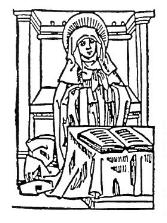
Rosalynn Voaden, Ed. Prophets Abroad: The Reception of Continental Holy Women in Late-Medieval England . Cambridge: Brewer, 1996. ISBN 0 85991 425 9
Again an excellent book but with the same curious flaw, the exclusion of Julian of Norwich. Kathryn Kerby-Fulton writes on Hildegard of Bingen in English manuscripts, Nicholas Watson on the Middle English of Marguerite Porete' s Mirror of Simple Souls, Rosalynn Voaden on Mechtild of Hackeborn in England, Roger Ellis and Joan Isobel Friedman on Birgitta of Sweden in England, the first on the Rule, the second on the Revelationes, Janette Dillon discussing holy women and their confessors with Margery Kempe , Denise L. Despres, the Orcherd of Syon, Diane Watt, on Elizabeth Barton as influenced by Birgitta of Sweden and Catherine of Siena. Ian Johnson in general discussing holy women and their texts.
Despite
the apophatic vanishing act of Julian of Norwich in these
texts they are worthwhile reading for Julian scholars. The
type of scholarship carried out in them is textual and
historical, densely packed with primary information, rather
than flimsy secondary theory. Moreover they demonstrate the
powerful 'clout' the distaff side had in this period in the
form of books by and for women; likewise the transcending of
language barriers with continental women writers/authors being
presented in Middle English texts for English women and men
readers. The book and the essays also manifest the great
cooperation taking place across language and gender
differences to bring about this 'textual community ' of women's revealed
theology. Such a presence of women's books shall be not seen
again until the Victorians and then those books shall be
secularized as novels, rather than the talking of and with
God.
Nicholas Watson and Jacqueline Jenkins, eds. The Writings of Julian of Norwich, A Vision Showed to a Devout Woman and A Revelation of Love. University Park: Pennsylvania State University, 2006. ISBN 0-271-02547-6.
The Writings of Julian of Norwich: A Vision Showed to a Devout Woman and A Revelation of Love, with its imprimatur by the Archbishop of Canterbury. has the heft of a textbook, rather than an edition. The introduction is filled with images of powerful vehicles, 'devout bus tours' (twice), 'test drove' (one smells the anachronistic petrol fumes pouring into the Julian cell), and he ends by speaking of the difference between the two visions as being 'at stake'. Indeed, it is, for in 1413, as Nicholas Watson himself showed in his fine Speculum 1993, 1995 articles, Julian could risk burning at the stake for her courage in writing that text. Julian speaks less of sculpting than of the 'painting of crucifixes', which had become mandatory, like the Pater Noster, Ave and Credo in Latin, under Archbishop Arundel. Protestants, from Lollardy, permit only the Cross, Catholics, and Anglo-Catholics, are encouraged to have the Crucifix, which has the body of Christ upon the cross. Nicholas Watson speaks of a 'sculpted image of Christ's head fixed to a crucifix' and as 'on his sculpted cross'. A characteristic of sacred medieval art, versus that of the Renaissance and of ours today, is its use of the entire body of the human being, not a dismembered part of the whole, the Vernicle (which Julian may have seen) and the Head of St John the Baptist being exceptions which shock.
 ere es Avisioun. Shewed
Be the goodenes of god to Ade/uoute Woman and hir Name es
Julyan that is recluse atte/ Norwyche and 3itt ys oun
lyfe. Anno domini
millesimo
CCCC/xiij. In the whilke visyoun er fulle many
Comfortabylle wordes and/ gretly Styrrande to alle thaye
that desyres to be crystes looverse/
ere es Avisioun. Shewed
Be the goodenes of god to Ade/uoute Woman and hir Name es
Julyan that is recluse atte/ Norwyche and 3itt ys oun
lyfe. Anno domini
millesimo
CCCC/xiij. In the whilke visyoun er fulle many
Comfortabylle wordes and/ gretly Styrrande to alle thaye
that desyres to be crystes looverse/
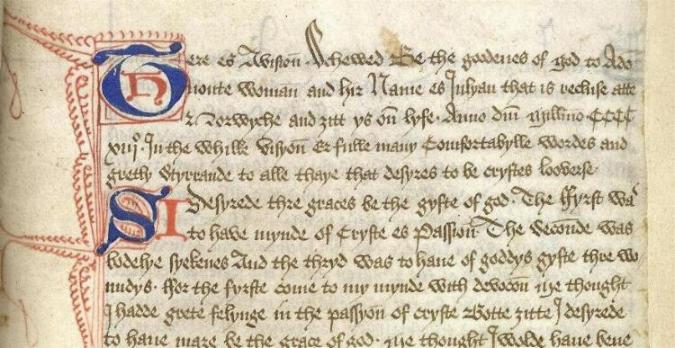
By Permission of The British Library, Amherst Manuscript, Additional 37,790, fol. 97. Reproduction Prohibited.

 Desyrede thre graces be the
gyfte of god. The ffyrst was/ to have mynde of Cryste es
Passioun. The Secounde was/ bodelye syekenes
And the thryd was to haue of goddys gyfte thre wo=/undys.
ffor the fyrste come to my mynde with devocioun me
thought/ I hadde grete felynge in the passyoun of
cryste Botte 3itte I desyrede/ to haue mare be the grace of
god. me thought I wolde have bene
Desyrede thre graces be the
gyfte of god. The ffyrst was/ to have mynde of Cryste es
Passioun. The Secounde was/ bodelye syekenes
And the thryd was to haue of goddys gyfte thre wo=/undys.
ffor the fyrste come to my mynde with devocioun me
thought/ I hadde grete felynge in the passyoun of
cryste Botte 3itte I desyrede/ to haue mare be the grace of
god. me thought I wolde have beneCOPAC
lists:
| Main Author: | Holloway, Julia Bolton |
| Title Details: | [Articles on Julian of Norwich] |
| Publisher: | [Fiesole] : [J.B. Holloway], [2000?] |
| Physical desc.: | 14pamphlets : ill. (some col.) : ports. ; 22 cm., pbk. |
| Note: | Includes
bibliographical references Title supplied by cataloguer |
| Subject: | Mysticism - History - Middle
Ages, 600-1500 Julian, of Norwich, b. 1343 |
For holdings information select a library from those below. Those marked with an asterisk give current availability.
Held by: British Library
| Title Details: | The Julian Library portfolio / [project director] Julia Bolton Holloway |
| Publisher: | [Florence : Julian Library Project, 1996- ] |
| Physical desc.: | [13 pamphlets in a slipcase + introductory leaflet] : ill ; 22 cm |
| Note: | Contents: [1] Augustine, Boethius, Dionysius: Julian's mystic philosophers.-- [2] Hilda and Cædmon: the dream of the rood.-- [3] La Beata Umiltà: contemplating on holy humility.-- [4] God Friends: the continental medieval mystics.-- [5] Henry Suso: Horologium sapientiae.-- [6] Jan van Ruysbroeck: the sparkling stone.-- [7] Julian of Norwich: the Showings: the Westminster Cathedral/Abbey manuscript.-- [8] Anchoress, prophetess, cardinal: Julian of Norwich, Birgitta of Sweden and Adam Easton O.S.B. -- [9] A Julian-related manuscript in Norwich Castle.-- [10] The soul a city: Margery and Julian.-- [11] Margaret Gascoigne/Bridget More: contemplating on Julian.-- [12] Dame Barbara Constable, O.S.B., and the Upholland Julian fragment.-- [13] 'Colections': an English nun in exile |
| Subject: | Julian, of Norwich, b. 1343 Mysticism - History - Middle Ages, 600-1500 Mysticism - England |
| Other Names: | Holloway, Julia Bolton, 1937- |
| Language: | Italian |
For holdings information select a library from those below. Those marked with an asterisk give current availability.
Held by: Oxford*
I was
presented the first excerpt which became the item 11,
'Margaret Gascoigne/Bridget More Contemplating on Julian' at
St Mary's Abbey, Colwich, the second which became the item 12,
'Dame Barbara Constable, O.S.B., and the Upholland Fragment'
at Stanbrook Abbey, with the copy-left requirement they be
acknowledged. I published these excerpts of Julian's Showing written out by
Dame Bridget More and Dame Barbara Constable, in booklet form
in the Julian Library Portfolio in 1994, giving these to
Nicholas Watson, the Julian Centre, the British Library and
the Bodleian Library at Oxford; and virtually in 1997, at http://www.umilta.net/gascoign.html and http://www.umilta.net/uphollan.html. He uses both items, 11 and
12, but does not cite their source. His 'Dame
Clementina' should be 'Dame Clementia Cary'; Upholland's
scribe is Dame Barbara Constable; Dom Serenus Cressy,
though the editor of Holy Wisdom, did not have the
acquaintance of Dom Augustine Baker, as they did not
overlap in time at their Abbey.
The Westminster
Cathedral Manuscript figures strongly in this teaching text
of Julian of Norwich's Writings.
The manuscript was initially discovered and published in a
modernised version by Betty Foucard in 1955, it was edited
diplomatically by Sister Anna Maria Reynolds in 1956, Paoli
Molinari noting in 1958 that it is the second earliest
Julian manuscript we have, and it was subsequently published
in a modernized version again by James Walsh and Eric
Colledge in 1961. Then it was lost. In 1989, I made
inquiries about it - to silence. I had come to realize
Julian of Norwich's importance through her relationship with
Birgitta of Sweden, whose manuscripts I was researching in
England, Sweden and Italy, research published as books in
1991 and 1992. Finally a letter came in 1990 from Bishop
Patrick O'Donoghue, then at Westminster Cathedral's Clergy
House. I could now see the manuscript. I flew from America, in 1991, to transcribe it. The secretary told me how it had been discovered
wrapped up at the back of the safe where it had been
forgotten for decades and only recognised because of my
letter about it. Reading its pages I found my vocation as a
religious, joined my Anglican Community in Sussex where I
had gone to school, giving up my Professorship and
Directorship of Medieval Studies, in 1992. At the same time
I wrote to the Archbishop of Canterbury's Lambeth Diploma
programme to submit this work for the degree by thesis in
Theology, my scholarly community's contribution to the
Church of England having been to tutor in the Lambeth, Greek
being required and Hebrew encouraged for our Profession
since the nineteenth century. I gave lectures on editing the
Westminster Cathedral text of Julian's Showing at my
Universities, Berkeley and Colorado, in 1993 (and, later, at
Norwich Cathedral, 1998), and my colleague, Edward Peter
Nolan, a fellow Anglican, asked to include its transcript in
his book, Cry Out and
Write: A Feminine Poetics of Revelation, which was
published posthumously in 1994. He also flew from America to
Europe in 1994 to examine the manuscript with me, but we
were brusquely told it was no longer available to us, now
being in the hands of Westminster Abbey and being studied by
another. My thesis was submitted in 1995, and I also earlier
self-archived it as a book printed and bound by myself in
seven copies, shared with the Julian Centre and with scholar
colleagues. Then a long wait occurred before the rejected
thesis was returned to me, time enough for it to be sent to
the other side of the world and back. The other's work was
published in 1997 as the 'first' edition of the Westminster
Cathedral text. In that same year Marleen Cré's fine
University of Glasgow thesis appeared transcribing the
entire manuscript and placing it in the milieu of Syon
Abbey. My paleography teacher, Professor Jean Preston,
former Curator of the Huntingdon Library and Head of
Princeton's Rare Books (now famous as ther owner of two Fra
Angelico panels from the dismembered San Marco altar pala),
identified the hand as of a nun at Syon Abbey. Christopher
de Hamel noted the connections between the recusant Lowe
family, which owned the Westminster Cathedral manuscript,
and Syon Abbey, which I then further researched. I shared with Nicholas Watson all of the above in
1995. I discussed the Westminster problem in Julian's Web. He gives the Westminster Cathedral edition as by
this other while failing to list in their bibliography the
publications by Foucard, 1955, or Nolan (Holloway), 1994, of
the Westminster Cathedral text, a bibliography that also
fails to note that Sister Anna Maria Reynolds' first thesis
edited the Sloane Manuscripts (under wartime conditions in
1947), only listing her second thesis editing the Paris,
Amherst and Westminster manuscripts, in 1956, and not noting
her editing of Westminster. But one is grateful for that
partial and long overdue recognition of her editions.
Scholars acknowledge prior work.
See also catalogues for Libreria Editrice Fiorentina, SISMEL, James Hogg's Analecta Cartusiana, etc.
Indices to Umiltà
Website's Essays on Julian:
Preface
Influences
on Julian
Her Self
Her
Contemporaries
Her Manuscript
Texts ♫ with recorded readings of them
About Her
Manuscript Texts
After
Julian, Her Editors
Julian in our
Day
Publications related to Julian:


Saint Bride and Her Book: Birgitta of Sweden's Revelations Translated from Latin and Middle English with Introduction, Notes and Interpretative Essay. Focus Library of Medieval Women. Series Editor, Jane Chance. xv + 164 pp. Revised, republished, Boydell and Brewer, 1997. Republished, Boydell and Brewer, 2000. ISBN 0-941051-18-8
 To see an example of a page inside with
parallel text in Middle English and Modern English, variants
and explanatory notes, click here. Index to this book at http://www.umilta.net/julsismelindex.html
To see an example of a page inside with
parallel text in Middle English and Modern English, variants
and explanatory notes, click here. Index to this book at http://www.umilta.net/julsismelindex.html
Julian of
Norwich. Showing of Love: Extant Texts and Translation. Edited.
Sister Anna Maria Reynolds, C.P. and Julia Bolton Holloway.
Florence: SISMEL Edizioni del Galluzzo (Click
on British flag, enter 'Julian of Norwich' in search
box), 2001. Biblioteche e Archivi
8. XIV + 848 pp. ISBN 88-8450-095-8.
 To see
inside this book, where God's words are in red, Julian's
in black, her editor's in grey, click here.
To see
inside this book, where God's words are in red, Julian's
in black, her editor's in grey, click here.
Julian of
Norwich. Showing of Love. Translated, Julia Bolton
Holloway. Collegeville:
Liturgical Press;
London; Darton, Longman and Todd, 2003. Amazon
ISBN 0-8146-5169-0/ ISBN 023252503X. xxxiv + 133 pp. Index.
GoodBookReview: The definitive scholarly
edition of Showing of Love is here presented in a
form for the general reader, without sacrificing academic
rigour. One is able to flow into her mind, for, as far as
possible, the rhythms, style and dialect of Julian's East
Anglian English of c1400 have been retained. To have
translated her slavishly into modern English would have
negated that closeness with her experiences and meditations
which we enjoy here. A twenty-seven page Preface provides
more than adequate background information about Julian, her
contemporaries, the theology she and they expound, and the
history of the manuscripts used. The 'chapters' into which
her meditations were divided, permit leisurely and profound
'lectio divina'.
 To view sample copies, actual
size, click here.
To view sample copies, actual
size, click here.

'Colections'
by an English Nun in Exile: Bibliothèque Mazarine 1202.
Ed. Julia Bolton Holloway, Hermit of the Holy Family. Analecta
Cartusiana 119:26. Eds. James Hogg, Alain Girard, Daniel Le
Blévec. Salzburg: Institut für Anglistik und Amerikanistik
Universität Salzburg, 2006.

Anchoress and Cardinal: Julian of
Norwich and Adam Easton OSB. Analecta Cartusiana 35:20 Spiritualität
Heute und Gestern. Salzburg: Institut für Anglistik und
Amerikanistik Universität Salzburg, 2008. ISBN
978-3-902649-01-0. ix + 399 pp. Index. Plates.
Teresa Morris. Julian of Norwich: A
Comprehensive Bibliography and Handbook. Preface,
Julia Bolton Holloway. Lewiston: Edwin Mellen Press, 2010.
x + 310 pp. ISBN-13: 978-0-7734-3678-7; ISBN-10:
0-7734-3678-2. Maps. Index.

Fr Brendan
Pelphrey. Lo, How I Love Thee: Divine Love in Julian
of Norwich. Ed. Julia Bolton Holloway. Amazon,
2013. ISBN 978-1470198299

Julian among
the Books: Julian of Norwich's Theological Library.
Newcastle upon Tyne: Cambridge
Scholars Publishing, 2016. xxi + 328 pp. VII Plates, 59
Figures. ISBN (10): 1-4438-8894-X, ISBN (13)
978-1-4438-8894-3.

Mary's Dowry; An Anthology of
Pilgrim and Contemplative Writings/ La Dote di
Maria:Antologie di
Testi di Pellegrine e Contemplativi.
Traduzione di Gabriella Del Lungo
Camiciotto. Testo a fronte, inglese/italiano. Analecta
Cartusiana 35:21 Spiritualität Heute und Gestern.
Salzburg: Institut für Anglistik und Amerikanistik
Universität Salzburg, 2017. ISBN 978-3-903185-07-4. ix
+ 484 pp.
  |
To donate to the restoration by Roma of Florence's
formerly abandoned English Cemetery and to its Library
click on our Aureo Anello Associazione:'s
PayPal button: THANKYOU! |
UMILTA
WEBSITE, JULIAN OF NORWICH, HER SHOWING OF LOVE
AND ITS CONTEXTS ©1997-2024
JULIA BOLTON HOLLOWAY | JULIAN OF NORWICH || SHOWING OF
LOVE || HER TEXTS
|| HER SELF || ABOUT HER TEXTS || BEFORE JULIAN || HER CONTEMPORARIES || AFTER JULIAN || JULIAN IN OUR TIME || ST BIRGITTA OF
SWEDEN || BIBLE AND WOMEN || EQUALLY IN GOD'S IMAGE || MIRROR OF SAINTS || BENEDICTINISM || THE CLOISTER || ITS SCRIPTORIUM || AMHERST
MANUSCRIPT || PRAYER || CATALOGUE AND PORTFOLIO (HANDCRAFTS,
BOOKS ) || BOOK REVIEWS || BIBLIOGRAPHY ||