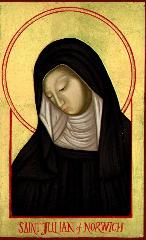
SYON ABBEY
ST BIRGITTA'S LESSONS
LESSONS FOR THE FIRST WEEK
SUNDAY
First Reading
{When John in his Gospel speaks of the Word,
that is he who is, and has ever
been,
with the Father and the Holy
Spirit, one God,
In this one God, there are truly
Three Persons;
yet not three Gods,
for in the Three Persons is only
one divinity,
the one, perfect Godhead,
belonging equally to each;
and in the Three Persons,
only one will,
one wisdom, one power,
one beauty, one strength,
one love, one joy.
The Word, then,
being for ever one with the
Father and the Holy Spirit,
is truly God.
A familiar word like ONE can help us, perhaps, to understand -
for each of the three letters is
necessary to the whole,
and we cannot take awau one
letter without destroying the meaning.
So in God,
there must ever be the Three
Persons,
equal in all things,
with all things equally in each,
for there can be no dividing of
God.
There was no dividing when the Word, the Son of God,
took a human nature;
he was not separated, by this,
from the Father and the Holy Spirit.
He took our human nature,
yet remained ever the Word of
God.
His human nature was necessary
for him.
to achieve our salvation.
It can help us to understand
this
if we consider how our thoughts
and our words
are not things we can see or
touch,
except in so far as writing
gives them a more material existence.
{The Word of God, the Son of God,
could not have come as one of
us,
or lived with us, for our
salvation,
unless he had taken on our human
nature.
A written word can be seen and
read,
then understood, then spoken.
The Son of God can be seen, in
that flesh he took to himself,
and so we can understand and
have no doubt
that he is one with the Father
and the Holy Spirit.
Truly then, there are Three
Persons,
undivided,
unchanging and unchangeable,
eternally in all things equal,
Three, yet but one God.
Since God is eternal and timeless,
all things were eternally known
to him,
before their existence in time.
Then, when he willed them to be,
they came to be
with that exact perfection which
suited their purpose.
The divine wisdom of God willed
all things to be what they are
for his own honour and glory.
He had no need of them;
it was not to make up for any
deficiency in himself -
something wanting to his
goodness or joy -
there can be no defect or
deficiency in God.
It was his love,
and his love alone,
which led him to create;
that there might be beings,
apart from himself,
whose existence should be an
existence of joy,
deriving from his own being an
joy.
All things, then,
foreseen by God,
and present to him eternally,
though as yet uncreated,
had already that design and
perfection which they would possess
when his creating brought them
to be.
One thing excelled all others,
designed and perfected by God
with a special joy.
This was Mary,
the Virgin who was a Mother,
the Mother who was ever a
Virgin.
Third Reading
{It has been said that all created things are
made up of four elements -
fire, air, water and earth.
If so, then in Mary's pure body,
these elements were to have a
special perfection:
the air should be fittingly an
image of the Holy Spirit;
the earth should be rich and
fruitful,
for the growth of useful things,
to supply every need;
the water should be calm and
unmenacing,
unruffled by every wind;
and the fire so strong and
bright
that all the earth should be
warmed by it,
and the heavens themselves.
Virgin Mary,
we know that in you the design
and perfection willed by God
have come to be.
As he foresaw you,
so he has perfectly created you.
And of all his creation,
you most please him.
The Father rejoiced that he would do so much through
you:
the Son rejoiced in your
holiness and love:
the Holy Spirit rejoiced in your
lowliness and obedience.
The Father's joy is that of the Son and the Holy
Spirit:
the Son's joy is that of the
Father and Spirit:
and the Holy Spirit's joy is
that of the Father and the Son.
Father, Son and Holy Spirit rejoice in you,
the one joy of Three who are
One.
Father, Son and Holy Spirit love
you, Mary,
the love of the Three Persons,
One God.
First Reading
{It was love that led God to create.
There could be nothing lacking
in God,
nothing wanting to his goodness
or his joy.
It was out of love alone that he
willed creation,
that there might be beings,
apart from himself,
who would partake of his
infinite goodness and joy.
So the Angels came to be,
created by God in countless
numbers.
To them he gave free will,
freedom to act, in accordance
with their nature,
as they willed.
As he himself is under no
necessity
but has created out of love
alone,
he will that the Angels,
whom he designed for eternal
happiness with him,
should likewise be under no
necessity.
He looked for love in response
to his love,
obedience to his offer of
eternal joy.
Second Reading
{Yet in the first moment of their creation,
there were Angels who chose,
freely and deliberately
against their Creator,
in spite of his infinite love,
which called them to love in return.
Justly they fell, fixed in their
evil will,
from an eternal joy into an
eternal misery.
But not all fell.
To those Angels who chose love
for love,
there was given the
contemplation of God
in all his glory, power and
holiness.
From this contemplation, they
came to know the eternity of God,
that he has no beginning and no
end;
they learnt what it meant to
have him for their Creator;
and they saw most clearly
how everything they possessed
had come to them from his love
and his power.
They learnt too that his wisdom
had given them a wisdom of their own,
bu which he allowed them to
foresee the future.
And it was a joy and consolation
to them
to know that God in his mercy
and love
wished to replace, in his own
way,
those Angels who had forfeited
by pride and envy
their place in heaven.
Third Reading
{In their contemplation of God,
the Angels saw with wonder
a throne placed next to that of
God himself.
They knew that the one for whom
this throne had been prepared
had not yet been created.
Yet already they loved this
chosen one,
and rejoiced as they waited.
Their love for each other was
born of their love for God.
But between these two loves they
saw one who was more lovable
than themselves,
one whom God loves with great
joy
more than all his creatures.
Virgin Mary, you were the chosen one,
destined for that throne near to
the throne of God.
It was you whom the Angels
loved, after God,
from the first moment of their
creation,
seeing in the contemplation of
God,
how beautiful he had made
themselves,
but how much more beautiful he
would make you.
They saw that in you there would
be a love and a joy far greater
than their own.
They saw too the crown that
awaited you,
a crown of glory and beauty
supassed only by the majesty of God.
They knew how God their Creator
was glorified by themselves and they rejoiced.
They knew how much more he would
be glorified by you,
and they rejoiced still more.
Before ever you were created,
Mary,
God and Angels together rejoiced
in you.
TUESDAY
First Reading
{We read in the Bible of Adam's original state
of happiness.
Then of his disobedience to God,
which brought so much suffering
and sorrow.
We are not told that he
continued in disobedience.
From his conduct after Cain had
killed Abel,
his refraining from intercourse
with Eve
until he knew that this was no
longer the will of God,
we may judge that the love and
service of God was his first thought.
His sorrow was not so much the
unhappiness he had brought on himself,
but rather the offence he had
committed against God.
Created by God, owing his
exisentence and his happiness to God,
he had turned against God,
and so justly deserved God's
anger.
This was true sorrow,
bringing with it reprentance and
humility.
And with this true sorrow came
also consolation from God.
One thing, and one thing only, could have fully
consoled him -
the promise that God himself
should come as man,
of Adam's own race,
and by love and humility redeem
that race which his pride
had deprived of life.
Second Reading
{That God should be born as men are born was
unthinkable.
Adam and Eve owed their
beginning in some way to a special creation by God.
Even this would not be fitting
for the coming of God to earth.
It would seem that Adam understood from God's words
something of what was to be.
At least, we may picture him
foreseeing the future,
foreseeing a woman, like Eve in
womanhood,
but lovelier and holier than all
of his race,
a virgin and mother,
bringing God himself to this
world.
We may think of him grieving at the words spoken to
Eve by the Devil.
But rejoicing, his sorrow turned
to joy,
at the thought, Mary, of your
words to the Angel.
We may think of him grieving
that Eve his wife,
created by God from his body,
had deceived him and drawn him
on to eternal death.
But rejoicing that you, Virgin
Mary, would bear in all purity
Christ, the Son of God, to
restore man to life.
Grieving that Eve's first act
was of disobedience;
rejoicing that you, Mary, would
be a daughter of God,
most dear to him in all things,
ever obedient to his will.
Third Reading
{Grieving that Eve had been tempted,
in the sight of God and all the
Angels,
by the false promise of being
made like to God;
rejoicing that in the sight of
God and the Angels,
you, Mary, would acknowledge
yourself the Handmaid of God.
Grieving that Eve had offended
God,
and brought about the
condemnation of man;
rejoicing that your word to God
should bring such joy
to yourself and to all men.
Grieving that Eve had closed to
man the gate of heaven;
rejoicing that your word had
opened that gate again
to yourself and to all who
sought to enter.
So we may think of Adam rejoicing with great joy
at the thought, Mary, of your
coming,
as we know the Angels rejoiced,
before the creation of the
world,
foreseeing your creation by God.
WEDNESDAY
First Reading
{Before God made known his law to Moses,
man had to live without a rule
of life.
Those who loved God, did what
they thought was God's will.
Those who rejected his love, and
did not fear to do so,
acted as they chose.
To dispel their ignorance,
God in his goodness made known
his law,
teaching first the love of God,
then love for others,
then his will concerning
marriage,
its holiness and binding force,
its purpose in his plan - the
growth of his people.
The union of man and woman in a holy marriage was
most pleasing to God,
for he willed to choose the
child of such a union
as the Mother of Christ.
The eagle, flying above the earth, looks down at the
trees,
and choosing with its sharp eyes
the tallest tree,
one firmly rooted to withstand
the storms,
one that cannot be climbed,
one that nothing can fall on,
builds there its next,
God sees, with penetrating gaze,
all things, both present and future.
Second Reading
{He looked therefore among all men and women,
from the beginning to the end of
time,
for a husband and wife fit for
the bearing of the child of his choice.
He found none so worthy as
Joachim and Anne,
who lived together in holiness
and a love for each other born
of their love for him.
It was to them he entrusted the
one who was to be Mother of his Son.
She was to be, as it were, the
eagle's nest,
in which he could find
protection and shelter.
Joachim and Anne were the tall
tree in which this nest would be built,
firmly rooted in a union based
on the love and honour of God;
the branches of this tree their
lifelong thought for the will of God,
and their desire for a child,
not for their own sake,
but to beget one who would grow
to love God and serve him
as they themselves did.
The tallness of this tree,
beyond the reach of the winds,
and higher than all around,
was the height of holiness which
Joachim and Anne had attained,
beyond the attacks of Satan,
untroubled, except by the
thought that God's honour
was many times assailed by the
sins of many,
with no thought of honour or
worldly possessions,
no pride or ambition to move
them from their selfless love of God.
Third Reading
{God knew that for the birth of the Mother of
Christ,
none holier could be found than
Joachim and Anne.
What a treasure you held, blessed Anne,
while she who was to be Mother
of God rested in your womb.
How precious to God that seed of
Mary's life in your womb,
more precious than the offspring
of all men on earth.
Anne became God's treasure-house,
keeping safe this most precious
thing,
this seed of so precious a life.
God saw it and watched over it,
for as his Son was to say -
where one's treasure is, there
is one's heart.
The Angels looked on this
treasure with joy,
knowing how precious it was to
God their Creator.
It was a holy and blessed day,
to be honoured by all,
the day when this precious seed
was first sown.
God himself and the Angels
greeted that day
with great rejoicing.
THURSDAY
First Reading
{Speaking of the beauty of Mary, we think of
lovely things:
her sacred body is like a vase
of purest crystal;
her soul like a lantern of
clearest light;
her mind like a fountain of
water rising up into the air,
then falling in cool streams to
the deep valley.
Passing from infancy to childhood,
to the age when she was able to
understand,
she began to think of the
existence of God,
and how he made all things,
and especially man,
for his own eternal glory,
and how his justice embraces all
things.
Her thoughts reached out to God,
as the waters of the fountain
rise into the air;
then, like those waters flowing
down to the valley,
her thoughts returned to herself
and brought her a most profound
humility.
The Church sings of Christ leaving and returning to
the Father,
though he was ever with the
Father
and the Father ever with him.
Mary's thoughts reached up to
heaven in contemplation
and grapsed God by faith.
Then in the love with which God
possessed her,
she turned her mind again to God
and to herself,
never losing her thought of God.
Together with hope and trust,
and with holy fear,
the fire of this love inflamed
her heart,
as the flame is the brightness
of the lantern.
Second Reading
{She understood the perfect subjection of body
to soul,
and no discord ever troubled
her,
so that in body she was purer
than purest crystal.
How soon she learnt to appreciate God's love,
and treasure it with all her
being!
Think of this love as a lily which God had planted,
with a threefold root,
bearing three flowers of great
beauty.
The three roots are three most
powerful virtues, protecting her body.
The three flowers, three
adornments of her soul,
which gave great joy to God and
the Angels.
The first of the three virtues was her abstinence,
her right use of God's gifts of
food and drink -
no over-indulgence to make her
slow in the service of God,
no unwise austerity to impair
her health.
The second was her wakefulness,
so that she rested no longer
than was necessary -
not wasting God's time in
laziness,
but not fatiguing herself to the
detriment of her work.
The third was her command over
her will,
so that she was not easily
wearied in body,
and never over-anxious or
over-excited.
Third Reading
{The first adornment of her soul was her love
for the things of God
rather than the things of earth,
no matter how beautiful these
might seem to be.
The things men so often prize,
possessions and wealth,
were utterly distasteful to her.
The second adornment was her
appreciation of the infinite distance
between worldly honours and
spiritual glory.
This world's praises were as
abhorrent to her as the poisoning air of corruption.
The third adornment was her love
for all that God loves,
her repugance for all that was
hateful and displeasing to him.
She sought in all things the
true sweetness of God,
and no taste of bitterness was
permitted to endure in her after her death.
With such beauty of soul,
Mary surpassed all other created
things.
God willed that only through her
should his promise be fulfilled.
Her love left no blemish or
defect, not even the smallest.
In nothing could the enemy claim
victory over her.
If then she was so pleasing in
the sight of God and the Angels,
may we not think that she had
also great earthly beauty?
Those who saw her looked with
delight,
and knew that her loveliness was
born of her love for God.
They saw her, and loved to see
her,
and were led to a new love for
God.
They watched her, and loved to
be with her,
and knew that no evil could
touch them,
nothing sinful attract them,
in the presence of her beauty
and holiness.
FRIDAY
{We are told that Mary was afraid
when the Angel appeared and
spoke to her.
It was not fear of any bodily
harm to herself,
but dismay at the thought that
this might be a trick of Satan,
to lead her into sin.
At the moment when her mind first knew God and his
holy will,
she had chosen for herself a
life of love,
and this brought with it a wise
and holy fear of God.
It is our delight to call Mary a rose of great
beauty.
We know that the lovelier and
healthier the rose,
the stronger and sharper are the
thorns which surround it.
It Mary is a rose of beauty,
she will not be untouched by the
sharp thorns or trial and sorrow.
Indeed, as the days of her life
went by,
her sorrows increased in
bitterness and pressed more heavily upon her.
Her first sorrow was that fear
of God which her knowledge
of his existence and his will
had brought her.
It was a sorrow to her
that in all she did, she must
keep in mind
the thought and threat of sin.
She directed each thought, word
and work to God,
but there was always the fear
that some defect might creep in
to lessen its value in his eyes.
How foolish are those who deliberately and without
fear
throw themselves into all kinds
of sin,
bringing on themselves suffering
and sorrow.
Second Reading
{Mary was sinless, and immune from sin.
Everything she did pleased God.
In every way she was entirely
pleasing to him.
Yet she never allowed herself to
be free from the fear of displeasing him.
A greater sorrow still was in
her heart,
for she knew from the writings
of the Prophets
that God willed to come as man,
and suffer as man.
In her love for God, this caused
her great grief,
though she did not yet know that
she was to be the Mother of God.
When that moment arrived,
the moment when she knew that
the Son of God had become her Son,
to take in her womb that human
body which was to suffer
as the Propehts had foretold -
who could measure her joy?
Who could measure her sorrow?
Like the rose, she had grown in
beauty,
but the thorns had grown too,
stronger and sharper and more
piercing.
To Mary it was joy beyond words
that her son should come in
humility to lead man to heaven,
saving him from the penalty
which Adam's pride had incurred,
the misery of hell.
It was great sorrow
that the sin of Adam by which
man rebelled in both body and soul
should require the redeeming
death of her Son
in such agony of body and soul.
Third Reading
{It was great joy to her
to conceive her Son in
sinlessness and purity.
It was great sorrow to her
that this so loved son was born
to suffer a shameful death,
and that she herself would be
there to stand and see.
Great joy to know that he would
rise from death,
and win in return for his
Passion
an everlasting honour and glory;
great sorrow to know that this
glory would not be won
except by the agony and shame of
the Cross.
The perfect rose blooms in beauty on its stem,
and our delight is not spoiled
by the sharp thorns around it.
The sharp thorns of Mary's
sorrow piercing her heart
could not change her or weaken
her will,
and in her suffering
she accpeted whatever God's will
should demand of her.
We call her a Rose of Jericho,
for men say that nowhere can so
lovely a rose be found.
In her holiness,
Mary is more beautiful than all
mankind,
surpassed only by her Son.
To God and the Angels in heaven,
her patience and willing
endurance brought joy.
To all on earth, it must be a
joy
to meditate on her sufferings so
willingly accepted,
and on that consolation she had
ever in her heart,
that all was the will of God.
SATURDAY
First Reading
{We read that the Queen of Sheba made the long
journey from her own lands
in the south to visit Solomon
the King.
Her journey was not wasted,
for she found great delight in
his words.
No gifts were too precious for
her to give,
no praise too high,
and she departed in admiration
of such great wisdom.
The Virgin Mary spent long hours in thought,
considering the course of events
in this world,
and all the things that this
world holds dear.
Nothing delighted or attracted
her,
except the wisdom she had
learned from God.
This was her desire and her
search,
and she did not rest till she
had found it in Christ.
In the Son of God she found
wisdom infinitely greater than Solomon's.
The Queen of Sheba was overcome with wonder
as she contemplated the wisdom
of Solomon.
Mary was overcome with sorrow as
she pondered the loving wisdom of Christ,
who saw salvation in suffering,
and willed to save man from
subjection to Satan
by his sufferings and cross.
When at last the sufferings of Christ were over,
Mary looked up from the depths
of her sorrow,
ever offering herself and her
will to God for his glory,
gifts most precious to him.
Gifts too of another kind,
for many were led to the truth
of God by her faith.
No words or works of men were so
powerful
to bring men to God.
Many lost faith when they saw
Christ die.
She alone withstood the unbelief
of men,
seeing in Christ her Son the Son
of God,
over whose Godhead death could
have no dominion.
Second Reading
{When the third day came,
it brought bewilderment and
anxiety to the Disciples.
The women going to the tomb to
anoint the body of Jesus
sought him and could not find
him.
The Apostles were gathered
together in their fear, guarding the doors.
Then, surely, though we are not
told of this in the Gospels,
Mary spoke of the resurrection
of her Son,
that he had truly risen from
death,
that he was alive again in all
his humanity,
no more subject to death,
risen to an eternal glory.
We read that Mary Magdalen and the Apostles were
first to see the risen Christ.
But we may believe that Mary his
Mother knew of his rising before all others,
and that she was the first to
see him.
It was Mary in her lowliness who
first gave praise and adoration to the risen Christ.
When Christ ascended to the glory of his kingdom,
the Virgin Mary remained on
earth.
We cannot know what her presence
meant to so many.
Those who loved God were
strengthened in their love;
those who had turned from him
were brought back to his love.
The Apostles looked to her for guidance and counsel.
The Martyrs found in her,
courage to face suffering and death.
The Confessors of the Faith were
strengthened in their believing.
Virgins were drawn to her
purity.
Widows were consoled by her
sorrows.
Husbands and wives found in her
a pattern of perfection.
All who heard and obeyed the
word of God
found in Mary great comfort and
help.
Third Reading
{Whenever the Apostles came to her,
she was able to teach them about
Christ,
and help them to understand.
The Martyrs rejoiced to suffer
for Christ,
for he had suffered for all.
They remembered the long years
of sorrow borne so patiently by Mary his Mother,
and they bore their martyrdom
even more readily.
The Confessors, meditating on
Mary, learnt many things about the truths of the Faith.
From her example, they learnt
too the wise use of earthly things,
food, drink and sleep, work and
rest.
and how to order their lives in
all things
to the honour and glory of God.
Virgins learnt from Mary's
example true chastity in virtue.
They learnt too the wise use of
their time,
how to avoid vanity and foolish
talk,
and see all things in the light
of true holiness.
Widows learnt from her,
consolation in sorrow,
strength against temptation,
and humble submission to God's
will.
With a mother's love,
Mary could never have wished for
the death of her Son,
still less for the death of the
Son of God.
Yet she willed in all things the
will of God.
She chose for God's sake the
humble acceptance of suffering and sorrow.
Husbands and wives learnt from
Mary true love for each other, in body and in soul,
and the union of their wills, as
of their flesh,
in all that the will of God
demanded.
They learnt how she had united
herself for ever with God by faith,
and never in any way shown
resistance to his divine will.
{These Lessons, composed in the Fourteenth Century in Rome by St Birgitta of Sweden, who herself had borne eight children, are still recited daily at Syon Abbey, Totnes, Devon, by Brigittine nuns who wear the black veil with white crossed crown and five red circlets at each interstice for the wounds of Christ above blue grey habits. The Lady Abbess gave them to me for you. They are written by a woman for women. These same Brigittine nuns also preserved Julian of Norwich's Showing of Love, at a time when Catholic contemplative texts were forbidden.
{ Read these Lessons on the days appointed for
them. Read them in prayer. Meditate upon them. Take them with
you in your mind, in your soul, like the Virgin, pondering on
all these things in her heart, as you go about your daily
business in the world. Taste, and see, that the Lord is good.
Go to Second Week of Syon Abbey Brigittine Offices
Indices to Umiltà
Website's Essays on Julian:
Preface
Influences
on Julian
Her Self
Her
Contemporaries
Her Manuscript
Texts ♫ with recorded readings of them
About Her
Manuscript Texts
After
Julian, Her Editors
Julian in our
Day
Publications related to Julian:
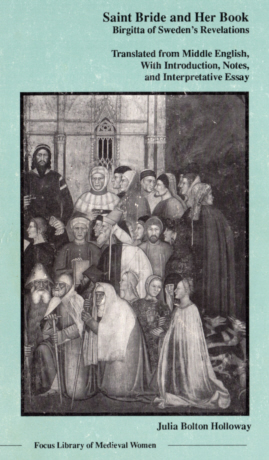

Saint Bride and Her Book: Birgitta of Sweden's Revelations Translated from Latin and Middle English with Introduction, Notes and Interpretative Essay. Focus Library of Medieval Women. Series Editor, Jane Chance. xv + 164 pp. Revised, republished, Boydell and Brewer, 1997. Republished, Boydell and Brewer, 2000. ISBN 0-941051-18-8
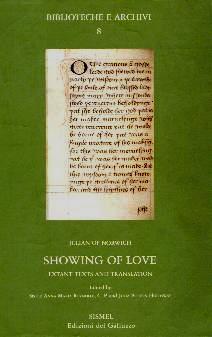 To see an example of a
page inside with parallel text in Middle English and Modern
English, variants and explanatory notes, click here. Index to this book at http://www.umilta.net/julsismelindex.html
To see an example of a
page inside with parallel text in Middle English and Modern
English, variants and explanatory notes, click here. Index to this book at http://www.umilta.net/julsismelindex.html
Julian of
Norwich. Showing of Love: Extant Texts and Translation. Edited.
Sister Anna Maria Reynolds, C.P. and Julia Bolton Holloway.
Florence: SISMEL Edizioni del Galluzzo (Click
on British flag, enter 'Julian of Norwich' in search
box), 2001. Biblioteche e Archivi
8. XIV + 848 pp. ISBN 88-8450-095-8.
 To see inside this book, where God's words are in
red, Julian's
in black, her editor's in grey, click here.
To see inside this book, where God's words are in
red, Julian's
in black, her editor's in grey, click here.
Julian of
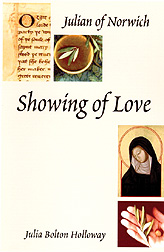
Norwich. Showing of Love. Translated, Julia Bolton
Holloway. Collegeville:
Liturgical Press;
London; Darton, Longman and Todd, 2003. Amazon
ISBN 0-8146-5169-0/ ISBN 023252503X. xxxiv + 133 pp. Index.
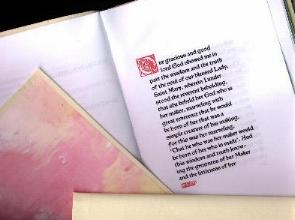 To view sample copies, actual
size, click here.
To view sample copies, actual
size, click here.

'Colections'
by an English Nun in Exile: Bibliothèque Mazarine 1202.
Ed. Julia Bolton Holloway, Hermit of the Holy Family. Analecta
Cartusiana 119:26. Eds. James Hogg, Alain Girard, Daniel Le
Blévec. Salzburg: Institut für Anglistik und Amerikanistik
Universität Salzburg, 2006.
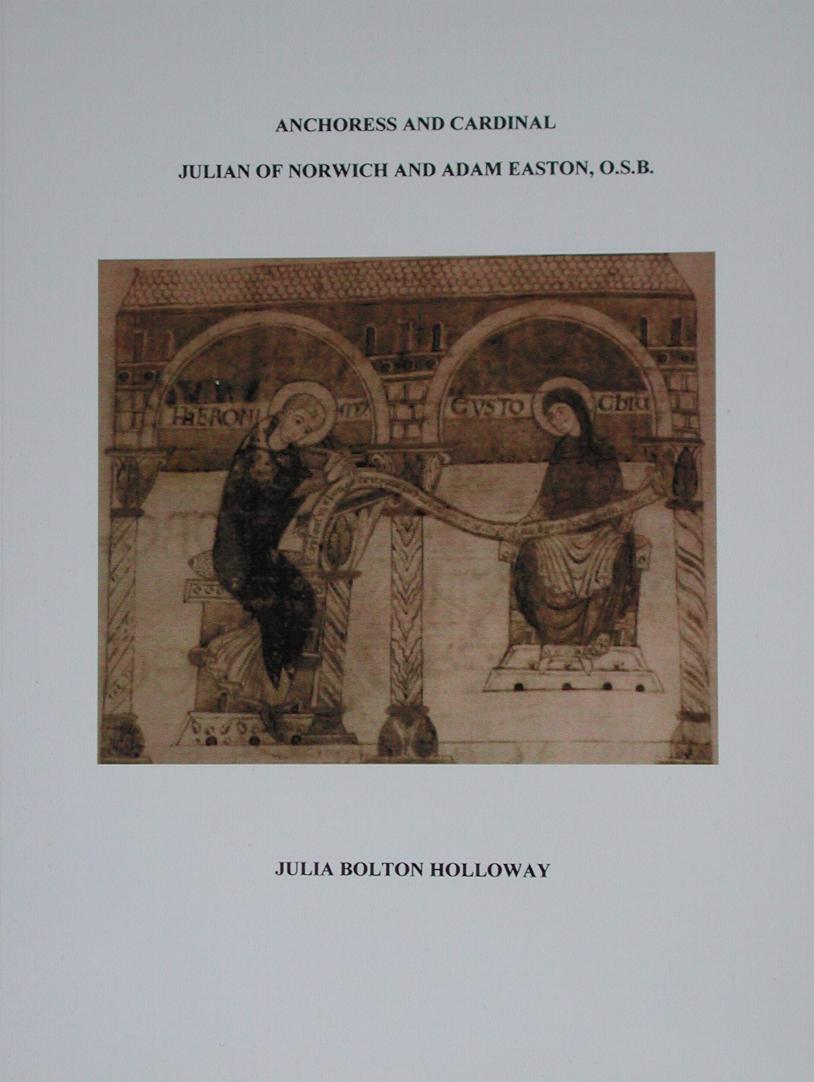
Anchoress and Cardinal: Julian of
Norwich and Adam Easton OSB. Analecta Cartusiana 35:20 Spiritualität
Heute und Gestern. Salzburg: Institut für Anglistik und
Amerikanistik Universität Salzburg, 2008. ISBN
978-3-902649-01-0. ix + 399 pp. Index. Plates.
Teresa Morris. Julian of Norwich: A
Comprehensive Bibliography and Handbook. Preface,
Julia Bolton Holloway. Lewiston: Edwin Mellen Press, 2010.
x + 310 pp. ISBN-13: 978-0-7734-3678-7; ISBN-10:
0-7734-3678-2. Maps. Index.

Fr Brendan
Pelphrey. Lo, How I Love Thee: Divine Love in Julian
of Norwich. Ed. Julia Bolton Holloway. Amazon,
2013. ISBN 978-1470198299

Julian among
the Books: Julian of Norwich's Theological Library.
Newcastle upon Tyne: Cambridge
Scholars Publishing, 2016. xxi + 328 pp. VII Plates, 59
Figures. ISBN (10): 1-4438-8894-X, ISBN (13)
978-1-4438-8894-3.

Mary's Dowry; An Anthology of
Pilgrim and Contemplative Writings/ La Dote di
Maria:Antologie di
Testi di Pellegrine e Contemplativi.
Traduzione di Gabriella Del Lungo
Camiciotto. Testo a fronte, inglese/italiano. Analecta
Cartusiana 35:21 Spiritualität Heute und Gestern.
Salzburg: Institut für Anglistik und Amerikanistik
Universität Salzburg, 2017. ISBN 978-3-903185-07-4. ix
+ 484 pp.
  |
To donate to the restoration by Roma of Florence's
formerly abandoned English Cemetery and to its Library
click on our Aureo Anello Associazione:'s
PayPal button: THANKYOU! |
JULIAN OF NORWICH, HER SHOWING OF LOVE
AND ITS CONTEXTS ©1997-2024 JULIA
BOLTON HOLLOWAY || JULIAN OF NORWICH
|| SHOWING
OF LOVE || HER TEXTS
|| HER SELF || ABOUT HER TEXTS || BEFORE JULIAN || HER CONTEMPORARIES || AFTER JULIAN || JULIAN IN OUR TIME || ST BIRGITTA OF SWEDEN
|| BIBLE AND WOMEN || EQUALLY IN GOD'S IMAGE || MIRROR OF SAINTS || BENEDICTINISM || THE CLOISTER || ITS SCRIPTORIUM || AMHERST MANUSCRIPT || PRAYER || CATALOGUE AND PORTFOLIO (HANDCRAFTS, BOOKS
) || BOOK REVIEWS || BIBLIOGRAPHY ||