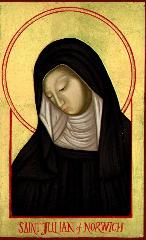
JULIAN OF NORWICH
SHOWING OF LOVE, PART III
♫
/S/In our substance we are full, in our
sensuality we fail, which God will restore by Mercy and
Grace. And how our Nature, which is the higher part, is knit
to God in the making, and God Jesus is knit to our nature in
the lower part in our flesh taking. And of Faith spring
other virtues. And Mary is our Mother. /SP/ The
Fifty-Seventh Chapter.
And regards our substance he
made us noble and so rich that ever more we work his will
and his worship. Where /P/ I /SP/ say 'we,' /SP/ it means 'man who shall be saved'. ¶ For
truly I saw that we are whom he loves, and do what he likes
lastingly without any stopping. And of the great riches and
of the high noble virtues by measure come to our soul, what
time it is knit to our body, in which knitting we are made
sensual. ¶ And thus in our substance we are full. And
in our sensuality we fail. Which failing God will restore
and fulfill by working /P/ of /SP/ mercy and grace, plenteously flowing into
us of his own natural goodness, and thus his natural /S/ Godhead /P/ goodness /SP/ makes that
mercy and grace work in us, and the natural /S/ Godhead /P/ goodness /SP/ that we
have of him enables us to receive the working of mercy and
grace. I saw that our nature is in God whole in which he
makes diverse /S/ satisfactions
/SP/ flowing out of him to work
his will, whose nature keeps, and mercy and grace restore
and fulfill. ¶ And of these none shall perish. For our
nature which is the higher part, is knit to God in the
making, and God is knit to our nature, which is the lower
part of our flesh taking. 
And thus in Christ our two
natures are oned. For the Trinity is comprehended in Christ
in whom our higher part is grounded and rooted, and our
lower part the second Person has taken, which nature first
to him was ordained. ¶ For I saw full /S/ securely /P/ truly /SP/ that all the works that God has done or
ever shall were fully known to him and /P/ truly /SP/ seen
before from without beginning. And for love he made mankind
and for the same love, himself would /S/ be /P/ become /SP/ man. ¶ The
next good that we receive is our faith in which our
profiting begins, and it comes of the high riches of our
natural substance, into our sensual soul. And it is grounded
in us and we in that through the natural goodness of God by
the working of mercy and grace, and thereof come all /S/ other /P/ our /SP/ goods by
which we are led and saved. For the Commandments of God come
therein. In which we ought to have two kinds of
understanding. /PN/¶ That
one is we owe to understand and know /SPN/ which
are his bidding, to love and to keep them. ¶ That
other is that we ought to know his forbiddings, to hate and
to refuse them. For in these two is all our working
comprehended. Also in our faith come the seven Sacraments,
each/
following the other in order as God has
ordained them to us, and all manner of virtues. For the same
virtues that we have received of our substance, given to us in
nature by the goodness of God, the same virtues, by the
working of mercy, are given to us in grace through the holy
Ghost renewed, which virtues and gifts are treasured to us in
Jesus Christ. /SP/¶ For in
that same time that God knitted him to our body in the
Maiden's womb, he took our sensual soul, in which taking, he
having us all enclosed in him, he oned it to our substance. In
which oneing he was perfect man. For Christ having knit in him
/S/
each /P/ all /SP/ man who shall be saved is perfect man. ¶ Thus our
Lady is our Mother in whom we are all enclosed, and of her
born in Christ, for she who is Mother of our Saviour is mother
of all who shall be saved in our Saviour. And our Saviour is
our very Mother, in whom we be endlessly born and never shall
come out of him. Plenteously and fully and sweetly was this
showed. And it is spoken of in the First Showing,
where /S/ he /P/ it /SP/ says we are all
enclosed in him and he is enclosed in us. ¶ And that
is spoken of in the Sixteenth Showing where /S/ it /P/ he /SP/ says he sits
in our soul. For it is his liking to reign in our
understanding blissfully and sit in our soul restfully, and to
dwell in our soul endlessly, us all working into him. In which
working he will we be his helpers giving to him all our
attention, learning his lore, keeping his laws, desiring that all
be done that he does, truly trusting in him. For /S/ soothly /P/ truly /SP/ I saw that
our substance is in God.
/S/God was never
displeased with his chosen wife, and of three properties in
the Trinity, Fatherhood, Motherhood and Lordship, and how our
substance is in every Person, but our sensuality is in Christ
alone. /SP/The Fifty-Eighth Chapter.
God the blissful Trinity who is
ever lasting and being, right as he is endless from without
beginning, right so it was in his endless purpose to make
mankind. Which fair nature first ordained to his own Son,
the second Person. And when he would, by full accord of all
the Trinity, he made us all at once. ¶ And in
our making he knit us and oned us to himself. By which
oneing we are kept as clean and as noble as we were made. By
the virtue of that same precious oneing. We love our Maker,
and like him, praise him, and thank him and endlessly enjoy
in him. ¶ And this is the work which is wrought
continually in every soul who shall be saved, which is the
godly will beforesaid. ¶ And thus in our making God Almighty is our
natural Father, and God All Wisdom is our natural Mother,
with the love and the goodness of the holy Ghost,/
which is all one God, one Lord. And in the knitting and in the oneing he is our very true spouse. And we his loved wife and his fair maiden, with which wife he is never displeased. For he says 'I love you and you love me, and our love shall never be parted in two'. I beheld the working of all the blessed Trinity in which beholding I saw and understood these three properties, the property of the Fatherhood, the property of the Motherhood, and the property of the Lordship in one God. In our Father Almighty we have our keeping and our bliss, as regards our natural substance, which is to us by our making /P/ from /SP/ without beginning. And in the second Person, in wit and wisdom we have our keeping, as regards our sensuality, our restoring and our saving. For he is our Mother, Brother and Saviour. And in our good Lord the holy Ghost we have our rewarding and our yielding, for our living and our travail, and endless overpassing all that we desire in his marvelous courtesy of his high plenteous grace. For all our life is in three. ¶ In the first we have our being. ¶ And in the second we have our increasing. ¶ And in the third we have our fulfilling. ¶ The first is nature. ¶ The second is mercy. ¶ The third is grace. ¶ For the first, I saw and understood that the high might of the Trinity is our Father. And the deep wisdom of the Trinity is our Mother. And the great love of the Trinity is our Lord. And all this we have in nature and in our substantial making. And furthermore I saw that the second Person who is our substantial Mother, that same dearworthy Person is /P/ now /SP/ become our sensual Mother. For we are double of God's making, that is to say, substantial and sensual. Our substance is the higher part, which we have in our Father God Almighty. ¶ And the second Person of the Trinity is our Mother in nature in our substantial making, in whom we are grounded and rooted. And he is our Mother in mercy in our sensuality taking /S/ flesh. /SP/ And thus our Mother is working to us in diverse ways in whom our parts are kept undivided. For in our Mother Christ we profit and increase. And in mercy he reforms us and restores. ¶ And, by the virtue of his Passion and his death and Uprising ones us to our substance. ¶ Thus works our Mother in mercy to all his /P/ beloved /SP/ children who are to him humble and obedient. And grace works with mercy and namely in two properties, as it was showed. Which work belongs to the third Person, the holy Ghost. He works, rewarding and giving. Rewarding is a /S/ large giving of truth /P/ gift of trust /SP/ that the Lord does to him who has travailed. ¶ And giving is a courteous working which he does freely of grace fulfilling/
and overpassing all that is deserved of
creatures. ¶ Thus in our Father God Almighty we have our
being. And in our Mother of mercy we have our reforming and /P/ our /SP/ restoring in
whom our parts are oned, and all made perfect man. And by
yielding and giving in grace of the holy Ghost we are
fulfilled. And our substance is our Father God Almighty. And
our substance is our Mother God All Wisdom. And our substance
is in our Lord the holy Ghost, God, all goodness. For our
substance is whole in each Person of the Trinity, who is one
God. ¶ And our sensuality is only in the second
Person, Christ Jesus, in whom is the Father and the holy
Ghost. And in him and by him we are mightily taken out of Hell
and out of the wretchedness on earth and worshipfully brought
up into heaven, and blissfully oned to our substance increased
in riches and nobleness by all the virtue of Christ, and by
the grace and working of the holy Ghost.
/S/ Wickedness
is turned to bliss by mercy and grace in the chosen. For the
property of God is to do good against evil by Jesus our Mother
in natural grace, and the highest soul in virtue is meekest,
of which ground we have other virtues. /SP/ The
Fifty-Ninth Chapter.
And all this bliss we have by
mercy and grace, which manner of bliss we might never have
had nor known, but if the properties of goodness which is /P/ in /SP/ God had
been contraried, whereby we might have this bliss. For
wickedness has been suffered to arise contrary to the
goodness. And the goodness of mercy and grace contraried
against the wickedness and turned all to goodness and to
worship to all these who shall be saved. For it is the
property in God which does good against evil. ¶ Thus,
Jesus Christ who does good against evil is our true Mother.
We have our being of him where the ground of Motherhood
begins with all the sweet keeping of love that endlessly
follows. /W/ Also /WSP/ ¶ As
truly as God is our Father, as truly God is our Mother, and
that showed he in all, and namely in these sweet words where
he says, 'I it am', that is to say, 'I it am, the might and
the goodness of the Fatherhood, I it am, the wisdom /W/ and the
nature /SP/ of the Motherhood, I it am, the light and
the grace that is all blessed love, I it am, the Trinity, I
it am, the Unity. I am the /W/ high /SP/ sovereign goodness of all manner of things.
I am who makes you to love, I am who makes you to long, I it
am, the endless fulfilling of all true desires'. ¶ For /WP/ there /S/ then /WSP/ the soul
is highest, noblest, and /WP/ worshipfullest /S/ worthiest,
/W/
there /S/ when /P/ yet /WSP/ it is lowest, meekest and mildest. ¶ And of
this substantial ground we have all our virtues, /W/ in /SP/ and /WSP/ our
sensuality by /W/ right /SP/ gift /WSP/ of nature and by helping and aiding of
mercy and grace, without which we may not profit./
/SP/ ¶ Our high Father God Almighty who is being, he /S/ knew /P/ knows /SP/ us and loved
us from before any time. Of which knowing in his marvelous
deep charity by the foreseeing endless counsel of all the
blessed Trinity he would that the second Person should become
our Mother, our Brother, and our Saviour. ¶ Whereof
it follows that as truly as God is our Father, as truly God is
our Mother. Our Father /P/ wills, /SP/ our Mother works, our good Lord the holy
Ghost confirms. ¶ And therefore it belongs to us to love our God
in whom we have our being, him reverently thanking and
praising of our making, mightily praying to our Mother of
mercy and pity. And to our Lord, the holy Ghost, of help and
grace. ¶ For in these three is all our life, Nature,
Mercy and Grace. Whereof we have /S/ meekness, /SP/ mildness, patience and pity, and hating of
sin and wickedness. For it belongs properly to virtues to hate
sin and wickedness. /W/ Also Jesus the second Person in the Trinity,
in whom is the Father and the holy Ghost, he is truly /SP/ ¶ And thus is Jesus /WSP/ our true
Mother in nature of our first making. ¶ And he
is our true /P/ first /WSP/ Mother in grace, by taking of our created
nature. /SP/ All the fair working and all the sweet
natural offices of dearworthy Motherhood are proper to the
second Person, for in him we have this godly will, whole and
saved without end, both in nature and in grace of his own
proper goodness. /WSP/¶ I
understood three kinds of beholding of Motherhood in God. The
first is ground of our nature making. ¶ The
second is /S/ taken /P/ taking /WSP/ of our nature, and there begins the
Motherhood of grace. ¶ The third is Motherhood of working. And
therein is a forth /WS/ spreading /P/ helping /WSP/ by the same grace, of length, and breadth,
and of height, and of deepness without end and all is /WP/ one /S/ his own /WSP/ love.
/S/ How we be
bought again and forth spread by mercy and grace of our sweet,
kind and ever loving Mother Jesus, and of the properties of
Motherhood. But Jesus is our true Mother, not feeding us with
milk but with himself opening his side on to us and
challenging all our love. /SP/ The Sixtieth Chapter. /WSP/
But now I must say a little
more of this forth spreading, as I understand in the meaning
of our Lord, how that we be
/WP/ brought /S/ bought /WSP/ again by
the Motherhood of mercy and grace into our natural stead,
where we were made by the Motherhood of natural love, which
natural love never leaves us. ¶ Our
natural Mother, our gracious Mother. For he would all wholly
become our Mother in all thing. He took the ground of his
work full low, and full mildly in the Maiden's womb, /W/ taking
flesh of her./SP/ And that he
showed in the First Showing when he brought that meek Maiden
before the eye of my understanding in the simple stature as
she was when she conceived. That is to say our high God is
sovereign wisdom of all. In this low place he went and /WSP/ prepared
himself all ready in our poor flesh, himself to do the
service and the office of Motherhead in all thing. ¶ The
Mother's service is nearest, readiest and securest. /WP/ Nearest
for it is most of nature, readiest for it is most of love,
and /WSP/ securest for it is most of truth. /SP/ This
office might not, nor could ever be done to the full but by
/W/
Christ Jesus, God and man, /SP/ him /WSP/ alone. We know /W/ well /WSP/ that all
our mothers bear us is to pain and to dying. /SP/ And what
is that? /WSP/ But our true Mother Jesus, he /S/ all love /WP/ alone, /WSP/ bears us
to joy /W/ and to bliss /SP/ and to endless living, blessed must he be.
Thus he sustains us within himself in love and travailed
into the full time, that he would suffer the sharpest
throes, and the most grievous pains that ever were, or ever
shall be, and died at the last. And when he had done and so
born us to bliss, yet might not all this make amends /S/ of /P/ to /WSP/ his
marvelous love. And that showed he in these high overpassing
words of love, 'If I might
suffer more I would suffer more'.
He might no more die but he would not stop from working.
Wherefore he needs to /WS/ feed /P/ find /WSP/ us for the dearworthy love of Motherhead has
made him debtor to us. ¶ The Mother may give her Child to suck of her
milk, but our precious Mother Jesus, he may feed us with
himself. And does most courteously and most tenderly with
the blessed Sacrament /W/ of his body and blood, /WSP/ that is
precious food of very life and with all the sweet sacraments
he sustains us most mercifully and graciously. And so meant
he in /W/ these gracious words /SP/ this
blessed word /WSP/ where he said, 'I
it am whom holy Church preaches to you and teaches you, that is to
say all the health and life of the Sacraments, all the
virtue and grace of my word, all that goodness that is
ordained in holy Church for you, I it am'. The
Mother may lay the Child tenderly to her breast, but our
tender /W/ Lord /SP/ Mother /WSP/ Jesus, he may homely lead us into his
blessed breast by his sweet open side and show /W/ us /WSP/ therein
part of the Godhead and the joys of heaven with ghostly
secureness of endless bliss. ¶ And
that he showed /SP/ in the Ninth Showing, giving the same
understanding /WSP/ in this sweet word where he says, 'Lo, how I loved you', beholding into his /P/ blessed /WSP/ side,
enjoying. This fair lovely word, 'Mother', it is so sweet
and so natural of the self, that it may not truly be said of
none, /W/ nor to none
/WSP/, but /W/ to /SP/ of /WSP/ him and
to /WP/ him /S/ her /WSP/ who is true Mother of /WP/ life /S/ him /WSP/ and of
all. ¶ To the property of Motherhood belongs
natural love, wisdom and knowing and it is /WP/ God /S/ good. For
though it be so that our bodily forth bringing be but
little, low and simple in regard to our ghostly forth
bringing, yet it is he who does it in the creatures by whom
it is done. ¶ The natural loving Mother who understands
and knows the need of her child/
she keeps it full tenderly as the nature and
the condition of Motherhead will. And /PW/ ever /WS/ as it grows
in age, /WP/ and in height,
/W/ so /WSP/ she
changes her working but not her love. And when it is grown of
more age she suffers that it be
/WS/ bruised /P/ chastised /WSP/ in breaking
down of vices to make the child receive virtues and graces. ¶ This
working with all /W/ other /WSP/ that be /SP/ fair and /WSP/ good, our Lord does it in them by whom it is
done. Thus he is our Mother in nature by the working of grace
/W/ in
us /WSP/ in the lower part for love of the higher
part. ¶ And /W/ which /WSP/ he will that we know it, for he will have all
our love fastened to him. And in this I saw that all our debt
that we owe by God's bidding, /W/ it is to /S/ by /P/ to /WSP/ Fatherhood and Motherhood, /S/ for God's
Fatherhood and Motherhood /WSP/ is fulfilled in true loving of God which
blessed love Christ works in us. ¶ And this
was showed in all, and namely in the high plenteous words
where he says, 'I it am whom you
love'.
/S/ Jesus uses
more tenderness in our ghostly bringing forth, though he
suffers us to fall in knowing of our wretchedness. He hastily
raises us, not breaking his love for our trespass, for he may
not suffer his child to perish. For he will that we have the
property of a child fleeing to him always in our need. /SP/ The Sixty-First Chapter. /WSP/
And in our ghostly
forthbringing he uses more tenderness of keeping, without
any likeness. By as much as our soul is of more price in his
sight, he kindles our understanding, he /W/ aids /S/ directs /P/ prepares /WSP/ our ways,
he eases our conscience, he comforts our soul, he lightens
our heart, and gives us in part knowing and loving in his
blissful Godhead, with gracious mind in his /SP/ sweet /WSP/ manhood
and his blessed Passion, with courteous marveling in his
high overpassing goodness. And makes us to love all that he
loves for his love, and be /P/ well /WSP/ paid with him /W/ with all that he does and in /WSP/ and all
his works. ¶ And /PW/ when /WSP/ we fall, hastily he raises us by his lovely
calling and gracious touching. And when we be thus
strengthened by his sweet working then we wilfully chose him
by his /S/ sweet /WSP/ grace, to be his servants and his lovers
lastingly without end. ¶ And /WP/ yet /WSP/ after this he suffers some of us to fall
harder and more grievously than ever we did before as we
think. And then believe we that be not all wise that all
were nought that we have begun. But it is not so. For we
need to fall, and we need /W/
know it and /WSP/ to see
it. For if we fell not, we should not know how feeble and
how wretched we are of our self, /SP/ nor also
we should not so fullsomely know the marvelous love of our
Maker. For we shall truly see in heaven without end that we
have grievously sinned in this life. ¶ And
notwithstanding this we shall
/P/ truly /SP/ see, that
we were/
never hurt in his love, nor were /P/ we /SP/ never the less of price in his sight. And by the testing of this falling we shall have a high /P/ and a /SP/ marvelous knowing of love in God without end. For hard and marvelous is that love which may not nor will not be broken for trespass. And this is one understanding of profit. ¶ Another is the lowness and meekness that we shall get by the sight of our falling, for thereby we shall highly be raised in heaven, to which rising we might never have come without that meekness. /WSP/ And /W/ also /SP/ therefore /WSP/ we need to see /W/ our falling, /SP/ it, /WSP/ and if we see it not, though we fell, it should not profit us. And commonly first we fall and then we see it, /WP/ through that sight by /SP/ and both /W/ by /P/ is /SP/ of /WSP/ the mercy of God, /W/ we be low and meek. /SP/¶ The Mother may suffer the child to fall sometimes and be discomforted in diverse ways for /P/ the one /S/ its own /SP/ profit. But she may never suffer that any manner of peril come to /S/ the /P/ her /SP/ Child for love./WSP/ ¶ And though our /SP/ earthly /WSP/ mother may allow her Child to perish, our heavenly Mother Jesus may /WP/ never /S/ not /WSP/ suffer us who are his Children to perish. For he is almighty, all wisdom and all love, and so is none but he, Blessed must he be. ¶ But often when our falling, and our wretchedness is showed us, we are so sore adread, and so greatly ashamed of our self, that scarce we know where we may hold us. But then wills not our courteous Mother that we flee away, for him were nothing more loathful. ¶ But he will then that we use the condition of /WP/ a child /S/ Childhood, /WSP/ for when it is diseased or afraid, it runs hastily to the Mother /WP/ and if it may do no more it cries on the mother /WSP/ for help with all its might. So will he that we do as a meek Child, saying thus, 'My kind Mother, my gracious Mother, my dearworthy Mother, have mercy on me, I have made myself foul and unlike you, and I neither may nor can amend it, but with /WP/ your /S/ privy /WSP/ help and grace'. And if we feel us not then eased soon we be secure that he uses the condition of a wise mother. For if he sees that it be /WS/ more /P/ for /WSP/ profit to us to mourn and to weep, he suffers it with ruth and pity into the best time for love. And he will then that we use the property of a Child who evermore naturally trusts to the love of the Mother in weal and in woe. And /W/ our Lord God /SP/ he /WSP/ will that we take us mightily to the faith of holy Church, and find there our dearworthy Mother in solace of true understanding with all the blessed Common. ¶ For one singular person may often be broken as it seems to itself, but the whole body of holy Church was never broken nor ever shall be without end. ¶ And therefore a secure thing it is, a good and a gracious to will meekly, and mightily be /WP/ fastened /S/ sustained /WSP/ and oned to our Mother holy Church who is Christ Jesus./
For the /WP/ flood /S/ food /WSP/ of mercy that is his dearworthy blood and
precious water, /W/ it /WSP/ is plenteous to make us fair and clean. The
blessed wound of our Saviour be open and enjoy to heal us. ¶ The
sweet gracious hands of our Mother be ready and diligent about
us. For he in all this working uses the office of a kind nurse
and has not /WP/ else /S/ all /WSP/ to do but to attend to the salvation of her
Child. It is his office /W/ of our Lord Jesus Christ /WSP/ to save /W/ it /SP/ us, /WSP/ it is his
worship to do us, and it is his will we know it. For he will
we love him sweetly and trust in him meekly and mightily. And
this showed he in these gracious words, 'I keep you most securely'.
/S/ The love of
God suffers never his chosen to lose time. For all their
trouble is turned into endless joy. And how we are all bound
to God for nature and for grace. For all nature is in man, and
we need not to seek out to know sundry natures but to holy
Church. /SP/ The Sixty-Second Chapter.
For in that time he showed our
frailty and our fallings, our breakings and our noughtings,
our despites and our /S/ outcastings /P/ chargings, /SP/ and all our woe, so much as I thought it
may befall in this life. 
And therewith he showed his
blessed might, his blessed wisdom, his blessed love that he
keeps us in this time, as tenderly and as sweetly to his
worship and as surely to our salvation, as he does when we
are in most solace and comfort. And thereto he raises us
ghostly and highly in heaven, and turns it all to his
worship and to our joy without end. For his /P/ precious /SP/ love /P/ he /SP/ allows us
never to lose time. And all this is of the natural goodness
of God by the working of grace. ¶ God is
natural in his being, that is to say, that goodness that is
natural, it is God. He is the ground, he is the substance,
he is the same thing that is nature. And he is true Father
and true Mother of nature. And all natures that he has made
to flow out of him to work his will, shall be restored and
brought again into him by the salvation of man, through the
working of grace. ¶ For of all natures that he has set in
diverse creatures in part, in man is all the whole, in
fullness and in virtue, in fairness and in goodness, in
royalty and in nobility, in all manner of solemnity, of
preciousness and worship. 
Here may we see that we are
all bound to God for nature, and we are all bound to God for
grace. Here may we see we need not greatly to seek far out
to know sundry natures, but to holy Church into our Mother's
breast, that is to say into our own soul where our Lord
dwells. And there shall we find all now in faith and in
understanding. And after truly in himself clearly in bliss.
But no man nor woman take this singularly to himself. For it
is not so, it is general, for it is our precious /P/ Mother /SP/ Christ.
And to him was this fair nature arranged for the worship and
nobleness of man's making, and for the joy and the bliss of
man's salvation, right as he saw, understood and knew from
without beginning./
/S/Sin is more
painful than Hell and vile and hurting nature, but grace saves
nature and destroys sin. The children of Jesus be not yet all
born, who pass not the stature of childhood, living in
feebleness until they come to heaven where joys are ever newly
beginning, without end./SP/ The Sixty-Third Chapter.
Here may we see that we have
truly of nature to hate sin, and we have truly of grace to
hate sin. For nature is all good and fair in the self. And
grace was sent out to save nature, and destroy sin, and
bring again fair nature to the blessed point from whence it
came, that is God, with more nobility and worship by the
virtuous working of grace. 
For it shall be seen before
God of all his holy ones in joy without end, that nature has
been assayed in the fire of tribulation, and therein found
no lack nor fault. Thus are nature and grace of one accord,
for grace is /S/ good /P/ God, /SP/ as /P/ unmade /SP/ nature is /S/ good /P/ God. /SP/ He is two in manner of working, and one in
love. And neither of them works without the other, none be
separated. ¶ And when we by the mercy of God and with his
help accord us to nature and grace, we shall see truly that
sin is /S/ truly /P/ worse, /SP/ viler and more painful than Hell without /P/ any /SP/ likeness.
For it is contrary to our fair nature, for as truly as sin
is unclean, so truly is /S/ it /P/ sin /SP/ unnatural. 
And thus /P/ All this is
/SP/
a horrible thing to see to the /S/ loved /P/ loving /SP/ soul, that would be all fair and shining in
the sight of God, as nature and grace teach. ¶ But be
we not afraid of this, but inasmuch as dread may help us,
but meekly make we our moan to our dearworthy Mother and he
shall all besprinkle us in his precious blood, and make our
soul full soft and full mild, and heal us full fair by
process of time, right as it is most worship to him and joy
to us without end. ¶ And of this sweet fair working he shall
never cease nor stop till all his dearworthy children be
born and brought forth. And that showed he where he /S/ showed /P/ gave /SP/
understanding of ghostly thirst, that is the love longing,
that shall last till Doomsday. ¶ Thus
in our true Mother Jesus our life is grounded in the
foreseeing wisdom of himself, from without beginning with
the high might of the Father, and the high sovereign
goodness of the holy Ghost. And in the taking of our nature
he quickened us in his blessed dying upon the Cross, he bare
us to endless life. ¶ And from that time and now, and ever shall
unto Doomsday, he feeds us and nourishes us. And right as
that high sovereign nature of Motherhood /P/ wills /SP/ and as the
natural need of Childhood asks. Fair and sweet is our
heavenly Mother in the sight of our soul, precious and
lovely are the gracious children in the sight of our
heavenly Mother with mildness and meekness, and all the fair
virtues that belong to Children in nature. /WSP/¶ For naturally the Child despairs not of the
Mother's love, naturally the Child presumes not of the self,
naturally the Child loves the Mother, and each one the
other. /SP/ These are the fair virtues, with all others
that be like wherewith/
our heavenly Mother is served and pleased. ¶ And I understood no lower stature in this life than Childhood in feebleness and failing of strength and of intellect, until the time that our gracious Mother has brought us up to our Father's bliss. And than shall it truly be made known to us his meaning in these sweet words where he says, 'All shall be well, and you shall see it your self that all manner thing shall be well.'
♫ /P/The Fifteenth Revelation. The Sixty-Fourth Chapter./SP/

Paris Manuscript
And then shall the bliss of
our Mother in Christ be new to begin in the joys of our /P/ Father /SP/ God,
which new beginning shall last without end, newly
beginning. Thus I understood that all his blessed Children
who be come out of him by nature shall be bought again
unto him by grace.
/S/ The Fifteenth Revelation is as it showed, etc. The absence of God
in this life is our full great pain, beside other travail,
but we shall suddenly be taken from all pain, having Jesus
to our Mother, and our patient abiding is greatly pleasing
to God. And God will take our disease lightly for love,
thinking us always at the point to be delivered. Sixty-Fourth Chapter. /SPA/ ¶ {Before this time /W/ Also /WSPA/ I had
great longing and desire of God's gift, to be delivered of
this world and of this life. /A/ For I should be with my God in bliss, /WA/ where I
hope securely, through his mercy, to be without end. /WSPA/ For
often I beheld the woe that is here, and the weal and the
/WPA/ blessed /S/
bliss that is /SPA/ being /W/ in
heaven /WSPA/ there. And if there had been no pain in
this life /A/ on earth /SPA/, but the absence of our Lord, /PS/ I
thought /WPS/ it was sometimes more that I might bear.
And this made me to mourn and busily to long. /WSP/¶ And also of my own wretchedness, sloth and
/W/
disgust /S/ weakness /P/ weariness,
/WSP/ so that I desired not
to live and to work as I had to do. /WSP/ And
to all this our courteous Lord /W/ God /WSP/
answered /A/ Then God said to me, /WSPA/ for
comfort and patience and said, /WSP/ these
words, /WSPA/ 'Suddenly
you shall be taken /WSP/ from all your pain, /WSP/ from
all your sickness, /WSPA/ from all your disease, and from all your
woe, and you shall come up above. And you shall have me to
your reward. And you shall be fulfilled of /WPA/ joy /S/ love /WSPA/ and of
bliss. And you shall have no manner of pain, /W/no manner
of sickness, /WSPA/ no manner of misliking, no wanting of
will, but ever joy and bliss without end. What should it
then grieve you to suffer awhile, since it is my will and
my worship'. /SP/ And in
this word, /A/ Also, in this reason, /SPA/ 'Suddenly you shall be taken', I saw that God rewards man of the
patience that he has in abiding God's will and of his
time. And that man lengthens his patience over the time of
his living. For unknowing of his time of passing. ¶ That
is a great profit. For if a man knew his time, he should
not have patience over that time. And as God will, while
the soul is in the body, it seems to the self, that it is
ever at the point to be taken. For all this life and this /SA/ langour
/P/ longing /SPA/
that we have here is but a
point. And when we are taken suddenly out of pain into
bliss, then pain shall be nought. /SP/¶ And in this time I saw a body lying on the
earth, which body showed heavy and /S/ ugly /P/ fearful
/SP/ without shape and form, as it were, a
bloated quagmire of a stinking bog, and suddenly out of
this body sprang a full fair creature, a little Child,
fully shaped and formed, swift and lively, whiter than a
lily, which sharply glided up into heaven. ¶ And
the swelling of the body betokens great wretchedness of
our deadly flesh, and the littleness of the Child betokens
the cleanness of purity in the soul. ¶ And
I thought with this/

The Office of the Dying, showing the soul as a child gliding to the heavens rapidly leaving the decaying body, while the people pray, 'Credo in unum Deum', and the Seven Penitential Psalms, then the chaplain and priest speaking of Christ's blood saving his Servant, followed by the Litany of Saints.
body is left no
fairness of this Child, nor on this Child dwells any
foulness of this body. It is full blissful, man to be
taken from pain, more than pain to be taken from man. For
if pain be taken from us it may come again. Therefore it
is a sovereign comfort and a blissful beholding in a /S/ loving /P/ longing /SP/ soul, if
we shall be taken from pain. ¶ For
in this promise I saw a marvelous compassion that our Lord
has in us for our woe and a courteous promising of clean
deliverance. For he will that we be comforted in the
overpassing /P/ joy. /SP/ And that he showed in these words, 'And you shall come up above, and you shall
have me to your reward, and you shall be fulfilled of joy
and bliss'. /WSP/ It is
God's will that we set the point of our thought in this
blissful beholding as often as we may, and as long /SP/ time
keep us therein with his grace. For this is a blessed
contemplation to the soul that is led of God and full
greatly to his worship for the time that it lasts. ¶ And
/P/
when /SP/ we fall again to our heaviness and
ghostly blindness and feeling of pains ghostly and bodily
by our /S/ frailty /P/ fragility, /SP/ it is God's will that we know that he has
not forgotten us. And so means he in these words and says
for comfort, 'And you shall
never more have pain, nor manner of sickness, nor manner
of misliking, nor wanting of will, but ever joy and bliss
without end. /A/ And therefore said our Lord, /SPA/ What
should it then grieve you to suffer a while, seeing it is
my will and my worship'. It
is God's will we take his promises and his comfortings as
largely and as mightily as we may take them. And also he
will that we take our abiding and our diseases as lightly
as we may take them, and set them at nought. For the
lighter we take them, and the less price we set at them
for love, the less pain shall we have in the feeling of
them, and the more thanks and reward shall we have for
them.
/S/ He who chooses God for love with reverent
meekness is secure to be saved. Which reverent meekness
sees the Lord marvelously great and the self marvelously
little. And it is God's will we dread nothing but him, for
the power of our enemy is taken in our friend's hand. And
therefore all that God does shall be great liking to us. The
Sixty-Fifth Chapter. /SP/
And thus I understood /A/ In this
blessed Revelation I was truly taught that /SPA/ what
man or woman wilfully chooses God in this life for love,
he may be secure that he is /SP/ loved without end, which endless love
works in him that grace. /A/ chosen. Keep this truly. /SPA/ For /SP/ he will
/A/ truly it is God's will /SP/ that we
keep this trusting that we be /S/ all /PA/ as /SPA/ secure
in /SP/ hope /A/ trust /SPA/ of the bliss of heaven while we are here,
as we shall be in secureness when we are there. ¶ And
ever the more liking and joy that we take in this sureness
with reverence and meekness the better he likes it. /SP/ ¶ As it was showed, this reverence that I
mean is a holy courteous dread of our Lord to which
meekness is knit, and that is that a creature sees the
Lord marvelously great, and /S/ the /P/ her /SP/ self marvelously little. ¶ For
these virtues are had endlessly to the beloved of God, and
it must now be seen and felt in measure by the gracious
presence of our Lord when it is. ¶ Which
presence in all thing is most desired, for it works
marvelous secureness in true faith and secure hope by
greatness of charity in dread that is sweet and
delectable. It is God's will that/
I see my self as much bound to
him in love, as if he had done for me all that he has done.
¶ And thus should every soul think in regard
of his lover, that is to say, the Charity of God makes in us
such a Unity, that, when it is truly seen, no man can part
himself from another. /A/ For I am secure that if there had been none
other but I who should be saved, God would have done all
that he has done for me and so should each soul think in
knowing of his lover, forgetting if he might all creatures
and thinking /SP/ And thus ought /S/ our /P/ each /SP/ soul to think /SPA/ that God has done for him all that he has
done. /SP/ ¶ And
this he shows /A/ I think should stir a soul /SPA/ to make
us love him, /PA/ and like him /SPA/ and nought dread but him. For it is his
will that we know that all the might of our enemy is /S/ taken into
/PA/
locked in /SPA/ our friend's hand, and therefore the soul
who knows this securely, shall not dread but him whom /SA/ he /P/ she /SPA/ loves.
All /S/ our /PA/ other /SPA/ dreads /S/ he /P/ she /SPA/ sets among passions and bodily sickness and
imaginations. And therefore /SP/ though we /A/ if a man /SPA/ be in so much pain, woe and disease, that /SP/ we /A/ he /SPA/ think /SP/ we /A/ he /SPA/ can
think right nought but that /SP/ we are /A/ he is /SPA/ in or that
/SP/ we feel /A/ he feels, /SPA/ as soon
as we may, /SP/ we /A/ he /SPA/ pass lightly over and we set it at nought.
And why? For God will /S/ we know him /PA/ be known.
For if we know him and love /SP/ him, reverently dreading him /SPA/ we shall
have /S/ peace, /PA/ patience /SPA/ and be in great rest. And it shall be great
liking to us, all that he does. And this showed /SPA/ our Lord
/A/
me /SPA/ in these words, /A/ that he
said, /SPA/ 'What should
it then grieve you to suffer a while, since it is my will
and my worship'. /A/ And here
was an end of all that the Lord showed me that day. /SP/¶ Now I have told you of Fifteen Showings as
God vouchsafes to minister them to /P/ my /SP/ mind,
renewed by lightings and touchings, I hope of the same
spirit that showed them all. Of which Fifteen Showings, the
first began early in the morning about the hour of four (or
ten o'clock, before noon) and it lasted showing by process
full fair and /S/ securely /P/ soberly, /SP/ each following the other, until it was nine
(or three o'clock in the afternoon) of the day, overpassed.
♫
The
Sixteenth Revelation, /S/etc. And it is conclusion and confirmation to
all Fifteen Showings. And of her frailty and mourning in
disease, and light speaking after the great comfort of Jesus,
saying she had raved, which being her great sickness, I
suppose was but venal sin. But yet the devil had great power
to vex her near to death. /SP/The Sixty-Sixth Chapter. /SP/
And /SP/ after
this /SP/ the good Lord showed the Sixteenth
Revelation on the night following as I shall say after,
which Sixteenth was conclusion and confirmation to all
Fifteen Showings. ¶ But first I needs must tell you, regarding
my feebleness, wretchedness and blindness. ¶ I have
said in the beginning, /P/ where it says, /SP/ 'And in
this all my pain was suddenly taken from me'. Of which pain
I had no grief nor disease, as long as the Fifteen Showings
lasted /S/ following /P/
in showing. /SP/ And at
the end all was close. And I saw no more. And soon I felt
that I should live and langour. And immediately my sickness
came again, first in my head with a sound and a din, and
suddenly all my body was fulfilled with sickness like as it
was before, /A/{After this, I fell into my self
and into my bodily sickness understanding that I should
live. /SPA/ And I was as barren and as dry as if I
never had comfort but little, and as a wretch, I moaned and
heaved for feeling of my bodily pains, and for failing of
comfort ghostly and bodily, /A/ and thought it great anguish that I should
live longer. /SPA/ ¶ Then came a monk to me and asked me how I
fared, and I said I had raved today, and he laughed out loud
and inwardly. ¶ And I said the Cross that stood /SP/ before my
face, /A/ at my bed's foot, /SP/ I thought
/SPA/
it bled fast, and with this word, the person I spoke to
became all grave and marveled. And immediately I was sore
ashamed/
/SP/ and
astonished /SPA/ for my recklessness. And I thought this man
takes seriously the least word that I might say. Then I /SP/ saw /A/ said /SPA/ no more
thereof. ¶ And when I saw that he took it so sadly /SP/ and with so
great reverence I /S/ wept /PA/ grew /SPA/ full greatly ashamed, and would have made my
confession, but at that time I could tell it to no priest. For
I thought, how should a priest believe me, /P/ when I /P/ by saying 'I
raved.' I showed myself /SA/ I believed /P/ to believe /SPA/ not our Lord God. /SA/ This /P/
Notwithstanding /SPA/ I believed /P/ him /SPA/ truly for the time that I saw him, and so was
then my will and my meaning ever to do without end, but as a
fool, I let it pass from my mind. ¶ Ah, lo,
I, a wretch, this was a great sin, a great unnaturalness, that
I for folly of feeling a little bodily pain so unwisely /S/ lost /PA/ left /SPA/ for the
time the comfort of all this blessed Showing of our Lord God.
¶ Here may you see what I am of my self. But
herein would our courteous Lord not leave me. And I lay still
till night, trusting in his mercy, and then I began to sleep.
/P/ The
Sixty-Seventh Chapter. /SPA/
And in /S/ the /PA/ my /SPA/ sleep at
the beginning I thought the fiend set him at my throat /SP/ thrusting
forth a face near mine like a young man, and it was long and
wonderfully lean, I never saw none such. The color was red
like the tilestone when it is new burnt, with black spots
therein, like black freckles fouler than the tile stone. His
hair was red as unscored rust, with side locks hanging on
the jowls. He grinned on me with a shrewd semblance showing
/P/
me /SPA/ white teeth, and so much I thought it the
more ugly. ¶ Body nor hands had he none shapely, but with
his paws he held me in the throat, /SPA/ and
would have /SA/ strangled me, /P/
stopped my breath and killed me,
/SPA/
but he might not. /SP/ This ugly Showing was made sleeping, and so
was none other. And in all this time I trusted to be saved
and kept by the mercy of God. /SP/¶ And
our courteous Lord gave me grace to wake, /A/ Then I woke
out of my sleep, /SPA/ and scarcely had I my life. ¶ The
persons who were with me beheld me and wet my temples, and
my heart began to strengthen. And soon a little smoke came
in the door with a great heat and a foul stink. ¶ I
said, 'Benedicite /S/ Domine /PA/ Dominus, /SPA/ is it all on fire that is here?' And I
believed it had been a bodily fire that should have burnt us
all to death. ¶ I asked them who were with me if they felt
any stink. They said, 'No', they felt none. I said, 'Blessed
be God'. ¶ For then I knew well it was the fiend, who
was come to /SA/ tempest /P/ only to tempt /SPA/ me. And anon I took to that our Lord has
showed me on the same day, with all the faith of holy
Church. For I beheld it both as one. And fled thereto as to
my comfort. And immediately all vanished away and I was
brought to great rest and peace without sickness of body or
dread of conscience.
/S/ Of the worshipful sight of the soul who is
so nobly created, that it might no better have been made, in
which the Trinity joys everlastingly. And the soul may have
rest in nothing but in God, who sits therein ruling all
things. Sixty-Seventh Chapter./A/ {But then I was left still awake
/SPA/
And then our Lord opened my
ghostly eye and showed me my soul in the midst of my heart.
I saw /SP/ the /A/ my /SPA/ soul so large as it were an /SP/ endless /S/ world /P/ ward /SP/ and as it
were a blissful /SPA/ kingdom. And by the condition I saw therein
I /SP/ understood, /A/ thought /SPA/ /
that it is a worshipful city. ¶ In the
midst of that city sits our Lord Jesus, /PA/ true /SA/ God and /PA/ true /SA/ man, a fair
person and of large stature, highest /SP/ Bishop,
solemnest King, worshipfullest /SPA/ Lord. And I saw him clad solemnly, and
worshipfully he sits in the soul, even right in peace and
rest. And /S/ the Godhead /PA/ he /SPA/ rules and guards heaven and earth and all
that is, /PA/ ¶ The
manhood with the Godhead sits in rest. The Godhead rules and
governs without any instrument or busyness. ¶ And /P/ the /A/ my /PA/ soul is all
occupied with the blessed Godhead, who is /SP/ sovereign
might, sovereign wisdom, and sovereign goodness. /SPA/ ¶ The place that Jesus takes in our soul he
shall never remove it without end /SP/ as to my
sight. /SPA/¶ For in
us is his homeliest home /SP/ and his endless dwelling, and in this he
showed the liking that he has of the making of man's soul, /A/ and most
liking to him to dwell in. /SP/¶ For as
well as the Father might make a creature, and as well as the
Son could make a creature, so well would the holy Ghost that
man's soul were made, and so it was done. ¶ And
therefore the blessed Trinity enjoys without end in the making
of man's soul. For he saw from without beginning what should
delight him without end. ¶ All thing that he has made shows his Lordship,
as understanding was given at the same time, by example of a
creature, who is /P/ led /SP/ to see great nobleness and kingdoms belonging
to a Lord. And when it had seen all the nobleness beneath,
there marveling, it was stirred to seek /P/ up /SP/ above to
the high place where the Lord dwells, knowing by reason that
his dwelling is in the worthiest place. ¶ And thus
I understood truly that our soul may never have rest in things
that are beneath it self, and when it comes above all
creatures into the self, yet may it not abide in the beholding
of the self. ¶ But all the beholding is blissfully set in God
who is the Maker, dwelling therein. For in man's soul is his
true /S/ home /P/ dwelling. 
And the highest light and the
brightest shining of the City is the glorious love of our
Lord, as to my sight. ¶ And what may make us more to enjoy in God,
than to see in him, that he enjoys /P/ in us /SP/ highest of
all his works. ¶ For I saw in the same Showing that if the
blissful Trinity might have made man's soul any better, any
fairer, any nobler than it was made, he should not have been
fully pleased with the making of man's soul. /P/ But for he
made man's soul as fair, as good, as precious as he might make
it a creature, therefore the blessed Trinity is full pleased
without end in the making of man's soul. /SP/¶ And he will that our hearts be mightily raised
above the deepness of the earth and all vain sorrows, and
enjoy in him.
/S/ Of true
knowing that it is Jesus who showed all this. And it was no
raving. And how we ought to have secure trust in all our
tribulation that we shall not be overcome. Sixty-Eighth
Chapter. /SPA/
{This was a delectable sight and a restful
Showing that it is so /A/ in truth /SPA/ without end. And the beholding of this
while we are here it is full pleasant to God, and full great
speed to us. And the soul who thus beholds it, makes it like
to him who is beheld and ones it in rest and peace by his
grace. ¶ And this was a singular joy and bliss to me,
that I saw him sit. For the /S/ secureness /P/ truth /A/ beholding /SP/ of the sitting shows /A/ to me securenessof his /SPA/ endless dwelling. And /SP/ he gave me
knowing /A/ I knew /SPA/ truly, that it was he, who showed me all
before. And when I had beheld this/
attentively, then showed /A/ me /SPA/ our good
Lord words full meekly without voice, and without opening of
lips, right as he had done /PA/ before, /SPA/ and said full
/SP/ sweetly /A/ soberly, /SPA/ 'Know it well that it was no raving that you
saw today, but take it and believe it, and keep you therein, /SP/ and comfort
you therewith, and trust you thereto, /SPA/ and you
shall not be overcome'. These
last words were said for teaching of true secureness, that it
is our good Lord /A/ Jesus /SPA/ who showed me all, right as in the
first word that our Lord showed /A/ me, /SPA/ meaning his blessed Passion, 'Herewith is the
devil overcome', Right so, he said, in the last word with full
true /SA/ secureness /P/ faithfulness, /SP/
meaning us all, /SPA/ 'You shall not be overcome'. And all this teaching in this true comfort,
it is general to all my even Christians as /SP/ it is /A/ I have /SPA/ said
before. And so is God's will. 
And these words, 'You shall not be overcome', were said full sharply, and full mightily
for secureness and comfort against all tribulations that may
come. ¶ He said not, 'You shall not be /SA/ tempested /P/ troubled, /SPA/ you shall
not be travailed, you shall not be diseased', but he said, 'You shall not be overcome'. God wills that we take heed at these words,
and that we be ever mighty in /S/ secure /P/ faithful /SP/ trust /A/ secureness /SPA/ in weal and woe, for he loves and likes us.
And so wills he that we love him and like him, and mightily
trust in him. And all shall be well. And soon after all was
closed and I saw no more.
/S/Of the second
long temptation of the devil to despair. But she mightily
trusted to God, and to the faith of holy Church, rehearsing
the Passion of Christ by which she was delivered. /P/ The
Sixty-Ninth Chapter. /SA/ {After this /SPA/
The fiend came again with his
heat and with his stink, and made me full busy. The stench
was so vile and so painful and /PA/
bodily heat /SPA/ also
dreadful and travailous. Also I heard a bodily /SA/ jangling /P/ talking, /A/ and a
speech, /SPA/ as it had been of two bodies, and both to my
thinking /SA/ jangled /P/ talked /SPA/ at one time, as if they had held a
parliament with a great business and all was soft /SA/ muttering
/P/ whispering, /SPA/ as I
understood nought of what they said. And all this was to
stir me to despair, as I thought, /SP/ seeming to
me as if they scorned bidding of beads which are said
boisterously with /S/ mouth /P/ much, /SP/ failing devout concentration and wise
diligence, which we owe to God in our prayers. ¶ And
our Lord God gave me grace mightily to trust in him and /A/ I trust
busily in God /SPA/ to comfort my soul with bodily speech as I
should have done to another person /A/ than
myself /SPA/ who had been /A/ so /SPA/ travailed. I thought that business might
not be likened to any bodily business. /P/The
Seventieth Chapter. /SPA/
My bodily eye I set in the same
cross where I had /S/ been in /P/ seen /SPA/ comfort before that time, my tongue /A/ I occupied
/SPA/
with speech of Christ's Passion, and rehearsing the faith of
holy Church, and my heart to fasten on God with all the
trust and my might /A/ that was in me. /SPA/ And I
thought to my self meaning,/
'You have now great business /SP/ to keep
yourself in the faith, for you should not be taken of your
enemy. /SPA/ Would you now for this time evcrmore be so
busy to keep yourself from sin, this were a good and sovereign
occupation'. ¶ For I thought /SA/ truly /P/ faithfully /SP/
were I safe from sin, I were fully
saved from all the fiends of Hell and enemies of my soul. ¶ And thus
/SP/
he /A/ they /SPA/ worried me all that night, and on the morn
till it was about prime day (dawn). And anon they were all
gone and all passed, and then left nothing but stink, and that
lasted still awhile. And I scorned /SP/ him /A/ them. /SPA/ And thus
was I delivered of them by the virtue of Christ's Passion. For
therewith is the fiend overcome as our Lord Jesus Christ said
before, /A/ to me. Ah, wretched sin. What are you? You are
nought. For when I saw that God is all things, I saw you not.
And when I saw that God has made all things, I saw you not.
And when I saw that God is in all things, I saw you not. And
when I saw that God does all things that are done, less and
more, I saw you not. And when I saw our Lord Jesus sit in our
soul so worshipfully and love and like and rule and govern all
that he has made, I say you not. And thus I am secure that you
are nought and all who love you and like you and follow you
and wilfully end in you, I am secure they shall be brought to
nought with you and endlessly confounded. God shield us all
from you. Amen. For charity. And what wretchedness is, I will
say as I am taught by the Showing of God. Wretchedness is all
thing that is not good, the ghostly blindness that we fall
into in the first sin and all that follows of that
wretchedness, passions and pains, ghostly or bodily, and all
that is on earth or in other place which are not good. And
then may be asked of this,' What are we?' And I answer to
this, if all were taken from us that is not good, we should be
good. When wretchedness is taken from us, God and the soul is
all one, and God and man all one. What is all thing on earth
that twins us? I answer and say, 'In that it serves us, it is
good. And in that it shall perish it is wretchedness, and in
that a man sets his heart upon it otherwise than thus, it is
sin'. And for that time that man or woman loves sin, if any be
such, he is in pain that passes all pains. And when he loves
not sin, but hates it and loves God, all is well. And he who
truly does thus, though he sin sometime by frailty or
ignorance in his will, he falls not, for he will mightily rise
again and behold God, whom he loves in all his will. God has
made them to be loved of him or her who has been a sinner. But
ever he loves and ever he longs to have our love. And when we
mightily and wisely love Jesus, we are in peace.
/S/ In all
tribulation we ought to be steadfast in the faith, trusting
mightily in God. For if our faith had no enmity it should
deserve no reward. And how all these Showings are in the
faith. Seventieth Chapter. /SP/
¶ In all
this blessed Showing our good Lord gave understanding that the
sight should pass. Which blessed Showing the faith keeps with
his own good will and his grace. For he left with me neither
sign nor token whereby I might know it. ¶ But he
left with me his own blessed word in true understanding,
bidding me full mightily that I should believe it. And so I
do, Blessed must he be. I believe that he is our Saviour who
showed it, and that it is the faith that he showed, and
therefore I /S/ believe /P/ love /SP/ it, enjoying. And thereto I am bound by all
his own meaning with the next words that follow, 'Keep you therein, and comfort you therewith
and trust you thereto'. Thus I am
/S/ bound
/P/
beholding /SP/ to keep it in my faith. For on the self same
day that it was showed, what time that the sight was passed,
as a wretch I forsook it and openly I said that I had raved. ¶ Then our
Lord Jesus of his mercy would not let it perish, but he showed
it all again within in my soul, with more fullness, with the
blessed light of his precious love, saying these words full
mightily and full meekly, 'Know
it now well, it was no raving that you saw this day'. As if he had said, 'Because the sight
passed from you, you lost it and could not keep it. But know
it now'. That is to say, 'Now that you see it'. This was said
not only for the same time but also to set thereupon the
ground of my faith, where he said immediately the following, 'But take it, /S/
believe /P/ and learn /SP/ it and keep
you therein, and comfort you therewith and trust you thereto,
and you shall not be overcome'. /P/The
Seventy-First Chapter./SP/
In these six words that follow
/P/
where he says, 'Take it', /SP/ his meaning is to fasten it faithfully in
our heart. For he will that it dwell with us in faith to our
life's end and after in fullness of joy, willing that we
have ever /S/ secure /P/ faithful /SP/ trust in his blissful promises, knowing his
goodness. For our faith is contraried in divers manners by
our own blindness and our ghostly enemy within and without.
And therefore our precious lover helps us with ghostly /S/ sight /P/ light /SP/ and true
teaching on sundry manners, within and without, whereby/
we may know him. ¶ And
therefore in what manner he teaches us he will we perceive him
wisely, receiving him sweetly, and keeping us in him
faithfully. ¶ For above the faith is no goodness kept in
this life, as to my sight. And beneath the faith is no /S/ help /P/ health /SP/ of soul. ¶ But in
the faith, there will the Lord that we keep us, for we have by
his goodness and his own working to keep us in the faith. And
by his suffrance, by ghostly enmity, we are assayed in the
faith and made mighty. For if our faith had no enmity, it
should deserve no reward, as to the understanding that I have
in all our Lord's meaning.
/S/ Jesus wills
our souls be in glad cheer to him. For his cheer is to us
merry and lovely. And how he shows to us three kinds, cheer of
passion, compassion and blissful cheer. Seventy-First Chapter.
/SP/
¶ Glad and
merry and sweet is the blissful, lovely cheer of our Lord to
our souls. /S/ For we must needs ever live /P/ For he beheld
us ever living /SP/ in love longing. And he will our soul be in
glad cheer to him to /S/ give /P/ yield /SP/ him his reward. ¶ And thus
I hope with his grace he has, and more, shall draw the outer
cheer to the inner cheer, and make us all at one with him, and
each of us with other in true lasting joy, that is Jesus. I
have meaning of three kinds of cheer of our Lord. ¶ The
first is cheer of Passion, as he showed while he was /S/ here /P/ with us /SP/ in this
life dying, though this beholding be mournful and grieving,
yet it is glad and merry, for he is God. ¶ The
second manner of cheer is pity, ruth and compassion, and this
shows he to all his lovers with secureness of keeping who have
/P/
need /SP/ to his mercy. ¶ The
third is the blissful cheer as it shall be without end, and
this was oftenest and longest continued. ¶ And thus
in the time of our pain and our woe he shows us cheer of his
Passion and of his Cross, helping us to bear it by his own
blessed virtue. And in the time of our sinning, he shows to us
cheer of ruth and pity, mightily keeping and defending us
against all our enemies. ¶ And these two be the common cheer which he
shows to us in this life, therewith meddling the third and
that is his blissful cheer like in part as it shall be in
heaven. And that is a gracious touching and sweet lighting of
the ghostly life, whereby we are kept in sure faith, hope and
charity, with contrition, devotion, and also with
contemplation, and all manner of true /S/ solace /P/ joys /SP/ and sweet
comforts. ¶ The blissful cheer of our Lord God works it in
us by grace.
/S/Sin in the
chosen soul is deadly for a time. But they be not dead in the
sight of God. And how we have here matter of joy and mourning,
and that for our blindness and weight of flesh. And of the
most comfortable cheer of God. And why these Showings were
made. Seventy-Second Chapter. /SP/
{But now I need to tell in what
manner I saw sin deadly in the creatures who shall not die
for sin, but live in the joy of God without end. /M/ ¶ I saw
that two contraries should never be /S/ to God /P/ together /SP/ in one
place. The most contrarious are the highest bliss and the
deepest pain. ¶ The highest bliss that is, is to have /S/ him /P/ God /SP/ in
clearness of endless life, him truly seeing, sweetly
feeling, all /S/ perfectly /P/
peaceably /SP/ having, in
fullness of joy. And thus was the blissful cheer of our Lord
showed in /S/ pity /P/ part. /SP/ In which Showing I saw that sin is most
contrary, so much that as long as we be meddled with any
part of sin we shall never see clearly the blissful cheer of
our Lord. And the more horrible and more grievous/
that our sins be, the deeper are we for that time from this blissful sight. ¶ And therefore it seems to us oftentimes as we were in peril of death in a part of Hell, for the sorrow and pain that the sin is to us. And thus we are dead for the time, from the very sight of our blissful life. But in all this I saw /S/ truly /P/ faithfully /SPA/ that we be not dead in the sight of God nor does he ever pass from us. But he shall never have his full bliss in us, till we have our full bliss in him. ¶ Truly seeing his fair blissful cheer, for we are ordained thereto in nature and get there by grace. ¶ Thus I saw how sin is deadly for a short time in the blessed creatures of endless life. And ever the more clearly that the soul sees this blissful cheer by grace of loving, the more it longs to see it in fullness, /P/ that is to say, in his own likeness. /SP/¶ For notwithstanding /S/ if /P/ that /SP/ our Lord God dwells in us and is here with us and he calls us and encloses us for tender love, that he may never leave us and is more near to us than tongue can tell or heart can think. ¶ Yet may we never cease from mourning nor weeping /P/ nor of seeking /SP/ nor longing till when we see him clearly in his blissful cheer. For in that precious blissful sight there may no woe abide, nor any weal fail. ¶ And in this I saw matter of mirth and matter of mourning. Matter of mirth for our Lord, our Maker, is so near to us, and in us, and we in him by /S/ secureness /P/ faithfulness /SP/ of keeping of his great goodness. ¶ Matter of mourning for our ghostly eye is so blind and we be so borne down by weight of our deadly flesh and darkness of sin that we may not see our Lord God clearly in his fair blissful cheer. ¶ No, and because of this darkness scarce we can believe and trust his great love and our /S/ sureness /P/ faithfulness /SP/ of keeping. ¶ And therefore it is that I say, we may never cease of moaning nor of weeping. This weeping means not all in pouring out of tears by our bodily eye, but also to more ghostly understanding. For the natural desire of our soul is so great and so unmeasurable, that if it were given us to our /S/ solace /P/ joy /SP/ and to our comfort, all the nobility that ever God made in heaven and in earth, and we saw not the fair blissful cheer of himself, yet we should not stint of moaning nor of ghostly weeping, that is to say of painful longing, till when we see truly the fair blissful cheer of our Maker. ¶ And if we were in all the pain that heart can think and tongue may tell, if we might in that time see his fair blissful cheer, all this pain should not grieve us. ¶ Thus is that blissful sight end of all manner of pain to a loving soul and fulfilling all manner of joy and bliss. And that showed he in the high marvelous words where he said, 'I it am who is highest, I it am /S/who is lowest, /P/ whom you love, /SP/ I it am who is all'. It belongs to us to have three kinds of knowings. ¶ This first is that we know our Lord God./
¶ The
second is that we know our self, what we are by him in nature
and grace. ¶ The third that we know meekly what our self is
regarding our sin and against feebleness. And for these three
was all the Showing made as to my understanding.
/S/These
Revelations were showed in three ways. And of two ghostly
surenesses, of which God will we amend us, remembering his
Passion, knowing also he is all love. For he will we have
secureness and liking in love, not taking on unreasonable
heaviness for our past sins./SP/
The Seventy-Third Chapter. /SPA/
All the blessed teaching of our
Lord God was showed /A/ to me /SPA/ by three parts,
/A/ as I have said before, /SPA/ that is
to say, by bodily sight, and by word formed in my
understanding, and by ghostly sight. For the bodily sight I
have said as I saw as truly as I can. ¶ And
for the words /A/ formed, /SPA/ I have said them right as our Lord showed
them to me. ¶ And for the ghostly sight I have said
somewhat, but I may never fully tell it. And therefore of
this /PA/ ghostly /SPA/ sight, I am stirred to say more, as God
will give me grace. ¶ {God showed /A/ me /SPA/ two kinds
of sickness that we have, /A/ of which he will we be amended. /SPA/¶ That one is impatience /SP/ or sloth.
/SPA/
For we bear our travail and our pains heavily. ¶ That
other is despair or doubtful dread, as I shall say after. ¶ /SP/ Generally he showed sin wherein that all is
comprehended. But in particular he showed not but these two.
/SPA/
And these two are they that most travail and /S/ tempest /P/ trouble /SP/ us. As by
that our Lord showed me. 
Of which he will we be
amended. I speak of such men and women who, for God's love,
hate sin and dispose themselves to do God's will. /SP/ Then by
our ghostly blindness and bodily heaviness we are most
inclined to these. /A/ Then are these two privy sins and most busy
about us. /SPA/¶ And
therefore it is God's will they be known, and then shall we
refuse them, as we do other sins. ¶ And
for full help /S/ of /P/ against /SP/ this, full meekly our Lord showed /A/ me /SPA/ the
patience that he had in his hard Passion. And also the
joying and the liking that he has of that Passion for love.
¶ And this he showed /A/ me /SPA/ in
example, that we should gladly and /S/ wisely /PA/ easily /SPA/ bear our
pains, for that is greatly pleasing to him and endless
profit to us. And the cause why we are travailed with them,
is for unknowing of love. Though the three Persons of the
Trinity be all equal in the /A/ property, Love was most showed to me, that
is most near to us all /SP/ self, the soul takes most understanding in
love. Yea, and he will in all thing that we have our
beholding and our enjoying in love. /SPA/¶ And of this knowing are we most blind. For /SP/ some of us
/A/
many men and women /SPA/ believe that God is Almighty and may do all,
and that he is all wisdom and can do all. But that he is all
love and will do all, there /SP/ we /A/ they /P/ fail /SA/ stop. /SPA/¶ And
this unknowing it is that most blocks God's lovers, /SP/ as to my
sight. /SPA/ For when /SP/ we /A/ they /SPA/ begin to hate sin and amend /SP/ us /A/ themselves,
/SPA/
by the ordinance of holy Church, yet there dwells a dread
that stops /SP/ us /A/ them /S/ from /P/ by /SPA/ the beholding of /SP/ our /A/ them /SPA/ self, and
of /SP/ our /A/ their /SPA/ sins done before. /SP/¶ And some of us for our every day sins, for
we hold not our /S/ covenants /P/ promises /SP/ nor keep not our cleanness that our Lord
sets us in, but fall often in so/
much wretchedness that it is shame to /S/ see /P/ say /SP/ it. ¶ And the
beholding of this makes us so sorry and so heavy, that scarce
we can /S/ find /P/ see /SP/ any comfort. /SPA/ And this dread /SP/
we /A/ they /SPA/ take sometimes for a meekness, but this is a
foul blindness and a /SA/ weakness /P/ wickedness. And we cannot despise it as we do
another sin that we know, /SA/ for it comes of /S/
enmity /A/ the enemy /P/ which comes
through lack of true judgment, /SPA/ and it is against truth. For of all the
properties of the blissful Trinity it is God's will that we
have most /SA/ secureness /P/ faithfulness /SP/ and liking in love. ¶ For love
makes might and wisdom full meek to us. For right as by the
courtesy of God, he /S/ forgives /PA/ forgets /SP/ our sins following the time that we repent.
Right so will he that we /S/ forgive /PA/ forget /SPA/ our sin /SP/ as regards /A/ and all /SPA/ our /SP/ unreasonable /SPA/ heaviness and our doubtful dreads.
/S/There be four
kinds of dread, but reverent dread is a lovely truth that
never is without meek love. And yet they be not both one. And
how we should pray God for the same./SP/The
Seventy-Fourth Chapter. /SPA/
{For I /SP/ understood
/A/
saw /SPA/ four manner of dreads. One is the dread of
fear that comes to a man suddenly by frailty. This dread
does good for it helps to purge man as does bodily sickness,
or such other pain that is not sin. For all such pains help
man, if they be patiently taken. ¶ The
second is dread of pain, whereby man is stirred and wakened
from the sleep of sin. /PA/ For man who is hard of sleep of sin, /SPA/ he is not
able for the time to /S/ perceive /PA/ receive /SPA/ the soft comfort of the holy Ghost, till he
/S/
have understanding of /P/ has undertaken /A/ has got /SPA/ this
dread of pain of bodily death, and of /SP/ ghostly
enemies, /A/ the fire of Purgatory. /SPA/ And this
dread stirs /SP/ us /A/ him /SPA/ to seek comfort and mercy of God. And thus
this dread helps /SP/ us /A/ him /PA/ as an entry, /S/ to seek comfort and mercy of God, /SPA/ and
enables /SP/ us /A/ him /SPA/ to have contrition by the blissful touching
of the holy Ghost. ¶ The third is doubtful dread. /SP/ Doubtful
dread inasmuch as it draws to despair. /A/ For though
it be little in the self, and it was known it is a spice of
despair, for I am sure that all doubtful dreads, God hates.
And he will that we have them cast from us with true knowing
of life. /SP/ God will have it turned in us into love by
true knowing of love, that is to say, that the bitterness of
doubt be turned into sweetness of natural love by grace. For
it may never please our Lord that his servants doubt his
goodness. /SPA/¶ The
fourth is reverent dread, for there is no dread that /SP/ fully /SPA/ pleases
/SP/
God /A/ him /SPA/ in us but reverent dread, and that /SPA/ is full /A/ sweet and /SPA/ soft. For
the more it is /SP/ had, the less is it felt for sweetness /SPA/ of love.
/SP/ Love and dread are brethren, and they are
rooted in us by the goodness of our Maker, and they shall
never be taken from us without end. We have of nature to
love and we have of grace to love. And we have of nature to
dread and we have of grace to dread. It belongs to the
Lordship and to the Fatherhood to be dreaded. As it belongs
to the goodness to be loved and it belongs to us who are his
servants and his children to dread him, for Lordship and
Fatherhood as it belongs to us to love him for goodness. /A/ And though
this reverent dread and love /S/
be not parted asunder, yet they
are /SPA/ not both one. But they are two in property
and in working, and neither of them may be had without the
other. Therefore I am sure he who loves, he dreads, though
he feels it but a little. All dreads other than reverent
dread, that are offered to us, though they come under the
color of holiness, yet are not so true, and hereby may they
be known /A/ and discerned, which is which, /SP/ asunder. /A/ For this
reverent dread the more it is had, the more it softens and
comforts and pleases and rests, and the false dread, it
travails and tempests and troubles. /SP/ That
dread that makes us/
hastily to flee from all that is not good, and fall into our Lord's breast as the Child into the Mother's /P/ arms /S/ lap /SP/ with all our intent and with all our mind, knowing our feebleness, and our great need, knowing his everlasting goodness, and his blissful love, only seeking to him for salvation, cleaving to him with /P/ faithful /S/ secure /SP/ trust, that dread that brings us into this working, it is natural, gracious, good and true. And all that is contrarious to this, either it is wrong, or it is meddled with wrong. /SPA/ ¶ Then is this the remedy, to know them both, and refuse the /SP/ wrong /A/ false. Right as we would a wicked spirit that showed himself in the likeness of a good angel, for right as an ill spirit though he come under the color and the likeness of a good angel, with his dalliance and his working, though he show never so fair, first he travails and tempests and troubles the person that he speaks with and hinders him and leaves him all in unrest. And the more that he comunes with him the more he troubles him, and the farther he is from peace. Therefore it is God's will and our help, that we know them thus asunder. For God will that we be ever secure in love and peaceable and restful, as he is to us. And right so of the same condition as he is to us, so will he that we be to our self. And to our Even-Christian. Amen. Explicit Juliane de Norwyche, Here ends Julian of Norwich.

Drawing at end of Amherst
Manuscript
/SP/ For the
natural /S/ profit /P/ property /SP/ of dread which we have in this life by the
gracious working of the holy Ghost, the same shall be in
heaven before God, gentle, courteous and fully /S/ delectable /P/ sweet. /SP/ And thus we
shall in love be homely and near to God, and we shall in dread
be gentle and courteous to God. And both alike even. Desire we
of our Lord God to dread him reverently and to love him meekly
and to trust in him mightily. For when we dread him reverently
and love him meekly our trust is never in vain. ¶ For the
more that we trust and the mightier /P/ that we
trust, /SP/ the more we please and worship our Lord in
whom we trust. And if we fail this reverent dread and meek
love (as God forbid we should), our trust shall soon be
misruled for the time. And therefore we most need to pray our
Lord of grace that we may have this reverent dread and meek
love of his gift in heart and in work. For without this no man
may please God.
♫
/S/We need
love, longing and pity. And of three kinds of longing in God
which are in us. And how at Doomsday the joy of the blessed
shall be increased, seeing truly the cause of all things
that God has done, dreadfully trembling and thanking him for
joy, marveling at the greatness of God, source of all that
is made. /SP/ The Seventy-Fifth Chapter.
I saw that God may do all that
we need. And these three that I shall say are needed, Love,
longing, pity. ¶ Pity /S/ in /P/ and /SP/ love keeps us in the time of our need. ¶ And
longing in the same love draws us into heaven. For the
thirst of God is to have the general man into him, in which
thirst he has drawn his holy
/P/ souls /SP/ who be now
in bliss and /P/ so /SP/ getting his lively members. Ever he draws
and drinks and yet he thirsts and longs. ¶ I saw
three kinds of longing in God and all to one end /S/ of which we
have the same in us and of the same virtue and for the same
end. /SP/ ¶ The first is that he longs to teach us to
know him and love him evermore as it is convenient and
helpful to us. ¶ The second is that he longs to have us up to
his bliss as souls are when they are taken out of pain into
heaven. ¶ The third is to fulfill us in bliss, and
that shall be fulfilled on the last day to last for ever./
For I saw as it is known in our faith that
the pain and the sorrow shall be ended to all who shall be
saved. And not only we shall receive the same bliss the soul
had had before in heaven, but also we shall receive a new /P/ bliss /SP/ which
plenteously shall /S/ be flowing /P/
fly /SP/
out of God into us, and
fulfilling us. And these be the goods which he hath ordained
to give us from without beginning.¶ These
goods are treasured and hid in himself. For into that time
the creature is not mighty nor worthy enough to receive
them. ¶ In this we shall see truly the cause of all /S/ things /P/ the deeds
/SP/ he has done. And ever more we shall see the
cause of all things that he has allowed, and the bliss and
the fulfilling shall be so deep, and so high, that for
wonder and marvel all creatures shall have to God such great
reverent dread overpassing
what has been seen, and felt before. That the pillars of
heaven shall tremble and quake. ¶ But
this manner of trembling and dread shall have no pain, but
it belongs to the worthy /S/ might /P/ majesty /SP/of God,
thus to be beheld of his creatures, dreadfully trembling and
quaking for /S/ meekness /P/ much more /SP/
of joy, /P/ endlessly/SP/ marveling
at the greatness of God the Maker, and of the /S/ littleness
/P/
least part /SP/of all that is made.¶ For
the beholding of this makes the creature marvelously meek
and mild. Wherefore God wills, and also it belongs to us
both in nature and grace to understand and know of this,
desiring this sight and this working, for it leads us in the
right way and keeps us in true life and ones us to God. And
as good as God is, as great he is. And as much as it belongs
to his Godhead to be loved, so much does it belong to his
greatness to be dreaded.¶ For this reverent dread is the fair courtesy
that is in heaven before God's face. And as much as he shall
then be known and loved overpassing than he is now, in so
much he shall be dreaded overpassing than he is now.¶ Wherefore
it needs must be that all heaven S/ and /P/ all /SP/ earth
shall tremble and quake when the pillars shall tremble and
quake.
/S/A loving
soul hates sin for vileness more than all the pains of Hell.
And how the beholding of another man's sin (but if it be
with compassion) stops the beholding of God. And the devil
by putting in remembrance our wretchedness would stop it in
the same way. And of our sloth./SP/
The Seventy-Sixth Chapter.
I speak but little of reverent
dread, for I hope it may be seen in this matter
beforesaid. ¶ But
well I know our Lord showed me no souls but those who
dread him. For well I know the soul who truly takes the
teaching of the holy Ghost, it hates sin more for vileness
and horribleness, than it does all the pain that is in
Hell.¶ For the soul who beholds the nature of our
Lord Jesus, it hates no Hell but /P/ Hell is
/S/
sin, /SP/ as to my sight.¶ And
therefore it is God's will that we know sin, and pray
busily and travail wilfully, and seek teaching meekly,
that we fall not blindly therein. ¶ And if we fall that we rise readily./
For it is the most pain that the soul may
have to turn from God any time by sin.¶ The
soul who will be in rest, when other man's sin comes to my
mind, he shall flee from it as the pain of Hell, seeking
into God /S/ for remedy /SP/ for help
against it. For the beholding of other men's sins, it makes
as it were a thick mist before the eye of the soul, and we
may not for the time see the fairness of God. But, if we may
behold him, with contrition with him, with compassion on
him, and with holy desire to God for him. For without this
it annoys and tempests and blocks the soul that beholds
them. For this /S/ is /P/ I /SP/understood in the Showing of compassion. In
this blissful Showing of our Lord, I have understanding of
two contraries.¶ That one is the most wisdom that any
creature may do in this life, that other is the most folly.
The most wisdom is for a creature to do after the will and
counsel of his highest sovereign friend.¶ This
blessed friend is Jesus, and it is his will and his counsel
that we hold us with him, and fasten us homely to him,
evermore, in whatsoever state we be. For whether we be foul
or clean, we are /S/all /P/ ever /SP/ one in his loving. For weal nor for woe he
will that never we flee from him. But for the changeability
that we are in our self we fall often into sin. Then we have
this by the stirring of the enemy, and by our own folly and
blindness. For they say thus, 'You know well you are a
wretch, a sinner, and also untrue, for you keep not the /S/ command /P/ covenant. /SP/ You
promised our Lord often that you shall do better and
immediately after you fall again in the same, namely in
sloth, in losing of time'. For that is the beginning of sin,
as to my sight. And namely to the creatures who have given
themselves to serve our Lord with inward beholding of his
blessed goodness. ¶ And this makes us dread to appear before our
courteous Lord. Then it is our enemy who will put us back
with his false dread of our wretchedness, for pain that he
threatens us by. ¶ For it
is his meaning to make us so heavy and so /S/weary /P/sorry /SP/ in this
that we should blot out of mind the /S/ fair /SP/ blissful
beholding of our everlasting friend.
/S/ Of the
enmity of the fiend who loses more in our uprising than he
wins by our falling and therefore he is scorned. And how the
scourge of God should be suffered with mind of his Passion.
For that is especially rewarded above penance chosen by our
self. And we must needs have woe, but courteous God is our
leader, keeper, and bliss. /SP/
The Seventy-Seventh Chapter.
Our good Lord showed the
enmity of the fiend whereby I understood that all that is
contrarious to love and to peace it is the fiend and of
his party. And we have of our feebleness and our folly to
fall, and we have of mercy and grace of the holy Ghost to
rise to more joy.¶ And if our enemy wins out over us by our
falling, for this is his liking, he loses/
manifold more in our rising by charity and meekness. And this glorious rising is to him so great sorrow and pain for the hate he has to our soul that he burns continually in envy. And all this sorrow that he would make us have, it shall turn upon himself. And for this it was that our Lord scorned him, /P/ and showed me that he shall be scorned. /SP/ And this made me mightily to laugh. Then is this the remedy, that we be to know our wretchedness and flee to our Lord. For ever the more needy that we be, the more helpful it is to us to /S/ draw near /P/ touch /SP/ him. And say we thus in our meaning, 'I know well I have /S/ a shrewd /P/ deserved /SP/ pain, but our Lord is Almighty and may punish me mightily. And he is all Wisdom and can punish me /S/ skillfully /P/ wisely. /SP/ And he is all Goodness and loves me tenderly. And in this beholding it is /S/ necessary /P/ helpful /SP/ for us to abide. For it is a lovely meekness of a sinful soul wrought by mercy and grace of the holy Ghost when we will wilfully and gladly take the scourge and chastening of our lord. He himself will give it to us, and it shall be full tender and full easy, if that we will only hold us /S/ paid /P/ pleased /SP/ with him and with all his works. ¶ For the penance that man takes of himself was not showed me, that is to say, it was not showed /P/ me /SP/ specified. ¶ But it was showed specially and highly and with full lovely cheer, that we shall meekly and patiently bear and suffer the penance that God himself gives us with mind in his blessed Passion. ¶ For when we have mind in his blessed Passion with pity and love, then we suffer with him as his friends did who saw it. ¶ And this was showed in the Thirteenth Showing near at the beginning, where it speaks of pity. For he says, 'Accuse not yourself over much,/S/ demanding /SP/ that tribulation and your woe is all for your fault. For I will not that you be heavy nor sorrowful indiscreetly. For I tell you how so you do you shall have woe. ¶ And therefore I will that you wisely know your penance, /P/ which you are in continually and that you meekly take it, for your penance, /SP/ and shall then truly see that all your living is profitable penance'. This place is prison and this life is penance, and in the remedy he will we enjoy. ¶ The remedy is that our Lord is with us keeping and leading us into the fullness of joy. For this is an endless joy to us in our Lord's meaning, that he who shall be our bliss when we are there, he is our keeper while we are here. Our way and our heaven is true love and /S/ secure /P/ faithful /SP/ trust. ¶ And of this he gave understanding in all and namely in the Showing of his Passion, where he made me mightily to choose him for my heaven. ¶ Flee we to our Lord and we shall be comforted, touch we him and we shall be made clean, cleave to him and we shall be sure and safe from all manner of peril. ¶ For our courteous Lord wills that we be as homely with him as heart may think or soul may desire. ¶ But beware that we take not so recklessly this homeliness, that we leave courtesy. For our Lord himself is sovereign homeliness and as homely as he is as courteous he is, for he is very courtesy. ¶ And the blessed creatures that shall be in heaven with him without end, he will have them like to/
himself in all things. And to be like our
Lord perfectly, it is our very salvation and our full bliss.
And if we know not how we shall do all this, /P/ all this /SP/ desire we
of our Lord and he shall teach us. For it is his own liking
and his worship, blessed must he be.
/S/ Our Lord
will we know four kinds of goodness that he does to us and
how we need the light of grace to know our sin and
feebleness for we are nothing of our self but wretchedness,
and we may not know the horribleness of sin as it is. And
how our enemy would we should never know our sin till the
last day, wherefore we are much bound to God who shows it
now./SP/The Seventy-Eighth Chapter.
Our Lord of his mercy shows
us our sin and our feebleness by the sweet gracious light
of himself. For our sin is so vile and so horrible that he
of his courtesy will not show it to us but by the light of
his /S/ grace and /SP/
mercy. ¶ Of
four things it is his will that we have knowing. ¶ The
first is that he is our ground of whom we have all our
life and our being. ¶ The second that he keeps us mightily and
mercifully in the time that we are in our sin and among
all our enemies who are full fierce upon us. And so much
we are in the more peril, for we give them occasion
thereto and know not our own need. ¶ The
third is how courteously he keeps us and makes us to know
that we have gone amiss. 
The fourth is how
steadfastly he abides us and changes no cheer. For he will
that we be turned and oned to him in love as he is to us.
¶ And thus by this gracious knowing we may
see our sin profitably without despair, for truly we need
to see it, and by the sight we shall be made ashamed of
ourself and broken down as /S/ regards /P/ against
/SP/ our pride and presumption. For we need
truly to see that of our self we are right nought but sin,
and wretchedness. And thus by the sight of the less that
our Lord shows us the more is wasted which we see not. For
he of his courtesy measures the sight to us. ¶ For
it is so /S/ vile /P/ foul /SP/ and so horrible that we should not endure
to see it as it is. ¶ And thus by this meek knowing through
contrition and grace we shall be broken from all things
that are not our Lord. 
And then shall our
blessed Saviour perfectly /S/ heal /P/ cure /SP/ us and one us to him. ¶ This
breaking and this /S/ healing /P/ curing /SP/ our Lord means by the general man. ¶ For
he who is highest and nearest with God, he may see himself
sinful, and needful with me. ¶ And
I that am the least and lowest of those who shall be
saved, I may be comforted with him who is highest. So has
our Lord oned us in charity. ¶ When
he showed me that I should sin, and for joy that I had in
beholding of him, I heeded not readily to that Showing,
and our courteous Lord stopped there and would not teach
me further, till he gave me grace and will to attend. ¶ And
hereof was I taught, though that we be highly lifted up
into contemplation by the special gift of our Lord, yet we
need therewith to have knowing, and sight of our sin and
our feebleness. For without this knowing we may not have
true meekness and without this we may not be saved. ¶ And
also I saw that we may not have this knowing of our self,
nor of none of all our ghostly enemies, for they will us
not so much good. ¶ For if it were by their/
will we should /S/ not /P/ never /SP/ see it until our dying day. ¶ Then
we be much bound to God that he will himself for love show
it to us in time of mercy and grace.
/S/We are taught to know our sin and not to
our neighbours but for their help. And God will we know what
ever stirring we have contrary to this Showing it comes of
our enemy. For the great love of God knows we should not be
the more reckless to fall and if we fall we must hastily
rise or else we are greatly unkind to God. The Seventy-Ninth Chapter.
Also I had in this more
understanding in that he showed me that I should sin. I
took it nakedly to my own singular person. For I was none
otherwise stirred at the time. But by the high gracious
comfort of our Lord that followed after, I saw that his
meaning was for the general man, that is to say to all man
who is sinful and shall be into the last day, of which man
I am a member, as I hope, by the mercy of God. For the
blessed comfort that I saw it is large enough for us all.
¶ And here was I taught that I should see my
own sin and not other men's sins, but if it may be for
comfort and help of my even Christian. ¶ And
also in this same Showing where I saw that I should sin,
then was I taught to be full of dread for unsecureness of
my self. For I know not how I shall fall, nor I know not
the measure nor the greatness of sin. For that would I
have understood fearfully. And thereto I had no answer. ¶ Also
our courteous Lord in the same time, he showed full /S/ securely
/P/
sweetly /SP/ and mightily the endlessness and the
unchangeability of his love. ¶ And
also by his great goodness and his grace inwardly keeping
that the love of him and our soul shall never be departed
in two without end. And thus in this dread I have matter
of meekness that saves me from presumption. And in the
blessed Showing of Love I have matter of true comfort and
of joy, that saves me from despair. ¶ All
this homely showing of our courteous Lord, it is a lovely
lesson and a sweet gracious teaching of himself in
comforting of our soul. 
For he will that we know
by the sweetness and homely loving of him, that all that
we see or feel within or without which is contrarious to
this is of the enemy, and not of God. As thus. ¶ If
we be stirred to be the more reckless of our living, or of
the keeping of our hearts by the cause that we have
knowing of this plenteous love, then we need greatly to
beware. For this stirring, if it come, it is untrue, and
greatly we ought to hate it, for it all has no likeness of
God's will. ¶ And when we fall by frailty or blindness,
then our courteous Lord touches us, stirs us, and /S/ calls /P/ keeps /SP/ us, and
then will that we see our wretchedness, and meekly be it
known. But he wills not we abide thus, nor wills he that
we busy us greatly about our accusing, nor he will that we
been /P/ too /SP/ wretched of our self. But he wills that
we hastily heed him./
For he stands all alone, and waits for us, /P/ continually
/SP/
mourning and moaning, till when we come, and has haste to
have us to him. For we are his joy and his delight and he is
our salve /S/ and /P/ of /SP/ our life. /S/ There /P/¶ Though
/SP/
I say he stands all alone, I leave the speaking of the
blessed company of heaven, and speak of his office and his
working here on earth, upon the condition of the Showing.
♫
/S/By three
things God is worshipped and we saved, and how our knowing
now is but as an ABC. And sweet Jesus does all, abiding and
moaning with us. But when we are in sin Christ moans alone.
Then it belongs to us for kindness and reverence hastily to
turn to him again. /SP/The
Eightieth Chapter.
By three things man stands in
this life, by which three God is worshipped and we be
helped, kept and saved. 
The first is use of man's
natural reason. ¶ The second is common teaching of the holy
Church. ¶ The third is inward gracious working of
the holy Ghost. And these three be all of one God. ¶ God
is the ground of our natural reason, and God the teaching
of holy Church; and God is the holy Ghost. And all be
sundry gifts to which he will we have great regard and /S/ heed /P/ according
/SP/ us thereto. ¶ For
these work in us continually all /S/ to God /P/ together
/SP/ and these be great things. Of which great
things he will we have knowing here as it were in one ABC,
that is to say that we have a little knowing whereof we
shall have fullness in heaven. And that is for to help us.
¶ We know in our faith that God alone took
our nature and none but he. And furthermore that Christ
alone did all the /P/ great /SP/ works that belong to our salvation and
none but he. And right so he alone does now the last end,
that is to say he dwells here /S/ with /P/ in/SP/ us, and
rules us and governs us in this life and brings us to his
bliss. And thus shall he do as long as any soul is in
earth who shall come to heaven. ¶ And
so much so that if there were no such soul with him but
one he should be all alone till he had bought him up to
his bliss. ¶ I believe and understand the ministrations
of /P/ holy /SP/ angels as clergy tell, but it was not
showed to me. For himself is nearest, and meekest, highest
and lowest, and does all. And not only all that we need
but also he does all that is worshipful to our joy in
heaven. And where I say he waits mourning and moaning, it
means all the true feeling that we have in our self in
contrition and compassion, and all mourning and moaning
that we are not oned with our Lord. And all such that is
helpful it is Christ in us. And though some of us feel it
seldom, it passes never from Christ, till what time he has
brought us out of all our woe. For love suffers /P/ him /SP/ never to
be without pity. ¶ And what time that we fall into sin and
leave the mind of him and the keeping of our own soul,
then Christ alone /S/ keeps /P/ bears /SP/ all the charge of us, and thus he stands
mourning and moaning. ¶ Then it belongs to us for reverence and
nature to turn us hastily to our Lord and leave him not
alone. He is here/
alone with us all. That is to say, only for
us he is here. ¶ And what time I am withdrawn from him by
sin, despair, or sloth, then I let my Lord stand alone
inasmuch as it is in me. 
And thus it fares with us
all, who be sinners. But though it be so that we do thus
often, his goodness suffers us never to be alone, but
lastingly he is with us, and tenderly he excuses us, and
ever shields us from blame in his sight.
/S/ This
blessed woman saw God in diverse manners. But she saw him
take no resting place but in man's soul. And he will we
enjoy more in his love than sorrow for often falling,
remembering reward everlasting and living gladly in penance.
And why God allows sin. /SP/ The
Eighty-First Chapter.
Our good Lord showed him in
divers ways, both in heaven, in earth, but I saw him take
no place but in man's soul. He showed him in earth, in the
sweet Incarnation and in his blessed Passion. And in other
ways he showed him in earth where I said 'I saw God in a point'. And in other ways he showed him on
earth, thus, as it were in a pilgrimage, that is to say he
is here with us, leading us, and shall be till when he has
brought us all to his bliss in heaven. ¶ He
showed him divers times reigning, as it is said before.
But principally in man's soul, he has taken there his
resting place and his worshipful city. ¶ Out
of which worshipful see he shall never rise nor remove
without end. Marvelous and solemn is the place where the
Lord dwells, and therefore he will that we readily heed to
his gracious touching, more enjoying in his whole love,
than sorrowing for our frequent fallings. For it is the
most worship to him of any thing that we may do that we
believe gladly and merrily for his love in our penance.
For he beholds us so tenderly that he sees all our living
/S/
and /P/ here to be
/SP/ penance. For natural
loving is to him always lasting penance in us, which
penance he works in us, and mercifully he helps us to bear
it. ¶ For his love makes him to long, his wisdom
and his truth with his righteousness makes him to suffer
us here, and in this way he will see it in us. For this is
our natural penance and the highest as to my sight. ¶ For
this penance comes never from us till what time we be
fulfilled, when we shall have him to our reward. ¶ And
therefore he wills that we set our hearts in the
overpassing, that is to say, from the pain that we feel
into the bliss that we trust.
/S/God beholds
the moaning of the soul with pity and not with blame. And
yet we do nought but sin in which we are kept/
in solace and in dread. For he will we turn
to him, readily cleaving to his love, seeing that he is our
medicine.And so we must love in longing and in enjoying. And
whatsoever is contrary to this is not of God but of enmity.
/SP/ The Eighty-Second Chapter.
But here showed our courteous
Lord the moaning and the mourning of the soul meaning
thus, 'I know well you will live for my love, merrily and
gladly suffering all the penance that may come to you. But
inasmuch as you live not without sin /P/ therefore
you are heavy and sorrowful and if you might live without
sin /SP/ you would suffer for my love all the woe,
/S/
all the tribulation and disease /SP/ that
might come to you and it is true. But be not greatly
grieved with sin that comes about against your will'. ¶ And
here I understood that, that the Lord beholds the servant
with pity and not with blame. For this passing life asks
not to live all without blame and sin. ¶ He
loves us endlessly and we sin habitually and he shows us
full mildly. And then we sorrow and mourn, discreetly
turning ourselves into the beholding of his mercy,
cleaving to his love and goodness, seeing that he is our
medicine, knowing that we do nought but sin. ¶ And
thus by the meekness that we get by the sight of our sin
faithfully, knowing his everlasting love, him thanking and
praising, we please him. 
'I love you, and you love
me, and our love shall not be parted in two. And for your
profit I suffer'. And all this was showed in ghostly
understanding, saying these blessed words, 'I keep you full securely'. And by great desire that I /S/ have /P/ saw /SP/ in our
blessed Lord that we shall live in this manner, that is to
say, in longing and enjoying. As all this lesson of love
shows thereby, I understood that all that is contrarious
to /S/ us /P/ this, /SP/ is not of him, but of enmity. And he will
that we know it by the sweet gracious light of his natural
love. ¶ If any such lover be in earth, who is
continually kept from falling I know it not. For it was
not showed me. ¶ But this was showed, that in falling and
in rising we are ever preciously kept in /S/ one /P/ our /SP/ love. ¶ For
in the beholding of God we fall not, and in the beholding
of /P/ our /SP/ self we stand not. And both these be true,
as to my sight. But the beholding of our Lord God is the
highest truth. Then are we much bound to /S/ God /P/ him, /SP/ that he
will in this living show us this high truth. And I
understood that while we be in this life it is most
helpful to us that we see both these at once. ¶ For
the higher beholding keeps us in ghostly solace and true
enjoying in God. ¶ That other that is the lower beholding
keeps us in dread and makes us ashamed of our self. But
our good Lord will ever that we hold us much more in the
beholding/
of the higher, and not believe the knowing of the
lower. Into the time that we be brought up above where we
shall have our Lord Jesus unto our reward and be fulfilled
of joy and bliss without end.
/S/ Of three
properties in God, Life, Love and Light. And that our reason
is in God according it its highest gift, and how our faith
is a light coming of the Father, measured to us and in this
night leading us. And the end of our woe. Suddenly our eye
shall be opened in full light and clearness of sight who is
our Maker, Father and holy Ghost in Jesus our Saviour./SP/ The
Eighty-Third Chapter.
I had in part touching, sight
and feeling in three properties of God, in which the
strength and effect of all the Revelation stands. And they
were seen in every Showing, and most properly in the
Twelfth where it says often, /P/ 'I it am'. /SP/ The properties of these, Life, love and light'. In life is marvelous homeliness, and in
love is gentle courtesy, and in light is endless kindness.
These /P/ three /SP/
properties were /P/ seen /SP/ in one
goodness, into which goodness my reason would be oned and
cleave to with all its might. ¶ I
beheld with reverent dread, and highly marveling in the
sight and in the feeling of the sweet accord that our
reason is in God, understanding that it is the highest
gift that we have received. And it is grounded in nature.
¶ Our faith is a light naturally coming of
our endless day, that is our Father God, in which light
our Mother Christ, and our good Lord, the holy Ghost, lead
us in this passing life. 
The light is measured
discreetly, needfully standing to us in the night. The
light is cause of our life, the night is cause of our pain
and of all our woe, in which we deserve /P/ endless /SP/ reward
and thank of God. For we with mercy and grace, wilfully
know and believe our light going therein wisely and
mightily. And at the end of woe suddenly our eye shall be
opened, and in clearness of
/S/ light our sight /P/ sight
our light /SP/ shall be full. Which light is God our
Maker /P/ Father, /SP/
and holy Ghost in Christ Jesus
our Saviour. ¶ Thus I saw and understood that our faith
is our light in our night, which light is God our endless
day.
/S/Charity is
this light which is not so little but that it is needful
with travail to deserve endless worshipful thanks of God.
For faith and hope lead us to charity which is in two kinds./SP/ The
Eighty-Fourth Chapter./S/ The/P/
This light is charity, and
the measuring of this light is done to us profitably by
the wisdom of God. For neither the light is so large that
we may see /P/ clearly /SP/ our blissful day, nor is it kept from us,
but it is such a light in which we may live rewarded with
travail deserving the /S/ endless worship /P/
worshipful thanks /SP/ of God. And this was seen in the Sixth
Showing where he said. 'I thank you for your service and of your
travail'. Thus charity keeps
us in faith and in hope, and /P/ faith and /SP/ hope leads us in charity. And at the end
all shall be charity. ¶ I had three manner of understanding in
this light /S/ charity /P/ the city.
/SP/ ¶ The first is charity unmade. ¶ The
second is charity made. 
The third is charity
given. Charity unmade is God. Charity made is our soul in
God. Charity given is virtue. And that is a gracious gift
of working in which we love God, for himself, and our
selves in God, and /P/ all /SP/ that God loves for God./
/S/ God loved
his chosen from without beginning. And he never suffers them
to be hurt, whereof their bliss might be lessened. And how
privities now hid in heaven shall be known. Wherefore we
shall bless our Lord that every thing is so well ordained. /SP/The Eighty-Fifth Chapter.
And in this sight I marveled
highly. For notwithstanding our simple living and our
blindness here, yet endlessly our courteous Lord beholds
us in this working, enjoying. ¶ And
of all things we may please him best, wisely, and truly,
to believe it and to enjoy with him, and in him. ¶ For
as truly as we shall be in the bliss of God without end,
him praising and thanking, as truly we have been in the
foresight of God loved and known in his endless purpose,
from without beginning, in which unbegun love he made us,
and in the same love he keeps us. and never suffers us to
be hurt, by which our bliss might be lessened. ¶ And
therefore when the Doom is given, and we be all brought up
above, then we /P/ shall /SP/ clearly see in God the privities which be
now hid to us. Then shall none of us be stirred to say in
anyway, 'Lord, if it had been thus, then it had been full
well'. ¶ But we shall all say /S/ without
/P/ with one /SP/ voice, 'Lord, blessed must you be. ¶ For
it is thus. It is well. And now we see truly that all
thing is done as it was /S/ then
ordained /P/ your ordinance, /SP/ before
that any thing was made'.
/S/ The good
Lord showed this book should be otherwise performed than at
the first writing. And for his working he will we thus pray,
him thanking, trusting, and in him enjoying. And how he made
this Showing because he will have it known. In which knowing
he will give us grace to love him. For fifteen years after
it was answered that the cause of all this Showing was love,
which Jesus must grant us. Amen. /SP/ The
Eighty-Sixth Chapter.
This book is begun by God's
gift and his grace, but it is not yet performed as to my
sight. For charity pray we all /S/ to God /P/ together
/SP/ with God's working, thanking, trusting,
enjoying. For thus will our good Lord be prayed. As by the
understanding that I took in all his own meaning and in
the sweet words where he says full merrily, 'I am ground of your prayer'. For truly I saw and understood in our
Lord's meaning, that he showed it, for he will have it
known more than it is. 
In which knowing he will
give us grace to love him and cleave to him. For he
beholds his heavenly treasure
/S/ with so great love on
earth, that he will give us more light /SP/ and
solace in heavenly joy, in drawing of our hearts for
sorrow and darkness which we are in. ¶ And
from that time that it was showed I desired oftentimes to
know what was our Lord's meaning. ¶ And
fifteen years after and more I was answered in ghostly
understanding, saying thus, 'Would
you know your Lord's meaning in this thing? Know it well,
love was his meaning. Who showed it to you? Love. /S/ What did he show you? Love. /SP/ Why did he show it to you? For Love. Hold
yourself therein, and you shall understand /S/ and know /SP/ more
of the same. But you shall never know or understand
therein other things without end.' Thus was I taught that Love was our
Lord's meaning. And I saw full surely in this, and in all,
that before God made us he loved us, which love was never
slaked nor never shall be. ¶ And
in this love he has done all his work, and in this love he
has made all things profitable to us. And in this love our
life is everlasting. ¶ In our making we had beginning. But the
love wherein he made us, was in him from without
beginnings. ¶ In which love we have our beginning. And
all this shall /S/ be seen /P/
we see /SP/ in God
without end. /S/Which Jesus must grant
us.
Amen.
/P/ Deo
gracias. Thanks be to God. Explicit
liber revelacionum Julyane anatorite norwyche cuius anime
propicietur deus. Here ends the Book of Showings of Julian,
Anchoress of Norwich, upon whose soul may God have mercy.
/S/ Thus ends
the Revelation of Love of the blessed Trinity showed by our
Saviour Christ Jesus for our endless comfort and solace and
also to enjoy in him in this passing journey of this life.
Amen. Jesus. Amen.
I pray Almighty God that this book come not but to
the hands of them who will be his faithful lovers, and to
those who will submit them to the faith of holy Church, and
obey the wholesome understanding and teaching of the men who
be of virtuous life, serious age and profound learning. For
this Revelation is High Divinity, and high wisdom; wherefore
it may not dwell with him who is thrall to sin and to the
devil. And beware you take not one thing after your
affection and liking and leave another, for that is the
condition of a heretic. But take every thing with other, and
truly understand. All is according to holy Scripture and
grounded in the same, and that Jesus, our very love, light
and truth, shall show to all clean souls who with meekness
ask perserveringly this wisdom of him. And you to whom this
book shall come thank highly and heartily our Saviour Christ
Jesus that he made these Showings and Revelations for you
and to you of his endless love, mercy and goodness, for your
and our safe guide and conduct to everlasting bliss, the
which Jesus must grant us. Amen.
Indices to
Umiltà Website's Essays on Julian:
Preface
Influences
on Julian
Her Self
Her
Contemporaries
Her Manuscript
Texts ♫ with recorded readings of them
About Her
Manuscript Texts
After
Julian, Her Editors
Julian in our
Day
Publications related to Julian:

Saint Bride and Her Book: Birgitta of Sweden's Revelations Translated from Latin and Middle English with Introduction, Notes and Interpretative Essay. Focus Library of Medieval Women. Series Editor, Jane Chance. xv + 164 pp. Revised, republished, Boydell and Brewer, 1997. Republished, Boydell and Brewer, 2000. ISBN 0-941051-18-8
 To see an example of a
page inside with parallel text in Middle English and Modern
English, variants and explanatory notes, click here. Index to this book at http://www.umilta.net/julsismelindex.html
To see an example of a
page inside with parallel text in Middle English and Modern
English, variants and explanatory notes, click here. Index to this book at http://www.umilta.net/julsismelindex.html
Julian of
Norwich. Showing of Love: Extant Texts and Translation. Edited.
Sister Anna Maria Reynolds, C.P. and Julia Bolton Holloway.
Florence: SISMEL Edizioni del Galluzzo (Click
on British flag, enter 'Julian of Norwich' in search
box), 2001. Biblioteche e Archivi
8. XIV + 848 pp. ISBN 88-8450-095-8.
 To see inside this book, where God's words are
in red, Julian's in black, her
editor's in grey, click here.
To see inside this book, where God's words are
in red, Julian's in black, her
editor's in grey, click here.
Julian of
Norwich. Showing of Love. Translated, Julia Bolton
Holloway. Collegeville:
Liturgical Press;
London; Darton, Longman and Todd, 2003. Amazon
ISBN 0-8146-5169-0/ ISBN 023252503X. xxxiv + 133 pp. Index.
 To view sample copies, actual
size, click here.
To view sample copies, actual
size, click here.

'Colections'
by an English Nun in Exile: Bibliothèque Mazarine 1202.
Ed. Julia Bolton Holloway, Hermit of the Holy Family. Analecta
Cartusiana 119:26. Eds. James Hogg, Alain Girard, Daniel Le
Blévec. Salzburg: Institut für Anglistik und Amerikanistik
Universität Salzburg, 2006.
Anchoress and Cardinal: Julian of
Norwich and Adam Easton OSB. Analecta Cartusiana 35:20 Spiritualität
Heute und Gestern. Salzburg: Institut für Anglistik und
Amerikanistik Universität Salzburg, 2008. ISBN
978-3-902649-01-0. ix + 399 pp. Index. Plates.
Teresa Morris. Julian of Norwich: A
Comprehensive Bibliography and Handbook. Preface,
Julia Bolton Holloway. Lewiston: Edwin Mellen Press, 2010.
x + 310 pp. ISBN-13: 978-0-7734-3678-7; ISBN-10:
0-7734-3678-2. Maps. Index.

Fr Brendan
Pelphrey. Lo, How I Love Thee: Divine Love in Julian
of Norwich. Ed. Julia Bolton Holloway. Amazon,
2013. ISBN 978-1470198299

Julian among
the Books: Julian of Norwich's Theological Library.
Newcastle upon Tyne: Cambridge
Scholars Publishing, 2016. xxi + 328 pp. VII Plates, 59
Figures. ISBN (10): 1-4438-8894-X, ISBN (13)
978-1-4438-8894-3.

Mary's Dowry; An Anthology of
Pilgrim and Contemplative Writings/ La Dote di
Maria:Antologie di
Testi di Pellegrine e Contemplativi.
Traduzione di Gabriella Del Lungo
Camiciotto. Testo a fronte, inglese/italiano. Analecta
Cartusiana 35:21 Spiritualität Heute und Gestern.
Salzburg: Institut für Anglistik und Amerikanistik
Universität Salzburg, 2017. ISBN 978-3-903185-07-4. ix
+ 484 pp.
  |
To donate to the restoration by Roma of Florence's
formerly abandoned English Cemetery and to its Library
click on our Aureo Anello Associazione:'s
PayPal button: THANKYOU! |
JULIAN OF NORWICH, HER SHOWING OF LOVE AND ITS CONTEXTS ©1997-2022 JULIA BOLTON HOLLOWAY || JULIAN OF NORWICH || SHOWING OF LOVE || HER TEXTS || HER SELF || ABOUT HER TEXTS || BEFORE JULIAN || HER CONTEMPORARIES || AFTER JULIAN || JULIAN IN OUR TIME || ST BIRGITTA OF SWEDEN || BIBLE AND WOMEN || EQUALLY IN GOD'S IMAGE || MIRROR OF SAINTS || BENEDICTINISM || THE CLOISTER || ITS SCRIPTORIUM || AMHERST MANUSCRIPT || PRAYER || CATALOGUE AND PORTFOLIO (HANDCRAFTS, BOOKS ) || BOOK REVIEWS || BIBLIOGRAPHY || © Liturgical Press, U.S.A.

Portrait of Sir Robert Cotton who collected this manuscript with Pearl and Sir Gawain and the Green Knight, and for whom Augustine Baker worked, who in turn helped preserve Julian manuscripts