JULIAN OF NORWICH, HER SHOWING
OF LOVE AND ITS CONTEXTS ©1997-2022 JULIA BOLTON HOLLOWAY
|| JULIAN OF NORWICH || SHOWING OF
LOVE || HER TEXTS ||
HER SELF || ABOUT HER TEXTS || BEFORE JULIAN || HER CONTEMPORARIES || AFTER JULIAN || JULIAN IN OUR TIME || ST BIRGITTA OF SWEDEN
|| BIBLE AND WOMEN || EQUALLY IN GOD'S IMAGE || MIRROR OF SAINTS || BENEDICTINISM|| THE CLOISTER || ITS SCRIPTORIUM || AMHERST MANUSCRIPT || PRAYER|| CATALOGUE AND PORTFOLIO (HANDCRAFTS, BOOKS
) || BOOK REVIEWS || BIBLIOGRAPHY || Originally published, St Ansgar's Bulletin,
96 (April 2000), 9-10.
THE BIRGITTA CELEBRATION, 1999
 N my research I had been finding strong connections
between Julian of Norwich and Birgitta of Sweden through
Cardinal Adam Easton, OSB, of Norwich, who was reading the Revelations
and writing the defense for Birgitta of Sweden's 1391
canonization in Norwich at the same time that Julian of
Norwich was writing her Long Text of her Revelations,
in which her contemporary editor quotes directly from
Birgitta's Revelations.
N my research I had been finding strong connections
between Julian of Norwich and Birgitta of Sweden through
Cardinal Adam Easton, OSB, of Norwich, who was reading the Revelations
and writing the defense for Birgitta of Sweden's 1391
canonization in Norwich at the same time that Julian of
Norwich was writing her Long Text of her Revelations,
in which her contemporary editor quotes directly from
Birgitta's Revelations.
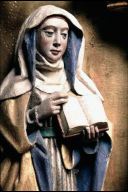
Accordingly,
when I heard from Scandinavians about the celebrations for St
Birgitta and the Holy Year to be held in Rome, I went. Alas,
this time the publicity for this event was limited to the
Catholics in Rome and Lutherans in Sweden and Finland, unlike
the celebration in 1991 which was open to everyone. Seemingly
not invited were the original Birgittine Order of the Most Holy
Saviour's five houses in England, Holland, Bavaria and Sweden.
Nor were the major Birgittine scholars. But the recently-formed
Birgittine Brothers from Oregon were, and processed with great
candles behind the Pope down the nave of St Peter's.
Nevertheless,
it was a fine conference, with excellent papers on the Jubilee
in the Bible, in Birgitta's life and writings, and today.
Present were Lutheran priests and bishops of both genders, with
Catholic clergy, male, and nuns, and no one got upset. In 1991
one woman priest had been allowed to be present, a dear motherly
elderly sort, with her husband, likewise a Lutheran priest, and
the plethora of deaconnesses. This year, 1999, no deaconnesses
were in evidence. Only one paper was given by a woman, and it
was the final one.
The
second day, at eight o'clock in the morning, greatly daring, I
rang the doorbell of the convent of Santa
Francesca Romana, just below the steps of the Ara Coeli,
to ask if I could put an essay about their frescoes of the life
of their sainted foundress on the Web, and they invited me back
at one o'clock. So enclosed is Santa Francesca Romana's convent
of Tor de' Specchi that the public may only enter there on two
days in the year. As one sister said to me, 'It is not a
museum'. The conference over, I came back and was shown
everything, Francesca Romana's cell, her chapel, the manger from
a Roman sarcophagus for firewood she would give to the poor, her
church in restauro. Also, a long talk with their Mother
about Birgitta's connection with Francesca, her son being
married into Birgitta's landlady's family, the Papazzuri. And I
was granted permission. It was like stepping into the frescoes.
Francesca, married, with children, started a lay congregation of
women, refusing all privileges, paying taxes, working for the
poor, and living in clausura, in prayer.
Nothing, in five hundred years, has been changed, everything is
spotless and gleaming and perfect and all for charity. There are
fifteen sisters, still wearing Francesca's simple black habit,
white veil, and nothing could be more beautiful.
Then, in the
afternoon, I went to Santa Cecilia in
Trastevere to see Cardinal Adam Easton's tomb there
opposite St Cecilia's, both bodies later found incorrupt. Though
the church has been altered, its original apse mosaic is there
that Adam Easton would have seen and loved, with this portrait
of her,

and beneath
it are the baths and Roman buildings Cecilia gave to the
Christian community at her death.
We remember
how Julian describes Cecilia's three neck wounds:

When they
found Cecilia's body in the Catacombs, later than Julian's day,
Maderna sculpted it as it was showing the neck wound:

Outside the
now Renaissance/Baroque church are still medieval buildings that
once would have lodged our Norwich Cardinal and his retinue
which, in his Roman Last Will and Testament, included Norwich
names, for each Cardinal is given a Roman church, this one being
his. Ritamary Bradley believes, from Julian's description of the
Veronica Veil, that she had come to Rome, and seen it shown at
St Peter's. If she did she most likely came under the protection
of the Cardinal from Norwich and knew this place sacred to her
beloved St Cecilia, likely staying with the Benedictine nuns
here.
Next to a
much cleaner St Peter's Basilica, beneath a most beautiful
sunset, in broken shoes letting in rain water the day before and
tattered clothings. I consoled myself, remembering Birgitta,
too, was in rags in Rome. I entered it to receive a still unlit
candle for the Vigil of the Great Jubilee of 2000 with Pope John
Paul II concelebrating with the Lutheran Archbishops of Uppsala
and Turku (Birgitta's Bishop Heming's Åbo), and the Catholic
Bishops of Stockholm and Copenhagen, the Cardinals and Bishops
of the Roman Curia and other Lutheran and Catholic Bishops from
Northern Europe and the King and Queen of Sweden. And, in
spirit, I took all of you with me. For this was in honour of
Birgitta being proclaimed Co-Patroness of Europe 'for the unity
of faith and of the Church', as had been said in Boniface IX's
canonization bull 7 October 1391.
St Peter's
was in darkness and silence, broken by Pope John Paul II
singing 'Deus in adiutorium meum
intende . . .'
Then saying:
Dear Brothers and Sisters,
Christ, joyful light and splendour of the Father's glory, sheds
his light upon our ecumanical assembly. Present in our midst, he
unites us all by the grace of the Holy Spirit in this evening
prayer. A special ray of his light he shone upon Saint Bridget,
radiant woman of the North, wife and mother, foundress of the
Most Holy Saviour, whom I recently proclaimed Co-Patroness of
Europe, the model of a life of holiness, entirely spent 'for the
unity of the faith and of the Church'.
In our
preparation for the Great Jubilee, now rapidly approaching,
Bridget, the woman of pilgrimage and of hospitality, immersed
in contemplation of the mysteries of Christ goes before us and
guides us by her example, that we may worthily celebrate the
mystery of the Incarnation by advancing along the way of
conversion, prayer and works of charity.
Together
with the distinguished prelates and pilgrims who have come
from the North of Europe, let us sing joyfully to the Father.
May our prayers ascend like fragrant incense, in the unity of
our hearts and minds, a sacrifice of praise for our God.
Next,
the Birgittine sisters lit their candles while singing in
Italian and Swedish, 'O luce gioiosa',
all processed from the west end to the east, the Pope surrounded
by Bishops, all of us lighting our candles as they passed, the
Pope only three feet from me and looking far healthier than we
see on television, stooped with age, yes, but no more than that,
then incense was offered at Peter's Tomb by him. A woman's voice
explained beforehand each psalm in Italian and in English, then
these were sung by the choir and the people, each also followed
by prayers by the ecumenical bishops. Then Apocalypse 21.1-7,
was read (I think by the Queen of Sweden) in Swedish (reminding
one of Bergman's Seventh Seal reading by Karin, the
Knight's wife). The Pope then preached very movingly in English
and Italian on Birgitta and her uniting of the Church, 'Ut unum sint', then and now and
forever. All kept returning to Birgitta's prayer, 'Lord, show me
the way, and make me willing to walk it'. Alas, the choir failed
in its singing of the most beautiful 'Rosa
rorans bonitatem', especially composed in the
Middle Ages for the translation of St Birgitta's body to Sweden.
Especially fine was the discourse by the Lutheran Archbishop of
Uppsala on the Magnificat, on humility undoing pride. The Pope
next prayed,
Dear Brothers and Sisters,
we have sung the praise of God's mercy, which from generation to
generation, in the words of the Mother of the Lord. Let us now
invoke Christ, born of Mary, as our Saviour and Redeemer.
Prayers
were then given in Swedish, Finnish, Danish, Norwegian, Estonian
and Polish. Then the Lord's Prayer in Latin was sung by all.
Finally, the Pope's concluding prayer in Latin and, together,
with the Lutheran Bishops, the great Aaronic Blessing.
This
blessings comes from that given at St Peters. Perhaps a bit
tattered, but joyously.
Julia Bolton
Holloway
Hermit
of the Holy Family
Florence,
Italy
St Cecilia
22 November 2004
Epiphany 2005
JULIAN OF
NORWICH, HER SHOWING OF LOVE AND ITS CONTEXTS ©1997-2022 JULIA BOLTON HOLLOWAY
|| JULIAN OF NORWICH || SHOWING OF
LOVE || HER TEXTS
|| HER SELF || ABOUT HER TEXTS || BEFORE JULIAN || HER CONTEMPORARIES || AFTER JULIAN || JULIAN IN OUR TIME || ST BIRGITTA OF
SWEDEN || BIBLE AND WOMEN || EQUALLY IN GOD'S IMAGE || MIRROR OF SAINTS || BENEDICTINISM|| THE CLOISTER || ITS SCRIPTORIUM || AMHERST
MANUSCRIPT || PRAYER||
CATALOGUE AND
PORTFOLIO (HANDCRAFTS, BOOKS ) || BOOK REVIEWS || BIBLIOGRAPHY || Originally published, St
Ansgar's Bulletin, 96 (April 2000), 9-10.


