JULIAN OF NORWICH, HER SHOWING
OF LOVE AND ITS CONTEXTS ©1997-2024
JULIA BOLTON HOLLOWAY || JULIAN OF NORWICH
|| SHOWING
OF LOVE || HER TEXTS
|| HER SELF || ABOUT HER TEXTS || BEFORE JULIAN || HER CONTEMPORARIES || AFTER JULIAN || JULIAN IN OUR TIME || ST BIRGITTA OF
SWEDEN || BIBLE AND WOMEN || EQUALLY IN GOD'S IMAGE || MIRROR OF SAINTS || BENEDICTINISM|| THE CLOISTER || ITS SCRIPTORIUM || AMHERST
MANUSCRIPT || PRAYER
|| CATALOGUE
AND PORTFOLIO (HANDCRAFTS, BOOKS) || BOOK REVIEWS || BIBLIOGRAPHY ||
THE
LADY JULIAN OF NORWICH
CANON A.E. BAKER
This essay was written in 1943, published in 1944, during
World War II, when Julian's church had been bombed. Canon
A.E. Baker wrote it in an apocalyptic time, in a Lent book
for the Archbishop of Canterbury titled Prophets for a Day of
Judgment, of which this is Chapter III, the
others being on Jeremiah, St Augustine of Hippo and
Dostoevsky. Eyre and Spottiswoode published the book with
the emblem of a lion over a book whose pages state: 'BOOK/PRODUCTION/WAR
ECONOMY/STANDARD,' and below that is
repeated in smaller capitals, 'THIS BOOK IS
PRODUCED IN COMPLETE CONFORMITY WITH THE AUTHORIZED
ECONOMY STANDARDS.'
http://www.the-plunketts.freeserve.co.uk§ give fine pre-
and post-war photograph albums of Norwich, in particular of St
Julian's Church and Carrow Priory.

27th June, 1942: St
Julian’s Church in King Street had almost everything excepting
its north wall and porch completely annihilated by a high
explosive bomb.


I have found the dominant of my
range and state -
Love, O my God, to
call Thee Love and Love.
Gerard Manly Hopkins
 hen
we say that the Lady Julian was born in 1342 and finished her
book in 1393 or later: that she was anchoress, i.e. a religious
solitary: that she was the first Engish woman of letters, read
to-day more than most pre-Reformation writers in our tongue:
that she was a mystic in one of the two great periods of
Christian mysticism that Western Europe has known; well, each of
these statements presents her as the focus of a set of
happenings and spiritual forces which we only begin to
understand if we try to enter a world and a mind at once
deceptively like and startlingly unlike our own.
hen
we say that the Lady Julian was born in 1342 and finished her
book in 1393 or later: that she was anchoress, i.e. a religious
solitary: that she was the first Engish woman of letters, read
to-day more than most pre-Reformation writers in our tongue:
that she was a mystic in one of the two great periods of
Christian mysticism that Western Europe has known; well, each of
these statements presents her as the focus of a set of
happenings and spiritual forces which we only begin to
understand if we try to enter a world and a mind at once
deceptively like and startlingly unlike our own.
In the fourteenth century western Europe was moving towards the
end of an epoch, the culmination and dissociation of a culture,
the decay and passing of a civilization: a civilization whose
achievements were magnificent, but tragically insecure. Men's
lives were passed in awe of the Church, whose authority had not
been seriously questioned. For example, a king and his nobles
went to confession, pale with terror, because Westminster Abbey
had been desecrated by the murder of a man before the High
Altar. The splendid failure of St Dominic and St Francis
witnessed to the dire need for a reformation of the Church and a
conversion of the world. Scholasticism, one of the supreme
achievements of the Western mind, had related all human thought
to theology in a synthesis so completely unified that no further
progress in knowledge could take place except by a sort of
dialectical revolt to the extreme specialization which is the
modern ideal - each man knowing more and more about less and
less. The close of the thirteenth century had, in the
scepticism, infidelity, and irreligion of the practical world,
provided a deadful foil for the achievements of theologians and
saints. In the words of Dean Church, religion had been neither
the guide nor check to society but only the consolation of its
victims.
The devastating scandal of the Papal Schism - one Pope for
Frenchmen and another for English and Germans - largely
discredited the Church in the minds of thoughtful men; but the
picture is not all shallow. The colleges of Oxford and Cambridge
which Churchmen were founding, as well as the large and splendid
churches built in all parts of the country in the fourteenth
century, suggest that there is truth in the judgment that the
common life was permeated by genuine religion, even though signs
were already appearing of 'the break up of our mediaeval society
and a period of anarchy and moral prostration.'
Murders (the killer was often not brought to trial), famines,
storms, unsafe and insanitary houses, combined to make life
insecure. When Julian was six years old the Black Death of 1349
destroyed more than a third of the population. Corn rotted in
the fields for lack of reapers, villages disappeared, never to
be reinhabited, there was an acute shortage of food and goods,
prices soared, the villeins demanded the right to sell their
labour in the open market - they demanded freedom, in other
words - and the crude and cruel attempts of the landowners to
maintain the status quo intensified a dangerous situation. The
inherited social order began to be felt as a grievance by the
majority of common men. Piers Plowman and John Ball encouraged
men to sing as they worked:
When Adam dalf, and Eve span
Who was
then the Gentleman?
Then, suddenly, the Peasants' Revolt of 1381 took the upper
class by surprise. Wat Tyler led the rebels on London 'to
deliver the king from his enemies and theirs.' The lords were
helpless, but King Richard II won the mob promising them pardon
and freedom. Later the Lord Mayor murdered Wat Tyler, and the
rising was over. Every promise made by the king was broken. The
leaders of the people were ruthlessly executed, and the grants
of freedom proved worth far less than the paper they were
written on.
It was one of the most brilliant periods of English history, but
the social fabric was breaking up. The contrast was merely
absurd between Chaucer or Langland or Richard of Bordeaux and
the half-savages by whom they were surrounded. He was not far
wrong who described the fourteenth century as that 'futile,
bloody, immoral century.'
It was against this background of civilization and savagery, or
moral disintegration and class struggle and revolutionary social
change, of war and pestilence and revolt, that the Lady Julian
lived and prayed and saw her visions and wrote her bok. Norwich,
where she was born, suffered more severely than most places from
the Black Death. It was a prosperous city, and supplied an
unusually large number to the levies of bowmen whom Edward III
raised for his French war. It was those bowmen who provided the
strong, disciplined, trained backbone of the Peqsants' Revolt,
without which it could hardly have scared the nobles as it did.
Julian had seen her visions, and was writing her book when
London and the south-east of England were living in terror of
the enormous forces that the French had collected to invade this
island, and when Wat Tyler and John Ball asserted the freedom
and equality of all Englishmen. She was still alive when Henry
of Lancaster crushed in his crude fingers the frial lily that
was Richard of Bordeaux - when it seemed as though the English
people were forming the habit of unmaking kings. Some time after
1393 her book was finished, towards the close of a century
through whose later decades, as Coulton has said, the world
seemed to grow madder and madder,
What was her reaction to all this? It is significant, surely,
that she became an anchoress, solitary nun. She lived alone in a
tiny house built against the south-eastern wall of a little
church at 'Conisford, outlying Norwich'. There were two windows
to her room, one into the church, so that she might hear Mass
daily, and see Christ's Body made, and adore Him, and take
Comunion fifteen times a year. The other window looked upon the
world, but lest she should be tempted to be a starer or gossip
each window was shaded by a black curtain marked with a white
cross. She never left the anchorage, but sometimes women, and
perhaps men, would come to her window to recount their needs and
ask her counsel. And 'her curate,' as she calls him, would hear
her confession and - in what was believed to be the mortal
sickness at the time of her visions - he gave her the last rites
of the Church. In her old age (but we must remember that old age
came much earlier then than now) she had two maids to attend
her; one would go out to gather from the faithful the gifts by
which they lived. Julian spent her time in prayer and fasting
and meditation and spiritual reading and in writing - and
perhaps in sewing vestments for the church. And particularly in
prayer; and no one can doubt that the world needed the prayers
of the saints at least as much in her day as at any time before
or since.
And so we come to her book. It is called a Revelation of love
that Jesus Christ, our endless bliss, made in sixteen shewings
or revelations particular. She tells us that as a young woman
she had in prayer longed earnestly for two things. First, that
she might have all the experience of a mortal illness - its
loneliness, its weakness, its fear, so that she would feel in
her very bones, as we say, that she was nothing, and there is
nothing but God Himself and her trust in Him. And she also
longed that she might behold His sufferings, and enter into
them, as though she were one of His friends present with the
Blessed Virgin on Calvary. And then, when she was thirty years
old, on May 8, 1373, her prayers were answered. She was on the
point of death and the last rites of the Church were
administered to her. She was certain she was going to die. 'I
assented fully with all the will of my heart to be at God's
will.' When the priest came to be at her ending she was no
longer able to speak. He set the cross before her face and said:
'I have brought the image of thy Maker and Saviour. Look
thereupon and comfort thee therewith.' She set her eyes on the
face of the crucifix. Her sight began to fail, It was dark as
night save in the image of the Cross. The lower part of her body
was quite dead, and much of the rest. Her breath came short.
And as she looked on the face of the Crucified she saw the red
blood trickle from under the Crown of Thorns, hot and fresh and
plenteous, as when the thorns were pressed on His blessed head
who was both God and Man and suffered thus for her. The great
drops of blood fell down from under the Garland like pellets.
And when they came to the brows, then they vanished,
notwithstanding, the bleeding continued till many things were
seen and understood. This showing was quick and life-like, and
horrifying and dreadful, sweet and lovely.
Two of the things she understood are worth repeating. God showed
her a little thing, the size of an hazel nut, in the palm of her
hand; and it was as round as a ball. She thought: 'What may this
be?' And it was answered generally thus: It is all that is made.
She marvelled how it might last, for it seemed it might suddenly
have fallen to nothing for littleness. And she was answered in
her understanding: It lasteth, and ever shall, for that God
loveth it. And so All-thing hath the Being by the love of God.
'Well I wot,' she says, 'that heaven and earth and all that is
made is great and large, fair and good; but the cause why it
showed so little to my sight was for that I saw it in the
presence of Him that is the Maker of all things.'
The other thing she umderstood in this first showing was this.
She wished that all her fellow Christians might see and know
what she saw. For God showed it to her in order that we might
all have the comfort of it. 'Because of the showing I am not
good, but if I love God the better: and inasmuch as ye love God
the better, it is more to you than to me . . . for I am certain
that there be many that never had showing not sight but of the
common teaching of Holy Church, that love God better than I.'
Then as she gazed continually on the face of the Crucified she
saw something of His suffering: despite, spitting, and sullying,
and buffeting, and many languorous pains, more than she could
tell, and often changing of colour. At one time she saw half His
face overgone with dry blood, and then the other half: a figure
and likeness of our foul deed's shame that our fair bright
blessed Lord bare for our sins.
Then, in her understanding, she saw God in a Point - by which
she understood that God is in all things. To a modern reader
that seems a little odd, to say the least of it. In a later
chapter she speaks of 'the blessed Point from which nature came:
that is, God.' Miss Grace Warrack has a valuable note on this.
Dante had used the word in this sense - il punto, the point. In
the Paradise he speaks of a point which rayed forth light so
keen that it would close any eye that it shone on: the centre of
nine circles of fire - each a host of angels burning with
enkindled love. And from that point doth hang heaven and all
nature. The Lady Julian's explanation is: 'I saw truly that God
doeth all-thing, be it never so little. And nothing is done by
hap or adventure, but all things by the fore-seeing wisdom of
God. Wherefore it must be granted that all thing that is done,
it is well done: for our Lord God doeth all. For in this time
the working of creatures was not shown but the working of our
Lord God in the creatures: for He is the Mid-point of all thing,
and all he doeth.'
This making of God directly responsible for every existence and
every event raises the problem of evil in a very acute form. 'I
beheld and considered,' says Julian, 'seeing and knowing in
sight, with a soft dread, and thought: What is sin? . . . And I
was certain He doeth no sin.' A common declaration of the
mystics is that evil is nothing - non-existence - just the
absence of reality, which is perfectly good. 'And here I saw,'
she says, 'that sin is no deed: for in all this was not sin
shewed. . . . And God meant: See! I am God: see! I am in all
thing: see! I do all thing: see! I lift never mine hands off my
works, nor ever shall, without end: see! I lead all thing to the
end I ordained it to from without beginning, by the same Might,
Wisdom and Love whereby I made it. How should anything be
amiss?' Often she wondered why by the great foreseeing wisdom of
God the beginning of sin was not hindered: 'for then, methought,
all should have been well. . . But Jesus answered it behoved
that there should be sin, but al shal be well and al manner of
thing shal be well. But I saw not sin, she said, for I believe
it hath no manner of substance nor no part of being, nor could
it be known but by the pain it is the cause of. And this pain,
it is something for a time; for it purgeth, and maketh us to
know ourselves and to ask mercy. Julian says that our pain shall
be turned to praise and glory by virtue of Christ's passion. . .
. And if we see truly that our sin deserveth it, yet His love
excuseth us, and of His great courtesy He doeth away all our
blame, and behldeth us with ruth and pity as children innocent
andunoathful.' She was convinced that it was revealed to her
that just as the blissful Trinity made all things of nought,
right so the same blessed Trinity shall make all well that is
not well. Here she saw a clear contradiction of the Church's
teaching. One point of our Faith, she said, is that many
creatures shall be condemned: sinful angels, heathen men, all Jews, except the few who have
been converted, men that have received Christendom and live
un-Christian lives, and so die out of charity: all these shall
be condemned to hell without end, as Julian says that Holy
Church taught her to believe. And so it seemed to her impossible
that all manner of things should be well, as our Lord showed
her. And she had no answer but this: That which is impossible to
thee is not impossible to me.
She saw Christ dying. His face was dry and blodless. Then it
changed colour, as the flesh turned more deeply dead. His
suffering showed most specially in HIs blessed face: but all His
body turned out of fair life-like colour, with dry longing. For
that same time our Lord and blessed Saviour died upon the Rood,
it was a dry hard wind, and wondrous cold: and all the precious
blood drained out of the sweet body. It seemed as if He were
seven nights dying, at the point of outpassing away, suffering
the long pain. 'Ah! hard and grievous was His pain.'
The which Showing of Christ's pain filled her full of pain. She
thought: Is any pain like this? And she was answered in her
reason: Hell is another pain: for there is despair. But of all
pains that lead to salvation this is the most pain, to see thy
Love suffer, Hw might any pain be more to me, she asks, than to
see Him suffer that is all my life, all my bliss, and all my
joy? Then said Jesus, our kind
Lord: 'It is a joy, a bliss, an endless satisfying to me that
ever I suffered for thee: and if I might suffer more, I would
suffer more. And here saw I the love that made Him suffer
passeth as far all His pain as Heaven is above earth. A glad
giver taketh but little heed of the thing that He giveth, but
all his desire and all his intent is to please him and solace
him to whom he giveth it.'
'It is a wonderful property of God,' she says, 'that He is ever
the same.' And she interprets this to mean that in God there can
be no wrath. He always loves those who shall be saved. He keeps
us when we think we are near foresaken and cast away our sin and
because we have deserved it. Our courteous Lord willeth not that
His servants despair for often nor for grievous falling, for our
falling hindereth not His love for us. Although we are sinners
our Lord is never wrath; it is against the property of His Might
to be wrath, and against the property of His Wisdom, and against
the property of His Goodness. God is the Goodness that may not
be wrath, for He is naught but Goodness. She saw no wrath but on
man's part, and that He forgiveth in us. For wrath is nothing
else but a frowardness and contrariness to peace and love. And
it cometh of failing either of might or wisdom or of goodness.
Elsewhere she says that if God might be wrath for an instant we
should never have life nor place nor being. To the soul that of
His special grace seeth so far into the high marvellous goodness
of God, and seeth that we are endlessly united to Him in love,
it is the most impossible thing that may be that God should be
wrath. For wrath and friendship are two contraries. For He that
wasteth and destroyeth our wrath and makes us meek and mild - it
behoveth needs to be that He Himself be ever one in love, meek
and mild; which is contrary to wrath. Julian makes this last
point elsewhere in slightly different words. Christ Himself, she
says, is the ground of all the laws of Christian men, and He
taught us to do good against ill. Here may we see that He
Himself is this charity, and doeth to us as He teacheth us to
do, He it is that doeth good against evil. His mercy and
goodness are to slacken our wrath.
Of the Christian mystics with whose writings I am acquainted not
one is more Christian than Julian. But what meaning do I put
into the word 'Christian'? Julian has a thorough-going,
unshakable belief in God's indomitable, undiscriminating love.
And she holds to it even when the Church's teaching, as she
understands it, seems to qualify or deny it. She does not say
that the Church's teaching is wrong, but she holds to what she
sees. It is the heart of her religion that Christ's
undiscriminating love binds all men into an unbreakable unity.
'It is God's will,' she says, 'that I should see myself bound to
Him in love because of all that He has done for me. And thus
should every soul think of Him. That is to say, the charity of
God maketh in us such a unity that, when it is truly seen no man
can part himself from other.' And in an earlier place she wrote:
'And then I saw that each natural compassion that man hath on
his fellow Christian with charity, it is Christ in him.'
The root of Lady Julian's mysticism appears in the eighth
showing. 'I wist well,' she said, 'that while I beheld in the
Cross I was surely safe; therefore I would not assent to put my
soul in peril: for away from the Cross was no sureness, for
frightening of fiends. Then had I a proffer in my reason, as if
it had been friendly said to me: look up to heaven to His
Father. And then saw I well, that there was nothing betwixt the
Cross and Heaven that might have harmed me. I answered inwardly
with all the might of my soul, and said: Nay, I may not: for
Thou art my heaven. . . . For I would liever have been in that
pain till Doomsday than to come to heaven otherwise than by Him.
. . Thus was I learned to choose Jesus to my Heaven, whom I saw
only in pain at that time: meliked no other Heaven than Jesus,
which shall be my bliss when I come there.'
The aim of all mystics is to be 'oned' with God. Many have
sought Him by emptying themselves of everything that is not God.
Mr. R.E. Hughes, Reader in Chinese Philosophy and Religion at
Oxford, has spoken of the technique of levitating oneself into
reality by mystical mind-emptying. They have turned from all
sense-experience, have hushed all memory, either of their own
experience or of that common human experience which we call
history, have stilled every desire, all fear and every other
emotion, and then, the self turned in upon its empty self is one
with the ground of all being. Mr Aldous Huxley has said that in
the highest stages of orison all ideas and images, even ideas
and images connected with the life of Christ, must be put aside,
as distractions standing in the way of perfect union. It will be
remembered that Plotinus speaks of 'the flight of the alone to
the Alone.' And Father Joseph (Mr Huxley's Grey Eminence) said that
the mystic was like a ship on 'the open sea of denudation.'
Mysticism seeks its goal, that is to say, by withdrawing
from the world - whose duties are, for the Christian, the symbol
of God's will as its happenings are the sacrament of His
providence - by deliberate and callous aloofness from its
obligations and a wilful blindness to its opportunities, in
order to be, in the worst and most literal sense of the word,
'unworldly,' and by abstraction from all that is special and
particular in any positive, historical religion, being in
intention non-Christian and becoming in fact subhuman.
This arrogant Mysticismus
is vain of a spirituality that dare not be incarnate or even
immanent in the struggle and vulgarity of this mortal life. It
is profoundly significant, a horrid denial of all that is most
human or truly personal, that the climax of the mystic way is
sought and found in 'ecstasy.' Karl Barth rightly regards this
mysticism that descends through Pseudo-Dionysius and Plotinus
from Buddhism and the Upanishads as nothing but 'esoteric
atheism.' Mr Huxley, who has strong sympathies with it, has
described the object it claims to reach as 'imageless godhead.'
The mysticism, however, which has a rightful claim to a place in
the Christian tradition (and nothing which is not essentially
Christian has any relation with the Lady Julian) glories in that
profound anthropomorphism which recognizes the ultimate
revelation and the final Act of God in that particular human
Life which triumphed in the defeat that sin inflicted, and
redeemed this so unspiritual world by suffering and death. The
'obsessive, hallucinatory preoccupation with the sufferings of
Calvary' which Mr Huxley so politely dismisses as a divagation
from authentic mysticism is, there is no need to say, of a the
very essence of the Lady Julian's message to her time and to all
the centuries. The first of these gifts which, as a young woman
Julian had desired of God, was that she might 'have mind' of His
Passion. She had 'some feeling' in the Passion of Christ, but
yet she desired more by the grace of God. She desired a bodily
sight wherein she might have more knowledge of the bodily pains
of our Saviour and of the compassion of our Lady and of all His
true lovers that saw, that time, His pains. 'For I would be one
of them that suffer with Him.' The object of this prayer was
that after the revelation she would have the more true mind in
the Passion of Christ.
Lady Julian's mysticism - her 'oneing' with God - is, then
primarily a matter of conviction rather than of experience. It
does not come, to any considerable extent, within the range of
psychology, which has played such devastating havoc with the
neo-Platonic type of mysticism, but is the concern of theology.
It is based on the teaching that was 'shewed' her in these
revelations.
As we have seen, she teaches that God does everything that is
done, and makes everything that is made. 'God is all that is
good, and the goodness that al thing hath, it is He.' And
elsewhere she says: 'All that is good our Lord doeth, and that
which is evil our Lord suffereth.' Man's Soul is made of nought:
that is to say, it is made, but of nought that is made. So human
nature is rightly 'oned' to its Maker, and therefore there is
nothing between God and man's soul. 'I believe and understand
the ministration of angels, as clerks tell us,' she says, 'but
it was not showed me. For Himself is nearest and meetest,
highest and lowest, and doeth all.' God is nearer to the soul
than it is to itself, for He is the very Ground of its being.
'By the endless assent of the full accord of all the Trinity,
the Mid-Person (i.e. Christ) willed to be Ground and head of
this fair nature of man: out of Whom we be all come, in Whom we
be all enclosed, into Whom we shall all wend.' Later she says:
'Our substance is in God: that is to say, that God is God, and
our substance is a creature in God.' It is easier for us to know
God, she teaches, than to know our own soul. But it is also true
that we shall never arrive at a full knowledge of God until we
first know our own soul clearly.
Christ dwell in the soul, and the soul in Christ. 'It is His
good pleasure,' she says, 'to reign in our Understanding
blissfully, and sit in our Soul restfully, and to dwell in our
Soul endlessly, us all working unto Him . . . the place that
Jesus taketh in our Soul He shall never remove it, without end.
. . . For in us is His homeliest home and His endless woning
(dwelling) . . . our Lord God dwelleth in us and is here with
us, and is more near to us than tongue can tell or heart can
think.' But, as we have seen, although there is no being between
God and man's soul, it is a fact that man falls into sin. But as
God's love and power keep a man both in weal and in woe, so He
keeps him in love even when he sins. 'For we shall see verily in
heaven, without end, that we have grievously sinned in this
life, and notwithstanding this, we shall see that we were never
hurt in His love, we were never the less of price in His sight.
And by the assay of this falling we shall have an high
marvellous knowing of love in God without end. For strong and
marvellous is that love which may not, nor will not, be broken
for trespass.' There is no conflict between God's merciful love
and His anger, but rather between His love and our anger. For no
more than His love is broken to ourself and our
'even-Christians': 'But that we endlessly hate the sin and
endlessly love the soul, as God loveth it.' Although it is
obviously true that no man sins without his own consent - the
citadel falls because there is a traitor within who yields it up
to the enemy - it is also true,as St Paul teaches, that I do
that which I allow not, and I do not what I would . . . the good
that I would I do not, but the evil which I would not, that I
do. That also was revealed to Lady Julian. 'I saw and understood
full surely,' she says, 'that in every soul that shall be saved
there is a Godly Will that never assented to sin, nor ever shall
. . . for that same human nature that heaven shall be filled
with behoveth needs, of God's rightfulness so to have been knit
and oned to Him, that therein was kept a Substance which might
never, nor should, be parted from Him.'
God's grace will bring it about that man's lot will be more
blessed as a result of his sin and repentance than it would have
been if he had not fallen. Joy shall be in heaven over one
sinner that repenteth more than over ninety and nine just
persons which need no repentance. Julian saw that the worst
thing that ever happened, or could happen, was Adam's sin, but
that the glorious Satisfaction is more pleasing to God and more
'worshipful' than Adam's sin was harmful. God said: 'Since I
have made well the most harm, then it is my will that thou know
hereby that I shall make well all that is less.' He allows us to
fall! But in this blessed love we are kept by His Might and
Wisdom, so that by mercy and grace we are raised to manifold
more joys. 'By contrition we are made clean, by compassion we
are made ready, and by true longing toward God we are made
worthy . . . .' And elsewhere she records that God said that it
falls to Him to give to the penitent sinner a gift that is
better for him, and more worshipful, than his own wholeness
would have been - or else, surely, He would do him no grace. God
who loves us allows us to fall into sin that we may learn our
weakness and helplessness without Him, and turn to him. She
speaks of a 'holy courteous dread of our Lord, to which meekness
is united: that is, that a creature seeth the Lord marvellous
great, and itself marvellous little . . . and this showeth He to
make us love Him and nought dread but Him.'
Penitence leads to prayer, and the end of prayer is to be oned
to God. That is the plain, gracious, Christian meaning of what
has been called her mysticism. 'Prayer is a witness that the
soul willeth as God willeth. Our courteous Lord of His grace
sheweth Himself to our soul . . . all the cause wherefor we
pray, it is oned with the sight and beholding of Him to whom we
pray. . . . When we of His special grace plainly behold Him,
seeing none other needs, then we follow Him and He draweth us
unto Him by love . . . then we can do no more but behold Him,
enjoying, with an high, mighty desire to be all oned unto Him,
centred on His dwelling, and enjoy in His loving and delight in
His goodness . . . and then shall we come into our Lord, our
Self clearly knowing, and God fully having; and we shall
endlessly be all had in God: Him verily seeing and fully
feeling, Him spiritually hearing, and Him delectably
in-breathing, and Him sweetly drinking. And then shall we see
God face to face, homely and fully. The creature that is made
shall see and endlessly behold God which is the Maker, For there
may no man see God and live after, that is the say, in this
deadly life. But when He of His special grace will show Himself
here, He strengtheneth the creature above itself, and He
measureth the shewing after His own will, as it is profitable
for the time.'
This use of the activities of the body, even of smelling and
drinking, to describe not only the soul's experience of God, but
also the reality of its relation to Him, is typical of Julian's
vivid and concrete style. Elsewhere, for example, she says that
as the body is clad in the cloth, and the flesh in the skin and
bones in the flesh, and the heart in 'the bouke' (the bulk, the
thorax) so are we, soul and body, clad in the goodness of God,
and enclosed. 'For truly our Lord desireth that our soul cleave
to Him with all its might.' Flee to our Lord, she says, and we
shall be comforted, touch we Him and we shall be made clean,
cleave we to Him and we shall be 'sekir' (sure; c.f. Scots, siccar) and safe from all
manner of peril.'
The insistence on the unity between God and man's soul is,
indeed, the framework of all Julian's teaching. That, she says,
was revealed in the first Shewing, and in the last she saw that
the Blissful Trinity, our Maker, in Christ Jesus our Saviour,
endlessly dwelleth in our soul. The major theme of her book is
that there is nothing that separates God from the soul. Our good
Lord the Holy Ghost, she says, is endless life dwelling in our
soul. And elsewhere she says that God made man's soul to be His
own City and His dwelling-place; which is most pleasing to Him
of all His works. All mankind that shall be saved . . . is the
Manhood of Christ: for He is the Head and we be His members. He
is with us in our soul, endless dwelling. That same Kind that
Heaven shall be filled with (i.e. human nature) behoveth needs
of God's rightfulness so to have been knit and oned to Him that
therein was kept a Substance which might never, nor should, be
parted from Him. . . There may nor shall be right nought atwixt
God and man's soul. 'Highly ought we to rejoice that God
dwelleth in our soul, and much more highly ought we to rejoice
that our soul dwelleth in God.' And the practical religious
outcome of this doctrine is that God wills that we shall give
Him all our 'attending,' learning His lores, keeping His laws,
desiring that all be done that He doeth, truly trusting in Him.
'For soothly I saw that our substance is in God.'
She looked out from her anchorage window in the little Norwich
churchyard on a world in which many things men had thought
eternal were going up in smoke. And she was not afraid. There
was absolutely no place in her religion for the fear of the
devil, for our good Lord showed her that by His blissful Passion
the devil is overcome. The Fiend has the same malice now as
before the Incarnation, and he travaileth as sore; but 'all
souls of salvation' escape him. The victory is complete; God
triumphs over his malice and unmight; his might is all locked
into God's hand. And at the sight of the Fiend's helplessness
she laughed mightily for pleasure, in spite of her pain, and she
wished that all her 'even-Christians' had seen what she saw, so
that they might laugh with her. But she did not see Christ
laugh.
More than five hundred years before Rudolf Otto she saw and
stated what he described in the word 'numinous.' We are to love
God, she says, and to dread nothing but Him. The soul that is
assured that all the might of our Enemy is taken into our
Friend's hand will not dread but Him that he loveth. 'All other
dread he setteth among passions and bodily sickness and
imaginations.' There are four kinds of dread, Julian teaches.
First, there is the fear that cometh through sudden weakness.
Then there is the fear of pain and death and spiritual enemies,
that awakens man from the sleep of sin to seek comfort and mercy
of God, and helps us to contrition by the blessed touching of
the Holy Ghost. Thirdly, there is the dread which draws to
despair because it doubts the Goodness of God. And there is
reverent dread, than which no other dread fully pleaseth God.
Love and Dread are brethren, and they are rooted in us by the
Goodness of our Maker, and they shall never be taken from us
without end. . . . It belongeth to the Lordship and the
Fatherhood to be dreaded, as it belongeth to the Goodness to be
loved; and it belongeth to us that are His servants and His
children to dread Him for Lordship and Fatherhood, as it
belongeth to us to love Him for Godness. . . . That dread that
maketh us hastily to flee from all that is not good and fall
into our Lord's breast, as the Child into the Mother's bosom,
with all our intent and with all our mind, knowing our
feebleness and our great need, knowing His everlasting goodness
and His blisful love, only seeking to Him for salvation,
cleaving to Him with sure trust; that dread . . . is natural,
gracious, good and true. . . . As good as God is, so great He
is, and as much as it belongeth to His goodness to be loved, so
much it belongeth to His greatness to be dreaded. For this
reverent dread is the fair courtesy that is in Heaven afore
God's face. And as much as He shall then be known and loved
overpassing that He is now, in so much He shall be dreaded
overpassing that He is now.
She looks out on the end of the world with no false hopes.
'God's servants, Holy Church,' she says, 'shall be shaken in
sorrow and anguish, tribulation in this world, as men shake a
cloth in the wind.' She has little to say of the wickedness of
wicked men, of the world which lieth in the evil one. 'For the
beholding of other men's sins, it maketh as it were a thick mist
afore the eyes of the soul, and we cannot, for the time, see the
fairness of God, but as we may behold them with contrition with
him, with compassion on him, and with holy desire to God for
him. For without this it harmeth and tempestet and hindereth the
soul that beholdeth them.' And in another place she says that
she was taught that she should see her own sins and not those of
others except it might be for comfort and help of her
'even-Chrsitian.' What did it all mean? She herself asked that
question. From that time that it was showed, she says, I desired
oftentimes to learn what was our Lord's meaning. And fifteen
years after and more, I was answered in ghostly understanding,
saying thus: Wouldst thou learn thy Lord's meaning in this?
Learn it well. Love was His meaning. Who shewed it thee. Love.
What shewed He thee? Love. Wherefore shewed it He? For Love.
Hold thee therein and thou shalt learn and know more in the
same. But thou shalt never know nor learn therein other thing
without end.
Which Jesus mot grant us. Amen.
 From an old
engraving of St Julian's Church with its tower as it was was
before WWII's bombing.
From an old
engraving of St Julian's Church with its tower as it was was
before WWII's bombing.
Canon Albert E. Baker then cites the two editions then extant
that he has used, those of Grace Warrack and of George Tyrrell.
Indices
to Umiltà Website's Julian Essays:
Preface
Influences
on Julian
Her Self
Her
Contemporaries
Her Manuscript
Texts ♫
with recorded readings of them
About Her
Manuscript Texts
After Julian,
Her Editors
Julian in our Day
Publications related to Julian:
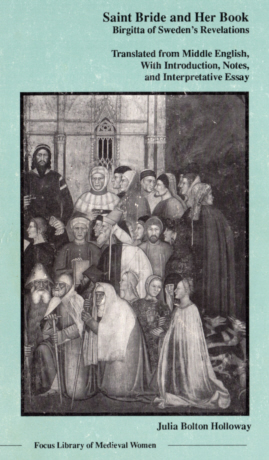

Saint
Bride and Her Book: Birgitta of Sweden's Revelations
Translated from Latin and Middle English with Introduction,
Notes and Interpretative Essay. Focus Library of Medieval Women. Series Editor,
Jane Chance. xv + 164 pp. Revised, republished,
Boydell and Brewer, 1997. Republished, Boydell and Brewer,
2000. ISBN 0-941051-18-8
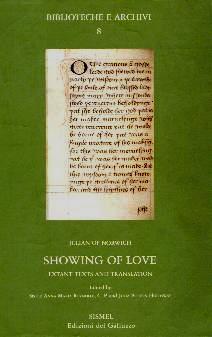 To see an example of a
page inside with parallel text in Middle English and Modern
English, variants and explanatory notes, click here. Index to this book at http://www.umilta.net/julsismelindex.html
To see an example of a
page inside with parallel text in Middle English and Modern
English, variants and explanatory notes, click here. Index to this book at http://www.umilta.net/julsismelindex.html
Julian of
Norwich. Showing of Love: Extant Texts and Translation. Edited.
Sister Anna Maria Reynolds, C.P. and Julia Bolton Holloway.
Florence: SISMEL Edizioni del Galluzzo (Click
on British flag, enter 'Julian of Norwich' in search
box), 2001. Biblioteche e Archivi
8. XIV + 848 pp. ISBN 88-8450-095-8.
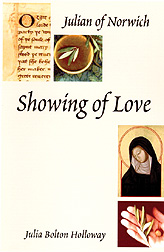 To see inside this book, where God's words are
in red, Julian's in black, her
editor's in grey, click here.
To see inside this book, where God's words are
in red, Julian's in black, her
editor's in grey, click here.
Julian of
Norwich. Showing of Love. Translated, Julia Bolton
Holloway. Collegeville:
Liturgical Press;
London; Darton, Longman and Todd, 2003. Amazon
ISBN 0-8146-5169-0/ ISBN 023252503X. xxxiv + 133 pp. Index.
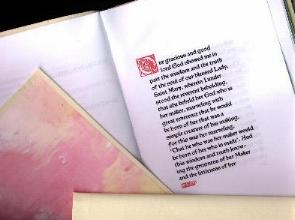 To view sample copies, actual
size, click here.
To view sample copies, actual
size, click here.
Julian of
Norwich, Showing of Love, Westminster Text, translated into
Modern English, set in William Morris typefont, hand bound
with marbled paper end papers within vellum or marbled paper
covers, in limited, signed edition. A similar version
available in Italian translation. To order, click here.

'Colections'
by an English Nun in Exile: Bibliothèque Mazarine 1202.
Ed. Julia Bolton Holloway, Hermit of the Holy Family. Analecta
Cartusiana 119:26. Eds. James Hogg, Alain Girard, Daniel Le
Blévec. Salzburg: Institut für Anglistik und Amerikanistik
Universität Salzburg, 2006.
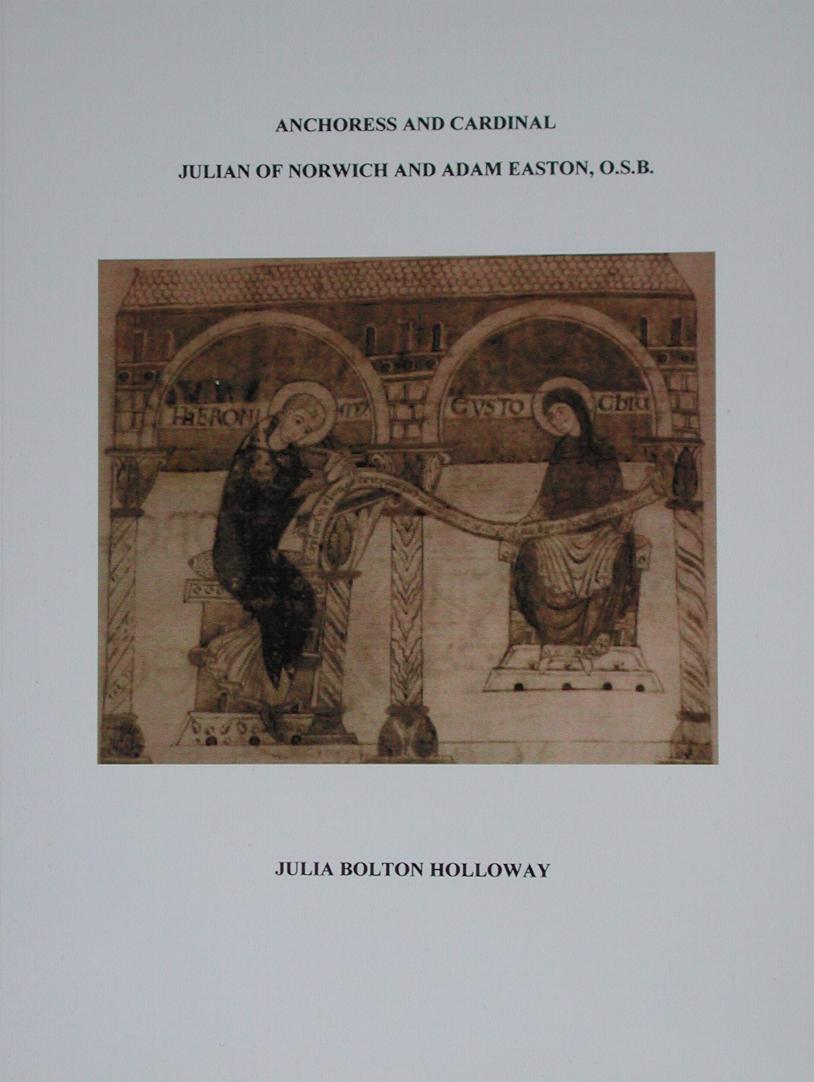
Anchoress and Cardinal: Julian of
Norwich and Adam Easton OSB. Analecta Cartusiana 35:20 Spiritualität
Heute und Gestern. Salzburg: Institut für Anglistik und
Amerikanistik Universität Salzburg, 2008. ISBN
978-3-902649-01-0. ix + 399 pp. Index. Plates.
Teresa Morris. Julian of Norwich: A
Comprehensive Bibliography and Handbook. Preface,
Julia Bolton Holloway. Lewiston: Edwin Mellen Press, 2010.
x + 310 pp. ISBN-13: 978-0-7734-3678-7; ISBN-10:
0-7734-3678-2. Maps. Index.

Fr Brendan
Pelphrey. Lo, How I Love Thee: Divine Love in Julian
of Norwich. Ed. Julia Bolton Holloway. Amazon,
2013. ISBN 978-1470198299

Julian among
the Books: Julian of Norwich's Theological Library.
Newcastle upon Tyne: Cambridge
Scholars Publishing, 2016. xxi + 328 pp. VII Plates, 59
Figures. ISBN (10): 1-4438-8894-X, ISBN (13)
978-1-4438-8894-3.

Mary's Dowry; An Anthology of
Pilgrim and Contemplative Writings/ La Dote di
Maria:Antologie di
Testi di Pellegrine e Contemplativi.
Traduzione di Gabriella Del Lungo
Camiciotto. Testo a fronte, inglese/italiano. Analecta
Cartusiana 35:21 Spiritualität Heute und Gestern.
Salzburg: Institut für Anglistik und Amerikanistik
Universität Salzburg, 2017. ISBN 978-3-903185-07-4. ix
+ 484 pp.
JULIAN OF NORWICH, HER SHOWING OF LOVE
AND ITS CONTEXTS ©1997-2024 JULIA
BOLTON HOLLOWAY || JULIAN OF NORWICH || SHOWING OF
LOVE || HER TEXTS ||
HER SELF || ABOUT HER TEXTS || BEFORE JULIAN || HER CONTEMPORARIES || AFTER JULIAN || JULIAN IN OUR TIME || ST BIRGITTA OF SWEDEN
|| BIBLE AND WOMEN || EQUALLY IN GOD'S IMAGE || MIRROR OF SAINTS || BENEDICTINISM|| THE CLOISTER || ITS SCRIPTORIUM || AMHERST MANUSCRIPT || PRAYER || CATALOGUE AND PORTFOLIO (HANDCRAFTS, BOOKS)
|| BOOK REVIEWS || BIBLIOGRAPHY ||


