UMILTA WEBSITE, JULIAN OF NORWICH, HER SHOWING OF LOVE
AND ITS CONTEXTS ©1997-2024 JULIA
BOLTON HOLLOWAY
| || JULIAN OF
NORWICH || SHOWING OF LOVE || HER TEXTS || HER
SELF || ABOUT HER TEXTS || BEFORE JULIAN || HER CONTEMPORARIES || AFTER JULIAN || JULIAN IN OUR TIME || ST BIRGITTA OF SWEDEN
|| BIBLE AND WOMEN || EQUALLY IN GOD'S IMAGE || MIRROR OF SAINTS || BENEDICTINISM || THE CLOISTER || ITS SCRIPTORIUM || AMHERST MANUSCRIPT || PRAYER || CATALOGUE AND PORTFOLIO (HANDCRAFTS, BOOKS )
|| BOOK REVIEWS || BIBLIOGRAPHY || JULIAN
PORTAL ♫
Click on red
arrow below for soundtrack of reading
THE VOYAGE OF
BRAN, SON OF FEBAL
IMRAIM BRAIN MAIC
FEBAL
Edited and Translated, Kuno Meyer (London: David Nutt, 1895)

♫
' was
fifty quatrains the woman from unknown lands sang on the floor
of the house to Bran son of Febal, when the royal house was full
of kings, who knew not whence the woman had come, since the
ramparts were closed.
was
fifty quatrains the woman from unknown lands sang on the floor
of the house to Bran son of Febal, when the royal house was full
of kings, who knew not whence the woman had come, since the
ramparts were closed.
This is the beginning of the story. One day, in the
neighbourhood of his stronghold, Bran went about alone, when he
heard music behind him. As often as he looked back, 'twas still
behind him the music was. At last he fell asleep at the music,
such was its sweetness. When he awoke from his sleep, he saw
close by him a branch of silver with white blossoms, nor was it
easy to distinguish its bloom from that branch. Then Bran took
the branch in his hand to his royal house. When the hosts were
in the royal house, they saw a woman in strange raiment on the
floor of the house. 'Twas then she sang the fifty quatrains to
Bran, while the host heard her, and all beheld the woman.
And she said:
'A branch of the apple-tree from Emain
I bring,
like those one knows;
Twigs of
white silver are on it,
Crystal
brows with blossoms.
'There is
a distant isle,
Around
which sea-horses glisten:
A fair
course against the white-swelling surge, -
Four feet
upheld it.
'A
delight of the eyes, a glorious range,
Is the
plain on which the hosts held games:
Coracle
contends against chariot
In
southern Mag Findergast.
Feet of
white bronze under it
Glittering
through beautiful ages.
Lovely
land throughout the world's age,
On which
the man blossoms drop.
'An
ancient tree, there is with blossoms,
On which
birds call in the Hours.
'Tis in
harmony it is their wont
To call
together every Hour.
'Splendours
of every colour glisten
Throughout
the gentle-voiced plains.
Joy is
known, ranked around music,
In
southern Mag Argatnel.
'Unknown
is wailing or treachery
In the
familiar cultivated land
There is
nothing rough or harsh,
But sweet
music striking on the ear.
'Without
grief, without sorrow, without death,
Without
any sickness, without debility,
That is
the sign of Emain -
Uncommon
is an equal marvel.
'A beauty
of a wondrous land,
Whose
aspects are lovely,
Whose
view is a fair country,
Incomparable
is its haze.
'Then if
Aircthech is seen,
On which
dragonstones and crystals deep
The sea
washes the wave against the land,
Hair of
crystal drops from its maze.
'Wealth,
treasures of every hue,
Are in
Ciuin, a beauty of freshness,
Listening
to sweet music,
Drinking
the best of wine.
'Golden
chariots in Mag Rein,
Rising
with the tide to the sun,
Chariots of silver in Mag Mon,
And of bronze without blemish.
'Yellow golden steeds are on the sward there,
Other steeds with crimson hue,
Others with wool upon their backs
Of the hue of heaven all-blue.
At sunrise there will come
A fair man illumining level lands;
He rides upon the fair sea-washed plain,
He stirs the ocean till it is blood.
'A host will come across the clear sea,
To the land they show their rowing;
Then they rose to the conspicuous stone,
From which arise a hundred strains.
'It sings a strain unto the host,
Through long ages, it is not sad,
Its music swells with choruses of hundreds -
They look for neither decay nor death.
'Many-shaped Emne by the sea,
Whether it be near, whether it be far,
In which are many thousands of motley women,
Which the clear sea encircles.
'If he has heard the voice of the music,
The chorus of little birds from Imchiuin,
A small band of woman will come from a height
To the plain of sport in which he is.
'There
will come happiness with health
To the land against which laughter peals,
Into Imchiuin at every season
Will come everlasting joy.
'It is a
day of lasting weather
That showers silver on the lands,
A pure white cliff on the range of the sea,
Which from the sun receives its heat.
'The host race along Mag Mon,
A beautiful game, not feeble,
In the variegated land, over a mass of beauty
They look for neither decay nor death.
'Listening to music at night,
And going into Ildethach,
A variegated land, splendour on a diadem of beauty,
Whence the white cloud glistens.
'There are thrice fifty isles
In the ocean to the west of us;
Larger than Erin twice
Is each of them, or thrice.
A great
birth will come after ages,
That will not be in a lofty place,
The son of a woman whose mate will not be known
He will raise the rule of the many thousands,
A rule without beginning, without end,
He has created the world so that it is perfect,
Whose are earth and sea,
Woe to him that shall be under his unwill!
''Tis He
that made the heavens,
Happy he that has a white heart,
He will purify hosts under pure water,
'Tis He that will heal your sicknesses.
'Not to all of you is my speech,
Though its great marvel has been made known:
Let Bran hear from the crowd of the world
What of wisdom has been told to him.
Do not fall on a bed of cloth,
Let not thy intoxications overcome thee,
Begin a voyage across the clear sea,
If
perchance thou mayst reach the land of women'.
Thereupon the woman went from them, while they knew not whither
she went. And she took her branch with her. The branch sprang
from Bran's hand into the hand of the woman, nor was there
strength in Bran's hand to hold the branch.
Then on the morrow Bran went upon the sea. The number of his men
was three companies of nine. One of his foster-brothers and
mates was set over each of the three companies of nine. When he
had been at sea two days and two nights, he saw a man in a
chariot coming towards him over the sea. That man also sang
thirty other quatrains to him, and made himself known to him,
and said that he was Manannan the son of Ler, and said that it
was upon him to go to Ireland after long ago, and that a son
would be born to him, even Mongan son of Fiachan - that was the
name which would be upon him.
So he sang these thirty quatrains to him:
'Bran deems it a marvellous beauty
In his
coracle across the clear sea:
While to
me in my chariot from afar
It is a
flowery plain on which he rides about.
'What is a clear sea
For the prowed skiff in which Bran is,
This is a happy plain with profusion of flowers
To me from the chariot of two wheels.
'Bran sees
The number of waves beating across the clear sea;
I myself see in Mag Mon
Red-headed flowers without fault.
'Sea-horses glisten in summer
As far as Bran has stretched his glance:
Rivers pour forth a stream of honey
In the land of Manannan son of Ler.
'The sheen of the main, on which thou art,
The white hue of the sea, on which thou rowest about,
Yellow and azure are spread out,
It is land and is not rough.
'Speckled salmon leap from the womb
Of the white sea on which thou lookest:
They are calves, they are coloured lambs
With friendliness, without mutual slaughter.
'Though but one chariot ride is seen
In Mag Mon of many flowers,
There are many steeds on its surface,
Though these thou seest not.
'The star of the plain, the number of the host,
Colours glisten with pure glory,
A full stream of silver, cloths of gold,
Afford a welcome with all abundance.
'A beautiful game, most delightful,
They play sitting at the luxurious wine,
Men and gentle women under a bush,
Without sin, without crime.
'Along the top of a wood has swum
Thy coracle, across ridges.
There is a wood of beautiful fruit
Under the prow of thy little skiff.
'A wood with blossoms and fruit,
On which is the vine's veritable fragrance,
A wood without decay, without defect,
On which are leaves of golden hue.
'We are from the beginning of creation
Without old age, without consummation of earth,
Hence we expect not that there should be frailty,
The sin has not come to us.
'An evil day when the Serpent went
To the father to his city!
She has perverted the times in this world,
So that there came decay which was not original.
'By greed and lust he has slain us,
Through which he has ruined his noble race;
The withered body has gone to the fold of torment,
And everlasting abode of torture.
'It is a law of pride in this world
To believe in the creatures, to forget God,
Overthrow by disease, by old age,
Destruction of the soul through deception.
'A noble salvation will come
From the King who has created us,
A white law will come over seas,
Besides being God, He will be man.
'This shape, he on whom thou lookest,
Will come to thy parts;
'Tis mine to journey to her house,
To the woman in Linemag.
'For it is Monnan son of Ler,
From the chariot in the shape of a man,
Of his progeny will be a very short while,
A fair man in a body of white clay.
'Monann, the descendant of Ler, will be
A vigorous bedfellow to Gaintigern:
He shall be called to his son by the beautiful world,
Fiachna will acknowledge him as his son.
'He will delight the company of every fairy-knoll,
He will be the darling of every goodly land,
He will make known secrets - a course of wisdom -
In the world, without being feared.
'He will be in the shape of every beast,
Both on the azure sea and on the land,
He will be a dragon before hosts at the onset,
He will be a wolf of every great forest.
'It will be about kings with a champion
That he will be known as a valiant hero,
Into the strongholds of a land on a height
I shall send an appointed end from Islay.
'High shall I place him with princes,
He will be overcome by a son of error;
Moninnan, the son of Ler,
Will be his father, his tutor.
'He will be -- his time is short --
Fifty years in this world:
A dragonstone from the sea will kill him
In the fight at Senlabor.
'He will ask a drink from Loch Lo,
While he looks at the stream of blood,
The white host will take him under a wheel of clouds
To the gathering where there is no sorrow.
'Steadily then let Bran row,
Not far to the Land of Women,
Emne with many hues of hospitality
Thou wilt reach before the setting of the sun'.
From the chariot in the shape of a man
Thereupon, Bran
went from him. And he saw an island. He rows round about it, and
a large host was gaping and laughing. They were all looking at
Bran and his people, but would not stay to converse with them.
They continued to give forth gusts of laughter at them. Bran
sent one of his people on the island. He ranged himself with the
others, and was gaping at them like the other men of the island.
He kept rowing round about the island. Whenever his man came
past Bran, his comrades would address him. But he would not
converse with them, but would only look at them and gape at
them. The name of his island is the Island of Joy. Thereupon
they left him there.
It was not long thereafter when they reached the Land of Women.
They saw the leader of the women at the port. Said the chief of
the women: 'Come hither on land, O Bran son of Febal! Welcome is
thy advent!' Bran did not venture to go on shore. The women
throws a ball of thread to Bran straight over his face. Bran put
his hand on the ball, which clave to his palm. The thread of the
ball was in the woman's hand, and she pulled the coracle towards
the port. Thereupon they went into a large house, in which was a
bed for every couple, even thrice nine beds. The food that was
put on every dish vanished not from them. It seemed a year to
them that they were there, - it chanced to be many years. No
savour was wanting in them.
Homesickness seized one of them, even Nechtan the son of
Colibran. His kindred kept praying Bran that he should go to
Ireland with him. The woman said to Bran their going would make
them rue. However, they went, and the woman said that they
should visit and take with them the man whom they had left in
the Island of Joy.
Then they went until they arrived at a gathering at Srub Brain.
The men asked of them who it was came over the sea. Said Bran:
'I am Bran the son of Febal', saith he. However, the other
saith: 'We do not know such a one, though the Voyage of Bran is
in our ancient stories'.
The man leaps from them out of the coracle. As soon as he
touched the earth of Ireland, forthwith he was a heap of ashes,
as though he had been in the earth for many hundred years. 'Twas
then that Bran sang this quatrain:
'For Colibran's son great was the folly
To lift
his hand against age,
Without
any one casting a wave of pure water
Over
Nechtan, Colibran's son'.
Thereupon, to the people of the gathering Bran told all his
wanderings from the beginning until that time. And he wrote
these quatrains in Ogam,
and then bade them farewell. And from that hour his wanderings
are unknown.
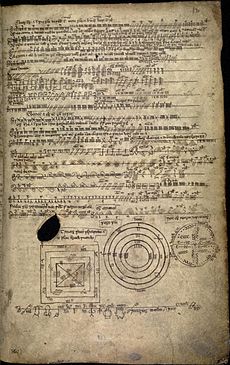 Ogham, Book of Ballymote
See also for Ogham, the poem St
Erkenwald by the Pearl Poet.
The letters of Ogham have the names of trees which I have placed
within this poem:
Prophecy
 he
sallows
basket,
he
sallows
basket,
the
fern-strewn manger,
of Miriam
and Mary,
splendid
with apples
foretell
of
fir, ash
and oak,
almond
and rowan,
hazel and
mistletoe,
holly and
ivy.
 shepherd boy from the Abruzzi
flauting in wintry
Roman streets
heralds today
in a grove of
twelve
Aaron and Christ

Eileen Mary Bolton,
Nativity, Welsh Shepherds
THE END
UMILTA
WEBSITE, JULIAN OF NORWICH, HER SHOWING OF LOVE
AND ITS CONTEXTS ©1997-2024 JULIA
BOLTON HOLLOWAY
|
| || JULIAN OF NORWICH
|| SHOWING
OF LOVE || HER TEXTS
|| HER SELF || ABOUT HER TEXTS || BEFORE JULIAN || HER CONTEMPORARIES || AFTER JULIAN || JULIAN IN OUR TIME || ST BIRGITTA OF SWEDEN
|| BIBLE AND WOMEN || EQUALLY IN GOD'S IMAGE || MIRROR OF SAINTS || BENEDICTINISM || THE CLOISTER || ITS SCRIPTORIUM || AMHERST MANUSCRIPT || PRAYER || CATALOGUE AND PORTFOLIO (HANDCRAFTS, BOOKS
) || BOOK REVIEWS || BIBLIOGRAPHY || JULIAN PORTAL

