JULIAN OF NORWICH, HER SHOWING OF LOVE
AND ITS CONTEXTS ©1997-2024 JULIA BOLTON HOLLOWAY || JULIAN OF NORWICH
|| SHOWING
OF LOVE || HER TEXTS ||
HER SELF || ABOUT
HER TEXTS || BEFORE JULIAN
|| HER CONTEMPORARIES || AFTER JULIAN || JULIAN IN OUR TIME || ST BIRGITTA OF SWEDEN
|| BIBLE AND WOMEN || EQUALLY IN GOD'S IMAGE || MIRROR OF SAINTS || BENEDICTINISM ||
THE CLOISTER || ITS SCRIPTORIUM || AMHERST MANUSCRIPT || PRAYER|| CATALOGUE AND PORTFOLIO (HANDCRAFTS, BOOKS
) || BOOK REVIEWS || BIBLIOGRAPHY || For download of published book, Mary's Dowry
MARY'S DOWRY, PART I
ENCLOSED CONTEMPLATION
 artin
Buber
(1878-1965), as a young man, assembled contemplative
writings into a most beautiful anthology he published in
1909 that he called Ekstatische
Konfessionem, Ecstatic Conversations.
Into it he poured the spirituality of Hassidic Jews, of
Sufi, of the Friends of God, of Julian of Norwich. For
in contemplation all religions become one, or, as Julian
says in her Middle English 'oned', rather than
'noughting', cancelling each other out, the stuff of
wars. Yet, as we study these contemplatives (not
choosing the word 'mystic', too aloof from us), we shall
find there is a division. The Torah and the Gospel are
rooted and grounded in earth and clay, in flesh and
blood reality, in the beginning the Word creating all,
then becoming flesh and blood, dwelling in our midst,
the Incarnation, theology being the love of God and
equally of our neighbour. Pseudo-Dionysius (Thomas
Aquinas cited him over a thousand times believing he was
the Dionysius the Areopagite of Acts), instead, was a
Neoplatonist Syrian, who spoke of the 'dark cloud of
unknowing' in which God is to be found, as if attaining
the Buddhist Nirvana, Pseudo-Dionysius even inventing
the word 'hierarchy'. We shall find the Cloud
Author, who translated and put Pseudo-Dionysius'
negative theology into practice in his contemplative
treatises, to be resisted by the likes of Julian of
Norwich and Margery Kempe. The struggle is between
elitist Plato and democratic Christ; between philosophy
and its gender apartheid on the one hand, the Gospel and
its inclusion of women on the other. That paradoxical
dialectic caused a springtime in the Christian theology
of prayer, a rich flowering and harvesting, down the
centuries.
artin
Buber
(1878-1965), as a young man, assembled contemplative
writings into a most beautiful anthology he published in
1909 that he called Ekstatische
Konfessionem, Ecstatic Conversations.
Into it he poured the spirituality of Hassidic Jews, of
Sufi, of the Friends of God, of Julian of Norwich. For
in contemplation all religions become one, or, as Julian
says in her Middle English 'oned', rather than
'noughting', cancelling each other out, the stuff of
wars. Yet, as we study these contemplatives (not
choosing the word 'mystic', too aloof from us), we shall
find there is a division. The Torah and the Gospel are
rooted and grounded in earth and clay, in flesh and
blood reality, in the beginning the Word creating all,
then becoming flesh and blood, dwelling in our midst,
the Incarnation, theology being the love of God and
equally of our neighbour. Pseudo-Dionysius (Thomas
Aquinas cited him over a thousand times believing he was
the Dionysius the Areopagite of Acts), instead, was a
Neoplatonist Syrian, who spoke of the 'dark cloud of
unknowing' in which God is to be found, as if attaining
the Buddhist Nirvana, Pseudo-Dionysius even inventing
the word 'hierarchy'. We shall find the Cloud
Author, who translated and put Pseudo-Dionysius'
negative theology into practice in his contemplative
treatises, to be resisted by the likes of Julian of
Norwich and Margery Kempe. The struggle is between
elitist Plato and democratic Christ; between philosophy
and its gender apartheid on the one hand, the Gospel and
its inclusion of women on the other. That paradoxical
dialectic caused a springtime in the Christian theology
of prayer, a rich flowering and harvesting, down the
centuries.
The
ecstatic
conversation amongst these contemplatives transcends
space and time and gender and order, in dialogue between
Augustinians, Benedictines, Brigittines, Carmelites,
Carthusians, Cistercians, Dominicans, Franciscans,
Hieronymites and lay people.The contemplative theology
they conveyed was not the trauma of 'shock and awe', the
sterile and paralysing apartheid of power, but instead
the serotonin-enhancing awareness of the humility of the
creature in the presence of the greatness, mercy and
love, the might, wisdom and love, of the Creator.
Amongst them illiterate women such as Umiltà of Faenza,
Angela of Foligno, Catherine of Siena, and Margery Kempe
could participate equally, dictating their theology to
nuns and priests become their disciples, St Catherine
even being proclaimed Doctor of the Church and then,
with St Birgitta, Patron of Europe. Judaism and the
Gospel celebrated littleness, the smallest Hebrew
letter, yod,
that beginning the names of God, Jesus and Jerusalem,
and meaning hand, another letter, kaph, meaning the
palm of the hand, while God is born ignominiously as a
baby in poverty in a stable in Bethlehem, dying on a
gallows cross as a common criminal. Not only does it
involve composing with words, but also their being
written into books, such books being inscribed first on
parchment, then on paper, first as manuscript, then in
print, and bound between covers. The Beguines and the
daughters of Nicholas Ferrar at Little Gidding will
support themselves by binding such books. It is a
tangible concrete linguistic theology where letters are
things and also numbers, God creating the world with the
Word, in number, weight and measure, 'Amen' being that
which is said, which therefore is. It is opposed, as
Augustine found, leading to his conversion, to Greek
Neoplatonism's abstractions and hierarchies.
We
shall find Aelred of Rievaulx, the Ancrene Wisse
Author, Richard Rolle, Walter Hilton and the Cloud of Unknowing
Author, writing to anchoresses, generally using
Pseudo-Dionysius, while the women to whom they write
have the example of Scholastica's 'holy disobedience' to
her twin brother Benedict, the resulting dialogue of
bass and treble voices permitting 'ecstatic
conversations'. One such 'ecstatic conversation' is that
between Saints
Augustine and Monica, another, between Richard Rolle
and Margaret Kirkby, another,
between Henry
Suso
and Elsbeth Stägel. In the
withdrawal from the world, the stripping away of
external things, in these holy conversations, God is
found - and shared. This 'cell of self knowledge and of
God' was medieval psychiatry, was the soul-healing,
rather than killing, was the Gospel, the 'Good News',
that gave happiness. In the Gospels, Jesus seeks times
of solitude and prayer, then returns to the world to
carry out healing. He himself prayed the Psalms and the
prophets, such as Isaiah. He taught the Lord's Prayer,
which so echoes the Virgin's Magnificat, again bass and
treble voices, of gender inclusion. When I was a novice
I was told that his 'greatest gifts, apart from himself,
are the Psalter and the Lord's Prayer'. Monasteries and
anchorholds, for men and for women, created structures
for that withdrawal for prayer, but with the
concommittant responsibility for the healing of the
souls, minds and bodies of all people of all walks of
life.
We
see, for instance, the illiterate lay woman, Margery
Kempe, having read to her contemplative materials
concerning Marie d'Oignies, Richard Rolle and Birgitta
of Sweden. When the printing press was introduced in
England, these contemplative texts were promptly readied
for wider publication, with that intent, particularly by
Brigittine Syon Abbey, but at the same time came the
Reformation, causing texts being readied for
type-setting to be blocked, as was the case with the
Westminster Manuscript of Julian's Showing of Love, or
even whole editions, every single volume, as was the
case with Elizabeth Barton's 'Grete Boke', and even
Elizabeth Barton OSB herself, destroyed, in her case by
hanging at Tyburn in 1534. Similarly, the Bishop of
Cambrai had destroyed all known copies of the Beguine
Marguerite Porete's Speculum
Simplicium Animarium, the Mirror of Simple Souls,
then she herself had been burnt at the Sorbonne in 1310.
These crucial texts were seen in England as a threat to
the State, allied with the Church, first as seeming to
be Lollard for permitting women a theological voice,
then as Catholic in opposition to the Church of England,
while in France, first Jean Gerson, Chancellor of the
University of Paris, opposed these texts, particularly
those by women, and then they were seen by the State and
Church as partaking of the 'Quietist' heresy, finally
the atheist French Revolution condemned nuns to the
guillotine, seizing their contemplative 'superstitious'
writings.
Our
first
writers followed in Christ's footsteps, both in books,
in the Gospel, and in reality, on pilgrimage,
re-imagining the events that had taken place at
Bethlehem and Jerusalem, the Nativity, the Crucifixion.
Later, cloistered women were discouraged from those
pilgrimages, only the lay Birgitta of Sweden and Margery
Kempe being able to do so, the others imaging them in
their cells. We shall find images of pilgrims in
Christina of Markyate, Walter Hilton and Augustine
Baker. The Pseudo-Dionysian disciples, among them
Meister Eckhart and the Cloud of Unknowing author, however,
discouraged the nuns' affective imaging of Holy Land
events. Convents would become, quite literally at the
French Revolution, prisons. Countering their negativity,
William Flete, Alfonso of Jaén, Adam Easton, a Norwich
Benedictine and the Cardinal who effected Birgitta's
canonization, and Augustine Baker praised women's
contemplative writings and laid down rules for their
acceptance as prophetic where their visions led to
charity, to the love of God and neighbour. These
'ecstatic conversations' on the part of hermits and
anchoresses led to great joy, even laughter, as we see
in Richard Rolle, John Whiterig, the Cloud of Unknowing
author and Julian of Norwich.
We
shall
first present the contemplatives who were read in
England and throughout Latin Christendom, the precursors
and models for our own, Augustine with Monica, Jerome
with Paula and Eustochium, Arsenius, Boethius,
Pseudo-Dionysius, Benedict, Scholastica and Gregory. We
shall also present the later influences upon the English
contemplatives of Continental Hildegard of Bingen
(influenced by Anglo-Saxon Lioba), Marguerite Porete,
Angela of Foligno, Mechtild of Hackeborn, the Friends of
God, Henry Suso and Jan van Ruusbroec, Birgitta of
Sweden and Catherine of Siena, from texts present in
English manuscripts. We lack Mechitild of Magdebourg's
entry into this tradition until Lucy Menzies' fine
translation of her.
In
the second part of this book, our truly English
contemplatives, Christina of Markyate, Richard Rolle,
John Whiterig, William Flete, the Cloud of
Unknowing Author, Walter Hilton, Julian of Norwich
and Margery Kempe, are presented, giving also their
textual transmission in manuscripts written out by
Brigittine and Benedictine nuns and recusants. Our
touchstone will be the Amherst manuscript in which a
Carmelite monk (perhaps Prior Richard Misyn), copies out
for Margaret Heslyngton and perhaps, earlier, for a
Carmelite anchoress, such as Dame Emma Stapleton,
daughter of the Sir Miles Stapleton who is the executor
of the Countess of Suffolk's Will leaving Julian of
Norwich a legacy, magnificent contemplative texts. It
contains writings by Richard Misyn, Richard Rolle,
Marguerite Porete, Julian of Norwich, Jan van Ruusbroec,
Henry Suso, Birgitta of Sweden, and, in another
manuscript by the same scribe, Mechtild of Hackeborn.
The
third
section discusses English nuns in exile at the
Reformation, among them first the Brigittines, then the
Benedictines, Dame Margaret Gascoigne, Dame Gertrude
More, Dame Catherine Gascoigne, Dame Barbara Constable,
Dame Bridget More, Dame Clementia Cary, Dame Agnes More,
as they carried out Father Augustine Baker's suggestions
for editing and publishing in manuscript and in print
the medieval contemplative texts, for treasuring these
as their own monastic dowry and for sharing it with the
English Mission.
We
present
these texts in their original languages in sequence
(like James Joyce's Birth of Mrs Purefoy's Baby in the
'Oxen of the Sun' chapter to Ulysses, where we are regaled with the
nine centuries of the English language, alongside the
nine months' gestation of her child) so that this guide
may be not only one to contemplation but also be a
linguistic study through time, as is Fernand Mossè's
most useful Handbook
of Middle English.
In
an epilogue we see this tradition alive today in the
writing about and editing of these texts by Evelyn
Underhill and Lucy Menzies, by Father Robert Llewellyn
and Revd John Clark, these both Anglican priests, in the
careful editorial publishing by Catholic James Hogg of
the University of Salzburg, and in the practice of
Julian and Ruusbroec's spirituality by Don Divo Barsotti
of Settignano, and other labourers in the vineyard.
Italian has the word 'intrecciato', meaning things being
linked and braided together, being Lucretius' and John
Livingston Lowes' 'hooked atoms'. We shall find this
here in this anthology, strands being 'Arsenius', or
'pilgrim' or 'treadling', the little white stone with
one's name, or the hazelnut in the palm of one's hand,
or the whole cosmos shrunk into one ray of light.
An
Anglican
nun,
I was staying at Kilcullen, County Kildare, in Ireland,
amongst Catholic nuns, one of whom explained to me that
England is 'Mary's Dowry'. I had come to work with
Sister Anna Maria Reynolds, C.P., the editor of the
extant manuscripts of Julian of Norwich. Together we
discussed the opening of the Westminster Cathedral
Manuscript of Julian, in which Mary's Advent
contemplation, 'O Sapientia', of her as-yet-unborn
Child, is mirrored in Julian's contemplation of Mary,
and which in turn is mirrored in ourselves reading
Julian and thus mirroring her in ourselves and through
her, the Virgin and Child. Three times in Luke Mary
treasures all these things in her heart. A Carthusian
monk enters his cell through an ante-room called the
'Ave Maria', because of the significance of Mary and
prayer.
This
e-book
thus presents an anthology of the contemplative
writings, those written out in England, and then in
exile from England, being treasured and copied out in
turn by generations, across space and time, becoming the
'English Mission' to win back Mary's lost Dowry. Its
Italian edition will be presented in parallel text, both
in English and in Italian.
Florence
Christmas
Day, 2007
I.
The Precursors
A.
Helena
and Constantine, Monica and Augustine, Jerome, Paula
and Eustochium, Arsenius, Boethius,
Dionysius
the Areopagite, Benedict, Scholastica and Gregory
Helena
(†327)
and Constantine (†337)
Table
of Contents
I.
THE
PRECURSORS
A.
Helena
and Constantine, Monica and Augustine, Jerome, Paula
and Eustochium, Arsenius, Boethius,
Dionysius the Areopagite, Benedict, Scholastica and
Gregory
B.
Lioba, Hildegard
of Bingen, Marguerite Porete, Angela of Foligno,
Mechtild of Hackeborn, Dante Alighieri, the
Friends of God, Henry
Suso, Jan van Ruusbroec, Birgitta of Sweden,
Catherine of Siena
II.
MEDIEVAL
IRISH AND
ENGLISH CONTEMPLATIVES
St
Patrick's
Lorica, 'The Cry of the Deer'
'The
Dream
of the Rood'
Christina
of
Markyate,
Richard
Rolle,
John Whiterig, William Flete,
Walter Hilton, the Cloud
of Unknowing Author, Julian of Norwich,
Margery Kempe
III.
THEIR
EXILED PRESERVERS
A. The Brigittines
Orcherd of Syon,
Mirroure of Oure Lady
B.
The Benedictines: Dames Margaret Gascoigne, Gertrude
More, Catherine Gascoigne, Barbara Constable,
Clementia Cary, Father Augustine Baker, Serenus
Cressy, OSB
Epilogue
I. THE PRECURSORS
A.
Helena and Constantine, Monica and Augustine, Jerome,
Paula and Eustochium, Arsenius, Boethius, Dionysius the Areopagite,
Benedict, Scholastica and Gregory
 et us begin with the Empress Helena,
mother of the Emperor Constantine. The official account of her
life speaks of her as an Eastern princess, but in Celtic
Britain the legends persist that she was a Christian British
slave. She became Constantius' concubine and, A.D. 274,
Constantine's mother. She was repudiated by the Emperor
Constantius in 292, next treated with honour by Constantine
when he was proclaimed Emperor, at York, in 302. Christianity
was adopted by the Empire in 312. It could well be that his
mother, like African Augustine's, had much to do with
Constantine's conversion to Christianity. Constantine would
establish the seat of Empire not in Rome but in Byzantium,
Constantinople, on the shores of the Black Sea. Orthodox art
before and after its iconoclastic phase, shows the Madonna and
Child dressed in imperial garb, in Roman togas. This
iconography doubly refers to Mary and Jesus, Helena and
Constantine, palimpsested the one on the other. Both times,
when iconoclasm is overturned, it is in turn carried out
similarly by Empresses, Irene in 787 and Theodora in 843, as
we witness in the British Museum's icon, the 1400 'The Triumph
of Orthodoxy', showing the Regent Empress Theodora with her
four-year-old son the Emperor Michael presiding at the
restoration of the use of icons.
et us begin with the Empress Helena,
mother of the Emperor Constantine. The official account of her
life speaks of her as an Eastern princess, but in Celtic
Britain the legends persist that she was a Christian British
slave. She became Constantius' concubine and, A.D. 274,
Constantine's mother. She was repudiated by the Emperor
Constantius in 292, next treated with honour by Constantine
when he was proclaimed Emperor, at York, in 302. Christianity
was adopted by the Empire in 312. It could well be that his
mother, like African Augustine's, had much to do with
Constantine's conversion to Christianity. Constantine would
establish the seat of Empire not in Rome but in Byzantium,
Constantinople, on the shores of the Black Sea. Orthodox art
before and after its iconoclastic phase, shows the Madonna and
Child dressed in imperial garb, in Roman togas. This
iconography doubly refers to Mary and Jesus, Helena and
Constantine, palimpsested the one on the other. Both times,
when iconoclasm is overturned, it is in turn carried out
similarly by Empresses, Irene in 787 and Theodora in 843, as
we witness in the British Museum's icon, the 1400 'The Triumph
of Orthodoxy', showing the Regent Empress Theodora with her
four-year-old son the Emperor Michael presiding at the
restoration of the use of icons.

Helena, now Empress, visited the Holy
Places, such as Bethlehem,
Jerusalem and Sinai, determined where their churches would be
built, and she and her son officially established for
Christendom the cult of the Cross. However it is likely that the
present Mount Sinai is not the true Sinai of Exodus but a
mountain Helena decreed by fiat as Mount Sinai and that
declaration is taken on faith by pilgrims to this day. Eusebius
of Caesaria (260-339), their contemporary, wrote the account of
Constantine and Helena's pilgrimages and building programmes in
the Holy Places. Eusebius emphasizes Constantine as undertaking
the excavations on Golgotha and building the Church of the Holy
Sepulchre in 335. Later legend will have this archeology and
architecture be Helena's. Eusebius affirms Helena's actions in
this area in connection with the Bethlehem cave and basilica and
with that on the Mount of Olives. He touchingly describes how
she wished, quoting Psalm 132.7, to 'worship at the place
whereon his feet have stood.' He also describes how
Greek
especially abundant were the gifts she bestowed on
the naked and unprotected poor. To some she gave money, to
others an ample supply of clothing: she liberated some from
imprisonment, or from the bitter servitude of the mines;
others she delivered from unjust oppression, and others,
again, she restored from exile.
While, however, her character derived luster from
such deeds as I have described, she was far from neglecting
personal piety toward God. She might be seen continually
frequenting his Church, while at the same time she adorned
the houses of prayer with splendid offerings, not
overlooking the churches of the smallest cities. In short,
this admirable woman was to be seen, in simple and modest
attire, mingling with the crowd of worshipers, and
testifying her devotion to God by a uniform course of pious
conduct.
Reading
between Eusebius' lines we see that Helena, who died at
eighty in 327, preceded, with her building programme at
Bethlehem and the Mount of Olives, those of Constantine in
Jerusalem; Eusebius noting that Constantine's programme
there is partly in memory of his mother. Thus Helena, as
Christian Empress, could give to later women and men in her
own third and fourth centuries and in others, a pattern
centered upon poverty and power, piety and pilgrimage. She
lived out those words read from Isaiah by Christ in the
synagogue at Nazareth.

Monica (†387) and Augustine (†430)
 ugustine, Aurelius
Augustinus, was born in Africa in A.D. 354 at a time when
the Roman Empire was crumbling. He grappled with the
conflicting beliefs of that uncertain era, coming to reject
Neoplatonism and Manicheanism for Christianity, being
converted in a garden outside Milan through reading Paul's
Epistle. And his mother's tears. He had been a Professor of
Rhetoric, of Literature, he now professed Christ, the Word.
Edith Stein has written a beautiful dialogue between Ambrose
and Augustine in her Three Dialogues. Augustine was baptised
by Ambrose in 387. Returning to Africa he became Bishop of
Hippo, dying as the Vandals were besieging his beloved
cathedral city. In his Confessions he writes his
spiritual biography, much as Julian does in her Showing
of Love. In it he
explains that sin is the tending to non-being, to diverging
from God's Creation. In its Book XI Augustine presents a
heady discourse upon Time and Eternity, based upon Ambrose's
evening hymn.
ugustine, Aurelius
Augustinus, was born in Africa in A.D. 354 at a time when
the Roman Empire was crumbling. He grappled with the
conflicting beliefs of that uncertain era, coming to reject
Neoplatonism and Manicheanism for Christianity, being
converted in a garden outside Milan through reading Paul's
Epistle. And his mother's tears. He had been a Professor of
Rhetoric, of Literature, he now professed Christ, the Word.
Edith Stein has written a beautiful dialogue between Ambrose
and Augustine in her Three Dialogues. Augustine was baptised
by Ambrose in 387. Returning to Africa he became Bishop of
Hippo, dying as the Vandals were besieging his beloved
cathedral city. In his Confessions he writes his
spiritual biography, much as Julian does in her Showing
of Love. In it he
explains that sin is the tending to non-being, to diverging
from God's Creation. In its Book XI Augustine presents a
heady discourse upon Time and Eternity, based upon Ambrose's
evening hymn.
Latin
Take the line 'Deus Creator omnium', which consists
of eight syllables . . [Augustine
sings the line.] What has become
of each syllable? Their sound is finished and has been wafted
away into the past. They no longer exist. . . . It is in my
own mind, then, that I measure time . . . . Suppose that I am
going to recite a psalm that I know. Before I begin, my
faculty of expectation is engaged by the whole of it. But once
I have begun, as much of the psalm as I have removed from the
province of expectation and relegated to the past now engages
my memory, and the scope of the action which I am performing
is divided between the two faculties of memory and expectation
. . . But my faculty of attention is present all the while,
and through it passes what was the future in the process of
becoming the past. [Then Augustine compares
that action to God.] If
there were a mind endowed with such great power of knowing and
foreknowing that all the past and all the future were known to
it as clearly as I know a familiar psalm, that mind would be
wonderful beyond belief. We should hold back from it in awe at
the thought that nothing in all the history of the past and
nothing in all the ages yet to come was hidden from it. It
would know all this as surely as, when I sing the psalm, I
know what I have already sung and what I have still to sing,
how far I am from the beginning and how far from the end. But
it is unthinkable that you, Creator of the universe, Creator
of souls and bodies, should know all the past and all the
future merely in this way. Your knowledge is far more
wonderful, far more mysterious than this.
Augustine
wrote those lines in his homeland, in Africa; but earlier in
Milan in Italy he had met Ambrose, then was converted and
baptised by him. He had next set forth to journey home with
his mother Monica but in Ostia the two of them had a vision
together, a vision beyond time and even music, that informs Confessions
XI. The two were discussing one night the Kingdom of Heaven.
Latin
My mother and I were alone, leaning from a window
which overlooked the garden in the courtyard of the house were
we were staying at Ostia. . . .Our conversation led us to the
conclusion that no bodily pleasure, however great it might be
and whatever earthly light might shed lustre upon it, was
worthy of comparison, or even of mention, beside the happiness
of the life of the saints. As the flame of love burned
stronger in us and raised us higher towards the eternal God,
our thoughts ranged over the whole compass of material things
in their various degrees, up to the heavens themselves, from
which the sun and the moon and the stars shine down upon the
earth. Higher still we climbed, thinking and speaking all the
while in wonder at all that you have made. At length we came
to our own souls and passed beyond them to that place of
everlasting plenty, where you feed Israel for ever with the
food of truth. There life is that Wisdom by which all these
things that we know are made, all things that ever have been
and all that are yet to be. But this Wisdom is not made: it is
as it has always been and as it will be for ever . . . And
when we spoke of the eternal Wisdom, longing for it and
straining for it with all the strength of our hearts, for one
fleeting instant we reached out and touched it. Then with a
sigh . . . we returned to the sound of our own speech, in
which each word has a beginning and an ending - far, far
different from your Word, our Lord, who abides in himself for
ever, yet never grows old and gives new life to all things.
And so our discussion went on. Suppose, we said,
that the tumult of man's flesh were to cease and all that
his thoughts can conceive, of earth, of water, and of air,
should no longer speak to him; suppose that the heavens and
even his own soul were silent, no longer thinking of itself
but passing beyond; suppose that his dreams and the visions
of his imagination spoke no more and that every tongue and
every sign and all that is transient grew silent - for all
these things have the same message to tell, if only we can
hear it, and their message is this: We did not make
ourselves, but he who abides for ever made us.
In that moment
they together touched and were touched by the eternal Wisdom.
Shortly thereafter Monica, saying she desired no longer to
live in this world, died. Julian, who herself echoed those
words, when she came to her Anchorhold, lived across the
street from an Augustinian Priory where this saint's works
were read and studied. She would have heard the Austin Friars'
chanting of Psalms and of Ambrose's 'Deus Creator Omnium'.
Jerome (†420), Paula (†404) and Eustochium (†419)
 or was
Helena the only European woman to visit the Holy Places in
Africa and Asia during this period and to write letters
describing her experiences. Let us also look at the Roman
matron and widow Paula and her virgin daughter Eustochium.
Paula and Eustochium wrote an important, joint, and most
joy-filled letter to their friend in Rome, Marcella,
published as Jerome's Epistola XLVI/46, in which they
described their pilgrimage in A.D. 385 to the Holy Places,
to Africa, to Israel, before settling down for the rest of
their lives with Jerome in Bethlehem, financially
supporting him and assisting his labours with translating
the Bible from Hebrew
and Greek into Latin, the Vulgate text to which Egeria did
not have access. We often see paintings of scarlet-clad
Cardinal Jerome in his study at his labours, but
his womenfolk are forgotten and omitted from those
canvesses, except in two, one now in the National Gallery
in London, but which was at San Girolamo in Fiesole, which
shows the widowed Paula, at her side her most beautiful
virgin daughter, Eustochium, and another by Francisco
Zurburan and Workshop now in the National Gallery in
Washington,
and originally painted for the Hieronymite Order founded
by Alfonso of Jaén's brother, and to which belonged the
famous Sor Juana de la Cruz in Mexico City.
or was
Helena the only European woman to visit the Holy Places in
Africa and Asia during this period and to write letters
describing her experiences. Let us also look at the Roman
matron and widow Paula and her virgin daughter Eustochium.
Paula and Eustochium wrote an important, joint, and most
joy-filled letter to their friend in Rome, Marcella,
published as Jerome's Epistola XLVI/46, in which they
described their pilgrimage in A.D. 385 to the Holy Places,
to Africa, to Israel, before settling down for the rest of
their lives with Jerome in Bethlehem, financially
supporting him and assisting his labours with translating
the Bible from Hebrew
and Greek into Latin, the Vulgate text to which Egeria did
not have access. We often see paintings of scarlet-clad
Cardinal Jerome in his study at his labours, but
his womenfolk are forgotten and omitted from those
canvesses, except in two, one now in the National Gallery
in London, but which was at San Girolamo in Fiesole, which
shows the widowed Paula, at her side her most beautiful
virgin daughter, Eustochium, and another by Francisco
Zurburan and Workshop now in the National Gallery in
Washington,
and originally painted for the Hieronymite Order founded
by Alfonso of Jaén's brother, and to which belonged the
famous Sor Juana de la Cruz in Mexico City.
Paula movingly contrasts the wealth of Rome
and the poverty of Bethlehem:
Latin
Where are spacious porticoes? Where are gilded
ceilings? Where are houses decorated by the sufferings and
labours of condemned wretches? Where are halls built by the
wealth of private men on the scale of palaces, that the vile
carcase of man may move among more costly surroundings, and
view his own roof rather than the heavens, as if anything
could be more beauteous than creation? . . . . In the village
of Christ . . . all is rusticity, and except for psalms,
silence. Whithersoever you turn yourself, the ploughman,
holding the plough handle, sings Alleluia; the perspiring reaper diverts himself with psalms,
and the vine-dresser sings some of the ballads of this
country, these are the love-songs, as they are commonly
called; these are whistled by the shepherds, and are the
implements of the husbandman. Indeed, we do not think of what
we are doing or how we look, but see only that for which we
are longing.
Paula has
written a Christian Georgics, a Christian pastoral, though as
if through the eyes of Karl Marx, Simone Weil, and Frantz
Fanon. These insights into the injustices of privileged wealth
bridge time; one can find them in the Prophets and the
Gospels, in Horace and Juvenal, in Wyclif and More; but they
are especially likely to be perceived by women who stand
outside the structures of power, such as Simone Weil, Hannah
Arendt, and Nadine Gordimer. Her style is shaped by Cicero and
Virgil, Horace and Juvenal; while her social thought is shaped
by the Prophets, the Gospels and by Josephus. But in it she
has also presented a discussion of the places she and her
daughter physically visited in Jerusalem, Bethany, Bethlehem,
Nazareth, Galilee, Cana, Tabgha, Capharnaum, Egypt and
elsewhere, noting often the meanings of the Hebrew names of
places and blending that philological knowledge with theology.
Hebrew is a language centered upon the word, even the word for
English's 'thing' being what is a spoken word, dabar,
with the implication that all creation is God's Word and
Adam's naming. Paula and Egeria grasp at that concept and for
these women the names of places deeply involve the meaning of
those names with the place.(24)
Paula's pilgrimage, like Egeria's, is a
mapping out in time and space, using the Bible to understand the
lands of the Bible. But Paula adds to Egeria's knowledge of the
Bible in its Old Latin translation and her curiosity about Greek
and comparative liturgy, her own knowledge not only of classical
Latin but also of Greek and the Hebrew she is avidly studying.
Helena, Egeria and Paula all use time and space, the book of the
Bible and geography of the Holy Land as their Internet upon
which to weave a web of links to sanctity, retrieving what is
hallowed and hallowing.
Twenty years later, Jerome was to write
another letter, his Epistola CVIII/108, praising Paula, and in
it recapitulating the description of the pilgrimage that she had
made. We learn much about Paula in Jerome's voluminous writings.
He tells of her luxurious Roman life, her wealth, and her very
great status. She, who had once always dressed in silks, and who
had been used to being carried about Rome by her eunuch slaves
so that her feet might never touch the ground, who was descended
from Agamemnon, and whose husband was descended from Aeneas, had
joined Marcella's group of high-born, wealthy Roman ladies, who
together attempted to follow a life of monastic severity. Jerome
became their teacher, expounding the Scriptures to them. But he
quarrelled with Church officials in Rome most bitterly and found
it expedient to return to Bethlehem. Paula and her daughter,
Eustochium, joined him there, Paula leaving behind the rest of
her children weeping on the quay. In the Holy Land Paula studied
Hebrew so that she might sing the psalms, the chief early
Christian devotional practice, in their original language and
assist him in his translation work. She lived for twenty years
in Bethlehem, dying there in A.D. 404. Paula and Eustochium's
letter to Marcella pleads with their old friend that she leave
Rome, called in the letter a 'Babylon,' and come to Jerusalem
and its Holy Places. A noted Jerome scholar remarks that this
letter is 'written in the name of Paula and her daughter but
manifestly by Jerome himself, to Marcella,' then goes on to say,
'It is an idyllic piece, relating spiritual serenity and
contentment . . . and stands in striking contrast to the
querulous, vituperative note' of Jerome's typical writings. We
find other male scholars making the same statements of Heloise's
letters, that they are Abelard's, yet that they are in a totally
different style than his.
The letter in question is Epistola XLVI. It
describes Paula's pilgrimages to all these Holy Places in such a
way as to have Marcella participate in their sacred journeying,
mentally, and vicariously, in her imagination. Paula and
Eustochium begin their letter by stating that, although the
Crucifixion may have made Jerusalem an accursed place, there is
ample scriptural justification for Christians to return to that
holy city. Paula relies not only on the Scriptures and upon her
growing knowledge of Hebrew but also upon Cicero for her
arguments, describing both St. Paul speaking of his need to
return to Jerusalem and Cicero speaking of his need to learn
one's Greek not only in Sicily but in Athens, one's Latin not in
Lilybaeum but in Rome. She adds, in a capstone to her argument,
that Jerusalem is 'our Athens.' She then quotes Virgil's First
Eclogue on the great distance of the British Isles from Rome in
noting that Christian Gauls and Britons all make haste to come,
not to Rome, but to far Jerusalem. Jerome is also fond of this
phrase, but states it the opposite way: ' Et de Hierosolymis
et de Britannia aequaliter patet aula coelestis: regnum enim
dei intra nos est,' Epistola LVIII. Chaucer may have had
it in mind with his Wife of Bath, who so often speaks of Jerome.
Jerome writes the letter in 404 after Paula's death, giving
Paula's vita to her virgin daughter, Eustochium. In contrast to
Paula's letter to Marcella, Jerome's account of the pilgrimage
Paula made is almost barren of references to classical authors.
He does, however, mention the ' fables of the poets', de
fabulis Poetarum , in giving the tale of Andromeda chained
to a rock, as happening at Joppa, which he notes was also the
harbor of the fugitive Jonah. He had earlier cited some lines of
the Aeneid concerning the Greek Isles. But, unlike Paula, he
does not show off his classical learning. He is here being more
Christian than Ciceronian. (We recall his dream in which he is
chided, or chides himself, by being told, 'Thou art not a
Christian. Thou art a Ciceronian.' But it is full of
descriptions of her great piety and of her deep emotional
participation in the past drama of the present places which she
visits. He feminizes her. He is writing in her praise as had
Valerius in that of Egeria. The letter waxes most sentimental
about her parting from her family members, describing her as
torn between the love of her children and her love for God.
Jerome in
Epistola CVIII/108 notes Paula's deep, affective piety at
the Cross and the Sepulchre in Jerusalem, and at the cave
and church in Bethlehem, which she had not particularly
stressed herself. He amplifies her previous words to
Marcella and speaks of her as prostrating herself before the
Cross, almost seeing upon it the hanging body of the Lord,
as she prays, and as kissing the stones, the one which the
angel had rolled away and the one in the Holy Sepulchre on
which the Lord had lain. Then he describes her entering into
the cave of the Nativity,
weeping and as if seeing the Virgin wrapping the Child in
swaddling clothes and placing him in the manger between the
ox and the ass written of in the Prophets, the Magi adoring
him, the star shining above, the Mother nursing the Child,
the shepherds coming by night and seeing the Word which was
made flesh as John wrote in the beginning of his Gospel:
 n principio erat verbum et
verbum caro factum est.'
n principio erat verbum et
verbum caro factum est.'
One should note that Jerome, Paula and
Eustochium lived in the adjacent cave, which one can still see
today, reached by a passage from that of the Nativity, beneath
the sanctuary in the Empress Helena's Bethlehem basilica.
Jerome's account in Epistola CVIII/108 ends
by saying, and unconsciously echoing Valerius concerning Egeria:
Latin
Her zeal was wonderful - her courage scarcely
credible for a woman. Forgetful of her sex and the weakness of
her frame, she desired to dwell with her maidens among so many
thousands of monks' in the Egyptian Thebaid, but returned to
Jerusalem.
It is an
interesting relationship, that between Paula and Jerome. We
should not forget that Chaucer will play upon it when he
writes the Wife of Bath's Prologue, in which he has the Wife,
in her scarlet garb, visit the same Holy Places as did St.
Paula, and has her constantly cite, not classical authors, but
St. Jerome, especially his treatise, Adversus Jovinianum,
his diatribe against marriage and widowhood, in which he
advocates, as he also did in a letter to Paula's daughter
Eustochium, perpetual virginity.
Arsenius (†450)
 rsenius, born in 354 into Roman Senatorial rank,
was selected as imperial tutor to Theodosius' sons, Arcadius and
Honorius, arriving in Constantinople in 383, teaching there for
eleven years. Agonizing amidst the splendour of the court one
day he heard a voice saying, 'Arsenius, flee the company of men, and thou shalt live'.
So he left, going to Alexandria and into the desert of
Nitria.There he counselled the staying in one's cell for prayer,
work and sustenance. It is said of him that at sunset on the
Sabbath he would raise his hands in prayer, until the dawn light
of Sunday shone upon his face. One brother looked through the
window to see Arsenius standing in his cell in prayer, his whole
body afire. It is said that because at court he had worn the
finest, softest clothes, as a hermit he wore the meanest garb,
and that he hid behind a pillar in church so that his white hair
and beard not be seen. Similarly he let the water in which he
soaked the rushes for basket become rank to compensate for the
perfumes to which he had been accustomed. Arsenius would say, 'The monk is a stranger in a
foreign land: let him not occupy himself with anything there
and he will find rest'. He also said, 'If we seek God
he will be revealed to us; if we laid hold on him he will remain
with us'. On an occasion a brother said to Abba Arsenius, 'How is it that you who have
much learning, both Greek and Latin, ask questions about the
thoughts of humble Egyptian villagers'. Arsenius
replied, 'With Greek and
Latin learning I am acquainted, but I have not yet learned the
alphabet of these villagers'. The Sayings of the Holy Fathers
gives, 'It is right for a monk to live even as Abba Arsenius
lived. Take care each day to stand before God without sin, and
draw nigh unto him with tears as did the sinful woman, and pray
to God as if he were before you, for he is near and looks
carefully upon you'. Once a lawyer came to tell Arsenius he had
been left a large sum of money in a will. Arsenius replied, 'I died before he did'.
Abba Anthony told his disciples of Abba Arsenius and Abba Moses,
that when a monk went to Abba Arsenius concerning the silent
life of contemplation, he neither set a table for him nor gave
him refreshment. Then he went to the blessed Abba Moses and he
both welcomed him and gave him refreshment. Next in a vision he
saw Abba Arsenius in a ship with the Spirit of God who was
travelling with him. He also saw Abba Moses in a ship filled
with angels. Thus it was understood that the life of silent
contemplation was exalted above alms and ministrations as was
the conduct of Matthew the Evangelist above that of Zacchaus the
tax-gatherer. Often cited by our writers in this volume, in the
Amherst manuscript, and in the writings of Dame Gertrude More,
is his saying, 'That I
have spoken I have many times repented, that I held my peace,
I have never repented'.
rsenius, born in 354 into Roman Senatorial rank,
was selected as imperial tutor to Theodosius' sons, Arcadius and
Honorius, arriving in Constantinople in 383, teaching there for
eleven years. Agonizing amidst the splendour of the court one
day he heard a voice saying, 'Arsenius, flee the company of men, and thou shalt live'.
So he left, going to Alexandria and into the desert of
Nitria.There he counselled the staying in one's cell for prayer,
work and sustenance. It is said of him that at sunset on the
Sabbath he would raise his hands in prayer, until the dawn light
of Sunday shone upon his face. One brother looked through the
window to see Arsenius standing in his cell in prayer, his whole
body afire. It is said that because at court he had worn the
finest, softest clothes, as a hermit he wore the meanest garb,
and that he hid behind a pillar in church so that his white hair
and beard not be seen. Similarly he let the water in which he
soaked the rushes for basket become rank to compensate for the
perfumes to which he had been accustomed. Arsenius would say, 'The monk is a stranger in a
foreign land: let him not occupy himself with anything there
and he will find rest'. He also said, 'If we seek God
he will be revealed to us; if we laid hold on him he will remain
with us'. On an occasion a brother said to Abba Arsenius, 'How is it that you who have
much learning, both Greek and Latin, ask questions about the
thoughts of humble Egyptian villagers'. Arsenius
replied, 'With Greek and
Latin learning I am acquainted, but I have not yet learned the
alphabet of these villagers'. The Sayings of the Holy Fathers
gives, 'It is right for a monk to live even as Abba Arsenius
lived. Take care each day to stand before God without sin, and
draw nigh unto him with tears as did the sinful woman, and pray
to God as if he were before you, for he is near and looks
carefully upon you'. Once a lawyer came to tell Arsenius he had
been left a large sum of money in a will. Arsenius replied, 'I died before he did'.
Abba Anthony told his disciples of Abba Arsenius and Abba Moses,
that when a monk went to Abba Arsenius concerning the silent
life of contemplation, he neither set a table for him nor gave
him refreshment. Then he went to the blessed Abba Moses and he
both welcomed him and gave him refreshment. Next in a vision he
saw Abba Arsenius in a ship with the Spirit of God who was
travelling with him. He also saw Abba Moses in a ship filled
with angels. Thus it was understood that the life of silent
contemplation was exalted above alms and ministrations as was
the conduct of Matthew the Evangelist above that of Zacchaus the
tax-gatherer. Often cited by our writers in this volume, in the
Amherst manuscript, and in the writings of Dame Gertrude More,
is his saying, 'That I
have spoken I have many times repented, that I held my peace,
I have never repented'.
Boethius (†524)
 oethius,
Anicius
Manlius
Severinus
Boethius,
was born about A.D. 480. A Christian, he also knew all the
classical and pagan works of philosophy written by Plato and
Aristotle, Parmenides and Pythagoras, Cicero and Seneca, and
he reconciled these to Christian theology in his own writings.
He was a Roman Senator, defending the ancient principles of
their Republic, but was thrown into prison by the barbarian
Emperor Theodoric where he awaited a most brutal form of
execution, ropes to be bound around his head till his eyes
burst out and then to be finished off by the bludgeon and the
axe, A.D. 524. During that time he wrote The Consolation
of Philosophy, which is modeled upon the biblical books
of Job and Wisdom and upon the Platonic dialogues about
Socrates while he was awaiting execution in Athens. Boethius
in this work presents Philosophia as a beautiful woman who
consoles Boethius (she is really his wiser self) for his
foolish and mawkish self-pitying. She gets him to recover from
his depression by telling him of Time and Eternity, Creation
and Creator, Man and God, the Circle and the Centre. She is
his and our psychiatrist.
oethius,
Anicius
Manlius
Severinus
Boethius,
was born about A.D. 480. A Christian, he also knew all the
classical and pagan works of philosophy written by Plato and
Aristotle, Parmenides and Pythagoras, Cicero and Seneca, and
he reconciled these to Christian theology in his own writings.
He was a Roman Senator, defending the ancient principles of
their Republic, but was thrown into prison by the barbarian
Emperor Theodoric where he awaited a most brutal form of
execution, ropes to be bound around his head till his eyes
burst out and then to be finished off by the bludgeon and the
axe, A.D. 524. During that time he wrote The Consolation
of Philosophy, which is modeled upon the biblical books
of Job and Wisdom and upon the Platonic dialogues about
Socrates while he was awaiting execution in Athens. Boethius
in this work presents Philosophia as a beautiful woman who
consoles Boethius (she is really his wiser self) for his
foolish and mawkish self-pitying. She gets him to recover from
his depression by telling him of Time and Eternity, Creation
and Creator, Man and God, the Circle and the Centre. She is
his and our psychiatrist.
His book was treasured up for centuries,
only falling out of favour at the Age of Reason. King Alfred
translated it into Old English, Jean de Meun translated it into
French, Chaucer translated it into Middle English. Queen
Elizabeth I translated it into Elizabethan English. Dante,
Chaucer and Julian of Norwich all used its concepts and were all
deeply influenced by it. Boethius' Consolation is a key
to understanding medieval poetry and Christian theology. It is
also a 'golden book' as Edward Gibbon called it, that can be of
use to disordered souls in our own moment in time.
The work is
written in sections, divided between Prose and Poetry.
Medieval manuscripts of the text are richly illuminated,
presenting Boethius in prison, mourning on his bed, and
visited by the Lady Philosophia, and from her Dante derived
his consoling figure of Beatrice.
Latin
Book II, Prose 7 Boethius: You know that ambition for material things
has not mastered me; but I have desired the opportunity for
public service so that my virtue should not grow old and
weak through lack of use. Philosophia: But think
how trivial and empty such glory is. You know from
astrological computation that the whole circumference of the
earth is no more than a pinpoint when contrasted to the
space of the heavens; in fact, if the two are compared, the
earth may be considered to have no size at all. . . But, if
the soul, in full awareness of its virtue, is freed from
this earthly prison and goes to heaven, does it not
disregard all earthly concerns and, in the enjoyment of
heaven, find its satisfaction in being separated from
earthly things?
Book II, Poem 8 Philosophia:
Love rules the earth and the seas, and commands the heavens.
Book III, Prose 1 Philosophia:
I am about to lead you to true happiness, to the goal your
mind has dreamed of. But your vision has been so clouded
by false images you have not been able to reach it.
Poem 1 Philosophia: Just so, by first recognizing false goods,
you begin to escape the burden of their influence; then
afterwards true goods may gain possession of your spirit.
Poem 3 Philosophia:
The only stable order in things is that which connects the
beginning to the end and keeps itself on a steady course.
Poem 9 Philosophia:
You [God] who are most beautiful produce the beautiful world
from your divine mind and, forming it in your image, You
order the perfect parts into a perfect whole.
Prose 12 Philosophia: Then it is the supreme good which rules
all things firmly and disposes all sweetly (Wisdom
8.1). Boethius: I am delighted not
only by your powerful argument and its conclusion, but
even more by the words you have used. And I am at last
ashamed of the folly that so profoundly depressed me. Philosophia:
Then can God do evil? Boethius: No, of course not. Philosophia:
Then evil is nothing, since God, who can do all things,
cannot do evil. Boethius: You are playing with me by weaving a
labyrinthine argument from which I cannot escape. You seem
to begin where you ended and to end where you began. Are
you perhaps making a marvelous circle of the divine
simplicity? Philosophia: As Parmenides puts it, the divine
essence, is 'in body like a sphere, perfectly rounded on
all sides'.
Book IV,
Prose 6 Philosophia: Consider the example of a number of
spheres in orbit around the same central point: the
innermost moves toward the simplicity of the center and
becomes a kind of hinge about which the outer spheres
circle; whereas the outermost, whirling in a wider orbit,
tends to increase its orbit in space the farther it moves
from the indivisible midpoint of the center. If, however
it is connected to the center, it is confined by the
simplicity of the center and no longer tends to stray into
space. In like manner whatever strays farthest from the
divine mind is most entangled in the nets of Fate;
conversely, the freer a thing is from Fate, the nearer it
approaches the center of all things. Therefore, the
changing course of Fate is to the simple stability of
Providence as time is to eternity, as a circle to its
center.
Book V, Prose 6 Philosophia:
Eternity is the whole, perfect, and simultaneous possession
of endless life. The meaning of this can be made clearer by
comparison with temporal things, For whatever lives in time
lives in the present, proceeding from past to future, and
nothing is so constituted in time that it can embrace the
whole span of its life at once. It has not arrived at
tomorrow, and it has already lost yesterday; even the life
of this day is lived only in each moving, passing moment.
But God sees as present those future things which result
from free will. If you will face it, the necessity of
virtuous action imposed upon you is very great, since all
your actions are done in the sight of a Judge who sees all
things.
Pseudo-Dionysius
(†VI century)
 hristianity, for
centuries, believed that a late fifth-century, early
sixth-century theologian was, as he pretended to be, that
Dionysius the Areopagite whom Paul converted, along with the
woman Damaris, at Athens (Acts 17.22-34). The Neoplatonist
Pseudo-Dionysius wrote magnificent treatises, Julian of
Norwich quoting from him three times in her Showing of Love. His manuscripts had been
given by the Emperor Michael the Stammerer in A.D. 827 to
King Louis the Pious. John Scotus translated them in 862,
Anastasius, the papal librarian, commenting on the text in
875. Abbot Suger of St Denis (Saint Dionysius) commenced
Gothic architecture through using Dionysius' theology in
stone, lead and glass.
hristianity, for
centuries, believed that a late fifth-century, early
sixth-century theologian was, as he pretended to be, that
Dionysius the Areopagite whom Paul converted, along with the
woman Damaris, at Athens (Acts 17.22-34). The Neoplatonist
Pseudo-Dionysius wrote magnificent treatises, Julian of
Norwich quoting from him three times in her Showing of Love. His manuscripts had been
given by the Emperor Michael the Stammerer in A.D. 827 to
King Louis the Pious. John Scotus translated them in 862,
Anastasius, the papal librarian, commenting on the text in
875. Abbot Suger of St Denis (Saint Dionysius) commenced
Gothic architecture through using Dionysius' theology in
stone, lead and glass.
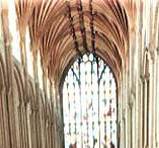
Gothic Architecture, Norwich Cathedral
But Abelard, while a monk at St Denis,
denounced Dionysius's identity as fraudulent. Meanwhile, the
Victorines also discovered and used the Dionysian corpus of
writings. Cardinal Adam Easton, the brilliant Benedictine of
Julian's Norwich, owned the complete works of Pseudo-Dionysius,
in a fine thirteenth-century manuscript giving some of the Greek
text as well as all the Latin translation, the invocation to the
Trinity being most beautifully illuminated with a gold-leafed,
intertwined 'T' at folio 108v. That manuscript is today,
Cambridge Ii.III.32. Meanwhile, the Cloud of Unknowing
Author (but whom I suspect to have been Adam Easton writing to
Julian), translated the Mystic Theology into Middle
English as Deonise Hid Diuinite for a woman
contemplative. To do so he converted the Trinity into an
invocation to divine and feminine Wisdom.

Thou vnbigonne & euerlastyng Wysdome, the whiche
in thiself arte the souereyn-substancyal Firstheed, the
souereyn Goddesse, & the souereyn Good, the inliche
beholder of the godliche maad wisdome of Cristen men: I
beseche the for to drawe us up in an acordyng abilnes to the
souereyn-vnknowen and the souereyn-schinyng height of the
derke inspirid spekynges, where alle the pryue thinges of
deuinytee ben kouerid and hid vnder the souereyn-schinyng
derknes of wisest silence, makyng the souereyn-clerest
souereynly for to schine priuely in the derkyst; and the
whiche is in a maner that is alweys inuisible & vngropable
souereynli fulfillyng with ful fayre cleertees alle thoo
soules that ben not hauyng eyghen of mynde.
Dionysius
also, similarly as had Boethius, spoke of God at the centre, 'All the radii of a circle are brought together
in the unity of the centre', Adam Easton annotating those
lines in his manuscript now at Cambridge.
Benedict (†547), Scholastica (†before 547) and Gregory (†604)
 regory the
Great (c. 540-604) wrote an account of the Life and Miracles
of St Benedict (c.480-547), casting these in the form of
Dialogues between himself and Peter, a fellow monk. In these
Dialogues there is a most moving account of Benedict
and of his twin sister Scholastica and how she is able to
force her brother to break his Rule and stay over night at
her convent at Subiaco so that they may converse all night
upon God. She prays to God for a storm which he grants.
Three days later she dies.
regory the
Great (c. 540-604) wrote an account of the Life and Miracles
of St Benedict (c.480-547), casting these in the form of
Dialogues between himself and Peter, a fellow monk. In these
Dialogues there is a most moving account of Benedict
and of his twin sister Scholastica and how she is able to
force her brother to break his Rule and stay over night at
her convent at Subiaco so that they may converse all night
upon God. She prays to God for a storm which he grants.
Three days later she dies.
That account is followed by one of
Benedict's vision of God as greater than all his Creation. He is
standing in prayer at a window of a great tower, apart from his
sleeping disciples, when suddenly there is a great light,
greater than that of the sun. As he marvels he suddenly sees as
it were the whole world collected into one ray of light before
his eyes.
Gregory and
Peter discuss that vision, Gregory explaining that to the soul
who sees the Creator all Creation becomes small, 'animae
uidenti creatorem angusta est omnis creatorem'. He goes on
to explain that it is not that the world contracts, but that
the soul, seeing God, expands above the world, becoming
greater than itself. 'Quod autem
collectus mundus ante eius oculos dicitur, non caelum et terra
contracta est, sed uidentis animus dilatatus, qui, in deo
raptus, uidere sine difficultate potuit omne quod infra deum
est'. And he further discourses upon the interior
light and that of the eyes in this vision. The male abbot has
experienced Mary's Magnificat in his prayers. 'My soul doth
magnify the Lord'. Smallness become largeness; darkness,
light; humility, power.
Gregory's Dialogues was, of course,
a staple in Benedictine circles. The lovely dialogue, within the
Dialogues, following upon this one of Benedict's vision of God,
was of the twin brother and sister, and which is sung
antiphonally on the feast day of Benedict and Scholastica by
Benedictines, celebrating the breaking of their sacred Rule. And
that served to make Benedict's following vision concerning
prayer the more memorable.
Christina of Markyate refers to Benedict's
vision, where she sees in a flash of light the whole world.
And Julian of Norwich refers to it - and
especially in connection with the Virgin at the Annunciation and
Nativity,

and with the hazelnut passage,

and then again and again fugally throughout
her text.
For Julian,
whose anchorhold at St Julian's Church is under the
Benedictines of Carrow Priory, who are in turn under the
Benedictines of Norwich Cathedral Priory, is seeped in
Benedictinism. It is possible that her Benedictinism is taught
her by the brilliant Norwich Benedictine Adam Easton. It is
even possible that Adam Easton might be her brother, might
even be her twin.
B.
St
Lioba, Hildegard of Bingen, Marguerite Porete, Angela of
Foligno, Mechtild of Hackeborn, Dante Alighieri, the
Friends of God, Henry Suso, Jan van Ruusbroec, Birgitta
of Sweden, Catherine of Siena
n Early Christianity, in Ireland
and England, hermits, contemplatives, paralleling those of the
Egyptian and Syrian deserts, were known as the Celi Dei
, the Friends of God. This name is also frequent in later
contemplative movements and writings. At the same time that
Julian of Norwich, Walter Hilton and the author of the Cloud
of Unknowing were formulating their contemplative texts
in England, other mystics were writing on the Continent. As in
England, women were present alongside men in this project,
this textual community stretching over most of Europe. Meister
Eckhart had available to him the writings of Hildegard von
Bingen, as had also John Tauler those of Mechtild von
Magdebourg, and those of Marguerite Porete. Associated with
Meister Eckhart was Agnes of Hungary, with Henry Suso, Elsbeth
Stägel, while John Tauler likewise preached to Dominican nuns
and Jan van Ruusbroec wrote spiritual treatises to them. That
sense of women belonging to the 'Friends of God' (Wisdom 7.27,
James 2.23) as well as men may have had its origins in the
Christianizing of Germany from England by Anglo-Saxon monks
and nuns, influenced by the Celi
Dei, and who established double monasteries, St
Hilda's Whitby, St Lioba's Bischopsheim and countless others.
At first the mysticism, or contemplation, is Benedictine. Then
it becomes strongly Dominican. Associated with it are also the
women Beguines, such as Margaret Porete and Mechtild of
Magdebourg. This booklet traces the lives and works of the God
Friends, recognising that three of their texts, Marguerite
Porete's Mirror of Simple Souls, Jan van Ruusbroec's Sparkling
Stone and an extract of Henry Suso's Horologium
Sapientiae, are found together with Julian's Showing
of Love in the Amherst Manuscript in the British Library
and that these other works may well have been translated for
her and thus constituted her Library of Mystics from which she
partly drew her inspiration.
Lioba (†781)
 t Boniface travelled from England to Germany
proselytizing amongst the pagan tribes there and establishing
monasteries for both men and women. St Lioba, St Boniface's kinswoman,
was a nun in Wessex who had studied under Mother Tetta (in
secular life, Cuthberga, sister of the King of Wessex, wife of
the King of Northumbria). Boniface sent for Lioba to come to
Germany, because she was a skilled Classicist, learned in the
Scriptures, the Church Fathers, canon law and the decrees of all
the councils. In fact, she was never without a book in her hand,
reading at every possible opportunity and she never forgot what
she read. Her name 'Lioba' means 'Beloved'. Boniface asked that
her bones be laid by his at her death. Charlemagne's wife adored
her but Lioba hated the life of court like poison.
t Boniface travelled from England to Germany
proselytizing amongst the pagan tribes there and establishing
monasteries for both men and women. St Lioba, St Boniface's kinswoman,
was a nun in Wessex who had studied under Mother Tetta (in
secular life, Cuthberga, sister of the King of Wessex, wife of
the King of Northumbria). Boniface sent for Lioba to come to
Germany, because she was a skilled Classicist, learned in the
Scriptures, the Church Fathers, canon law and the decrees of all
the councils. In fact, she was never without a book in her hand,
reading at every possible opportunity and she never forgot what
she read. Her name 'Lioba' means 'Beloved'. Boniface asked that
her bones be laid by his at her death. Charlemagne's wife adored
her but Lioba hated the life of court like poison.
Latin
Her life
tells, among others, this story: 'She had a dream in which one night she saw a
purple thread issuing from her mouth. It seemed to her that
when she took hold of it with her hand and tried to draw it
out there was no end to it. . . When her hand was full of
thread and it still issued from her mouth she rolled it round
and round and made a ball of it .' An old and prophetic nun
was asked about the meaning of the dream and explained that it
referred to Lioba's wise counsels spoken from her heart. 'Furthermore, the ball which she made by
rolling it round and round signifies the mystery of the divine
teaching, which is set in motion by the words and deeds of
those who give instruction and which turns earthwards through
active works and heavenwards through contemplation, at one
time swinging downwards through compassion for one's
neighbour, again swinging upwards through the love of God.'
The image of the
ball of purple thread in Lioba's hand is similar to Julian's
hazel nut in the palm of her hand.
Hildegard
of Bingen (†1179)

From the Lucca Manuscript
Deus creavit mundum
non facio illi iniuriam,
sed volo uti illo.
Hildegard,
Ordo Virtutum
 ildegard
of Bingen, and other women like her, such as Hrotswitha
of Gandesheim (A.D. 932-1000) and Herrad of Landesburg, followed
in the learned Benedictine tradition established in
German-speaking countries from England, such as with St Leoba,
which gave women the status of Christian equality with men.
Hildegard composed music and wrote treatises on medicine, on
Benedict's Rule, a play, many letters, and visionary mystical
works which she also illuminated in a manner that is deeply
compelling. But, unlike Lioba, she was not a pleasing person.
Until the age of forty she kept to her bed. Richardis, her
friend and fellow nun, then persuaded her to embark on her
career as writer of letters to the leaders of Church and State
in her day and to compose her mystical treatises. When Richardis
left her to become an abbess at another monastery Hildegard was
furious, demanding her return. Richardis, obediently, died.
Hildegard ruled her monastery by means of tyrannising over her
nuns with her migraines - about which she writes in her medical
works and whose effect she illuminates in her mystical
treatises. She is an example of a genius who is less than
charitable. One admires her work, but not her desire for
control. She has significant prophetic messages for us today.
ildegard
of Bingen, and other women like her, such as Hrotswitha
of Gandesheim (A.D. 932-1000) and Herrad of Landesburg, followed
in the learned Benedictine tradition established in
German-speaking countries from England, such as with St Leoba,
which gave women the status of Christian equality with men.
Hildegard composed music and wrote treatises on medicine, on
Benedict's Rule, a play, many letters, and visionary mystical
works which she also illuminated in a manner that is deeply
compelling. But, unlike Lioba, she was not a pleasing person.
Until the age of forty she kept to her bed. Richardis, her
friend and fellow nun, then persuaded her to embark on her
career as writer of letters to the leaders of Church and State
in her day and to compose her mystical treatises. When Richardis
left her to become an abbess at another monastery Hildegard was
furious, demanding her return. Richardis, obediently, died.
Hildegard ruled her monastery by means of tyrannising over her
nuns with her migraines - about which she writes in her medical
works and whose effect she illuminates in her mystical
treatises. She is an example of a genius who is less than
charitable. One admires her work, but not her desire for
control. She has significant prophetic messages for us today.
We need to see Hildegard's play, the Ordo
Virtutum, in its contexts, first of monastic obedience,
then of flesh and blood reality concerning disobedience behind
its morality, the tragedy of Hildegard's companion, Richardis
von Stade, and lastly the surrounding text in which it first
was found, the Scivias, especially the final section,
and other writings by Hildegard which enclosed this central
drama in her thought and her life. Hildegard's Ordo Virtutum is the
celebration of Obedience following upon a period of revolt. It
is the story not so much of a prodigal son as of a prodigal
daughter.
In real life there was such a prodigal
daughter, Richardis von Stade, the much loved fellow nun who had
colluded with and nursed Hildegard in her illness of not only
the customary migraines but even bouts of blindness and
paralysis at the time when she sought to leave Disibodenberg in
order to found Rupertsberg. Richardis had encouraged Hildegard
in her writing of Scivias, begun in 1141. Perhaps she
recognized that this was psychotherapy for her abbess. The
partly completed text of Scivias, Bernard's interest in
it, and Richardis' family influence enabled Pope Eugenius III to
grant papal recognition to Hildegard at the Synod of Trier and
also made possible the move to Rupertsberg. At this time the
Emperor Frederick Barbarossa had a secret interview concerning
prophecy with Hildegard, the Sibyl of the Rhine, at his royal
palace at Ingelheim. It is very likely that these clustered
actions took place through the influence of Richardis von Stade
and her powerful family in their attempt to save Hildegard's
life.
Then Adelheid was elected abbess of
Gandesheim in 1152, Richardis having been elected abbes of
Bassum in 1151. Hildegard had bitterly opposed Richardis'
election which would take her way from her, and she ungratefully
took the case to her family and to the pope. Adelheid's election
was not so disturbing to her. The Archbishop of Bremen,
Richardis' brother, have been forced to write to Hildegard to
break the news to her of Richardis' sudden death on 29 October
1151. He told her that his sister when dying had stated her
intention of returning to Hildegard and Rupertsberg. Hildegard,
answering his letter, described Richardis in words that echo and
mirror those of the Ordo Virtutum and its surrounding
text in the Scivias; there are also echoes of another letter
written to a woman who had abandoned being a nun and to whom
Hildegard had referred as a prodigal son. In all these writings
Hildegard stressing her outrage at women's disobedience, used
the Benedictine emphasis upon Ordo, even to the extent of
paraphrasing Benedict's Rule, while describing the serpent, the
devil, in Virgilian terms borrowed from the Aeneid, Book
II, to give vent to her personal emotions.
Perhaps within that rage is Hildegard's
envy of Richardis' freedom. Her headaches and invalidism could
indicate suppressed fury. She herself tended to recover from
serious illness through being disobedient. She had been
presented to Disibodenberg as a child of eight, and took her
vows of perpetul virginity and obedience very early in life.
Obedience, Ordo, is central to her life and art. Yet her
writings are full of sexual curiosity and lore, this material
granting her writings some of their most powerful images. Yet
she disobeyed Disibodenberg in founding St Rupertsberg. Yet she
herself would defy St Paul against women preaching, and she
would herself preach at Trier - like Mary Magdalen's legendary
preaching in Provence. Mary Magdalen being perceived in
monasticism as having been the first contemplative, the model
for monastic life - though Hildegard oddly compared her love for
Richardis to that of Paul for Timothy. Yet she would even, in
1178, when she was eighty, defy the Church concerning the burial
of a young nobleman and would face six months of
excommunication. Yet her music
disobeys, to its glory, the acceptable and expected intervals of
Gregorian chant. Not for nothing did Goethe, who knew her work,
echo her love of viriditas
with his Faustian 'Grey, dear Friend, is all theory,/ And green
is life's golden tree'.
In the play,
but only in play, not in reality, the Anima/ Richardis returns
to Queen Humility/ Abbess Hildegard, the ugly shouted words of
the Devil giving way to the chanted symphony of the Virtues
and the returned Soul - an alternative and comedic ending to
the tragic story. The scenes of the Soul and of the chained
Devil are splendidly illuminated in the now lost Scivias
codex. It could well be that had it not been for
Richardis' disobedience, first to the concept of women's
helplessness, then to the concept of her dependency upon
another, and finally Richardis' choice of death as freedom
from Hildegard's tyranny, the writings, the music and the
illuminations we so treasure today could not have come into
being. They are like the pearl of great price: they
inscribe, chant and illumine the Kingdom of Heaven. Let us
now conclude with Hedwig's vision of Hildegard walking in
the cloister which she had built, singing her own sequence
O virga ac diadema.
Mechtild of
Hackeborn (†1298)
ertrude of Hackeborn
was elected Abbess of Helfta in 1251 at nineteen. Her sister,
Mechthild of Hackeborn, like Mechtild of Magdebourg, wrote
visionary works. And so did another nun who entered the convent,
Gertrude the Great. Their visions are largely based on Bernard
and the Song of Songs and filled with eroticism and the Body of
Christ, in particular, his Sacred Heart. Julian is to borrow
some of that imagery in her Showing of Love for the
scene where Christ shows her the wound in his side, as he had
earlier shown it to Doubting Thomas, to affirm his love for his
Creation. The scribe of her Amherst Short Text Showing of
Love also is the scribe of Mechtild of Hackeborn's Book
of Ghostly Grace in Middle English. The
seventeenth-century English Benedictine nuns in exile
consciously took Helfta as their model, the very young Helen
More taking the name in religion of 'Gertrude'
with that awareness.
Angela of Foligno (†1309)
ngela of
Foligno, a Franciscan tertiary, who did not really choose to
live in a physical cloister or a physical cell, spoke of the
fruits of contemplation as being where one's soul becomes a
room, a cell, in which one finds the All Good, finds the
entire Creation. This account, written down at her dictation
by Fra Arnaldo, her confessor and spiritual director, often
clandestinely, gives: 'anima mea est una
camera . . . est ibi . . . omne bonum'.
/Et quamvis ego possim recipere tristitias et
laetitias exterius aliqualiter et parum, tamen intus in anima
mea est una camera in qua non ingreditur aliqua laetitia nec
tristitia nec delectatio alicuius omnino virtutis nec
delectatio alicuius rei quae nominari possit, sed est ibi
illud omne bonum quod non est aliud bonum, vel illud
ita omne bonum quod non est aliud bonum. Et in illo
manifestare Dei, quamvis ego blasphemem dicendo et male
dicendo illud quia non possum illud loqui, dico tamen
quod in illo manifestare Dei est tota veritas; et in illo
manifestare Dei intelligo habeo totam veritatem quae
est in caelo et in inferno et in toto mundo et in omni loco et
in omni re, et totum delectamentum quod est in caelo et in
omni creatura, cum tanta veritate et certitudine, quod nullo
modo possem credere aliud toti mundo. Sed si totus mundus
diceret aliud, ego facerem inde truffas. Et video illum qui
est esse et quomodo est esse omnium creatorum. Et video
quomodo me fecit capacem ad intelligendum praedicta modo
melius quam fueram hactenus, quando videbam eum in illa
tenebra quae me tantum consuevit delectare. Et video me solam
cum Deo, totam mundam, totam sanctificatam, totam veram, totam
recta, totam certificatam et totam caelestem in eo. Et quando
sum in isto, non recordor alterius rei.
Et aliquando dum eram in praedictis dixit mihi
Deus: Filia divinae sapientiae, templum Dilecti, delectum
Dilecti. Et: Filia pacis, in te pausat tota Trinitas, tota
veritas, ita quod tu tenes me et ego teneo te. Et una
operationum animae est, quod intelligo cum magna capacitate
et cum magno delectamento quomodo Deus venit in Sacramento
altaris cum illa societate (IX: p. 215)/.
She also
speaks of this state of welcoming Christ in the Eucharist
within the soul with his heavenly host as being both 'thrones'
and 'cities', concepts Julian repeats in her own writing, in
the First, Long and Short Texts, and in reported discourse in
Margery's writing, the Oral Text. Angela will even, in the
Instructions, use the same image as had Christina of Markyate,
of Christ as Pilgrim, coming to one's soul, one cell of self
knowledge.
/Et in praedicto die habui tam nobilem elevationem
et tam claram intelligentiam quomodo Christus venit in
Sacramento altaris, quod nunquam nec prius nec postea fuit
mihi tam clare demonstratum. Et fuit mihi demonstratum quomodo
Christus veniebat cum illa societate. Et poteram delectari in
Christo et in illa societate, quod non est mihi consuetum quod
possim delectari nisi in Christo, unde mirata fui quomodo
poteram delectari in eo et in societate. Et aliter
intelligebam eum, et aliter intelligebam societatem illam, et
delectabar in eo et in societate. Et fuit mihi dictum
quod illa societas erat throni. Et ego non intelligebam quid
esset dicere "throni". Et erat illa societas una sclera
vel una acies tantae multitudinis, quod, nisi esset
quod ego intelligo quod Deus facit omnia cum mensura,
crederem quod illa societas esset numerus sine mensura, id est
innumerabilis. Et fuit ibi locutio divina dicens: Animae sunt
in quas venio, et transeo. Et dixit quod non erat anima in
magno numero civitatum, in qua pausem sicut pauso in anima
tua. Et dixit numerum civitatum, sed non recordor eius.
Et ego frater scriptor quaesivi ab ea si illa
acies, postquam acies erat, si habebat aliquid mensurae in
longitudine aliqua vel in latitudine aliquo modo. Et ipsa
respondit quod non habebat aliquam mensuram in longitudine
vel latitudine, sed erat ineffabiliter. (IX: p. 211)./
Yet in her Instructions
she also claims that she hypocritically enclosed herself in
her room in Lent to impress people and win esteem, and that in
her cell and her soul the devil lurked. Though following that
introduction, not merely of humility, but humiliation, not
merely of contempt but vituperation, she then speaks of truth
and wisdom seated in her soul, a passage Julian of Norwich
will echo:
/Sed postquam anima perfecte unitur Deo et ponitur
in sede veritatis, quae veritas est sedes animae, non clamat
nec conqueritur de Deo nec tenerescit nec infirmatur, immo
cognoscit se indignam omni bono et omni dono Dei et dignam
maiori inferno quam sit ille qui factus est. Et ponitur in ea
una sapientia et una maturitas, et fit stabilis et ordinata et
adeo fortificata quod iret ad mortem; et habet Deum in
plenitudine quantum capere potest, et Deus etiam ipsam
crescere facit ut fiat capax eius quod vult ponere in ea; et
videt illum qui est, et videt quod omnia nihil sunt nisi in
quantum habent esse ab illo qui est; et habet omnia quae
praecesserunt pro nihilo comparative et etiam omnia creata;
nec curat de morte nec infirmitate, honore vel vituperio. Et
ita pacificatur et quietatur quod nihil appetit et perdit
desideria, nec potest operari quia est victa; et ita videt in
illo lumine Deum omnia ita debite et ordinate facere, quod
etiam de eius absentia non infirmatur; et ita fit conformis
voluntati eius quod eum absentem non requirit, sed de omnibus
quae facit contentatur et totum ei committit. (Instructions
II: p. 223)./
And then
in Instruction XIV, she writes to her
Franciscan disciples, echoing Arsenius, that 'There are only two things in the world that I
find pleasure in speaking about, namely, knowledge of God and
self, and remaining continually in one's cell. . . . I believe
that anyone who does not know how to stay put and remain in a
cell ought not to go anywhere.'
/Non miremini, filii mei carissimi, si non rescripsi
vobis ad plures litteras quas mihi misistis, quia taliter sum
ligata quod nec vobis nec aliis litteras mittere possum nec
dicere verba spiritualia nisi haec communia. Et in toto mundo
non delectat me aliquid dicere nisi solum haec duo, scilicet
cognoscere Deum et seipsum, hoc est iacere continue in carcere
suo et nunquam de suo carcere exire. Et si de suo carcere
exit, cum dolore et cum vera contritione conetur redire ad
carcerem suum. Credo quod qui nescit iacere et stare in
carcere suo, non vadat et non habet bonum quaerere alienum et
non rimetur desuper se. (Instruction XIV: p. 267)/
In Instruction
XXIX, the material crescendoes with an entire Chapter on the
Knowledge of God and Oneself, exactly as in Julian's texts:
/De cognitione dei et sui ipsius
(Oportet quod homo cognoscat)
Iterum cum quaereretur ab ea quare oportet haberi
paupertatem, dolorem et despectum, respondit: Oportet quod
homo cognoscat Deum et seipsum.
Cognitio Dei praesupponit cognitionem sui hoc
modo, ut videlicet homo consideret et videat quem offendit;
postea consideret et videat quis est ipse qui offendit. Ex
qua secunda consideratione et visione datur gratia super
gratiam, visio super visionem, lumen super lumen.
Ex his incipit devenire ad cognitionem Dei. Et
quanto amplius cognoscit, tanto amplius diligit; et quanto
amplius diligit, tanto plus desiderat; et quanto plus
desiderat, tanto fortius operatur. Et ista operatio est
signum et mensura amoris; quia in hoc cognoscitur si amor
est purus et verus et rectus, si homo diligit et operatur
quod dilexit et operatus est ille quem diligit.
Sed Christus, quem diligit, habuit, dilexit et
operatus est illa tria donec vixit; ergo qui eum diligit,
debet eadam semper diligere, operari et habere sicut
Christus ea habuit, ut habetur supra./
Finally, the
Franciscans preparing her Book of Angela of Foligno
following her death conclude with noting that the apostles,
who preached Christ's life, learned from a woman that he was
raised from the dead to life, and that St Jerome had cited the
Prophetess Huldah, to whom crowds ran, that the gift of
prophecy had been transmitted to the female sex to shame men
who are doctors of the Law but who transgress God's
commandments.
/Recordemini, carissimi, quod Christi primo
passibilem vitam apostoli praedicantes, eam post mortem
resuscitatam a femina didicerunt. . . . Quia et beatus
Hieronymus dicit de Olda prophetissa ad quam concurrebat
populus, quia in opprobrium virorum et doctorum legis, qui
erant transgressores mandati, est ad femineum sexum prophetia
translata. Deo gratias semper. Amen./
Mechtild of
Magdebourg's Flowing Light of the Godhead was
similarly defended by Dominican Heinrich von Halle writing of
Deborah's practice of solitary contemplation from which to
prophesy to the people of Israel and of Huldah's prophecy to
the king Josias.
Perhaps Franciscan Angela of Foligno helped
shaped Dominican Catherine of Siena's and Benedictine Julian of
Norwich's concept of a 'Cell of Self-Knowledge'. Certainly the
English Benedictine nuns in exile at Cambrai and Paris were
copying out her text as well as
Julian's. A small manuscript by them, Bibliothèque Mazarine
1202, titled 'Colections', finished 23 July 1724, on pages
21-22, gives:
Blessed Angela of Foligno
 n a certain time while I
pray'd in my Cell, these words were sayd
n a certain time while I
pray'd in my Cell, these words were sayd
unto me interiorly by God.
And a manuscript at the Bodleian Library, Laud 46, at folios
70 verso and 72 recto, brings together excerpts from
Marguerite Porete's Liber speculum animarum simplicium,
her Mirror of Simple Souls, and the Libellus de
vita et doctrina Angelae de Fulgineo , The Book of
Angela of Foligno.
Marguerite Porete (†1310)
arguerite
Porete, like Mechtild of Magdebourg, was a Beguine. She,
too, was influenced by the writings of Pseudo-Dionysius. She
wrote her magnum opus, The Mirror of Simple Souls, presenting Pseudo-Dionysius' negative theology as a dialogue between
the Soul who sends to a distant Emperor, God, her portrait,
and Love and Reason. In the text she states that in such a
state of contemplative love of God the soul has no need of
masses or prayers or of anything else. She also gives the
Pseudo-Dionysian principle of evil as nought, as nothing, as
non-existence. First her book was publicly burned by the
Bishop of Cambrai at Valenciennes, then she was tried in
Paris by the Inquisition and herself burnt at the stake in
1310, the people weeping because of her great learning and
goodness. The theology faculty at the Sorbonne had united
against her, amongt them Nicholas of Lyra, the converted Jew, whose commentary on the
Apocalypse would influence Magister Mathias and through him Birgitta of Sweden. A
friend struggled to protect her, calling himself the Angel
of Philadelphia, but was forced to recant and burn his habit
and belt, living the rest of his life in a monastic prison.
Later we hear of Jean Gerson attacking both Marguerite
Porete, whom he misnames as Marie of Valenciennes, for 'her
incredibly subtle book', and Jan van Ruusbroec. Some copies
of her manuscript survived, including three translated into
English, one of which is in the same manuscript as is the
earliest extant Julian's Showing of Love manuscript in the British Library, the Amherst Manuscript, which is written by a
Lincolnshire scribe circa 1435-1450, perhaps earlier, and
which emphatically states that this version of Julian's
text, the Short Text, was written out in 1413 when she was
still alive. The contents of this manuscript, apart from its
initial two texts which are translations made by Richard
Misyn, a Lincoln Carmelite, for an anchoress, Margaret
Heslyngton, from texts written by Richard Rolle in Latin for
other women contemplatives, one of them also an anchoress
named Margaret, may represent Julian's own contemplative
library. The Amherst Manuscript includes as well the Henry Suso excerpts from the Horologium Sapientiae and the Jan van Ruusbroec, Sparkling Stone, which are given here on this Juliansite.
It is possible that Marguerite Porete's Mirror of Simple Souls, present in this same
manuscript, was a part of Julian's own anachoritic library
and that it influenced her. She departs from Marguerite
Porete, however, in being actively concerned for her
even-Christians, rather than Quietist.
Dante
Alighieri
(†1321)
 ante
Alighieri, like Julian, lived in the fourteenth-century, and
was as deeply influenced as was she by these three mystic
theologians. He embedded the principle of Love, spoken of by
all three, as the controlling force of his Commedia as
it is of the Cosmos, ' l'amor che move il sole e l'altre
stelle'. And in Vita Nuova XII, he had
described God as Love saying to him, 'Ego tamquam centrum circuli, cui simili modo
se habent circumferentie partes; tu autem non sic.' [I am as
at the centre of the circle, equidistant from all parts, but
you are not'.]
ante
Alighieri, like Julian, lived in the fourteenth-century, and
was as deeply influenced as was she by these three mystic
theologians. He embedded the principle of Love, spoken of by
all three, as the controlling force of his Commedia as
it is of the Cosmos, ' l'amor che move il sole e l'altre
stelle'. And in Vita Nuova XII, he had
described God as Love saying to him, 'Ego tamquam centrum circuli, cui simili modo
se habent circumferentie partes; tu autem non sic.' [I am as
at the centre of the circle, equidistant from all parts, but
you are not'.]
Dante and Julian both share in
the sense of the Trinity as Divine Power, Wisdom and Love (Inferno III), both share,
by way of Marguerite Porete, in the theology of Mary as
paradoxically Mother and Daughter of her Creator, 'figlia del
tuo figlio' (Paradiso
XXXIII).
It is not likely that Julian was influenced
by Dante except, perhaps, through Cardinal Adam Easton, who
quotes from him in his own writings. What is important is that
they share the same principles derived from these preceding
mystic theologians, participating in a past 'Internet' of God's
Wisdom. Common also to many of these mystics, these Friends of
God, is the sense of drawing apart, as to Mount Tabor with
Christ, only to descend the Mountain again to be with all people
in God's image, to be both chosen and universal, to treasure
these things in their heart as had Mary, their task to seek
Wisdom, amongst women and amongst men, and with her to be part
of God's sweet ordering of the cosmos.
All these writers, Augustine, Boethius,
Dionysius, Dante and Julian, are influenced by the Hebraic and
feminine figure of God's Wisdom, God's Daughter.
The Lord created me at the beginning of his
work. The first of his acts of old. Ages ago I was set up, at
the first, before the beginning of the earth . . . When
he established the heavens I was there, when he drew a circle
on the face of the deep. When he made firm the skies above,
when he established the fountains of the deep, When he
assigned to the sea its limits, so that the waters might not
transgress his command, when he marked out the foundations of
the earth, Then I was beside him, like a master workman, and I
was daily his delight, Rejoicing before him always, rejoicing
in his inhabited world. Proverbs 8.22-31
She reaches mightily from one end of
the earth to the other and she orders all things well. Wisdom of
Solomon 8.1
The Friends of
God, Henry Suso, Jan van Ruusbroec
Henry Suso (†1366)
enry Suso was born in Switzerland about
1296, entering the Dominican monastery at fifteen.
Five years later, after much guilt and excessive
asceticism (including inscribing Jesus' name over his
heart upon his flesh with his writing stylus), he was
'converted', giving his heart to the love of Eternal
Wisdom. He worked with Meister Eckhart at Cologne
after 1320 and wrote the Book of Divine Truth in
defense of Eckhart's teachings. Suso was then himself
forbidden to teach, though he continued to write, and
he wandered about, in close contact with John Tauler,
Henry of Nordlingen and other 'Friends of God'.
Elsbeth Stägel, a Dominican nun at Töss, wrote his
Life and received assistance from him as the 'Servant'
on interpreting Eckhart's writings.

Einsiedeln, Cod. 710 (322), fol. 89, Henry Suso and
Elsbeth Stagel sheltering under cloak of Sapientia
The Horologium Sapientiae ('Clock
of Wisdom', the 'Computer of Wisdom'), was written in 1339.
Henry Suso died at Ulm, 1366. Immensely popular throughout
Europe this work was translated into other languages.
Henry Suso's Horologium Sapientiae,
in British Library, Add. 37,790, fols. 135v-136v, presents part
of Chapter Four's dialogue between Wisdom and the Disciple.
British Library, Add. 37,790, the Amherst Manuscript, also
contains Julian of Norwich's Showing of Love, Marguerite
Porete's Mirror of Simple Souls, Jan van Ruusbroec's Sparkling
Stone, and works by Richard Rolle, Walter Hilton and
Birgitta of Sweden. It may have been copied out by Richard Misyn
himself for the recluse Margaret Heslyngton, and these earlier
layers of the manuscript could have even been written as early
as circa 1413, and represent Julian's own contemplative library.
One may be reading what she once read.
Both Henry Suso and Richard Rolle
stress Jesus ' name, Suso inscribing it upon his own flesh over
his heart with his writing stylus, Rolle wearing it as an
embroidered badge upon his hermit's garb, Charles de Foucauld as
a hermit using a similar practice in our own century. Women were
more likely to centre such a concept upon the heart of Jesus, as
did Mecthild of Hackeborn, whose Book of Ghostly Grace
in British Library, Egerton 2006, is copied out by the same
scribe as that of this Amherst Manuscript, and as did Julian of
Norwich herself.
There is a Carol sung each Christmas in
Germany, said in its legend to have been sung by the Angels when
they danced with Henry Suso.
The concluding reference in this text to
the Desert Father Arsenius is also to be found in the booklet
'Colections', seized at the French Revolution. Manuscripts of
this text by Henry Suso are sometimes illuminated with Henry
Suso, who was Swiss, and his translator together gazing upon the
medieval form of a computer, an elaborate Swiss clock, presented
to us by the figure of God as female Wisdom. The rubrication
here follows that in the Amherst Manuscript.
A Brief Formula for the
Spiritual Life:
N the fellowship of saints
which as the morning stars
shone in the dark night of this
world and as the sun and moon
shed forth the beams of their
clear knowledge you shall find some who
surpassingly were perfectly
grounded not only in active life and virtue but
also in contemplation, of whose
teaching and example you may take
the most perfect doctrine and
love of true spiritual life. And nevertheless I
willingly and condescendingly to
your youth and inexperience shall give you
some principles of spiritual
living for a memory to have always
at hand to set you in the right
working if you desire
to have the perfection of
spiritual life that is to be desired by all men
and if you will and desire to
take it up manfully you shall first
withdraw from ill fellowship and
harmful company of all men who would
hinder you from your good
purpose, seeking always opportunity when and what
time you may retire and there
take privy silence for contemplation
and flee from the perils and
turbulance of this harmful world. Always it
belongs to you first to study to
have cleanness of heart, that is to say
that you keep your sensory
perceptions turned into yourself and there you have as much as
is
possible the doors of your heart
busily closed from the
[Fol. 136]
forms of outward things
and images of earthly things. Truly
among all other spiritual
exercises cleanness of heart has the sovereignty,
as a final intent and reward of
all the travails that a chosen knight of Christ is to receive.
Also you must lessen your
affections from all your business about all the things that
might
hinder your freedom from such a
thing that in any manner has might and power to bind and
draw down your affection to it. As it is
written in Moses' Law, 'Remain
living in your own
dwelling and do not go out your
door on the day of the Sabbath. Every man shall live by
himself and
no man go out through the door of his house
upon the Sabbath day'. This is as
much as to say
that for a man to dwell with
himself is to gather all the various
thoughts and affections of his
heart and have them knit together into
one true and sovereign good,
that is God. And to keep the Sabbath is
to have your heart free and
unburdened from all fleshly affections that might
defoul the soul and from all
worldly cares and business that might distress
it and so rest sweetly in peace
of heart as in the haven of silence and
the love and feeling of his
Creator God. Above all other things, let
this be your principal intent
and business, that you always have your soul
and your mind lifted up to
contemplation of heavenly things, so that
frail earthly things be left, to
be continually drawn up to
the things that are above and
what thing so ever it be that is different
from this, though it seem great
in itself as chastising of the body, fasting,
vigils, and such like exercises
of virtue, they shall be taken
and considered as secondary and
less worthy and only so much expedient
and profitable as they profit
and help to cleanness of heart. And there
fore it is that so few go on to
perfection for they waste their time and their
strength in mean things that are
not greatly profitable and the due
remedies they leave and discard.
But if you desire to know the
right way to fulfil your intent
you shall sovereignly desire
to continual cleanness of heart
and rest of spirit and tranquillity and
to have your heart lastingly
lifted up to God.
Disciple: Who is he who in this
mortal body may always be knit to
that spiritual contemplation?
Wisdom: There may be no
deadly manner always fasten and
set into this contemplation but
from this cause, as said earlier,
that you may know. Where you
shall fasten and solemnly set the
intention of the spirit and to
what mark you shall always draw
the beholding of your soul when
at that time the mind may
get them he will be glad and
when he is distracted and drawn
away then he is sorry and sighs
often as he feels himself
separated from that beholding.
But if by chance you will ever turn against
me and say that you may not long
abide and dwell in one's man's state
you shall know and understand
that the power of God may do
and work more than any man may
think. Therefore it falls
often that that thing that a man
binds him to at the beginning
with a manner of violence and
difficulty, afterwards he shall
[Fol. 136v]
do it lightly and at last
with great liking, if he continue and
leave not what he has first
begun. Hear now, my dear son,
the teaching of your father.
Heed carefully my words and
write them in your heart as into
a book. Follow not the multitude
of those who go back to the
desires and lusts of their hearts
in which devotion is slackened,
charity grows cold and meek obedience
is cast aside, in those who
covet to be over other men in
prelacy and busily seek esteem
and delicacies for the stomach,
desiring overmuch gifts and
questing rewards that in this
world are gained, which they
covet for as reward of their work. But
in another world they shall be
left empty of everlasting
joy. And therefore follow not
this manner of people but take
heed busily to the worthy
flowers, that is the holy Fathers, that
spread about the sweet odour of
the sovereign holiness and busy
yourself to take the purpose
with like intent and conversation as is now
shown to you. Wherefore, whether
you eat or drink or any other
thing do it late. Ever this
voice of your sweet father sounds in your
ears saying, 'My son, turn again
into thy heart. Withdraw
yourself from all outward things
as much as
is possible to you and with a
fervent love cleave ever to the
sovereign good that is God and
having always your mind lifted
up in contemplation of heavenly
things. So that all your soul
with the powers and strengths
thereof gathered together into God
be made one spirit with him in
whom stands sovereign
perfection of our way and living
in this world. This short
doctrine for form and manner of
living is given to you in
which stands the sovereignty of
all perfection. And in which
if you will busily study and
truly fulfil it, in effect you
will be blessed and in this
manner begin here in this frail body
everlasting felicity. This is
the healthful way that Arsenius,
taught by the Angel, kept
himself and bade his disciples
keep. That is to say, 'Flee,
Keep Silence, and Be in Rest'. 'These', he
said, 'Are the principles of spiritual
health'. God be
Thanked.

P. Odo Lang O.S.B., Librarian,
Einsiedeln Abbey, which owns major Suso manuscript, Cod. 710
(322), also major Mechtild von
Magdebourg manuscript
Foto: Frau
Liliane Géraud, Zürich
Jan van
Ruusbroec (†1381)
The Amherst
Manuscript also translates Jan van Ruusbroec's Sparkling Stone
into Middle English:
 here may no man entere the sayde exercyse be
cunnynge
here may no man entere the sayde exercyse be
cunnynge
ffor contemplatyfe lyfe may nought be taught oone
be anothere
bot where as god
whiche es verrey trowthe manyfestys hym
selfe in spirit.
ther all necessaries moste plentevously are lerned
and that is that
the spirit says in the Apochalips vincenti
says he schalle
gyffe hym a litil white stone and in it a newe
name
the
whiche
no
man knowes but who that takys it. This
litel
stone
promysed
to
a victorious man it is called. Calcalus.
for
the
litelnes
ther
of. ffor yyf alle a man trede it with his fete
yit
he
is
not
hurte th er with. This stone it is red with a schyny
nge
witness
to
the
lykenesse of a flawme of fyre. litylle and
rownde
and
be
the
serkle ther of it is playne and smothe. Be this
litel
stone
we
vndyrstande
oure lorde ihesu cryste. whyche by
his
dyuynyte
is
the
whitnesse of euer lastande lyght and the
schynere
of
the
ioye
of god. Also the myrroure withoute spotte
in
the
whiche
alle
thynge hase lyfe. Whosumeuere therefore
[A118]
owrecommys and ascendys aboue hym selfe and alle
othere thyn
gys that maye be consayved be
bodely exercyse to hym his gyffyn
this litelle white stone, and in
it he takis clereness and lyfe
This litel whyte stone is
symulate to a flawme of fyre for
burnynge loue of the euer
lastynge worde hase sacyate alle the
worlde with charite and with
alle lovynge spiritys in loue
burne to nought And also this
Calcalus is so lytle astone
that whate tyme it is trodunn
apon vnnethes it is feled. And
therfore it is called Calcalus.
As who say trodunn apon
with the heyle. the whiche the
Apostele exspoundys where
he says that the sonne of god
sette hym selfe atte nought A=
nd also he was obedyente to the
deth vnto the whiche
Acordes the wordes of oure lorde
sayde by his prophet. Isays
oure lorde am aworme and no man.
reproued of men and ab=
iecte of peple. Wherefore the
same tyme that the iewes tre=
tyd hym downe. he made hym selfe
so lytell. that is to saye. so
meke. that vnnethes they myght
fele hym. ffor yif they hadde
knawynge hym for the sonne of
god they durste of no wyse
hafe crucyfyed hym.
Neuerthelesse yit he is botte litle in ther hertes
that loues hym nought and
therfore thay sette hym atte nought
Also this litel stone the whiche
I spake of. it is rounde and be
the circumference playne. The
rowndenesse thereof teches the de=
uyne trowthe nowthere to hafe
begynnynge ne endynge And
the playnesse ther of informes
vs that is to delyuer vs and to re
warde euere man aftyr he hase
atheled whiche rewarde be it
goode or euylle abydes be the
havere ther of with owtyn ende
The laste proprite that this
Calculus hase is that it is smothe
And so the euer lastynge worde
of the ffadere hase no burdene
And yit by the vertewe ther of
it beres bothe hevynn and erthe
And also it is nere euer
ethynge. And yit nithynge may cumme
tille it. ffor it excedes abofe
and gase before alle creatures. And
therfore to none botte to whome
he wille and where he wille
[A118v]
He shewys hym selfe. So than that in his smothenesse
the
humanyte ascendys aboue alle
hevenesse there abidynge cro=
wned on the ffadere ryght hande,
Considere nowe wele thann
that this is the litle white
stone whiche is gyffen to a contem =
platyue mann in the whiche is
gyffenn written anewe name
that noman knawes bot who that
takys it And therfore it is
to knowe that euer e spyrrit is
named in his reuertynge vnto
god. And that specyally be the
nobilite of his seruys, And also
be the hete of his loue. the
whyche name is the fyrst name
of innocentry gyffyn vs at oure
baptyme whiche newe
haue loste thorowe oure synne
and wrechidnesse. And yit be
the merites of oure loue and
infynyte grace of god. we
are merked and putte in
knawelynge ther with agayne And therfore
yif we wille obey to alle
myghtty god in thre principalle
thynges, whiche he wille wirke
in vs. yit we schalle be
baptysed agayne thorowe the
holigoste. And we schalle
resayfe a newe name whiche
schalle abyde with vs euer
Jan van
Ruusbroec, Sparkling Stone, Amherst Manuscript, fols. 117
verso-118 verso
St Birgitta of Sweden (†1373)
irgitta
of Sweden , like Hildegard of Bingen, began her intense
political and authorial career suddenly in her forties.
Birgitta was widowed in 1344 and at that point commenced her
role as prophet not just to Sweden but to all of Europe. She
had already had visions, and so did others concerning her.
These visions she now wrote down with the help of major
Swedish ecclesiasts, one of them Master Mathias, who had
studied Hebrew under Nicholas Lyra in Paris, an Augustinian
Canon who was associated with Dominicans, and who translated
the Bible into Swedish for her. She spoke of Master Mathias
and of many others in her circle as 'Friends of God'. Her
first agenda was the reform of King Magnus of Sweden, who was
much in need of it. But she was also deeply concerned about
Europe, particularly about the Hundred Years' War being waged
between England and France, and the exile of the Popes to
Avignon. Master Mathias in 1347 was delegated by Bishop
Hemming of Abo to take the document to the Kings of England
and France and to the Pope in which Christ and the Virgin
order them to cease their war and the Pope to return to Rome.
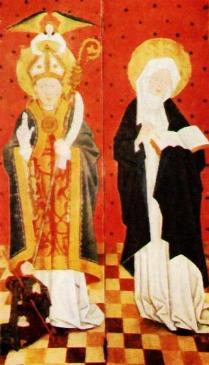
Bishop Hemming and St Birgitta, Diptych, Finland
Latin
This is what
she wrote in a vision about and to King Magnus. In it she sees
a lectern and a book. 'For the
appearance of the lectern was as if it had been a sunbeam [of
red, gold, white]. . . . And when I looked upwards, I might
not comprehend the length and breadth of the lectern; and
looking downward, I might not see nor comprehend the greatness
nor the deepness of it . . . After this I see a Book on the
same lectern, shining like most bright gold. Which Book, and
its Scripture, was not written with ink, but each word in the
book was alive and spoke itself, as if a man should say, do
this or that, and soon it was done with speaking of the Word.
No man read the Scripture of that Book, but whatever that
Scripture contained, all was seen on the lectern. Before this
lectern I see a king . . . The said king sat crowned as if it
had been a vessel of glass closed about . . .'
She continues
to describe how the king's glass globe is protected by an
angel but threatened by a demon .
. . 'This living king appears to you as if in as it were a
vessel of glass, for his life is but as it were frail glass
and suddenly to be ended'. She continues by speaking of how
this king knowingly sins but that if he repents he can be
saved by the angel from the fiend. Beside him is a dead king
above whom is writing describing his lust, his pride, his
avarice. . . but the writing is blankly gone from the part
that should have proclaimed his love of God.
'Then the Word speaks from the lectern, saying
"[What you see is the Godhead's self. That you cannot
understand the length, breadth, depth and height of the
lectern means that in God is not found either beginning or
end. For God is and was without beginning, and shall be
without end "]. Also the Word spoke to me and said "[The Book
that you see on the lectern means that in the Godhead is
endless justice and wisdom, to which nothing may be added or
lessened. And this is the Book of Life, that is not written as
the world's writing, that is and was not, but the scripture of
this Book is forever. For in the Godhead is endless being and
understanding of all things, present, past and to come,
without any variation or changing. And nothing is invisible to
it, for it sees all things "]. That the Word spoke itself
means that God is the endless Word, from whom are all words,
and in whom things have life and being. And this same Word
spoke then visibly when the Word was made man and was
conversant among men'. She adds to the King that she is giving
him the Word's words, adding that 'few receive and believe the
heavenly words given from God, which is not God's fault, but
man's'.
Later, she writes
'I saw an altar and a chalice with wine and water and bread
and I saw how in a church of the world a priest began the
mass, arrayed in a priest's vestments. And when he had done
all that belonged to the Mass, I saw as if the sun and moon
and the stars with all the other planets, and all the heavens
with their courses and moving spheres, sounded with the
sweetest note and with sundry voices.'
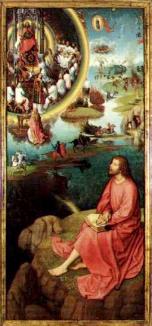
St John writing the Apocalypse, Hans Memling, St
John's Hospital, Bruges
In another vision, at the end of her life,
in the Church of the Holy Sepulchre, she sees the judgement of
her wicked son Charles where her prayers and her tears for
Charles cause the devil to have amnesia concerning her son's
sins. First the book in which the fiend has written them down
suddenly has blank pages instead of writing, then the sack in
which he has placed them is empty when turned inside out, then
the devil himself forgets them totally from his memory and goes
wailing off to Hell, cursing Birgitta.
Much of Birgitta's visionary imagery comes
from law courts, for her father was the King of Sweden's law man
and her husband was likewise a law man. She both prophesied and
wrote following the Black Death of 1348 when Doomsday, Judgment
Day, seemed particularly near. She told King Magnus that the
Black Death would happen, then left for Italy, Sweden being too
dangerous for her. Birgitta set up her household in Rome, living
in prayer and constantly receiving visions, having male
secretaries assist her, one of them a Spanish Bishop, Alfonso of
Jaén. In the last year of her life she journeyed to the Holy
Land, preaching on her journey in Naples and Cyprus, prophesying
the 1452 Fall of Constantinople. Her massive book of the Revelationes,
which is really Julian's title of 'Showings', was copied out in
illuminated manuscripts, then in print, and treasured throughout
Europe.
At her death in
1373 Alfonso of Jaén, Queen Joanna of Naples, Queen Margaret
of Sweden, the Emperor Charles of Bohemia, and Cardinal Adam
Easton of England, a Benedictine from Julian's Norwich, all
sought Birgitta's canonization as a saint.
St
Catherine of Siena (†1380)
 ope Gregory
XI sent Alfonso of Jaén to Catherine of Siena at Birgitta of
Sweden's death. At that point Catherine, who had previously
been illiterate, proceeded to write important letters to
Popes and Emperors, Kings and Queens and even to the
condottiere Sir John Hawkwood, on the need for peace. We do
not think of her as part of the Dominican-inspired Friends
of God movement across Europe but this act clearly places
her in that context. Pope Urban VI wanted her to have
Birgitta's daughter, Catherine of Sweden, accompany her to
carry out diplomacy on his behalf with Queen Joanna of
Naples.
ope Gregory
XI sent Alfonso of Jaén to Catherine of Siena at Birgitta of
Sweden's death. At that point Catherine, who had previously
been illiterate, proceeded to write important letters to
Popes and Emperors, Kings and Queens and even to the
condottiere Sir John Hawkwood, on the need for peace. We do
not think of her as part of the Dominican-inspired Friends
of God movement across Europe but this act clearly places
her in that context. Pope Urban VI wanted her to have
Birgitta's daughter, Catherine of Sweden, accompany her to
carry out diplomacy on his behalf with Queen Joanna of
Naples.
Catherine had been the twenty-fourth child
of a Sienese dyer. Everyone had wanted her to marry but she
refused, having made a vow of chastity, and instead sought to
enter the Dominican Third Order, which only admitted women who
were widows. She won. As a Dominican Tertiary she cared for the
sick and dying, including criminals condemned to death in Siena.
She was surrounded by disciples, one of them an English hermit,
William Flete, whose work, The Remedies Against Temptations,
Julian quotes and uses in the Showing of Love, another a
lawyer Cristofano Di Ganno, who later translated Birgitta's Revelations
into exquisite Italian, another a painter, Andrea Vanni, whose
delicate portrait of her survives, indeed in the very place of
her major visions in San Domenico, Siena.

Andrea Vanni, St Catherine of Siena, San Domenico,
Siena
The young Catherine of Siena
immured herself in her room in prayer - and later wrote or
rather, dictated, of that time as her 'Cell of
Self-Knowledge'. Besides her
Letters she had also written, or, again, rather dictated, the Dialogo,
the Dialogue between God and his Daughter, Catherine's Soul, in
which he tells her that his Son is the bridge between God and
man, a bridge that is like a stair, beginning first with the
affections, then love, then peace. He adds that his Son's
'divinity is kneaded with the clay of your humanity like one
bread'. This work, likely through Cardinal Adam Easton of
Norwich who knew all three women, influenced Julian's Showing
of Love, her 'Revelations'. A most beautiful manuscript of
the Dialogo was translated into Middle English for the
Brigittine nuns of Syon Abbey and called the Orcherd of Syon.
It was printed by Wynken de Worde, Caxton's successor, again
with that title, in 1519. It is illustrated below. Its exemplar
may well have been a manuscript Adam gave Julian.
The Middle English Orcherd of Syon translating her Revelation,
her Dialogo, states that such a soul
abideth in her inward beholdinge to know
herself, to that entent only that sche myght better knowe in
herself the goodnes of God.
/¶ Here begynneth the boke of dyuyne
doctryne. That is to/ saye of goddes techyng. Gyuen by the
person of god the fa/der to the intelleccyoun of the
gloryous vyrgyne seynt Kathe-/ryn of Seene/ of the ordre of
seynt Domynycke. Which was/ wryte n as she endyted in
her moder tongue. Whan she was in co n/templacyon
& rapt of spyryte she herynge actualy. And i n the
same/ tyme she tolde before many what our lorde god spake in
her.
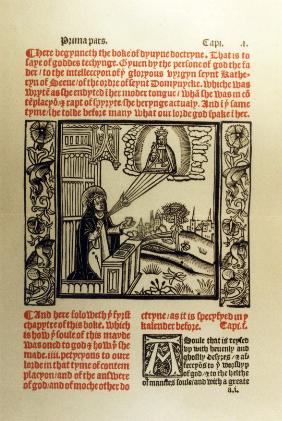
¶And here foloweth the fyrst/ chapytre of
this boke. Which/ is how the soule of this mayde/
was oned to god & how then she/ made .iiii.
petycyons to oure/ lorde in that tyme of contem/placyon and
of the answere/ of god and of moche other do/ctryne: as it
is specyfyed in the/ kalender before. Capt.1.
Soule
that is reysed up
with heuenly and
ghostly desyers & af-
feccyo ns to the worshyp
of god & to the helthe
of mannes soules with a greate . . .
________
The Orcherd of Syon (Westminster:
Wynken de Worde, 1519), Catherine of Siena's Dialogo
in Middle English, its colophon: 'a ryghte worshypfull and deuoute gentylman
mayster Rycharde Sutton esquyer stewarde of the holy
monastery of Syon fyndynge this ghostely tresure these
dyologes and reuelacions . . . of seynt Katheryne of Sene in
a corner by itselfe wyllynge of his greate charyte it sholde
come to lyghte that many relygyous and deuoute soules myght
be releued and haue comforte therby he hathe caused at his
greate coste this booke to be prynted'./
Her confessor and biographer was Raymond of
Capua who became head of the Dominican Order. Pope Urban VI
leaned heavily upon her for his own survival. Severely anorexic,
she died at the age of thirty-three, collapsing under the
weight, she said, of the Church.
II. Medieval Irish and English Contemplatives
The
contemplative
world is the world of prayer. When Julian would have
been enclosed in her Anchorhold one of the prayers said
was a later, abbreviated version of the following:
St Patrick's Lorica, 'The Cry of the Deer' (VII
century)
I
arise today
Through a mighty
strength, the invocation of the Trinity,
Through a belief in the Threeness,
Through confession of the Oneness
Of the Creator of creation.
I arise today
Through the strength of Christ's birth and
His baptism,
Through the strength of His crucifixion
and His burial,
Through the strength of His resurrection
and His ascension,
Through the strength of His descent for
the judgment of doom.
I arise today
Through the strength of the love of
cherubim,
In obedience of angels,
In service of archangels,
In the hope of resurrection to meet with
reward,
In the prayers of patriarchs,
In preachings of the apostles,
In faiths of confessors,
In innocence of virgins,
In deeds of righteous men.
I arise today
Through the strength of heaven;
Light of the sun,
Splendour of fire,
Speed of lightning,
Swiftness of the wind,
Depth of the sea,
Stability of the earth,
Firmness of the rock.
Christ with me, Christ before me, Christ
behind me,
Christ in me, Christ beneath me, Christ
above me,
Christ on my right, Christ on my left,
Christ when I lie down, Christ when I sit
down,
Christ in the heart of every man who
thinks of me,
Christ in the mouth of every man who
speaks of me,
Christ in the eye that sees me,
Christ in the ear that hears me.
I arise today
Through a mighty strength, the invocation
of the Trinity,
Through a belief in the Threeness,
Through a confession of the Oneness
Of the Creator of creation.
'The
Dream
of the Rood' (VIII century)
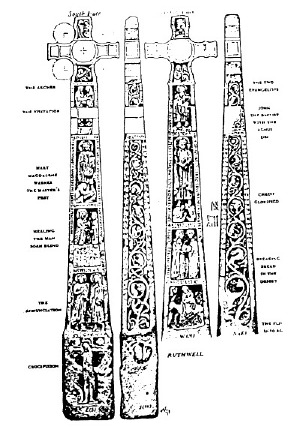
The Ruthwell Cross, Scotland
 he earliest written English poem is the 'Dream of the
Rood' inscribed in runes upon a stone cross in Scotland. The
delight
of being a pilgrim scholar is in journeying to Carlisle, then
across the border from Hadrian's Wall to Bewcastle and
Ruthwell to see these ancient monuments, and then to Vercelli
in Italy and seeing its manuscript. None of the original
versions of this poem are today in England. Today, the English
language in the world's eyes, is the language of commerce, of
power, of imperium, of war, like that of pagan Rome.
We tend to forget its earliest poem, centred most crucially
upon the Cross, upon spirituality.
he earliest written English poem is the 'Dream of the
Rood' inscribed in runes upon a stone cross in Scotland. The
delight
of being a pilgrim scholar is in journeying to Carlisle, then
across the border from Hadrian's Wall to Bewcastle and
Ruthwell to see these ancient monuments, and then to Vercelli
in Italy and seeing its manuscript. None of the original
versions of this poem are today in England. Today, the English
language in the world's eyes, is the language of commerce, of
power, of imperium, of war, like that of pagan Rome.
We tend to forget its earliest poem, centred most crucially
upon the Cross, upon spirituality.
My pilgrimages, imitating
those of hly women such as Helena, Egeria, Paula,
Eustochium, Pega, Guthrithyr, Margaret, Birgitta and
Margery, took me not only to Ruthwell, Bewcastle, and
Vercelli, but also to Jerusalem, where I saw the Holy
Sepulchre and the site of the Cross, and finally to
Florence, where I organized an international conference of
the Laurentian Library's Codex Amiatinus, brought by
Ceolfrith from Wearmouth-Jarrow to Italy. At that conference
we noted that Jarrow has the same inhabited vine sculpture
as has the Ruthwell Cross, copying classicizing scuptural
elements foreign to Hibernian or Anglo-Saxon work, and
Ceolfrith was specifically noted by Bede to have sent such
stone-masons skilled in Roman work to King Nechtan in 710.
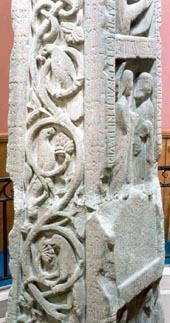
The Roman
Empress Helena, who likely came from York, where her son had
been proclaimed Emperor, had commenced the practice and
contemplation of pilgrimage to the Holy Places, to be followed
in turn by women such as Paula, Eustochium, Fabiola, Marcella,
Egeria and others. Emperor Constantine had himself been
converted to Christianity, and converted the whole Roman
Empire with him to Christianity, because of his Christian
mother Helena and because of the dream vision he experienced
(A.D. 312) of the Cross seen by him in the sky, prior to his
victory over a pagan enemy. Northumbria's King Oswald (A.D.
634), a successor to King Edwin, then erected a cross prior to
the Battle of Heavenfield in imitation of the Emperor
Constantine.
The Anglo-Saxon Ruthwell Cross, reflecting
Constantine and Oswald's crosses, allows those who see and read
it to contemplate in turn each place concerning the life of
Christ, Nazareth, the Egyptian Wilderness, the Jordan
Wilderness, Galilee, and Jerusalem, culminating with the
Crucifixion. It is a map of the Holy Places that pilgrims may
read. The runes of the 'Dream of the Rood' inscribed about their
edges, their margins, describe the writer, likely Cædmon,
dreaming of the Cross speaking to him, narrating of the wood and
blood and of the sacred burden it had once borne; then, in
Cynewulf's longer version, of its being turned into the sacred
reliquary bedecked by the Emperor Constantine with gold and
rubies at Constantinople. Jerome, whose works were read at
Whitby, had practiced contemplating upon the Crucifix, becoming
himself as naked as the naked Christ, in his 'imitatio Christi'.
So here does Cædmon, if he is its author, in his contemplation
meet with the blood-stained wood of the Roman gallows
(Anglo-Saxon 'galgu') erected once to hang Jesus, the Christ,
the King of the Jews. So does Cædmon's poem, and its Cynewulfian
revision, today have us converse as pilgrim visionaries with the
ignoble gallows and imperial reliquary of God.
The poem is shaped in two forms, both used
in Anglo-Saxon Riddles. It begins with the dreamer saying 'I
saw', then has the inanimate object speak, telling its
observers, its poet and its readers, 'I am'. There are such
Anglo-Saxon Riddles spoken by 'Book', by 'Cross', etc. In a
sense it, too, is the mocking titulus placed above the
Cross, 'Jesus, King of the Jews'.
The longer
version is given from the manuscript left by an Anglo-Saxon
pilgrim in Vercelli, Italy, the rubricated lines being those
given in the runes on the Ruthwell Cross.


Anglo-Saxon
 ear, while I tell of the best of dreams . which
came to me at midnight
ear, while I tell of the best of dreams . which
came to me at midnight
when humankind kept their beds.
It seemed that I saw the Tree
itself . borne on the air, light wound round it,
brightest of beams, all that
beacon was . covered with gold, gems stood
fair at its foot, and five
rubies . set in a crux flashed
from the crosstree. Around
angels of God . all gazed upon it,
since first fashioning fair . It
was not a felon's gallows,
for holy ones beheld it there .
and men, and the whole Making shone for it
Trophy of Victory . I, stained
and marred,
stricken with shame, saw the
glory-tree . shine out gaily, sheathed in
decorous gold; and gemstones
made . for their Maker's Tree a right mail-coat
Yet through the masking gold I
might perceive .
what terrible sufferings were
there
It bled from the right side .
Ruth in the heart
Afraid I saw that unstill
brightness . change raiment and colour,
again clad in gold or again slicked with sweat . spangled with
spilling blood.
I, lying there a long while .
beheld, sorrowing, the Healer's Tree
till it seemed that I heard how
it broke silence, best of wood, and spoke:
'It was long ago-I still
remember . back to the holt where I was hewn down;
From my own stock I was struck
away . dragged off by strong enemies
wrought into a roadside scaffold
. They made me a hoist from wrongdoers.
The soldiers on their shoulders
bore me . until on a hill-top they raised me
many enemies made me fast there
. Then I saw, marching toward me,
Mankind's brave King . He came
to climb upon me. I dared not break nor bend aside . against
God's will, though the ground itself
shook at my feet. Then the young warrior, Almighty God, mounted
the Cross, in the sight of many.
He would set free mankind.
I shook when his arms embraced
me, but I durst not bow to ground,
stoop to Earth's surface . Stand
fast I must.
I was reared up, a rood . I held the King, Heaven's lord, I dared not
bow . They drove me through with
dark nails: on me are the wounds
Wide-mouthed hate dents. I durst
not harm any of them.
They mocked us together . I was all wet with
blood sprung from the Man's side
. after he sent forth his soul. Many wry wierds I underwent .
up on that hilltop; saw the Lord of Hosts stretched out stark
. Darkness shrouded the King's corpse.
A shade went out wan under cloud
pall . All creation wept,
keened the King's death . Christ was on the Cross.
But there quickly came from afar
. many to the Prince .
All that I beheld had grown weak
with grief . yet with glad will bent then
meek to those men's hands .
yielded Almighty God.
They lifted Him down from the
leaden pain . left me, the commanders
Standing in blood sweat . I was sorely smitten with sorrow
wounded with shafts . Limb-weary
they laid him down.
They stood at his head . They
looked on him there .
They set to contrive Him a tomb
. within sight of his bane
carved it of bright stone . laid
in it the Bringer of Victory
spent from the great struggle .
They began to speak the grief song,
sad in the sinking light . then
thought to set out homeward;
their most high Prince . they
left to rest with scant retinue.
Yet we three, weeping, a good
while . stood in that place after the song
had gone up from the captains'
throats . Cold grew the corpse, fair soul house.
They felled us all . We crashed
to ground, cruel Wierd,
and they delved for us a grave .
The Lord's men learnt of it, His friends found me.
It was they who girt me with
silver and gold. . .
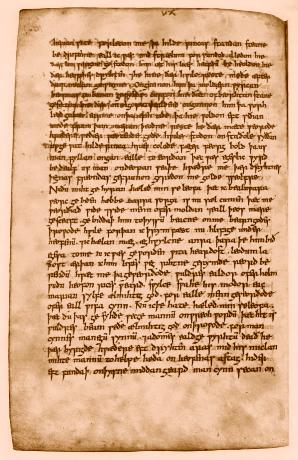

B.
Christina
of
Markyate, Richard Rolle, John Whiterig, William Flete,
Walter Hilton, the Cloud
of Unknowing Author, Julian of Norwich, Margery
Kempe
Christina of
Markyate (†circa 1155)
A manuscript now in the British Library, MS Cotton Tiberius
E.1, its edges charred in the Cotton Library fire in 1731,
tells us in Latin the story of a remarkable young woman of the
twelfth century, Theodora, who came to be named Christina,
Anchoress, then Prioress, of Markyate. The account breaks off
in the year 1142, but we know she was still living, 1155-6.
The very fine St Albans Psalter, together with the Vita St
Alexis, is also associated with Christina of Markyate, making
its way sometime after the Dissolution of the Monasteries to
the English Benedictine monks at Lambspring (whose Abbot was
to fund the publication of the first edition of Julian of
Norwich's Revelations), following that, to St
Godeharskirche at Hildesheim.
Christina had made her Vow of Virginity as a child at St
Albans and preserved that Vow with the famous reading of the
story of St Cecilia's wedding on her own wedding night. Her
Latin Vita retells the tales of St Cecilia, St Alexis
and St Mary of Egypt, giving them a local habitation and a
name, reliving the Thebaid in England. Following family and
ecclesial abuse Christina fled to the inner cell of the hermit
monk of St Albans, Roger. Roger was under obedience to the
Abbot, though living where three angels led him from Windsor,
on his return from Jerusalem, to Markyate, on the right of
Watling Road from St Albans Abbey towards Dunstable, the Latin
text very precisely tells us, - peopling England with angels.
Likewise the Latin text presents its protagonists, Christina
and Roger, forever speaking lines out of the Holy Book, lines
from the liturgical psalms. Indeed it is the lines from psalms
recited by Christina that dispel evil toads, who are devils,
from her cell.
She tells Roger of her vision of Christ
giving her his Cross to hold and Roger speaks amidst the Latin
in Old English:
letare mecum, myn sunendaege dohter
Soon after
Burthred, her husband, arrives, releasing her from her
Marriage Vows, and Roger decides to leave her his hermitage.
That decision is preceded by a vision, one
that looks back to Gregory's Dialogues on Benedict and
forward to Julian of Norwich and Catherine of Siena. In the
Dialogue following that concerning Scholastica and Benedict in
loving discourse upon heavenly matters all night, Benedict is
seen one night in prayer, and at the same instant the whole
world to shrink as into one beam of light. Here Christina sees
the Queen of Heaven and all the angels.
Latin
And falling downwards to the ground, she saw in one
flash the whole wide world.
But above all
else she turned her eyes towards Roger's cell and chapel and
she said
'I wish to have that place to dwell in'.
From having been a willing prisoner
in a cramped narrow cell, seated on stone, in silence and in
illness / Pp. 102-105/, Christina now becomes officially its
anchoress and soon prioress with a growing Benedictine community
of nuns about her, closely associated with the Benedictine Abbey
of St Albans, and advising its Abbot, Geoffrey. Their
relationship is compared to that of Jerome and Paula. Her years
of solitude, trial, temptation and illness had brought her
wisdom, concerning herself and God.
/Centuries later
the actual first Abbess of Syon, founded from St Birgitta's
Abbey of Vadstena, would be one Joan North, reclusionem moniales de Markyate, replacing the titular one, Matilda Newton, monialis de Barking, while the titular Confessor General, William
Alnwick, Benedictine of St Albans and Recluse of Westminster,
is replaced by Thomas Fishbourn, likewise a St Albans'
Benedictine, and indeed also one of its Recluses, its Hermits:
Margaret Deanesly, The Incendium Amoris of Richard Rolle
of Hampole, p. 114. The Brigittine manuscripts,
including those of Julian of Norwich, were either destroyed or
taken into exile, next coming into the hands of the exiled
English Benedictines, like the St Albans Psalter at
Lambspring. England's Brigittine Syon Abbey from its
foundation in the early fifteenth century knew the story of
twelfth-century Christina of Markyate, its Abbess's original
Mother Foundress. Likewise did the English Congregation of
Benedictines in exile on the Continent. At Benedictine
Cambrai, which became Stanbrook Abbey, Father Augustine Baker
encouraged the Benedictine nuns in their reading and copying
such medieval contemplative texts acquired from his former
employee, Sir Robert Cotton. Baker's successor, Father Serenus
Cressy, Chaplain to the Benedictine daughter house in Paris,
now St Mary's Abbey, Colwich, arranged that the Abbot of
Lambspring pay for the printing of the editio princeps
of Julian of Norwich's Revelations of Divine Love./
Richard Rolle (†1349)
 ichard Rolle became
a hermit, abandoning his university studies, after first
asking his sister to procure for him his father's raincoat
and an old dress of hers, for making his habit. She
proclaimed he had gone mad. His prolific writings were to be
copied out over and over again, his Latin works translated
by the Carmelite Misyn, in turn doing this for Margaret
Heslyngton. He has a strong presence in the Amherst
manuscript. Often William Flete's Remedies against Temptations is falsely
attributed to Richard Rolle. BL
MS Cotton Faustina B.vi.Part II
ichard Rolle became
a hermit, abandoning his university studies, after first
asking his sister to procure for him his father's raincoat
and an old dress of hers, for making his habit. She
proclaimed he had gone mad. His prolific writings were to be
copied out over and over again, his Latin works translated
by the Carmelite Misyn, in turn doing this for Margaret
Heslyngton. He has a strong presence in the Amherst
manuscript. Often William Flete's Remedies against Temptations is falsely
attributed to Richard Rolle. BL
MS Cotton Faustina B.vi.Part II
This is from Rolle's Meditations
on the Passion (which we shall see reflected, too,
in the Latin of John Whiterig):
'Thy body, sweet Jesus, is
like a book all written
with red ink; so is
thy body all written with
red wounds . . .
grant me to read upon thy book, and somewhat to understand the
sweetness of that writing and to have liking in studious
abiding of that reading'
'More yit, swet Jhesu, thy
body is lyke a boke written al with rede ynke; so is thy body al written with rede woundes. Now, swete Jhesu, graunt me to rede upon thy
boke, and somwhate to undrestond the swetnes of that writynge,
and to have likynge in studious abydynge of that redynge. And
yeve me grace to conceyve somwhate of the perles love of Jhesu
Crist, and to lerne by that ensample to love God agaynwarde as
I shold. And, swete Jhesu, graunt me this study in euche tyde
of the day, and let me upon this boke study at my matyns and
hours and evynsonge and complyne, and evyre to be my
meditacion, my speche, and my dalyaunce.'
And this is his 'Ghostly Gladness'
Gostly gladness in
Ihesu, and ioy in hert, with swetnesse in soule of þe sauour of heuyn in hope, is
helth in to hele, and my lyf lendeth in loue, and
lightsome vmlappeth my thoght. I dred nat þat me may wirch wo, so myche I
wot of wele. Hit ware no wonder if dethe ware dere, þat I myght se hym þat I seke; but not hit lengthes
fro me, and me behoueth to lyve here til he wil me lese.
List and lere of þis lare, and þe shal nat myslike. Loue maketh
me to melle, and ioy maked me jangle. Loke þou lede þi life in lightsomnes; and heuynesse, hold hit
away. Sorynesse let nat sit with the, bot in gladnes in
God euermore make thou thi glee.
Ghostly gladness in Jesus, and joy in heart, with
sweetness in soul of the Saviour of Heaven in hope, is
health into healing, and my life lends to love and lightly
surrounds my thought. I fear not that I may work woe, so
much I know of weal. It would be no wonder if death were
dear, that I might see him whom I seek; but this is now
distanced from me, and I must live here until he will loose
me. Listen and learn of this teaching, and you shall not
dislike it. Love makes me to speak, and joy makes me
voluble. Look that you live your life lightly, and hold
heaviness away. Let not sorrow sit with you, but in gladness
in God ever more joy.
John Whiterig (†1371)
here are strong similarities between the
contemplations of an Oxford-educated Benedictine, likely
named John Whiterig, who had become a hermit on to the
Island of Farne, 1363, dying there in 1371, and Julian of
Norwich's Showing of Love. When a student at Durham
College (for he mentions being saved from drowning in
Oxford's Cherwell River), he would have overlapped with Adam
Easton, a student at Gloucester College, both colleges
established for educating young Benedictines at Oxford. The
Durham Benedictines first settled at Wearmouth and Jarrow in
memory of St Benet Biscop and St Bede, then were invited in
1083 to Durham where they served at the shrine of St
Cuthbert, who had died on Farne in 687. St Godric visited St
Cuthbert's cell on Farne before becoming himself a hermit at
Finchale (1065-1170). Lindisfarne, at some distance from the
island of Farne, also continued as a monastic site until the
Reformation, though like Whitby with gaps following Viking
arrivals. Durham typically kept two monks on Farne, where
they supported themselves by fishing and lived intense lives
of prayer.

The Ruins of Lindisfarne
In the following, the Latin text derives
from 'The Meditations of the Monk of Farne', ed. David Hugh
Farmer, OSB, Studia Anselmiana 41 (1957), 141-245; the
English translation from Christ Crucified and Other
Meditations, ed. David Hugh Farmer, Trans. Dame Frideswide
Sandemen, OSB (Leominster: Gracewing, 1994). The complete
paperback book is available: UK, ISBN 0 85244 266 1; USA, ISBN 0
87061 202 6. Dame Frideswide Sandeman well represents the
continuing tradition of Julian's association amongst
contemplatives, for she is a Benedictine at Stanbrook Abbey,
which was founded from Cambrai, where exiled English nuns,
including several descendants of St Thomas More ,
under the guidance of Dom Augustine
Baker , OSB, had studied, copied and contemplated upon
such texts, including Julian of Norwich's Showing of Love,
eventually preparing it for publication in 1670, with Dom
Serenus Cressy, OSB, as ostensible editor. Benedictinism is
about Eternity, more than time, a contemplative choral dialogue
of men and women across centuries. P. Franklin Chambers drew
attention to the similarities between the two contemplative
writers, John Whiterig and Julian of Norwich, in his Juliana
of Norwich: An Introductory Appreciation and an Interpretative
Anthology (London: Gollancz, 1955). The manuscript
transcribed is Durham B.iv.34, fols. 5v-75, and which is the
only extant manuscript with this text.
David Hugh Farmer mentions the
self-identification of the Hermit of Farne with St John the
Evangelist on the Isle of Patmos, to whom he addresses a
'Meditacio Eiusdem ad Beatum Iohannem Ewangelistam'.
Hans Memling, 'St John Writing Revelation,' St
John's Museum, Bruges
Reproduced with permission,
Memlingmuseum, Stedelijke Musea, Brugge, Belgium
John Whiterig, while Hermit on Farne, also
began to write a poem in praise of St Cuthbert, perhaps dying
before it could be finished.
Parallel passages in Julian of Norwich's Showing
of Love will be added more completely at a later date,
noted here with 'Julian '. My profound thanks to Catherina
Lindgren, Sweden, and to Iain Bruce, Oxford, for making these
texts available. The passages that follow can be read by both
contemplatives and scholars, and perhaps contemplatives and
scholars could even change places with each other to the profit
of both modes of thought and of being.
AD CRUCIFIXSUM
MEDITACIONES CUIUSDAM MONACHI APUD FARNELAND QUONDAM
SOLITARII
tudy then, mortal, to know
Christ: to learn your Saviour. His body hanging on the
cross, is a book, opened before your eyes. The words of this
book are Christ's actions. as well as his suffering and
passion, for everything that he did serves for our
instruction. His wounds are the letters or characters, the
five chief wounds being the five vowels and the others the
consonants of your book . . .
However much else you may
know, if you do not know this, I count all your learning for
naught, because without knowledge of this book, both general
and particular, it is impossible for you to be saved. So eat
this book which in your mouth and understanding shall be
sweet, but which will make your belly bitter, that is to say
your memory, because he that increases knowledge increases
sorrow too.
May this book never
depart from my hands, O Lord, but let the law of the Lord be
ever in my mouth, that I may know what is acceptable in thy
sight.
isce ergo homo Christum, cognosce Saluatorem tuum,
corpus etenim eius pendens in cruce uolumen expansum est
coram oculis tuis; uerba uolumina huius sunt actus Christi,
dolores et passiones eius. Omnis enim Christi accio nostra
est instruccio, litere seu carateres uoluminis huius vulnera
eius sunt, quorum quinque plage quinque sunt uocales, cetere
uero consonantes libri tui . . .
Quidquid scis, si
hoc nescis, nichil reputo quod scis; quia sine sciencia huius
libri uniuersali uel particulari inpossibile est te saluari.
Comede ergo uolumen hoc, quod dulce erit in ore tuo et
intelectu, sed amaricabit uentrem tuum, id est memoriam, quia
qui addit scienciam addit et dolorem . . .
Non recedat,
Domine, liber uoluminis huius de manibus meis, sed ut lex Domini
iugiter sit in ore meo, ut sciam quid acceptum sit in oculis
tuis.
John Whiterig, Meditacio ad Crucifixum, Chapter 53, fols. 29v-30
__________
'Thy body, sweet Jesus, is
like a book all written with red ink; so is
thy body all written with red wounds . . . grant me to read upon thy book, and
somewhat to understand the sweetness of that writing and to
have liking in studious abiding of that reading'
'More yit, swet Jhesu, thy
body is lyke a boke written al with rede ynke; so is thy body al written with rede woundes.
Now, swete Jhesu, graunt me to rede upon thy boke, and
somwhate to undrestond the swetnes of that writynge, and to
have likynge in studious abydynge of that redynge. And yeve me
grace to conceyve somwhate of the perles love of Jhesu Crist,
and to lerne by that ensample to love God agaynwarde as I
shold. And, swete Jhesu, graunt me this study in euche tyde of
the day, and let me upon this boke study at my matyns and
hours and evynsonge and complyne, and evyre to be my
meditacion, my speche, and my dalyaunce.'
Richard Rolle, Meditations on the Passion
Vowels are the soul,
consonants the bones and flesh of words.
Spinoza on Hebrew
On Jesus shadowed in
Isaac:
Thou art Isaac, who didst
make laughter for us by offering thyself to God in sacrifice
upon a mount called Calvary. Thou art the ram, caught by the
horns amidst the briers, and sacrificed in place of the son;
for that which thou hadst assumed succumbed to death, but thou
who didst assume it couldst not succumb. And yet thou art not
two but one; according to thy human nature thou didst die and
wast buried, according to thy divinity thou didst remain
unhurt. And thus, O good Jesus, thou didst make laughter for
us amidst tears and music for us in thine own lament.

Fourteenth-Century
Icelandic Manuscript, Bible in Icelandic, Abraham sacrificing
Abraham, stopped by angel grabbing his sword, ram caught by
horns in thicket. Árni Magnússon Institute, Reykjavik,
Iceland.
u es Isaac, qui risum nobis fecisti, quando te
ipsum tradidisti sacrificium Deo super unum moncium qui
Calvarie dicitur. Tu es ille aries inter uepres herens
cornibus, qui pro filio immolatur: quia quod assumpsisti
morti succubuit, sed qui assumpsisti morti succumbere non
potuisti; et non duo tamen sed unus, qui secundum humanum
naturam mortuus es et sepultus, et secundum Diuinam mansisti
illesus. Risum igitur, bone Ihesu, nobis in lacrimis
suscitasti, et musicam in luctu tuo.
John Whiterig, Meditacio ad Crucifixum, Chapter 2, fol. 7
Julian on Christ and
laughter
On Jesus shadowed in
Jacob
Thou hast beguiled the
devil, through whose envy death entered into the world; and
this thou didst do so wisely and fittingly, that life rose up
from thence whence death had sprung, and he, who by a tree had
gained his victory, was likewise by a tree overcome.
. . . delusisti
diabolo, cuius inuidia more introiuit in orbem terrarum: et tam
prudenter hoc fecisti et conuenienter, ut unde mors oriebatur
inde uita resurgeret, et qui in ligno uicerat per lignum quoque
uinceretur.
John Whiterig, Meditacio ad Crucifixum, Chapter 3, fol. 7
On Jesus shadowed in
Joseph
Thou shalt no longer be
called Jacob, Lord, but Joseph shall be thy name, which is
interpreted 'increase' or 'joining'. Either meaning is more
fitting, because thou hast increased thy people exceedingly,
and thou wast thyself joined to us, when the Word was made
flesh and dwelt among us, that that man could in very truth
say unto thee: 'This is now bone of my bone and flesh of my
flesh'.
on vocaberis ultra Domine Iacob, sed Ioseph erit
nomen tuum, quod augmentum siue apposicio interpretatur; qui
utraque nominis interpretacio optime tibi conuenit, siue
quia auxisti populum tuum uehementer, siue quia appositus es
nobis quando Verbum caro factum est et habitauit in nobis,
ita ut dicere ueraciter poterit homo tibi: Hoc nunc os ex
ossibus meis, et caro de carne mea.
John Whiterig, Meditacio ad Crucifixum, Chapter 3, fol. 7v
Remember us then, O Lord,
when it shall be well with thee, for thou art our brother and
our flesh; suggest to the Father that he should fill the sacks
of thy brethren - fill them, I mean, with that wheat which,
once it had fallen into the ground and died, brought forth
much fruit, and filled every living creature with blessing.
Thou who knowest no ill-will towards thy brethren, grant us
our measure of wheat. For we have no other advocate who has
been made unto us justice and sanctification, and whom the
Father always hears for his reverence, but thee, good Lord,
who art the propitiation for our sins. Remember then, O Lord,
when thou standest in the sight of God, to speak well on our
behalf. Ask thy Father to give me that wheat which with desire
I have desired to eat before I die.
emento nostri ergo, Domine, dum bene tibi fuerit,
quia caro et frater noster es, ut suggeras Patri two
quatinus impleantur sacci fratrum tuorum illo dico frumento,
quod dum semel cadens in terra mortuum fuit, multum fructum
attulit et omne animal benediccione repleuit. Qui igitur
nescis inuidere fratribus illius, tritici mensuram impertire
nobis. Non enim alium habemus Aduocatum, qui nobis factus
est iusticia et sanctificacio, quem semper audit Pater
propter suam reuerenciam, quam te, bone Domine; et tu
propiciacio es pro peccatis nostris. Recordare ergo, Domine,
dum steteris in conspectu Dei, ut loquaris pro nobis bonum.
Postula Patrem tuum ut michi donet triticum, quod desiderio
desideraui manducare antequam morior.
John Whiterig, Meditacio ad Crucifixum, Chapter 4, fol. 8
Julian on Christ as our
brother
I wish for no other wheat
but thee: give me thyself, and the rest take for thyself. For
what have I in heaven, and what have I desired more than thee
on earth? Whatever there is besides thee does not satisfy me
without thee, nor hast thou any gift to bestow which I desire
so much as thee. If therefore thou hast a mind to satisfy my
desire with good things, give me nought but thyself. For my
desire would not be pleasing in thy sight, if I longed for
something other than thee more than thee.
liud nolo triticum nisi temetipsum: da michi ergo
teipsum, et cetere tolle tibi. Quid enim michi est in celo,
et quid plus quam te optaui super terram? Certe quicquid est
preter te non michi sufficit preter te, nec est munus apud
te quod tantum desidero sicut te. Si ergo uelis replere in
bonis desiderium meum, nichil aliud michi des nisi
temetipsum. Non enim coram te cupiditas mea placeret si
aliquid aliud, quod tu non es, plus quam te optaret.
John Whiterig, Meditacio ad Crucifixum, Chapter 5, fol. 8

od for your goodness give to
me yourself. For you are enough to me. And I may ask nothing
that is less, that may be full worthy of you. And if I ask
anything that is less, ever I shall want, but only in you I
have all. And these words 'God of your goodness' are very
lovely to the soul and very close to touching our Lord's
will. For his goodness comprehends all . . .
Julian of Norwich,
Prayer, Showing of Love, Westminster Manuscript
On Jesus Shadowed in
Moses
Thou art the brazen
serpent hung upon the gibbet, a remedy to all believers
against the bites of the devil. Thou art the lonely sparrow
upon a house-top, and thou hast found a nest for thyself which
is the Virgin's womb. Thou art the scapegoat, and hast carried
our sins into the wilderness of eternal oblivion, so that as
far as the east is from the west, so far should our iniquities
be from us. Thou art the lamb of God who takest away the sins
of the world . . .
u es ille serpens eneus suspensus in patibulo, in
quem credentes curantur omnes a morsu diabolico. Tu es
enim ille passer in tecto solitarius, et nidum tibi
inuenisti, qui Virginis est uterus. Tu es hircus emissarius,
qui peccata nostra tulisti in desertum obliuionis perpetue,
ut quantum distat ortus ab Occidente longe fierent a nobis
iniquitates nostre. Tu es agnus Dei qui tollis peccata mundi
. . .
John Whiterig, Meditacio ad Crucifixum, Chapter 6, fol. 8v
. . . all things work
together for good; not only good works, but even sins. For
example, one of the elect who is somwhat elated on account of
an outstanding virtue is tempted by the devil to impurity and
allowed to fall, so that the memory of so shameful a sin may
for the future preserve him from pride, and give him rather,
what is safer, a fellow-feeling for the lowly.
. . . omnia
cooperantur in bonum, hiis qui secundum propositum uocati sunt
sancti, non tantum bona opera sed eciam peccata. Verbi gracia:
aliquis electus a diabolo temptatur per luxuriam, qui ex aliqua
uirtute qua forte pollet aliqualem habet elacionem, permittitur
cadere, ut quam uile se meminerit flagicium perpetrasse: de
cetero numquam habeat materiam superbie, immo, quod est tucius,
humilibus consentire.
John Whiterig, Meditacio ad Crucifixum, Chapter 9, fol. 10
Julian, 'All Shall Be
Well'
On Jesus Shadowed in
Jonathan
Let us by no means bring
to naught in our city the likeness of those whom we have made
to our own image and likeness, but rather let thy wisdom
prevail over the malice into which they have falled through
their proud self-love, desiring to become like gods, knowing
good and evil. Let it reach from thee, the end, for thou are
both beginning and end, unto the end of all creation, that is
to say man, who was created last of all, and let it dispose
all things sweetly.
 uos ad ymaginem et similitudinem nostram fecimus,
eorum ymaginem in ciuitate nostra nullo modo ad nichilum
redigamus; sed pocius uincat sapiencia tua maliciam eorum,
in quam proprie superbiendo impegerunt, cupientes fore sicut
dii, scientes bonum et malum. Attingat ergo a te fine, qui
principium es et finis, usque ad finem tocius creature,
hominem uidelicet qui ultimo creatus est, et disponat omnia
suauiter.
uos ad ymaginem et similitudinem nostram fecimus,
eorum ymaginem in ciuitate nostra nullo modo ad nichilum
redigamus; sed pocius uincat sapiencia tua maliciam eorum,
in quam proprie superbiendo impegerunt, cupientes fore sicut
dii, scientes bonum et malum. Attingat ergo a te fine, qui
principium es et finis, usque ad finem tocius creature,
hominem uidelicet qui ultimo creatus est, et disponat omnia
suauiter.
John Whiterig, Meditacio ad Crucifixum, Chapter 11, fol. 11
Julian, on God in the
City of the Soul, on Wisdom
Thou art Christ, Son of
the living God, who in obedience to the Father hast saved the
world.
u es Cristus Filius Dei uiui, qui precepto Patris
mundum saluasti.

Despenser Retable, Norwich Castle, Contemporary
with Julian
I see thee, O good Jesus,
nailed to the cross, crowned with thorns, given gall to drink,
pierced with the lance, and for my sake . . . upon the gibbet
of the cross.
uideo te, Ihesu
bone, cruci conclauatum, spinis coronatum, felle potatum, lancea
perforatum, et omnibus membris super crucis patibulum propter me
diuaricatum.
. . . being thyself most
beautiful, for me thou hast desired to be accounted as a leper
and the last of men;
. . . cum
speciosus sis, ut leprosus et uirorum nouissimus pr me reputari
uoluisti;
John Whiterig, Meditacio ad Crucifixum, Chapter 13, fols. 11v-12v
In thy head I perceive
wondrous multiplicity of suffering, for in all thy five senses
thou didst feel indescribable Pain. Thou didst see thyself
crucified and hanging between thieves, thy friends deserting
thee, thine enemies gathering round, thy mother weeping, and
the corpses of condemned criminals strewn round about;
whatever met thy gaze was a source of pain and sorrow, of
horror and dismay.
n capite tuo admirabilem penarum intueor
multitudinem, quia per omnia organa quinque sensuum inena
rrabilem sensisti dolorem. Te ipsum enim uidisti crucifixsum
atque pendentem in medio latronum, amicos uidisti fugere,
inimicos appropinquare, matrem uidisti flere, atque cadauera
dampnatorum in circuitu iacere, et quicquid uisu traxisti
pena fuit et dolor, tremor et horror.
Thou didst hear threats,
murmuring, sarcasm and taunts from the bystanders; threats,
when they cried out: 'Away with him, away with him; crucify
him'; murmuring, when they said: 'He saved others, himself he
cannot save', and some had said before that: 'He is good',
while others said: 'No, he seduceth the multitude'. Sarcasm,
when the soldiers, being their knees, greeted thee with:
'Hail, king of the Jews'; for sarcasm is a covert sort of
mockery, when one is ironically called something by the
scoffer, other than what he believes to be true. They believed
him indeed to be a criminal rather than the king of the Jews,
and yet they spoke the truth although with false intent. Thou
didst hear taunts, when they said: 'Vah! Thou who dost destroy
the Temple and in three days rebuild it!'
udisti timorem et susurrium, subsannacionem et
derisum ab hiis qui in circuitu stabant. Timorem, inquam,
audisti quando dixerunt: Tolle, tolle, crucifige eum.
Sussurium audisti quando dixerunt: Alios saluos fecit,
seipsum non potest saluum facere, et ante quidam dixerunt
quia bonus est, alii autem non, sed seducit turbas.
Subsannacionem tunc audisti quando geniculantes dicebant Aue
rex Iudeorum, quia subsannacio oculta est derisio, cum aliud
uidelicet aliquis uocatur ironice quam a deridente fore
creditur. Credebant enim eum pocius maleficum quam regem
Iudaeorum, et tamen uerum dicebant quamuia menciendo.
Audisti, Domine, derisum quando dicebant: Vah qui destruit
templum et in tribus diebus reedificat.
Thou didst taste
bitterness, O Lord, when they gave thee gall for thy food, and
in thy thirst gave thee vinegar to drink. Thy nostrils, O
Lord, breathed in the stench of the corrupting corpses of
executed criminals lying round about. Thy sense of touch felt
fierce pain in thy head, for the crown of thorns pierced it so
grievously that thy blood flowed down in torrents through thy
hair even to the ground. And so, good Lord, whatever thou
didst look upon was terrible, whatever thou didst hear was
horrible, whatever thou didst taste was bitter, whatever thou
didst smell was putrid, and whatever thou didst touch was
painful.
ustasti Domine amarum, quando in escam tuam
dederunt fel et in siti tua potauerunt te aceto. Per nares,
domine, traxisti fetorem ex cadaueribus putridis morte
punitorum, que in circuitu iacebant. Per tactum uero in
capite sensisti asperitatem, quia corona spinarum in tantum
pungebat capud tuum ut cruorem habunde per crines in terram
currere faceret. Bone ergo Domine, quicquid uidisti fuit
terribile, quicquid audisti fuit horribile, quicquid
gustasti fuit amarum, quicquid odorasti fuerat fetidum, et
quicquid tetigisti fuit ualde asperum.
John Whiterig, Meditacio ad Crucifixum, Chapter 14, fols. 12-12v
One thing, O good Jesus,
I would know of thee; namely what reward will be bestowed on
thee for all that thou hast suffered for us, since we have
nothing that we have not received from thee. All gold is but
as a grain of sand in thy sight, and silver would be accounted
much in compensation for thy passion.
 num a te, Ihesu bone, scire uellem, qua uidelicet
mercede donaberis pro hiis que passus es pro nobis, cum nos
nichil habeamus nisi quod a te accepimus. Omne enim aurum in
conspectu tuo arena est exigua, et tamquam lutum estimabitur
argentum in recompensacione tue passionis.
num a te, Ihesu bone, scire uellem, qua uidelicet
mercede donaberis pro hiis que passus es pro nobis, cum nos
nichil habeamus nisi quod a te accepimus. Omne enim aurum in
conspectu tuo arena est exigua, et tamquam lutum estimabitur
argentum in recompensacione tue passionis.
John Whiterig, Meditacio ad Crucifixum, Chapter 15, fol. 12v
Julian on Passion
Speak, Lord, for thy
servants listen, ready to receive the engrafted word which is
able to save their souls. If thou desirest to know this
plainly, call thy husband, that thou mayest understand aright.
Let him who hath ears to hear, hear what Christ saith now to
the churches.
oquere, Domine, quia audiunt serui tui, parati
suscipere institum uerbum quod potest saluare animas eorum.
Si hoc aperte scire desideras, uoca uirum tuum ut recte
inteligas. Qui ergo habet aures audiendi, audiat quid modo
ecclesiis Christus dicat.
John Whiterig, Meditacio ad Crucifixum, Chapter 16, fols. 13-13v
I know well, O Lord, that
thou desirest my whole self when thou askest for my heart, and
I seek thy whole self when I beg for thee.
cio Domine, scio, totum me cupis cum cor meum
petis, et totum te desidero cum te ipsum postulo.
John Whiterig, Meditacio ad
Crucifixum, Chapter 18,
fols. 13v-14
Julian's Prayer
. . . even if he at times
out of his goodness enters under our roof to abide with us.
This he does especially according to that operation whereby he
enables us to taste the first-fruits of the Spirit, by
breaking for us a little of the bread which is himself, and
saying: 'Taste and see that the Lord is sweet'.
. . . et si aliquando propter suam
bonitatem intret sub tectum nostrum ut maneat nobiscum,
secundum illam maxime operacionem qua nos facit probare de
primiciis Spiritus frangens nobis modicum de pane seipso et
dicens: Gustate et uidete quoniam suauis est Dominus.
Julian
Thou canst, O
good Jesus, most clearly be recognized in the breaking of this
bread, which no one else breaks as thou dost. For thou dost
visit the soul with such joy, and fill it with such ineffable
delight and indescribable love, that for one who loves such
favours the enjoyment of so gracious a visit from such a guest,
were it only for the space of a day, would surpass all physical
love and a whole world full of riches. This is not surprising,
since it is a sort of beginning of eternal joys, a sign of
divine predestination and pledge of eternal salvation; it is a
grace rendering us pleasing to God, and bestows on us a new
name, which no one knows save he who receives it, and apart from
the sons and daughters of God none can have a share in it.
iquidissime, Ihesu bone, cognosci poteris in
fraccione panis, quem nemo alius sic frangit sicut tu. Quam
enim sic uisitas animam iubilo, et ineffabili uoluptate ac
inenarrabili reples amore, ut delicias amanti delectabilius
foret tanti hospitis tam iocunda frui uisitacione, saltem
per diei medium, super omnem amorem mulierum et totum orbem
terrarum diuiciis repletum. Nec mirum cum sit de eternis
gaudiis inicium aliquod, argumentum Diuine predestinacionis,
et arra salutis perpetue, gratia gratum faciens et nomen
nouum, quod non nouit quis nisi qui accipit, cui non
communicat alienus a filiis Dei et filiabus.
John Whiterig, Meditacio ad Crucifixum, Chapter 20, fol. 14v
This last passage
is remniscent of Jan van Ruusbroec's Sparkling Stone, on the
little white stone with the new name which is given to us.
William Flete (†1383?)
William Flete's text, Remedies against Temptations, was known to
and used by Julian of Norwich in her Showing of Love. A miscellany at
Cambrige University Library, containing this text, twice
over, was likely compiled by the Benedictine nuns at Carrow
Priory, Norwich, the dialect likewise identified by LALME as
of Norfolk. Flete left Cambridge, where
he had been a scholar, for Italy, July 1359, where he became
spiritual director and executor to Catherine of Siena as an
Augustinian Hermit at Lecceto. Eric (later Edmund) Colledge
and Noel Chadwick published the text from Cambridge
University Hh.I.ii, folios 100-116, in the
difficult-to-obtain Archivio Italiano per la Storia della Pietá
5 (Rome, 1968). Only one Latin manuscript ascribes the text to
William Flete, other versions generally being attributed
wrongly to Richard Rolle or Walter Hilton. The text
influences Walter Hilton, Ladder
of Perfection, Julian of Norwich, Showing of Love, and
the anonymous Chastising
of God's Children. The work needs greater exposure
as an essential part of Julian of Norwich's contemplative
library, and as a book which was also to be recalled by
Thomas More when imprisoned and awaiting death in the Tower
of London, and to be copied out by his great granddaughter
Dame Bridget More, O.S.B., Cambrai and Paris. Compare it with John
Whiterig's Contemplating the Crucifixion. Like Boethius' Consolation of Philosophy,
it is one of the 'golden books' of western civilization.
These texts are medieval psychiatry. They are the cells of
the understanding of one's self and God, phrases common to
both Catherine of Siena and Julian of Norwich manuscripts.
See Chaucer, 'Miller's Tale', The Canterbury Tales, I (A) 3421-3525, for
John's consolation meted out to Nicholas who seems to have
fallen into mental illness. In these texts, written for
women, and here copied out by women, care is taken to use
gender inclusive language, speaking, in the fourteenth and
fifteenth century of 'men and women'. The letter þ (thorn) is the Middle English
character for 'th', the letter 3 (yoch), the Middle English
character for 'y, gh'. My thanks to Juliana Dresvina for making
the text available to me for this transcription.
Catherine
of Siena, The
Orcherd of Syon (Dialogo), London: Wynken de Worde, 1519
Here seweth a souereyn and a notable sentence to
comforte a persone that is in temptacion.
Capitulum primum
ure merciful lord god chastyseth hese
childirn and suffereth hem to ben tempted for many
profytable skeles to here soule profi3te: and þerfore ther schulde non man ne woman ben
hevy ne sory for no temptacion. For Seint Jame the apostele
thecheth vs þat
we schulden haue wery gret joy quan we ben tempted with
diuers temptacions. For as the goold is purged and pured be
fier, and a knight in hard batail is proued good but if he
suffre hym self to ben ouere come, right so is a man be
temptacion preued for good but if he suffre hym self to ben
ouere come, þat
is to seye but if he consente ther to be deliberacion.
Soothly, quan a man is scharply tempted, he may thanne hopen
of gret vertu, for Seynt Austynn seyth þat þe
perfeccion of euery vertu is for a man to be meche troubled
with temptaciones, for euery vertu is proued be his
contrary. Our enmy the fend is besy day and nyght to tarye
and trauaylen goode men and women with diuers temptaciones,
in doutes of the feythe, and dredes of sauacion, and other
many mo in divers maneris, and specially now in these dayes
he is ful besy to dysese and to disseyve mannes soule; and þerfore wysely reule 3ou to with stondyn the
fend in eche fonndynge or vyolent temptyng of temptacion,
and 3eve 3e no fors of alle his asawtes, of doughtes ne of
dredis, ne of erroures ne of dyspit, ne of false lesynges ne
of fantasies, ne of no maner trauaylynge of þe fend. Whether þou se hem, here hem or thynk hem, take non
heed of hem, for they ben materis of grete mede, and no
synne in no wyse, whether they ben trauelous or
angwyschiouse þat
comen of malice of þe
feend. or of yuel disposicion of mannes complexion. And þerfore alle suche trauels men ou3ten nouth
to charge, but suffren mekely and abyden pacyently, til god
do remedye þerto;
and for as moche as they ben materis of gret mede, no man
aughte not to stryuen þer a3ens, ne merueyle of hem, ne seeke þe cause, ne þenk be quat skyle he is so traueiled. For þe more þat a man duelleth in sechynge and þenkinge of errouris and in angwyschis, þe more deepely he fallyth bothe in to
errouris and in angwyschis.
And þerfore, for as moche
as a mannes þought
is often veyn and diuers, and non ende hathe, it oweth not
to ben charged ne to be taken heed off, ne a man schulde not
angre hym self with all, ne blame ne arette it to his owne
defaute þat he
is so traueiled, for swiche trauailes ben peyneful and not
synful, for as moche as þei been gretly ageyn his wil. Seynt Austyn
seyth þat
euery synne lyeth in wilful wil, and quat þat is a3ens a mannes wil it is not synne,
and the holy doctour Ysodre, De Summo Bono, seyth þat þe
fend tempteth a man no more þan god 3eueth hym leue. Þerfore lete vs alwey haue a good wil to
wilne weel and to do wel, and god wil kepe vs and 3eue vs
the victorye, and þe
fend schal ben confounded. Feith and hope ben ground of al
perfeccion and roote of al vertues: þerfore oure old enemy þe fend is ful besy with all his slyghtes to
drawe þe
soule doun þer
fro. And it falleth somtyme þat þe
fend tempteth and trauaileth a rightful soule so scharply þat it is ouere leid with care and dreuen to
dispeir; al þat
tyme, þou3
the soule perseyue it nought, it dwelleth stille in þe dreed and in the loue of god, and all þat trauaile is to his soule gret meede afore
the sighte of god. For oure lord of his endles mercy arettiþ not to the soule that synne þat him self suffereth the fend to wirche in
the soule; but quan we be oure oure owne wikkid wil fully
don a3ens þe wil
of god with deliberacion, þanne synne we, but quan we ben drawen with
wykkyd vilenous þoughtes,
and turmented with dispeir and thoughtes a3ens oure owne wil
þurgh fondynge or
violent temptynge of þe
fend, we sufferen þeyne
but we don no synne. And 3et þe sely soules knowliche is hid be þat turment.
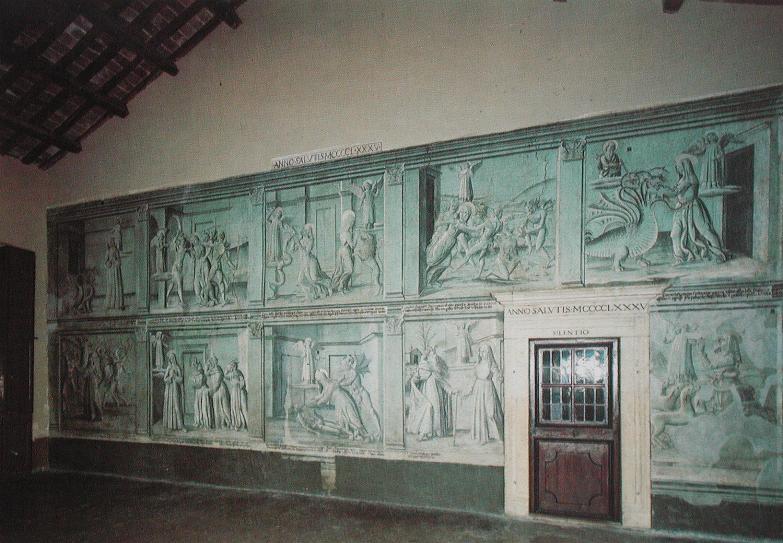
Santa Francesca Romana's cell in the corridor painted
with the visions she had of evil spirits, from which her
guardian angel, given her by her dead son, Evangelista,
saved her
Capitulum secundum
ut
often the temptynge of þe fend, þat maketh þe soule to erre in feyth and to fantasye in
dispeir, semeth gret synne to a manis soule, and is not so.
For all holy doctoures seyn þat feith and hope ben vertues of a mannes
wil, wherfore who so wolde rightfully beleue, he is in right
beleue aforn god, and who so wold trustely hope, he is in
trusty hope aforn god, þough he be neuere so moch trauailed with
weerful thoughtes or doughteful. Þe apostle Seynt Poule seyth þat in a mannes wil is þe beleue of rightwysnes, of which wordes
seyth þe
glose þat al
only in mannes wil, which may not be constreyened, lieth
bothe meede and gylt. Þat is to seyn, a man aforn god hath neuere
meede ne gylt for no dede, but only of tho dedes þat ben don wilfully.
But sumtyme mannes þoughtes
and womennes ben so trauailed and ouerleid that they knowen
nought here owne wil; and þough it so be, thei auten not to care, for
good dedes schewen alwey a good wil, and euele dedes yuel
wil. Werefore a man þat
doth in dede the seruice of god, þat man hath a good wil to god, þou3 his trauailouse herte deme the
contrarye. Also þer
schulde no creature demen his euencristen for no wers
fantasyes or douteful, but if thei haue a very opyn knowynge
of þat þinge for whiche thei schulen deme hem.
Fore þer schulde non
demen yuel of man ne woman for a thynge þat is oncerteyn or in weere or doute; and right
so it is yuel and not skylfully don ony resonable creature
to deme his owne soule in swich plyght, þat it were parted fro god for only wersum
fantasies or douteful.
Capitulum tercium
nd if it so be þat 3e have consentid and fallen in ony
temptacion, beth sory, and crieth god mercy þerof, and beth not discomforted þerfore. Þenke wel on the grete mercy of god, how he
forgaf Dauid his grete synnes, and Petir and Maudeleyn,
and not only hem but also alle tho þat haue be or mow be and schulen ben contrite
for here synnes and cryen god mercy.
Þerfore,
sustir, fle to hym þat al mercy is jnne, and aske mercy, and 3e
shuln haue mercy and forgeuenesse of alle 3oure synnes;
and make you louly to þe sacramentis of holy cherche, and þanne 3e owen to beleuen trustily þat þei ben forgouen, and 3e receyued into grace of
god. For god seyth hym self be his profete Ezechiel þat quan a synful man sorowth for his synnes he
wele neuere more haue mynde þer of. And if a man may parceyue in his herte no
verry sorwe, and þou3 he þenke quan he biddeth his bedes or cryeth to god
for mercy þat he doth al
a3ens herte, here fore schulde he not deme hym self
graceles; for who so wold haue very sorwe for his synnes,
in þe doom of god
he hath very sorwe for his synnes, and who so wolde in
herte crye god mercy veryly, he cryeþ god mercy veryly. For as I haue sayd afore, god
taketh heed to mannes wil, and not aftir his trauelous
fantasyes.
It is good þat a man take
non heed of all swiche trauelous fantasyes and steringes þat comen on this wyse, for god heydeth fro hem
the knowleche for grete skeles, to here profy3te of soule.
Suyche passyons is no synne, but mater of grace and of
grete merite, and so þenke alwey. And if it be so that the temptacyons
cesen not, but waxen alwey more and more, be not aferd,
but sey somtyme among, in þe worchepe of god and in dispite of þe fend, 3oure crede, and knowlyche 3oure beleue
and 3oure hope be mouthe, and þenk on þe wordes of Seynt Poule, þat seyth: Knowleche of mouth is don to helthe of
soule. And thei mow not ben disseyued be the fendes wyles
þat with a good
avysement bothe and wil withstondeth þe feend; for was þer neuere man disseyued of þe feend withouten assent of his owne wil, and
with suche a wil that is ful avysed and quemeful, with
very assent of herte, for a wersum or douteful trauelous
wil putteth not awey a man fro god.
Capitulum quartum
nd þerfore þer schulde no man kare ne ben hevy þat he is so traueiled more þan another. Sister, alwey quan I speke of man in
þis wrytinge,
take it bothe for man and woman, for so it is ment in alle
such writinges, for al is mankende. And forthermore as
touchynge 3oure troubles, þenke 3e in alle 3oure diseses qwat troubles and
diseses goddis seruantis have suffred, what peynes and
quat tormentis þei haue had here in erthe in many sondre
maneris, and 3e schal fynden cause to suffre. Leo þe pope seith þat it falleth somtime þat goode and righteful soules ben sterd be þe fend, and somtyme be sterynge of complexion to
angres, troubles, taryenges and diseses of dredes, þat it semeth to hem her lif a torment, and here
deth an ease, in so moche þat somtyme for disese þei begynnen to dispeire both of here lyf of body
and of here soule. And thei wenen þat þei ben forsaken of god, whiche asayeth and
proveth his chosen frendes be temptacyons and angres. But
these fondynges or vyolent temptynge and angwischis ben
but purgynges and preuynges of the soule, for as I sette
and seyde at þe begynnynge of þis wrytynge, right as þe feir purgeth gold, and a knight also is preuyd
good and hardy be bataile, right so temptacions and
trubles preueth and pureth þe rightful man. This is preued wel be Thobie,
for the angel Raphael seide to Thobie thus: For as moche
as þou were
righteful to god it was nedeful þat temptacion schulde preuen thi wil.
It is weel knowen þat seknesse falleth to a man aftir the
disposicion of his complexion, and Leo the pope seith þat the feend aspyeth in euery man in what wyse
he is disposed in complexion, and aftir that dispocicion
he tempeteth a man in his complexion; for ther as he
fyndeth a man ful of humors of malencolie, he tempteth hym
most with gostly temptacions. But þese, if thei wiln be meded of god, schape hem to
pacyens, and seye thei with Job: Sethen we haue receyued
of god benefetis, why schulde we not receyue and suffre
disese. And þink on the disese þat oure lord Jesu Crist suffred hym self here on
erthe, and suffred his blissed modir to haue also, and þenk weel also that 3e may not in þis frel world ben so free as aungel þat is conformed in grace; but while 3oure body
and soule beth togydre in this lyf, 3e most receyuve
troubles as well as esys. And þenke not þat god hath forsake 3ou, bur mekely abydeth the
comfort of god, and dredles quan it veryly nedeth, 3e
schul not failen þer of. For trusteth weel þerto, þat quan 3e felen 3ou in suche plyghte, þat grace is veryly with you.
But some men quan thei haue dredes of sauacion, or ben
tempted to dispeir, or if thei haue ony vycious gostly
sterynge or grete felynges of here owne frelte, thei wenen
anon þat thei haue
synned in the holy gost; and þanne fend putteth in hem þat it may neuere ben forgouen, and þerfore thei may not be saued. Þus speketh þe fend with jnne hem. and afrayeth som sely
creaturis þat þei wenen that thei schuln gon out of here mynde;
but 3e þat ben þus tempted, answere þe fend a3en þat he is fals and a lyer: it his nature to ben
soo. For the synne of þe holy gost as clerkes seyn is infenyte with
owten repentaunce and þat is quan a man wilfully be deliberacion wole
not ben repentaunt ne aske of god mercy ne for3eueness of
his synnes, ne wole not be turned, but wilfully departeth
hym from the godnesse of god, and in this wretchednesse
abydeth wilfully with ful consentynge of wil, and leueth
and deyeth þer inne. He þat dooth þus synneth in þe holy gost, which may not ben for3euen here ne
elles where, for he wolde not truste in þe goodnesse of þe holy gost and aske for3eueness of his synnes;
and a man þat wil no
mercy aske may no mercy haue. This is infenyte, with outen
repentaunce.
But þough a man or woman haue or feele alle
þe vycious sterynges and as many mo as ony herte kan þenke, a3ens here owne free wil,
and alwey quan reson cometh to hem, thei ben myspayed with al,
and fleen alwey to goddys mercy, it is to hem but preuynge and
clensynge of synnes,
þou3 thei been often in the nyght and in the day now vp, now
doun, as wrasteleris ben. And þou3 3e haue
ony tyme vtturly fallen in ony synne gostly or fleshly, and lyen
þer inne wilfuly be
deliberacion and ful consent of herte, þanne beeth soory and aske god for3euenesse, and
euere more þenke fully þat þe goodnesse of þe holy gost surmounteth al synnes þat euere were donn and euere
schul be don. For þou3
oo man hade do alle the synnes þat euere were don and euer schullen be do, þou3t and seyd in to þe day of jugement, and he were
wery contrite and asked god for3euenesse, and mekely lowned hym
to þe sacramentis of
holy cherche he schuld haue mercy and for3euenesse of all his
synnes.
Þe mercy of god
is so gret þat it passeth
alle his werkes, and þou3 sometyme 3e heren speke or reede in bokes
sharpe wordes and harde sentencys, comforteth 3oure self,
and þenke weel þat alle swiche harde wordis ben seyd and wretyn
to chasteise synneres, and to with drawe hem from
wikkednesse, and also to purge and pure goddis specials,
as is the metal in furneys, and of hem god wil make his
hous. And wete it weel, many wordis þat semen ful harde ben ment ful tendirly in good
vndirstondyng; and þou some wordes ben ment harde as þe pleyn text spekyth, 3e shul not taken hem to
3ou ward, but þenketh in comforte of 3oure self þat alle harde sentens moun ben fulfillyd in the
Jewis and Sarasyns. For the cristen þat wiln ben contrite, and truste to goddis
mercy, or haue a wil þat it were soo, thei schuln ascape alle perels,
so þat þei schul not perishe bt be saued; and þe Jewes and Sarasyns in þo perils schuln
perische to perdicion, for þei haue not the strenghte of baptym þe precyous oyntement of Crystes passyon, þat schulde to here soules 3eue lyf and heele.
Off þis we haue
gret exaumple and figure in holy writ, where þat Moyses ledde þe children of Israel, goddis people, ouere þe Rede See. Moyses went aforn hem and smot the
watir with his 3erd, and þerwith the watir departyd, and the childern of
Israel wentyn ouere saf and sound, and thei of Egypt
perisheden and drounchen in the watir. Be Moyses I
vndirstonde oure lord Jesu Crist, and be the 3erde that
departed the water þat þe children of Israel wern not perisched. I
vnderstonde his passyon, and be the children of Israel
cristen peple.
A man þat stondeth in
disese, he is holden to seken alle þe weyes he may to comforte hym self. Oure lord
Jesu Crist cam from his fadris bosom in to þis see of tribulacions and temptacions to be
oure ledere: he goth beforn vs, and with his precyous
passyon he smyteth awey the pereles of our tribulacions
and temptacions, so þat we schal not perische, but it schal brynge vs
to safte, þat is euere
lastynge blisse; and þerfore synge we to hym þangkynges and herynges or preysynges as the
childern of Israel deden.
And þough a cristen
man were neuere so wikkyd ne so synful, and stood in the
same sentens of hardest wordes þat ben wretyn, 3et he schulde trusten to goddis
mercy, for if he wolde forsaken his synnes and 3iue hym to
good liff, he schulde haue grace and for3euenesse, and the
scharpe wordes of dampnacion schulde turne hym to mercy
and sauacion. For þus seyth oure lord god in holy wryt be his
profete Jeremye: Þough I make gret thretes, I schal repente me of
my wordes, if my people wil repenten hem of here synnes.
O behold the gret goodness off oure lord, and how pyte
constreyneth hym, wurscheped and þanked be he euere. He is so good and so benynge
and so ful of mercy to the repentauntis þat he chaungeth his sentensis fro scharpe
vengeance in to for3euenesse, and of þe peynes 3eueth aleageances. He seyth also be
his profete Ezechiel: I schal for3eten þe synnes of ony man þat with wery contricion wil drawen hym to goode:
and þis great mercy
schewed our lord openly be the cyte of Niniue, and also be
king Ezechie. Þerfore dispeir no man for synne, but alwey trust
fully to goddis mercy þat so weel kan redresse alle our myscheues, and
turne alle oure woo to wele and our sorwe in to joye.
O þou glorious
myghteful god, þat þus merueilously werkest in thy creaturis, quat þi mercy is brod and large þat maketh þe to chaunge thi sentence, which is thi wil and
thi word. Blessed be þou good lord, in all thyn holy vertues, for thou
kanst, mayst and wilt turne and chaunge alle oure
infirmitee to our beste if we wele vs self flee to þi goodnesse and asken mercy.
But god forbede þat ony man schulde ben the more bolde or
necgligent to synne wilfully or wytyngly be deliberacion
for oure lord is so mercyful; for I dar sauely seyn þat euery creaunt soule and curteys wil be the
more loth to offenden hym. But 3e that ben tempted a3ens
3oure wil, and wolde not be 3oure good will for alle þe world displesen god wilfully, but ben yled and
taryed with peynful þoughtes, beeth not afered of þe fend ne of his affrayers. He is foule
discomfited quan he seeth a man or a woman whiche he
temptetch is not aferd of hym. Somtyme þe fend cometh and temptetch a soule fiersly like
a dragon. Somtyme he assaileth a soule rampandly lyke a
lyon. But and a man strenghte hym self sadly in þe goodnesse of god, and arme hym in his precyous
passyon, an hundyryd feendis, how euere thei come, schul
haue nomore poure ouere hym than haue as many flyes or
knattis. And therfore strenght 3ou alle in god, and
eschewe 3e not and beeth not abaysched to strengthe and
arme 3ou in hym þou3 3e bee synful; for he seyth hym self in the
gospel that he cam for þe synful. Also in a nother place of þe gospel he seyth that he cam for mercy and not
for vengeance. He cam, þe good lord, to be oure scheld and oure
strengthe, and so lete vs homly with a meke herte take
hym.
And if 3e fele 3et ony dredis be ymagynacion or
temptacion, or for wordes þat 3e haue herde or haue rede in bokes, be þe whiche 3e dowte of sauacion, þanne þenketh on tho wordes þat crist hym self taughte to a man þat doutyd and asked of oure lord who schulde be
saued, for hym þoughte hym selfe it was ful hard to eschewe all
þe poyntes þat leden to perdicion; and oure lord seyd to
hym: Crede in deum patrem omnipotentem. Beleve, seyd oure
lord Jesus, þat god þe fader is al myghtyful, as who seyth, there is
no þing impossible
to god, but alle is possible to hym þat alle synnes may for 3eue and alle wronges
redresse, and bryng soules to his blisse. And þerfore þenk wel þat his myght may do alle þinge, and his wisdom kan, and his goodnesse
wole, and trusteth fully þerto he wole saue 3ou and brynge 3ou to his
euere lastynge joye, quan he seeth beste tyme for 3ou. For
he hath bought 3ou þerto ful dere with his precious blod and
peyneful deth; and I dare safly seye þat þer is non so synful a caytef þat is cristen or wolde be cristen þis day on erthe, and þough he were for synne in the seyght of god
dampnable, and in the sighte of alle creaturis also, 3ha
and were juged to be dampned be alle scripture, and he
wolde for sake his synne and be contrite and asken god
for3eueness, he schuld haue mercy and for3euenesse of hym,
and if he stode soo or hadde a good wil to stonde soo in þe tyme of deth, he schulde be saued.
The myghte and þe mercy of god is so moche and so gret þat it surmounteth alle his lawes and judgementis
and alle scripture; and so oure lord Jesu scheweth vs be
an exaumple in the gospell of þe woman þat was founden in avouterye. By Moyses law, þat was ordeyned of god, shuld haue be stoned,
but þe myght and þe wisdam of god schewed to þe Faryseyes here owne synnes þat accused here, so þat þei myght not for schame demen here, but stolen
awey oute of þe temple, and oure lord Jesu demed here not, but
he of his gracious mercy for 3af here alle here
synnes. And þerfore be a man or a woman neuere so synful, and
þou3 thei fele
neuere so many bodyly and gostly synnes al day rysynge and
styringe with inne hem, thei schulden neuere the rathere
dispeire of þe mercy of god ne be discumforted, for þer as meche synne is, þere is meche mercy and grace, and the goodnesse
of god knowe, þat is to seye in the for3euenesse of synne, quan
a man turneth hym from synne and is very contrite.
But god schilde, as I seyde afore, þat ony creature be the more recheles or bold to
synne wilfully; but for þe mercy of god is so large, we owen to ben the
more besy and diligent to loue and plese god, for þat he is so good and so ful of mercy. God
werketh lyke a good lyche, for a lyche suffereth somtyme
the dede flesh to growe on hym þat he hath in cure, but aftirward he taketh awey
the dede flesh and maketh the qwyk flesh to growe, and so
he heleth þe man. Right
so doth oure lord, þat is euere ful of benyngnyte, and is makere of
heuene and erthe, blissed and þanked mote he be. He suffreth somtyme a man or a
woman to falle in dedly synne, but aftirward of his gret
pyte and mercy he putteth to his hond of grace, and hem þat weren dedly wounded þoru3 synne, he heleth hem and washcheth away
here synnes in þe welle of his mercy, and maketh in hem the quik
vertues to growe, wher þoru3 he 3eueth hem lyfe.
Oure lord god is also like a gardener, for a gardener
suffereth somtyme wikked wedys to growen in his gardeynn,
and whanne the erthe þoru3 reyn is moyste and tendre, he taketh awey
the wedys bothe rote and rynde. And in the same wyse doth
oure good lord. He suffereth somtyme in his gardeyn,
whiche is manis soule, wikked wedis of synne growe, but
quan the hert wexeth tendre be meknesse, and moyste þoru3 contricion, oure benynge lord taketh awey þanne alle þe synnes bothe rote and rynde, and planteth and
setteth in his gardeyn goode herbes and frutes of good
vertues, and wattereth hem with þe dewe of his blissed goodnesse, where þoru3 thei schal come to euere lastynge blisse,
joye and reste.
Now sethen þat oure lord
god is so good, so piteuouse and so mercyful to synneris þat wilfully haue offende hym in gret horryble
synnes, ful moche more, as 3e may weel wete, he is
mercyable and hath pyte and compassyion of a soule þat is a3ens his wil taried with trubles and
temptacion, but oonly þat god suffereth hem to be so wexed for helthe
of here soules.
And þerfore,
suster, be not douteful ne hevy, for it schal neuere turne
3ou to perell, but it schal turne 3ou to gret profyte, for
ther by 3e schal wynne the crowne of worchip and þe palme of victorie, whiche schal ben to 3ou
gret worchip and glorie in the blisse of heuene þou3 þe þank þat 3e schuln haue of oure lord god for 3oure
with stondynge of such temptacions and for your pacyens if
3e taken it mekely, and to þe fend it schal turne to schame and confusion.
And þou3 it seme
3ou somtyme þat 3e feele a discord betwyn god and 3ou, be not
þerfore
discomfortid, for þus seyth oure lord be þe profyte Ysaie: A lytel while I haue for seken
the, and in a moment I haue hyd my face fro the, but I
schal gadere the a3en in many mercyes, and I schal haue
mercy on the, and that mercy schal euere last.
Capitulum quintum
nd þerfore grutche no man a3ens the will of god, ne
merueile not of þese maner of temtacions, for the more a man or
woman is tempted in this maner or in ony other maner a3ens
here wil, and thei with stonden it, þat is to seye not with a quemeful wil
consentynge þerto, but mekely suffereth it, þe more thei ben sadded in good vertues and
profyten in the syght of god, þou3 it be hyd fro hem.
But parauenture quan 3e stonden scharply tempted, 3e þenken þat 3e ben to dulle and to necgligent in goostly
exercyse, for þoru3 weiknesse of 3oure spirit þat is for traueiled 3e seme þat 3e haue in wil consentyd to swyche
temptacions as 3en ben tempted with. But it is not soo,
for 3e schuln vnderstonde þat euery man or woman hath too willis, a good
wil and an yuel wil. Þe yuel wil cometh of the sensualite, the whiche
is euere dounward enclynynge to synne, and þe good wil cometh of graces, þe whiche is alwey vpward
enclynynge to alle
goodnesse. And whiles þat 3e haue alwey whanne resoun cometh to 3ou, a
good wil to de weel, and ben myspayd with all yuele þoughtes and sterynges þat 3e feele and wolde neuere feele ne don other
þanne in the
wil of god, þou3 suche wikked þoughtes and sterynges come among in to 3oure
herte, and be gret violens of scharpnesse of trouble and
disese 3e ben enclyned to the wil of þe sensualite, 3et do 3e it not ne 3e
consente not þerto, but it is þe sensulaite þat dooth it in 3ou, and 3oure good wil stondeth
stille in 3ou onbroke, þou3 the cloudes of yuel þoughtes stoppe awey 3oure syghte fro þe felynge of youre good wil, as
3e may se be exaumple of the sonne. The sonne schyneth alwey and
is in his due place, as weel quan we seen it noght as whanne we
seen it; but the reyny cloudes stoppen away our syghte, þat we may not seen it in suche tyme as reyny
cloudes ben. And so it fareth be þoure good wil, which stondeth alwey be goddis
grace vnbroken in 3ou, þou3 3e fele it noght for trauaileuse þoughtes that benymeth þe sighte of youre knowleche.
O yet goddis childern þat scharply ben vexed with
tribulacions and temptacions, comforte 3e 3ou in 3oure
benynge fadir, þat seyth to 3ou in holy writ be his profete: My
childern, þou3 3e go in
the feir, drede 3ou not, for the flaume schal not dere
3ou, as who seyth, 3e my chyldern þat ben cristen peple and in good wil to do weel,
þou3 3e go in
the feer of tribulacion and temptacion, drede 3e not, for
it schal be arettid to you for no perel of soule, but þoro3 my goodnesse and the merites of my passyon,
it schal turne to 3ou to gret helpe and profyte of soule.
Þe maner of
alle these temptacions, and the remedies þer a3ens, scheweth oure sauyour to his apostle
Seynt Petir in þe gospel wher he seyth þus: Petir, Sathanas asketh þat he myghte sifte the as who sifteth whete. In
as muche þat Sathanas
asked this, it schewed weel þat þe fend had no myght to tempte þe seruaunt of god in suche troubles but be his
suffraunce; and þat was openly schewed in the fondyngis or
temptyngis of Job, and that he wolde haue syfted hym as
who sifted whete. Taketh kepe: þe more þat whete is cast fro syde to syde in a seve, the
more clene it is; right so, þe more þat a man or woman is traveiled with the fend
a3ens here wil, þe more clene thei ben aforn god, and here be we
lerned openly þat god suffereth not his seruauntes to be
tempted but for here beste, be so þat þei schape hem to withsonte the fend as goddis
derlyngis schulden do.
But for as myche as no man may with stonde þe fend withouten the helpe of god, þerfore of his helpe he maketh vs sekir and seyth
thus: I haue preyed for the, þat þi feyth faile þe nouth. And there þat a man fyndeth in his herte a good paciens
redily to suffren all diseses makely for goddis sake and
for his loue, not takynge heed of alle the fendis
temptacions and traueles þat man þoru3 the myght and þe grace of Crist berith doun þe fend, and he hym self preued ther with. And to
suche men oure lord seyth þis: Þou þat art thus turned to god in pacyence, but if þou helpe to counceil and conferme thi brethern
and teche hem to suffre as the grace of god hath tau3t þee, ellis þou art onkende. Salamon seyth þat oo brother is a myght a3ens the fend, and þerfore thei that ben sorweful and scharply
traueiled, quan thei haue herd the good counceil of her
brother or suster, thei owen to taken comfort to hem and
sey these wordes with Dauid: O þou my soule, why art þou so drery, and why troubelest þow me soo, truste fully to good god þat is ful of mercy, and to hym I knowleche þat hym I schal serue, be I neuere so myche
traueiled ne trubled.
And suche men þat þus ben traueiled and taried with scharpe peynful
þoughtes and
sterynges, thei owen to taken the councel and techynge of
wys men þat ben goode
and discrete, and be no weye þat thei folwe here owne wielde fantasyes, for þat wold vttirly schende hem. And in the mene
tyme of suche troubles, þei musten 3eu hem to som good li3t occupacion,
and somtyme to redynge and syngynge the seruyse of god,
and to other good dedes, and euere among preyenge to god
of helpe, and þat he sende hem strenghte and pacyence. And þou3 thei fynde in hem self no maner of swetnesse
ne sauour oto goddis seruise, 3et thei owten not to care
ne ben heuy þerfore, for it is jnow to helthe of mannes soule
þat he wolde
haue reste and swetnesse in the seruise of god. For in the
doom of god, the wil stondeth as for dede, and so seyth
holy wryt, which may not ben ontrewe, þat every good wil is acceptid as for dede. Seynt
Bernard seyth þat somtyme god with draweth deuocion fro preyer
to make the preyer the more medful. God wold be serued
somtyme in bitternesse and somtyme in swetnesse, and both
to we musten mekely receyue. And Aristotil seyth a resoun,
þat with the
more and hardere trauueile þat vertues ben goten, þe bettir it arn and þe more þank wurthy. But the soule is more trauailed with
heuynesse of herte and vnlykynge to serue god þanne whanne a man is in good lykynge and ful
swetnesse and reste of soule, wherfore dredeles it is the
more medeful. It was no maystrye for Seynt Petir, quan he
saw oure lord Iesu on the hyl in blisse to seye: Lord, it
is good vs to dwelle here; but aftirward quan he saw hym
amongis his fomen tormentid, a womans word mad hym afered
and soo sore in dreed þat he seyde he know hym not. But aftir þat, quan he was confermed þoru3 the myght of the holy gost, þer was no turment in erthe, ne kynge ne prince,
þat myghte make
hym aferd. Right soo, if a man be in swetnesse and reste
of herte, it is no maystrye to seruen god, but it is no
maystrye quan a man is traveiled and oute of reste to
seruen hym. But qwat trauayle that a creature haue in the
seruyce of god, if a mannes wil be good, and wolde þat it were weel, þe more mede he schal haue. And if a man wolde
suffre pacyently til he aftir trauailes be strengthed of
the holy gost, þer schulde no fend in hell haue myght to affere
hym not gretly. And þou3 it be longe or he feele comfort, lete hym
not drede, for oure mercyful sauyour woteth wel what tyme
comforte is most nedeful to hym, and thanne fayleth he
nought. And þerfore lete hym trusten weryly þat it is al for his beste, þou3 þat he knowe not goddis abydynge.
Somtyme the feelynge of swetnesse and of comfort is with
drawen from a man, for ellis he schulde waxen proud and
presumptuouse, or necgligent and recheles in vertues; and
þerfore it is
withdrawen for the beste to helthe of his soule. And also
hardenesse and scharpnesse sent to a creature is ful
profitable to the soule, for Seynt Augustyn seyth þus in techynge of vs alle, þat þe manere of god is, þat quan a man is feble and newly turned to hym,
to 3eue hym pees and swetnesse, and soo to stable hym in
his lawe and loue; but quan he is stabled and sadly set
and grounded in loue, þan suffereth he hym to be al to trauailed for
twoo skylles. Oon is to preue hym, and to crowne hym þe more hy3e in the blisse of heuene, and another
is to purge hym of his synnes in this world that he in no
wyse be longe from hym in þe tother worlde.
Capitulum sextum
nd for as myche as many men kunne not in
tyme of temptacion ne woln not see it, but ben sory and
dredeful of complexion, þerfore to alle suche men thre thynges ben
nedeful. The firste is þat thei be not myche alone. The secunde is þat thei þenke not ne seche no þing deeply, but fully reule hem, as I seyde
afore, be som good discret persone; and þou3 it come in to here herte and mynde þat þei schuld be lore or in perell, þou3 þei wold beholde here counsell, thei owen to
taken non heed to suyche þou3tis and sterynges, ne charge hem. Take thei
non heed of suyche ymagynacions or sotyl conseytes, for it
may neuere turne hem to dampnacion, the counseil of wise
men þat is 3ouen to
hem for here sauacion. God seyth in the gospel þat if þe menynge be good of a manis purpose, þe dede is good. The thredde remedy is this, þat for as myche as the fend traueileth faste to
make a man dredful and sory, þanne þat he to þe worchip of god and in troust of his helpe, and
to schame and confusion of the fend and right in dispyct
of hym, þat he
strengthe hym self to be glad and mery, þou3 it be a3ens herte. And drede no þing the fendis malice, for þe lasse gladnesse that a man fyndeth in his
herte, þe more mede he
is worthy, so þat he strengthe hym self to be glad and mery to
the worchep of god and dispitte of þe fend. For holy writ seyth þat þe aposteles 3eden awey mery and glad quan the
Jewes, goddis enemyes, hadden schamfully beten hem.
Also a man oweth to be glad, quan the fend tempteth and
turmenteth hym, for three skelles. The first is þat he is turmentid of goddis enemy. The secunde
for in suche tormentis and temptynge the fend scheweth þat he is ful his enemy and þerfore oweth euery man to be glad þat goddis enemy is his enemy. And the threde is
for be suche tormentis a man is not only relesed of the
peynes of purgatory, but also it maketh hym to wynne
heuene blisse to his meede. Jesu seyth in the gospel:
Blissed be thei þat sufferent persecucion for rightwysnesse for
here is þe kyngdom of
heuene.
Capitulum septimum
lso oure olde enemy the fend and serpent is
often tymes aboute to begyle mannes soule in many sondre
maneris. He cometh somtme vndir þe colour of goodnesse to disseyuen hem þat fayn wold don wel; and specyally of the
thingis I wele speke of.
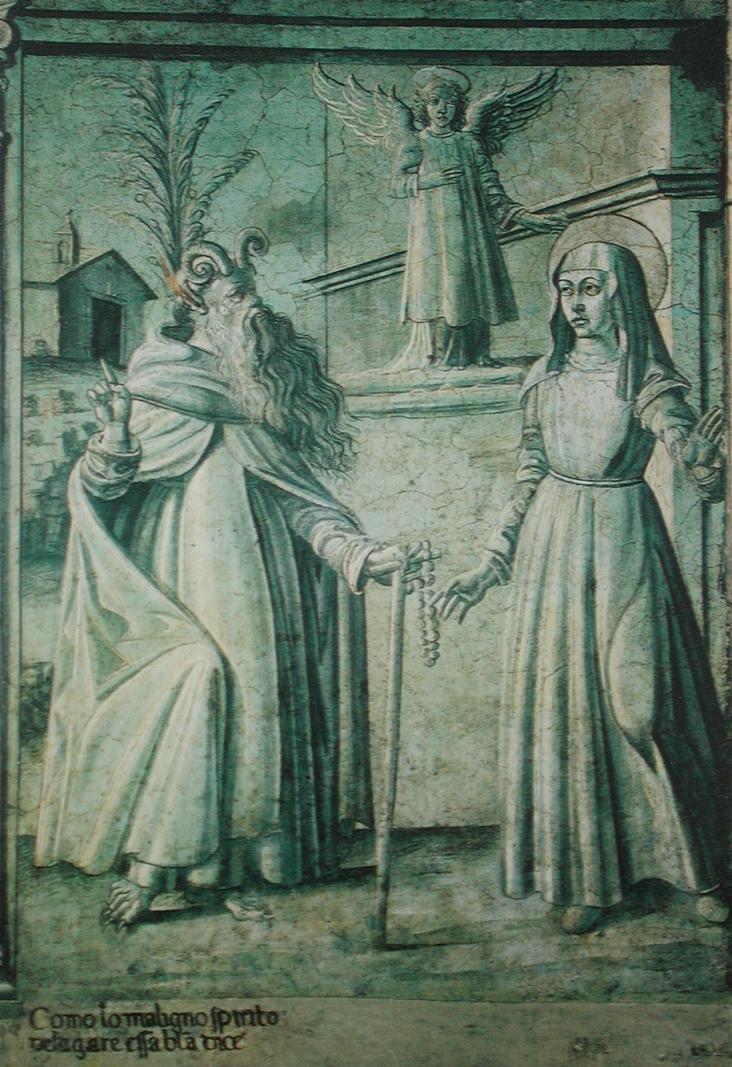
How the Blessed
Francesca met the Evil One disguised as her Patron,
Saint Onofrio
On is this, þat þou3 a creature, man or woman, be neuere soo wel
ne so ofte schreuen and in reste of soule, þe fend maketh hem to beleve þat þei ben not wel schreuen, and alle he doth to
brynge þe soule to
heuynesse. And somtyme þe fend be to myche trauayle and noi3aunce maketh
a man fully to for3ete som thing þat he wolde seye, and þanne he maketh þe soule oute of reste tyl he bee eftesones
shreuen; and þis doth he not for he wolde þat a man were often shreuen, but fully to
entarye hym, and to maken hym beleue þat he were out of grace and blyndet for synne,
and þerfore he
myghte not maken hym self clene.
The secunde gyle vndir colour of goodnesse þat the fend tempteth with is þis. Whanne somme men or women haue be custom
good sterynges and deuoute þou3tes and felyngis of meditacions and of
contemplacions, of suyche parauenture as ben solatarye, he
wele þanne tempte
hem to lothe here dyuyne seruyse that thei ben bounden in,
or werysom, and make hem to ben heuy and weersum to do it,
for he steryth hem to wene þat it were best and more plesynge to god to
folwe here owne werkynges with inne foorth of þinkynges and felynges, þanne for to sey þat þei ben bounden to, þat at some tyme thei ben so trauailed and
troubled to and fro þat thei weten neuere whiche syde is best to
take. And þis 3e may weel
wete is þe fend, for
alwey he cometh with taryengis, or with false plesaunce,
and þis doth he not
for thei schulde occupye hem highely in contemplacion or
in goode meditacions, but for he wolde lette and disturbe
hem þerfro, and
also he wolde maken hem vttirly to leue þe seruyse of god þat þei ben bounden to.
The thredde colour of gyle þat he tempteth with is þis. Whanne a man or a woman 3eueth hym to honest
solace, to strenghte hem self with a3ens the fendis
tormentis in comfort of his owne soule, þanne the fende wele stere hym to haue consciens
þerof, and
putteth in here hertis þat alle suyche disportys is but synne and
vanyte. And somtyme he wole bryng to here mynde herfore
don synnes, for to tary hem; this he doth for to drawe
here hertis to heuynesse, for thei schulde no comforte
haue, but al care and trouble, and so to tempte hem to
dispeir and to bitter þou3tis. But the remedyes of these temptacions
ben þese.
As vnto þe firste, þat þe feend tempeth a man or woman, þou3 thei ben neuere soo wel schrewen hem semeth
þat þei ben not wel schrewen, but alwey dou3ten þat it is not aright doon, or some is for3ete
which thei seen nought; but take þei right non
heed of suyche þoutis, no more þan þei wolden of a gnatte that fleeth before here
face, but þenken fully it
is þe feend to
lette and distrouble pees in here soule. And if so bee þat a man somtyme þoru3 trauelouse þou3tes for3eteth som þing of charge þat he wolde haue seyde, þanne schape a tyme and be confessed þer of; and if he may not ly3tly haue his
confessour, þenke þat he wolde ben confessed þerof quan he may haue his goostly fadir, and in
the mene tyme crye god mercy, and aske hym for3euenesse of
all his traspace, and troust fully it is for3ouen. For a
man is not so redy to asken for3euenesse and mercy, þat 3et oure mercyful lord of his grete goodnesse
is more redy to 3eue it hym.
And as touching the secunde temptacion, þat the feend wolde lette and forbarre a man fro
his dyuyne seruyse þat he is bounden to, and tempteth hym vtterly to
leue it, is þat he be þanne þe more diligent to seye it weel and deuoutly,
with grete reuerence and right good avysement or
attendaunce, and if he seye his seruyse alone, he may quan
deuoute þou3tes comen,
or loue with swetnesse vysyteth hym, or some hi3
visitacioun of the holy gost toucheth hym, he may stynte
of his seruyse for the tyme, and attend to þat, and aftir þat seye forth so þat his seruyse be not lefte undoon ne vnseyde.
And if he doth þus, it schal ben but lytel lettynge to his due
seruyse, but he schal fnde comfort and eese þerinne; and þou3 it lette hym at oo tyme, it schal supporte
hym another tyme.
Þe thredde
temptacion is þis. Whanne a man in comendable tyme 3eueth hym
to honest companye and solace in strenghtynge of his
soule, the feend putteth in his mende and maketh hym
beleue þat it is synne
and perel to hym; and not oonly þis, but also his olde synnes afoore don he
putteth to his mende for to tarye hym. But alle 3e þat ben taryed þus of the feend with þese þou3tes and sterynges, beleue hem not ne charge
hem not, for alle þing þat is treuly groundyd in god, it pleseth god and
not displeseth. Þerfore goddis seruaunties musten alwey grounden
hem weel in god, and don be þe counseil of holy cherche, and if thei don so,
þei schuln
neuere be disseyued. And in as myche as all þing hath tyme in goddis seruyse, a man au3te to
tende to no þing, be it neuere so good, þat schulde lette him fro goddis seruyse.
And also a man þat is traueiled and taketh hym to solace in
dispyt of þe fend, he
ou3te not þat tyme tende
to þat thing þat wolde tarye hym, but he oweth to schape hym a
tyme to crye god mercy and aske for3euenesse of al his
trespas and synne. Þanne ou3te he to taken to mynde þat þe firste mynde was but a taryenge of þe feend; for he þat is endeles good schuldd rather stere a man to
þenke on his
synne in helpe of his lyf þanne in taryenge of his lyf and of his soule.
Capitulum octauum
lso þe feend is ful besy to men and women of tendir
conscyens, to brynge in hem so myche errour þat thei wene þing that is no synne or parauenture is weel done
semethe to hem synne, and of a venyal synne maketh it to
seme greuouse as dedly synne, and of þing of no charge maketh it to seme as thou3 it
were don in dipiste of god or of his seyntis. And
somme the enemy the fend tarieth so gretly þat what euere thei doo or leue to do, thei ben
so byten in conscyens þat þei kan no whilte to gydir haue reste in hem
self; and alle this the fend doth þoru3 fals dreed and blynd conscyens. But þe remedy of þis temptacion and of all other is þat þei gouerne hem be here confessour, or be some
good discret persone, and rule hem fully aftir hym, and
not aftir here owne blynde mysruled consciens. For
suyche a man as is þus taryed, if he folwe his owne conscyens, it
were a gret pryde þat he wolde holden his owne wit betyr than the
trewe loore of holy cherche. Þerfore a man þat wolde don soo muste nedes fallen in to gret
errouris of þe feend and in to his handys; and if suyche an
errour of conscyence made be the enemy seye on to 3ou þat other men feele not þat þat 3e feele, and þerfore thei kunne not deme ne 3eue 3ou good
remedye þerto, and þerfore 3e muste folwe 3oure owne fantasyes, or
ellis 3e þenken that 3e
schuln be lore, take 3e non heed of this þou3t and steryng, ne of no suyche fantasyes þat comen in to 3oure herte, ne charge hem not.
But putteth awey all suyche errouris of consciens as faste
as thei comen to mende; lete him lightly go, and if ony
seye þat þei may not putten hem awey, thei seye not right,
for who so is in wil to do awey a fals conscience and
errour, to fore god it is alwey, þou3 þer leue in hym neuere so many fals domes. And
therfore þou3 a man haue
neuere so many teryenges a3ens his wil in his consciens,
he dare not drede hym, for dredeles god schal euere
comforte hym or he deye; and þe lengere that he suffereth suyche taryengis,
the more is he worthy in the syghte of god.
Capitulum nonum
nd þou3 the feend putte in 3ou ony þou3t of dispeir, or maketh 3ou to þenke þat in the our of death 3e schuln haue suych
yuele þou3tes and
sterynges, and þanne 3e ben but lore, beleue hem not ne charge
it not, but answere hym þus, þat 3e haue put fully 3oure trouste in oure lord
god, and þerfore þou3 he tempte 3ou with ony temptacions,
þou3 the myght
of god and merites of his passyon it schal be no perel to
3ou of soule, but to hym it schal turne to schame and
confusion. And if ony creature, man or woman, seie to 3ou
ony bytynge woord or wordes of discomfort, taketh it
mekely and paciently, and þenketh þat perauenture it is don þoru3 temptacion of the fend to distroblen 3ou
and lette 3ou, or it is a chastysyng of god for som word
or for dede þat 3e haue don or seyd. For oure lord god dooth
lyke a lovynge modir: a louynge modir that is wys and weel
tau3t, sche wole þat here childern be vertuouse and weel
norisched, and if sche may knowe only of hem with a
defau3te, sche wole 3eue hem a knocke on the heed, and if
thei don a gret defua3te, sche wole 3eue hem a buffet
vndir the chekes and if thei don a gretere trespas, sche
wole bylasche hem scharpely. Þus doth god, that is oure louynge fadir þat al vertue and goodnesse cometh fro. He wole þat his specyal and his chosen chyldern ben
vertuouse and weel tau3t in soule, and if thei don a
defaute, he wel knocke hem on the heed with suyche wordis
of displeasaunce and of discomfort. And if thei doo a gret
defaute he wole 3eue hem a buffet with gret scharpenesse
in sondry maneris, aftir þat the sundry defautys ben; and if thei don
grettere trespaces, he chastyseth hem ful scharpely with
gret duresses. And alle þis oure good lord dooth for a specyall loue, for
he hym self seyth þat tho þat he loueth he chastyseth. O treuly, and we
token good keep of these wordes, we wolden be gladdere of
his chastysyngis þan of alle the worldes cherysynges; and
if we deden soo, alle diseses and trybulacions schulden
turne to comfort and joye.
But it is ful hard in tyme of scharpenesse, quan a soule
stondeth naked fro alle goostly and bodyly cimfort, to
take and fynde joye in disese. But þei þat stonden in suyche inward duresse, thei must
seke, in all weyes of discomfort, how þei mowe comfort hem self in god, and þenke alwey þat it is for here beste. And trusteth fully þat god sent neuere chastysyng, þat he ne sent comfort, be long tyme or be
schort, where þoru3 he brengheth hem oute of here disese. Þe profete seyth: Many ben the trivulacions of
rightful men, and of all þo god schal deyueren hem.
And þou3 3e fele
somtyme steryingis of dispeir, or of vnkendely and
onreuerent þou3tes,
comforte 3ou euere more in the goodnesse of god, and in
the peyneful passyon þat his manhod suffered. And for as moche as þe feend tempteth many to desperacions and
dreedis of sauacion, and specyally goddis seruauntes, and
also worldly men and women the feend tempteth hem to
dispeir quan þei beholden here greuous synnes, and the goostly
lyueris he tempteth to dispeir be inputtynge of false
dreedys and streyt conscience, and be deep ymagynacion of
predestinacion, and in moo sondry wyses than I kan telle,
and ful graciously god hath comforted and sent comfort to
many that with dispeir hath be trauayled, and
amongis al tho þat god hath comforted and broute oute of þat errour. I am steryd to telle of oone of hem,
which was a squier þat hi3te John Homeleis.
Narracio
his squier þat I haue named had ben a synful man, and soo at
þe laste þoru3 the beholdynge of his synnes and be the
feendes temptacions, he feel in to dispeir, soo deeply and
so greuously that he had ny lost his mynde; and thus he
was traueiled fourty dayes, þat he myght neyther slepe ne ete, but wasted
awey and was in poynt to spille hym self. But good god, þat is ful of pyte and mercy, wolde not haue hym
lore, and on a day, as he in ful grete sorwe walked in a
wode alone, an aungel came to hym in fourme of a man, and
saluted the squier ful goodly, and talked with hym. Þanne seyde the aungel to hym: Þou semest, seyde he, a man ful of heuynesse and
sorwe. Telle me, I prey the, what causeth thi disese. Nay
seyde the squier, it is not the to telle. 3is, seyde the
aungel, þou wost neuere
how weel I may helpen the and thi disese remeue. A man
schulde, sayde þe aungel, alwey in discomfort and heuynesse
discouere his hert to somme creature þat myght ese hym, for þoru3 good counsel, he myght, seyde þe aungel, recouere bothe to comfort and to
heele, or in sum wyse haue good remedy. Þe squier answarde þe aungel a3en, and seyde þat he wiste weel that he cowde not ne myght not
helpe hym, and therfore he wolde no3te telle hym. This
squier wende alwey þat this aungel hadde ben an erthely man, and he
dreede þat if he had
tolde hym, he wolde a3enward haue seyde som word þat schulde vtterly haue disesed hym; and quan
the aungel si3 þat he wolde be no weye tellen hym, he seyde to
hym in this wyse: Now, seide he, sethen þou wilt not telle me thi greuaunce. I schal
tellen it the. Þou art, seyde the aungel, in dispeir of thi
sauacion, but truste fully þou schalt be saued, for the mercy of god is so
gret þat it passeth
alle his werkes and surmounteþ all synnes. It is sooth, sayde the squier, I
wot weel þat god is
mercyful, but he is rightful also, and his rightwysnesse
must nedys punysche synne, and therfore I drede his
rightwysnesse in iugementes. The aungel answered hym a3en,
and tolde hym many exaumples, how god ful graciously is
mercyful to synners: but this squier of whom I telle was
soo deeply fallen in heuynesse and in dreed that he kowde
take no comfort of thing that he seyde. Þanne spake the aungel to hym and seyde: O, seyde
he, quat þat þou art hard of beleue; but wilt þou haue an open schewynge þat þou schalt be saued, seyde þe aungel to the
squier. I haue here thre dises þat I wole throwe, and þou schalt throwe, and who so hath most on þe dises, sekirly he schal be saued. A, seyde the
squier, how myght I in þrowynge of dyses be in certeyn of my sauacion;
and helde it but a iape. The aungel þrewe the dyses, and had on euery dee vpward
syxe; and he had þanne the squier þrowe the dyse. O, seyde he, certis þat dar I not, for I wot wel, þou3 I caste the dise, mo þanne þou hast cast schulde I not haue and if I hadde
lesse þan þou hast, I schulde vtterly falle in discomfort.
But soo þe aungel spak,
þat at þe last the squier threwe the disc, and in the þrowynge be goddis myght euery dee claf atweyne,
and on eche dee was sixe, and so he hadde the double þat þe aungel hadde. And as he merueiled vp on this,
þe aungel
vanyschid oute of his syght. Þo wiste he wel it was aungel sent of god to
brynge hym oute of his wo. And þanne he cau3te so gret comfort and ioye in þe mercy of god, and in þe goodnesse of his grace, þat alle his sorwes and dredis wenten clene awey,
and he becam þanne goddis seruaunt, and was a blissed leuere,
and quan he schulde departen fro þis world, he diuysed þat whanne he was deed, þere schulde be leid up on hym a ston wreten with
þese wordes
aboute þat folwen:
Here lieth John Homeleis, þat of þe mercy of god may seyn a largeis. I knew a
wurchipful persoone that was in the same abbey here in
Ingelond there as he lyeth, þat redde up on hym the wordes aforn seyde.
Now þanne sethen
oure mercyful lord god, þanked and worchepid mote he bee, sent þus goodly comfort to þis man, þat was a worldly synful man, and receyued hym to
his grace, and brou3te hym oute of dispeir, þer schulde no man ben heuy ne discomforted, þou3 he fele temptacions of dispeir, for hardily
god wole comforten hym whanne he seeth tyme. And þou3 he sende not to a man comfort anon, it is
for to eerne hym the more mede. And þenke alwey, quan 3e feele ony temptacions bodyly
or goostly, that 3e stonden in the blissynge of holy
cherche, for holy write seyth: Blyssed be thei þat suffren temptacions, for whanne þei ben preuyd, thei schuln taken þe crowne of lyfe, the which god hath behi3t to
them that louen hym.
Capitulum decimum
3e childern of holy cherche, þat haue for saken the world for helthe of youre
soules, and principally to plesen god, comfort 3e in in
hym whom 3e haue chosen to loue and serue, for he wole ben
to 3ou ful free and large, as 3e may see be exaumple of
Petir in the gospel, where þat he asked oure lord Iesu what reward he
schulde haue þat had forsaken alle þing to
folwe hym; and oure lord answered hym and seyde that he schulde iugen with hym þe twelue tribis or kynredis of Israel at þe day of jugement. And ferthermore oure lord
seyde also to hym þat all, not only on or too or somme, but he
seyde þat alle þo that forsaken for his loue kyn or frendes or
possessiones, þat is to seyn hous or lond or ony other worldly
good, þe schuln hauen
here in þis lyfe an
hundirt fold mede and blisse with outen ende.
Þerfore,
suster, caste awey all fals dredis that wolde disturbele
and lette 3ou fro loue and hope in god, for no þing pleseth so moche þe feend as to see soules with drawen hem fro
goddis loue, and þerfore he bysyeth hym þer abouten day and nyght, to lette loue and
disturble pees in mannes soule. And on the other syde, no
thyng counfoundyth hym soo myche as dooth þe loue of god, to see a man to sette al his
desyr þerto. But þenk not now as in discomfort, allas, I feele not
that loue, I haue not þat loue þat is soo good, and so be youre owne ymaginacion
falle in discomfort and heuynesse of herte, and þenk and deeme 3oure self lore; but put awey alle
heuynesse and discomfort, and þenk weel it cometh of the enemye, þe feend, to entarye 3ou. Haueth a good wil to
loue and to plese god, and prenteth wel þese woordis in 3oure herte, þat a good wil is acceptid as for deede in þe sight of god, and comforte 3ow alwey in þe name of Jesu. For Jesu is as moche to seie as
sauyour: þenketh weel þer vp on, and haue it weel in mynde, and his
passyon and also his holy vertues, for no þing schal put awey so soone alle þese veyne dredis and temptacions and alle maner
of fantasyes as forto haue weel in mynde þe name of Jesus, his passion and his glorious
vertues.
Þese thre been
scheld and spere, armure and strenghthe to dryue adoun the
feend, be he neuere soo fersly aboute man or woman; and
specyally to þenk on his gracyous vertues, how god þe fadir in hym is al dyuyne nature, in whom is
al myght, to whom no thing is impossible but alle
possibilite: and god the sone is al wisdam, that all þing made and all þing gouerneth: and god the holy gost is al loue
and bounte, þat in a moment of tyme all synnes may for 3eve.
Not thre goddis by oo god in thre persones, thre persones
and oo god onl, in whom is al blisse and al glorye. He is
so fair and bright schynynge that all aungell wondern of
his bewte; his glorious blisful presence feedeth and ful
filleth alle þe court of heuene with merthe and melodye that
is euere lastynge. In hym is al benignyte, kepynge vs fro
vengeaunce, in hym is al grace and gentilnesse, curtesie,
freedam and largynesse, pite, mercy and for3euenesse,
joye, sweetnesse and endeles helte. Suster, he is in alle
oure tribulacions, quan we clepen on to hym, oure comfort,
oure strength, oure helpe and oure soules helthe. Suster,
this is 3oure spouse, whom 3e desyre to loue and plese.
The gretnesse of his vertues, ne the multitude of his
joyes whyche spredeth in to al þe court of heuene to hem þat ben þer inne, may non herte thenke, ne tunge telle
the blisfulnesse of his presense may not be seyd ne
wreten.
Joyeth therfore in oure lord Crist Jesu, for he hath bouth
3ou ful deere, to brynge 3ou to þat blisse, and seith som tyme to hym with a meke
herte: O holy god in whom is al goodnesse, whos pite and
mercy made þe to descende
fro thin hy3e trone, doun in to þis weylynge world, the valey of woo and wepyng,
and heere to taken oure kynde, and in þat kynde þou peyne and passion and cruel charp deeth, to
brynge oure soules on to thy kyngdom. Þou mercyful lord, for 3eue me all þe synnes þat I haue don, thou3t and seyd. Glorious
trinite, sende me clennesse of herte and purete of soule,
restore me with holy vertues and strengthe me with þi myght, þat I mowe alwey with stonden synne and all
temptacions. O good lord, comforte me with thin holy gost,
and fulfille me with perfi3t grace, þat I may fro hens forth lyue vertuosly and loue
þe with all my
myght, with alle myn herte and with alle myn soule, and
neuere to offende the, but euere to folwe thi plesyngis in
wil, word, thou3t and dede. Graunte me this, god infinite
þat eternaly
schal dure. Amen.
Suster, if 3e don thus, I hope it schal doon you ese, and
þou3 3e fynde
no maner of comfort ne swetnesse ne deuocion quan 3e
wolde, be not þerfore discomforted, but suffereth mekely. Many
ben þat stryuen
with hem self as þou3 thei wolde haue swetnesse and deuocion be
maistrie, and I sey 3ou, so wole it not come, but be
mekenesse it wil sunnere be had, and þat is þus, þat a man holde hym self vnwurthy to haue ony
swetnesse or comfort, and offere hym lowly to the wil of
god, and put his wil fully in goddis wil. A man schulde
not desyre to haue swetnesse and deuocion for his owne
comfort and plesaunce, but purely for this entent, only to
plese god, and to folwe his wil; and þerfore if we putte alwey oure wil in his wil, it
suffiseth on to vs, whether we haue it or noon.
Somme also wenen, but if thei felen swetness and deuocion,
þat thei ben
out of grace; but certeynly somme þat felen in hym self no swetnesse ne deuocion, þei ben in more grace than somme þat felen swetnesse and deuocion, and haue many
comfortys, for betir were mekenesse with oute feelyngis
than felyngis with outen mekenesse. Þerfore, suster, suffere mekely and pacyently
what euere falleth to 3ou, and alwey haue a good wil to do
as most were to þe plesynge of god: and quan ony discomfort
cometh in 3oure herte be ymaginacions or be temptacions of
the enemy, haueth tho wordes in 3oure mynde þat often ben seyd in this writynge, þat a good wil schal be accepted as for dede. For
and 3e desire to loue and plese god and to be vertuouse,
it is take and accepted as for dede of oure lord god. If
3e folwe it to 3oure myght alwey quan reson cometh to 3ou
with desirful wil to don weel, and if 3e haue felt comfort
and swetnesse, þou3 3e fele the same temptacions aftir as 3e
deden afore, beth not þerfore discomfortid, ne þenketh thus, allas, it is comen a3en, it wole
neuere awey fro me, and so falle in discomfort be 3oure
owne ymaginacions. But comforte 3ow in god, and beth glad
that þe feend hath
envye on to 3ou, for whiles þe lyf is in the body he wil entarye alwey goddis
seruauntis, for he is ful set a3ens hem, with al malice
and velanye to disese hem in diuers maneris in al þat he kan and may. Saynt Austyn seyth: Many
maneris ben þe temptacion be þe whiche þe wrong eddere the feend, enemye to al mankende,
tormenteth mannes soule, and Seynt Gregory seith þat þer is no þing in which we owne to be so seker of god as
for to haue taryenges and tormentis. And if a man seith
that bodily tormentis ben medeful and not gostly
tormentis, he seyth nou3t right, for dredeles þe gostly tormentis ben werse, more peyneful and
more a3ens wil þan ben the bodily toormentis, and in so moche
they ben þe more
medeful. And þerfore þat man dooth dishonour to god þat seith with a
ful vysement þat þe fend may in this world more tormenten þan god may meden. Wherfore treuly þer is no thing more medeful ne more goodly ne
more charitable þan for to strengthe and comfort the soule þat þe fend tarieth, for who so comforteth hem that
ben desolate, þe lord of comforte, Jesu Crist oure lord god,
wole comforte hem endelesly in the blisse of heuene. The
which lord, þouru3 þe myght and merite of his peyneful passion and
his precyous blood, felle down the poure of þe fend, and graunte cristen soules victorie
ouere the feend, to the worchip of al þe trinite, fader and sone and holy gost, þat lyueth and regneth with owten ende. Amen.
Here I haue endid of temptacions the remedie. God for his
goodnesse on me sinful haue mercy. Amen. Mercy god, mercy
god, mercy god on me. Amen, me sinful haue mercy. Amen.
Mercy god, mercy god, mercy god on me.
Amen
Gloria laus honorque deo patri. Amen.
Et sic explicit liber iste.
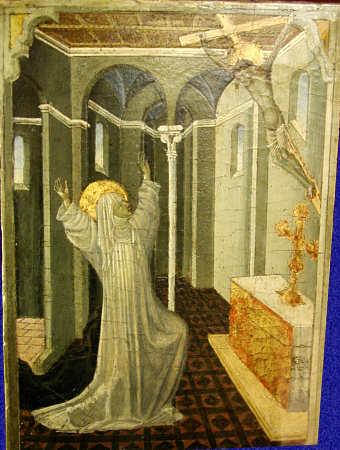
Giovanni di Paolo, St Catherine Receiving Stigmata,
Santa Cristina, Pisa, Metropolitan Museum of Art
Walter Hilton (†1396)
From
the
Scale of
Perfection Book II.21-23,
transcription from British Library, Harley
6579, fols. 84-89, translation by John P.H.
Clark:

' I. am
no3t .I. haf
no3t. nou3t .I. aske ne covete bot þe luf of
ihu '
British
Library,
Harley
6579,
fol. 88v.
21.
An introduction as to how a soul should behave
in purpose and in practice if it wants to come
to this reforming, through the example of a
pilgrim going to Jerusalem; and the two kinds
of humility.
evyrþeles for þu coueteþ for to
haue sm maw writynge by þe whilke þu mi3tes
þe gaþ nei3en to þt reformynge & schal
say þe as me þinkiþ bi þe grace of oure lord
ihu þe shortest & þe rediest helpe þat I
knowe in þis wirkynge. And how þt schal be
.I. schal telle þe by exaumple of a good
pilgrym vpon þis wise: þer was a man þat
wold gon to ierusalem & for he knewe not
þe weye he come to an oþ man þt he hopyt
knewe þe way & asked wheþer he mi3te
come to þat cite & þat oþ man seide to
him þat he mi3te not come þeder withoute
grete disese & mikil trauale for þe wey
is longe & periles and grete . of þefes
& robbers & many oþer / [fol. 84v]
lettynges þat ben þt fallen to a man wiþ
goyng . & also þare mony saie weies . as
it semiþ ledand þederward . Bot men alday
are slayn & dispoiled & mown not
comyn to þt place þt þei covete. Neveþeles
þer is .o. wey þe whilke whoso takiþ hit
& holdiþ it . he wolde undirtake . þy he
schude come to þe cite of ierusalem ne
schulde now les his lif ne be slayn . ne dye
for defaute: ne schulde often be
robbed & yuel betyn . & suffren
unkel disese in þe goyngr & bot he
schulde ay him his lif safe. þan saiþ þe
pilgrim if it be so þat I may have my lif
safe & come to þt place þt I coveite:
.I. charge not what meschef .I. suffre in þe
goynge & þerfore say me what þu
wil & sothly .I. bihote for to don afor
þe: þt oþ answered & saye þus . lo .I.
sait þe in þe ri3t wey. þis is þe wey. &
if þu kepe þe lesyinge þt .I. kemis
þe.
Nevertheless,
because
you
desire
to
have some kind of practice by which you could
approach that reforming more quickly, I shall
tell you by the grace of our Lord Jesus what
seems to me the shortest and promptest aid
that I know in this work. And how that shall
be I will tell you in this manner, through the
example of a good pilgrim.
There
was a man wanting to go to Jerusalem, and
because he did not know the way he came to
another man who he thought knew it and asked
whether he could reach that city. The other
man told him he could not get there without
great hardship and labour, for the way is long
and the perils are great, with thieves and
robbers as well as many other difficulties to
beset a man on his journey; also there are
many different ways seeming to lead in that
direction, yet people are being killed and
robbed daily and cannot come to the place they
desire. However, there is one way, and he
would undertake that anyone who takes and
keeps to it shall come to the city of
Jerusalem, and never lose his life or be slain
or die of want. He would often be robbed and
badly beaten and suffer great distress on his
journey, but his life would always be safe.
Then the pilgrim said: 'If it is true that I
can keep my life and come to the place I
desire, I do not care what trouble I suffer on
the journey, and therefore tell me what you
will, and I promise faithfully to do as you
say'. The other man answered and said this:
'See, I am setting you on the right road. This
is the way, and be sure to keep the
instructions I give you'.
What so you
heres or sees or felis þt schulde lette þe
in þi wey abide not wiþ it wilfully: tary
not for it restfully. behold it not. like it
not. drede it not. bot ay fo forþ in þi wey
& thinke þt þu wantes be at
Jerusalem'. For þt þu covetes þt þu
desires. & no3t elles bot þt. & if
man robbe þe . & dispoile þe bete þe
scorne þe . & dispise þe: ferse not
agayn if þu wilt hav þi lif. Bot holde þe wt
þe harme þt þu has & go forþ . as no3t
were. þt þu take no more harms. And also if
man wil tary þe wiþ tales & fede þe wt
lesynges. for to drawe þe to mirþis &
for to lese þi pilgrimage: make def ere
& answer not agayn & sey not elles
bot þt þu wuldes be at Jerusalem. And if men
proffer þe 3iftes & wil make þe riche wt
werdly gode tente not to hem: þinke ay on
Jerusalem. And if þu wil holde þis wey &
ben as I hafe sayde: promise & take þi
lif þt þu schal not be slayn. bot þou schal
come to þt place þt þu/ [fol. 85] coveites:
'Whatever
you
hear, see or feel that would hinder you on
your way, do not willingly stay with it, and
do not tarry for it, taking rest; do not look
at it, do not take pleasure in it, and do not
fear it; but always go forth on your way and
think that you want to be in Jerusalem. For
that is what you long for and what you desire,
and nothing else but that; and if men rob you,
strip you, beat you, scorn you and despise
you, do not fight back if you want to have
your life, but bear the hurt that you have and
go on as if it were nothing, lest you come to
more harm. In the same way, if men want to
delay you with stories and feed you with lies,
trying to draw you to pleasures and make you
leave your pilgrimage, turn a deaf ear and do
not reply, saying only that you want to be in
Jerusalem. And if men offer you gifts and seek
to enrich you with worldly goods, pay no
attention to them, always think of Jerusalem.
And if you will keep on this way and do as I
have said, I promise you your life - that you
shall not be slain but come to the place that
you desire'.
Softly to
oure propositions. Jerusalem is as mikel for
to seyen as si3t of pes & bitokneþ
contemplacion in perfit luf of god. ffor
contemplacion is not ellis bot a si3t of ihu
whilk is vrey pes. þan if þu coveit for to
com to þis blessednes of vrey pes & ben
a traw pilgrym to Jerusalemward: þaw3 it be
so þt .I. wase neuer þare: neverles as
ferforth as .I. kan .I. schal setes þe in þe
waye þedward:
According
to our spiritual propositions, Jerusalem is as
much as to say sight of peace and stands
for contemplation in perfect love of God, for
contemplation is nothing other than a sight of
Jesus, who is true peace. Then if you long to
come to this blessed sight of true peace and
to be a faithful pilgrim toward Jerusalem -
even though it should be that I was never
there, yet as far as I can - I shall set you
in the way that leads toward it.
þe bygynynge
of þe hi3e wey in þe whilk þu schalt gon is
reformyng in feiþ & in þe lawes of holy
kirke as .I. hafe saide beforn. for trust
sikirly þaw3 þu haue synned hard here bifore
. if þu be now reformed bi þe sacrament of
penaunce after þe lawe of hilikirke þt þu
art in þe ri3t wais. Now þan siþen þu in þe
siker weye: if þu wile spedyn in þi goyngs
& make gode jurndres: þe behoviþ to
holden þese two þonges often in þi mynde.
meknes & luf. þt is '.I. am no3t . .I.
have no3t .I. coveit no3t. but on' þu
sschalt hafe þe menynge of þese woedes in
þin entent & in habite of þi soule
lastendly: þaw3 þu hafe no3t specially þose
wordes ay formed in þi þou3tes: for þt nediþ
not. meknes seiþ .I. am no3t .I. hafe no3t.
lufe saiþ .I. coveit n3t bot on. & þt is
ihu: þese two strenges wel festned wt þe
mynde of Jerusalem makiþ gode acorde in þe
harpe of þe soule. When þei be craftely
touchid wt þe fingres of resoun: for þe
lower þu smytes up on þt in þe hi3er sonniþ
þt oþer: þe lesse þu felist þt þu art or þt
þu hast of þi self þruw3 meknes: þe more þu
coveites for to hau of ihu in desire of luf:
.I. mene not only of þt meknes þt a soule
feliþ in þe si3t of his own syn or holines
& wrecchednes of þis lif: or of þe
worþines of his euencristen: for þaw3 þis
meknes be soþfast & medicinable:
norþeles it is twistous & fleschly as in
segnses./[fol. 85v] not clene ne softe ne
lofli. So .I. mene also þis meknes beynge þt
þe soule feliþ þrw3 grace in si3t &
beholdyng of þe endeles beynge & þe
wondeful godnes of ihu & if you mowe not
seen it 3it wt þi gostly i3e: þt þou trows
it: ffor þrw3 si3t of his beynge eiþer in ful
feiþ or in felyng þu schalt holden þi self
not only as þe most wrecche þt is. but also
as no3t in substaunce of þi soule: þaw3 þu
hever don syn: And þt is lufly meknes: for
in of ihu þt is
soþfatch al: þu art ri3t no3t: And also þt
þu þinke þt þu hast ri3t no3t: So tht as a
vessel þt
standiþ ay
come as no3t Were in as of þi
self: for doo þ
þat
þu hast þe luf of ihu.
þu hast ri3t no3t. ffor wt
þat precious licour only
will þi soule be fulfilled.
& wt none oþer
The
beginning
of the highway along which you shall go is
reforming in faith, grounded humbly in the
faith and in the laws of holy church, as I
have said before, for trust assuredly that
although you have formerly sinned, you are on
the right road, if you are now reformed by the
sacrament of penance according to the law of
holy church. Now since you are on the sure
way, if you want to speed on your travels and
make a good journey each day, you should hold
these two things often in your mind - humility
and love. That is: I am nothing; I have nothing; I
desire only one thing. You shall have
the meaning of these words continually in your
intention, and in the habit of your soul, even
though you may not always have their
particular form in your thought, for that is
not necessary. Humility says, I am nothing; I
have nothing. Love says, I desire only one
thing, and that is Jesus. These two strings,
well-fastened with mindfulness of Jesus, make
good harmony on the harp of the soul when they
are skillfully touched with the finger of
reason. For the lower you strike upon the one,
the higher sounds the other; the less you feel
that you are or that you have of yourself
through humility, the more you long to have of
Jesus in the desire of love. I do not mean
only that humility that a soul feels as it
looks at its own sin or at the frailties and
wretchedness of this life, or at the
worthiness of his fellow Christians, for
although this humility is true and medicinal,
it is comparatively rough and carnal, not pure
or soft or lovely. But I mean also this
humility that the soul feels though grace in
seeing and considering the infinite being and
wonderful goodness of Jesus, and if you cannot
see it yet with your spiritual eye, that you
believe in it, for through the sight of his
being - either in full faith or in feeling -
you shall regard yourself not only as the
greatest wretch that there is, but also as
nothing in the substance of your soul, even if
you had never committed sin. And that is
lovely humility, for in comparison with Jesus
who is in truth All, you are but nothing. In
the same way think that you have nothing, but
are like a vessel that always stands empty, as
if with nothing in it of your own for however
many good works you do, outwardly or inwardly,
you have nothing at all until you have - and
feel that you have - the love of Jesus. For
your soul can be filled only with that
precious liquor, and with nothing else; and
because that thing alone is so precious and so
valuable, regard anything you have and do as
nothing to rest in, without the sight and the
love of Jesus. Throw it all behind you and
forget it, so that you can have what is best
of all.
Just
as a true pilgrim going to Jerusalem leaves
behind him home and land, wife and children,
and makes himself poor and bare of all that he
has in order to travel light and without
hindrance, so if you want to be a spiritual
pilgrim you are to make yourself naked of all
that you have - both good works and bad - and
throw them all behind you, and thus become so
poor in your own feeling that there can be no
deed of your own that you want to lean upon
for rst, but you are always desiring more
grace of love, and always seeking the
spiritual presence of Jesus. If you do so, you
shall then set in your heart, wholly and
fully, your desre to be at Jerusalem, and in
no other place but there; and that is, you
shall set in your heart, wholly and fully,
your will to have nothing but the love of
Jesus and the spiritual sight of him, as far
as he wishes to show himself. It is for that
alone you are made and redeemed, and that is
your beginning and your end, your joy and your
glory. Therefore, whatsoever you have, however
rich you may be in other works of body and
spirit, unless you have that, and know and
feel that you have it, consider that you have
nothing at all. Print this statement well on
the intention of your heart, and hold firmly
to it, and it will save you from all the
perils of your journey, so that you will never
perish. It shall save you from thieves and
robbers (which is what I call unclean
spirits), so that though they strip you and
beat you with diverse temptations, your life
shall always be saved; and in brief if you
guard it as I shall tell you, you shall within
a short time escape all perils and distresses
and come to the city of Jerusalem.
Now
that you are on the road and know the name of
the place you are bound for, begin to go
forward on your journey. Your going forth is
nothing else but the work of the spirit - and
of the body as well, when there is need for it
- which you are to use with discretion in the
following way. Whatever work it is that you
should do, in body or in spirit, according to
the degree and state in which you stand, it if
helps this grace-given desire that you have to
love Jesus, making it more whole, easier and
more powerful for all virtues and all
goodness, that is the work I consider the
best, whether it be prayer, meditation,
reading or working; and as long as that taks
most strenghtens your heart and your working;
and as long as that task most strengthens your
heart and you will for the love of Jesus and
draws your affection and your thought farthest
from worldly vanities, it is good to use it.
And if it happens that the savour of it
becomes less through use, and you feel that
you savour anothing kind of work more, and you
feel more grace in another, take another and
leave that one. For though your desire and the
yearning of your heat for Jesus should always
be unchangeable, nevertheless the spiritual
practices that you are to use in prayer or the
meditation to feed and nourish you desire may
be diverse, and may well be changed according
to the way you feel disposed to appply your
own heart, through grace.
For
it goes with works and desire as it does with
a fire and sticks. The more sticks are laid on
a fire, the greater is the flame, and so the
more varied the spiritual work that anyone has
in mind for keeping his desire whole, the more
powerful and ardent shall be his desire for
God. Therefore notice carefully what work you
best know how to do and what most helps you to
keep whole this desire for Jesus (if you are
free, and are not bound except under the
common law), and do that. Do not bind yourself
unchangeably to practices of your own choosing
that hinder the freedom of your heart to love
Jesus if grace should specially visit you, for
I shall tell you which customs are always good
and need to be kept. See, a particular custom
is always good to keep if it consists in
getting virtue and hindering sin, and that
practice should never be left. For if you
behave well, you will always be humble and
patient, sober and chaste; and so with all
other virtues. But the practice of any other
thing that hinders a better work should be
left when it is time for one to do this; for
instance in a certain way for a particular
length of time, or waking or kneeling for a
certian time, or doing other such bodily work,
this practice is to be left off sometimes when
a reasonable cause hinders it, or else if more
grace comes from another quarter.
22.
The delays and temptations that souls shall
feel from their spiritual enemies on their
spiritual journey to the heavenly Jerusalem,
and some remedies against them.
ow
Now
you are on the way and know how you shall go.
Now beware of enemies that will be trying to
hinder you if they can, for their intention is
to put out of your heart that desire and that
longing that you have for the love of Jesus,
and to drive you home again to the love of
worldly vanity, for there is nothing that
grieves them so much. These enemies are
principally carnal desires and vain fears that
rise out of your heart through the corruption
of your fleshly nature, and want to hinder you
desire for the love of God, so that they can
fully occupy your heart without disturbance.
These are your nearest enemies. There are
other enemies too, such as unclean spirits
that are busily trying to decieve you with
tricks and wiles. But you shall have one
remedy, as I said before: whatever it may be
they say, do not believe them, but keep on
your way and desire only the love of Jesus.
Always give this answer: I am nothing, I have
nothing, I desire nothing but the love of
Jesus alone. If your enemies speak to you
first like this, by stirrings in your heart,
that you have not made a proper confession, or
that there is some old sin hidden in your
heart that you do not know and never
confessed, and therefore you must turn home
again, leave your desire and go to make a
better confession: do not believe this saying,
for it is false and you are absolved. Trust
firmly that you are on the road, and you need
no more ransacking of your confession for what
is past: keep on your way and think of
Jerusalem. Similarly, if they say that you are
not worthy to have the love of God, and ask
what good it is to crave something you cannot
have and do not deserve, do not believe them,
but go forward, saying thus, 'Not because I am
worthy, but because I am unworthy - that is my
motive for loving God, for if I had that love,
it would make me worthy; and since I was made
for it, even though I should never have it I
will yet desire it, and therefore I will pray
and meditate in order to get it'. And then, if
your enemies see that you begin to grow bold
and resolute in your work, they start getting
frightened of you; however, they will not stop
hindering you when they can as long as your
are going on your way. What with fear and
menaces on the one hand and flattery and false
blandishment on the other, to make you break
your purpose and turn home again, they will
speak like this: 'If you keep up your desire
for Jesus, labouring as hard as you have
begun, you will fall into sickness or into
fantasies and frenzies, as you see some do, or
you will fall into poverty and come to bodily
harm, and no one will want to help you; or you
might fall into secret temptations of the
devil, in which you will not know how to help
yourself. It is very dangerous for any man to
give himself wholly to the love of God, to
leave all the world and desire nothing but his
love alone; for so many perils may befall that
one does not know of. And therefore turn home
again and leave this desire, for you will
never carry it through to the end, and behave
as other people do in the world'.
So
say your enemies; but do not believe them.
Keep up your desire, and say nothing else but
that you want to have Jesus and to be in
Jerusalem. And if they then perceive your will
to be so strong that you will not spare
yourself - for sin or for sickness, for
fantasies or frenzy, for doubts or fears of
spiritual temptations, for poverty or
distress, for life or for death - but that you
will is set ever onward, with one thing and
one alone, turning a deaf ear to them as if
you did not hear them, and keeping on
stubbornly and unstintingly with your prayers
and your other spiritual works, and with
discretion according to the counsel of your
superior or your spiritual father; then they
begin to be angry and to draw a little nearer
to you. They start robbing you and beating you
and doing you all the injury they know: and
that is when they cause all your deeds -
however well done - to be judged evil by
others and turned the worst way. And whatever
you may want to do for the benefit of your
body and soul, it will be hampered and
hindered by other men, in order to thwart you
in everything that you reasonably desire. All
this they do to stir you to anger, resentment
or ill-will against your fellow Christians.
But
against all these annoyances, and all others
that may befall, use this remedy; take Jesus
in your mind, and do not be angry with them;
do not linger with them, but think of your
lesson - that you are nothing, you have
nothing, you cannot lose any earthly goods,
and you desire nothing but the love of Jesus -
and keep on your way to Jerusalem, with your
occupation. Nevertheless, if through your own
frailty you are at some time vexed with such
troubles befalling your life in the body
through the ill-will of man or the malice of
the devil, come to yourself again as soon as
you can; stop thinking of that distress and go
forth to your work. Do not stay too long with
them, for fear of your enemies.
23.
A general remedy against wicked stirrings and
painful vexations that befall the heart from
the world, the flesh and the devil.
nd aftir
þis
Your
enemies will be much abashed, when they see you so
well-disposed that you are not annoyed,
heavyhearted, wrathful, or greatly stirred against
any creature, for anything that they can do or say
against you, but that you fully set your heart
upon bearing all that may happen - ease and
hardship, praise or blame - and that you will not
trouble about anything, provided you can keep
whole your thought and your desire for the love of
God. But then they will try you with flattery and
vain blandishment, and that is when they bring to
the sight of your soul all your good deeds and
virtues and impress upon you that all men praise
you and speak of your holiness; and how everybody
loves you and honors you for your holy living.
Your enemies do this to make you think that their
talk is true, and take delight in this vain joy
and rest in it; but it you do well you shall hold
all such vain jabbering as the falsehood and
flattery of your enemy, who proffers you a drink
of venom tempered with honey. Therefore refuse it;
say you do not want any of it, but want to be in
Jerusalem.
' I. am
no3t .I. haf
no3t. nou3t .I. aske ne covete bot þe
luf of iћu '
British
Library,
Harley
6579,
fol. 88v.
You
shall feel such hindrances, or others like them -
what with your flesh, the world and the devil -
more than I can recite now. For as long as a man
allows his thoughts to run willingly all over the
world to consider different things, he notices few
hindrances; but as soon as he draws all his
thought and his yearning to one thing alone - to
have that, to see that, to know that, and to love
that (and that
is only Jesus) - then he shall well feel many
painful hindrances, for everything that he feels
and is not what he desires is a hindrance to him.
Therefore, I have told you particularly of some as
an example. Furthermore, I say in general that
whatever stirring you feel from your flesh or from
the devil, pleasant or painful, bitter or sweet,
agreeable or dreadful, glad or sorrowful - that
would draw down your thought and your desire from
the love of Jesus to worldly vanity and utterly
prevent the spiritual desire that you have for the
love of him, so that your heart should stay
occupied with that stirring: think nothing of it,
do not willingly receive it, and do not linger
over it too long. But if it concerns some worldly
thing that ought to be done for yoruself or your
fellow Christian, finish with it quickly and bring
it to an end so that it does not hang on your
heart. If it is some other thing that is not
necessary, or does not concern you, do not trouble
about it, do not parley with it, and do not get
angry; neither fear it nor take pleasure in it,
but promptly strike it out of your heart, saying
thus: 'I am nothing; I have nothing; I neither
seek nor desire anything but the love of Jesus'.
Knit your thought to this desire and make it
strong; maintin it with prayer and with other
spiritual work so that you do not forget it; and
it shall lead you in the right way and save you
from all perils, so that although you feel them
you shall not perish. And I think it will bring
you to perfect love of our Lord Jesus.
On the other hand I also say: Whatever work or
stirring it may be that can help your desire,
strengthen and nourish it, and make your
heart furthest from the enjoyment and remembrance
of the world, and more whole and more ardent for
the love of God - whether it be prayer or
meditation, stillness or speaking, reading or
listening, solitude or company, walking or sitting
- keep it for the time and work in it as long as
the savor lasts, provided you take with it food,
drink and sleep like a pilgrim, keeping discretion
in your labor as your superior advises and
ordains. For however great his hate on his
journey, yet at the right time he is willing to
eat, drink and sleep. Do so yourself, for although
it may hinder you at one time it shall advance you
at another.
The Cloud of Unknowing
Author (†unknown)
GO TO
MARY'S DOWRY, PART II
For download of published book, Mary's Dowry
Indices to Umiltà Website's
Essays on Julian:
Preface
Influences
on Julian
Her Self
Her
Contemporaries
Her Manuscript
Texts ♫
with recorded readings of them
About Her
Manuscript Texts
After Julian,
Her Editors
Julian in our Day
Publications related to Julian:


Saint
Bride and Her Book: Birgitta of Sweden's Revelations
Translated from Latin and Middle English with Introduction,
Notes and Interpretative Essay. Focus Library of Medieval Women. Series Editor,
Jane Chance. xv + 164 pp. Revised, republished,
Boydell and Brewer, 1997. Republished, Boydell and Brewer,
2000. ISBN 0-941051-18-8
 To see an example of a page inside with
parallel text in Middle English and Modern English, variants
and explanatory notes, click here. Index to this book at http://www.umilta.net/julsismelindex.html
To see an example of a page inside with
parallel text in Middle English and Modern English, variants
and explanatory notes, click here. Index to this book at http://www.umilta.net/julsismelindex.html
Julian of
Norwich. Showing of Love: Extant Texts and Translation. Edited.
Sister Anna Maria Reynolds, C.P. and Julia Bolton Holloway.
Florence: SISMEL Edizioni del Galluzzo (Click
on British flag, enter 'Julian of Norwich' in search
box), 2001. Biblioteche e Archivi
8. XIV + 848 pp. ISBN 88-8450-095-8.
 To see
inside this book, where God's words are in red, Julian's
in black, her editor's in grey, click here.
To see
inside this book, where God's words are in red, Julian's
in black, her editor's in grey, click here.
Julian of
Norwich. Showing of Love. Translated, Julia Bolton
Holloway. Collegeville:
Liturgical Press;
London; Darton, Longman and Todd, 2003. Amazon
ISBN 0-8146-5169-0/ ISBN 023252503X. xxxiv + 133 pp. Index.
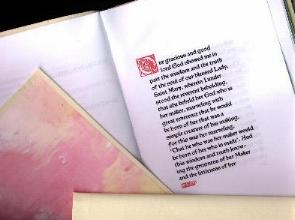 To view sample copies, actual
size, click here.
To view sample copies, actual
size, click here.
Julian of
Norwich, Showing of Love, Westminster Text, translated into
Modern English, set in William Morris typefont, hand bound
with marbled paper end papers within vellum or marbled paper
covers, in limited, signed edition. A similar version
available in Italian translation. To order, click here.

'Colections'
by an English Nun in Exile: Bibliothèque Mazarine 1202.
Ed. Julia Bolton Holloway, Hermit of the Holy Family. Analecta
Cartusiana 119:26. Eds. James Hogg, Alain Girard, Daniel Le
Blévec. Salzburg: Institut für Anglistik und Amerikanistik
Universität Salzburg, 2006.

Anchoress and Cardinal: Julian of
Norwich and Adam Easton OSB. Analecta Cartusiana 35:20 Spiritualität
Heute und Gestern. Salzburg: Institut für Anglistik und
Amerikanistik Universität Salzburg, 2008. ISBN
978-3-902649-01-0. ix + 399 pp. Index. Plates.
Teresa Morris. Julian of Norwich: A
Comprehensive Bibliography and Handbook. Preface,
Julia Bolton Holloway. Lewiston: Edwin Mellen Press, 2010.
x + 310 pp. ISBN-13: 978-0-7734-3678-7; ISBN-10:
0-7734-3678-2. Maps. Index.

Fr Brendan
Pelphrey. Lo, How I Love Thee: Divine Love in Julian
of Norwich. Ed. Julia Bolton Holloway. Amazon,
2013. ISBN 978-1470198299

Julian among
the Books: Julian of Norwich's Theological Library.
Newcastle upon Tyne: Cambridge
Scholars Publishing, 2016. xxi + 328 pp. VII Plates, 59
Figures. ISBN (10): 1-4438-8894-X, ISBN (13)
978-1-4438-8894-3.

Mary's Dowry; An Anthology of
Pilgrim and Contemplative Writings/ La Dote di
Maria:Antologie di
Testi di Pellegrine e Contemplativi.
Traduzione di Gabriella Del Lungo
Camiciotto. Testo a fronte, inglese/italiano. Analecta
Cartusiana 35:21 Spiritualität Heute und Gestern.
Salzburg: Institut für Anglistik und Amerikanistik
Universität Salzburg, 2017. ISBN 978-3-903185-07-4. ix
+ 484 pp.
JULIAN OF NORWICH, HER SHOWING OF LOVE
AND ITS CONTEXTS ©1997-2024 JULIA BOLTON HOLLOWAY
|| JULIAN OF NORWICH || SHOWING OF
LOVE || HER TEXTS || HER SELF || ABOUT
HER TEXTS || BEFORE JULIAN
|| HER CONTEMPORARIES || AFTER JULIAN || JULIAN IN OUR TIME || ST BIRGITTA OF SWEDEN
|| BIBLE AND WOMEN || EQUALLY IN GOD'S IMAGE || MIRROR OF SAINTS || BENEDICTINISM ||
THE CLOISTER || ITS SCRIPTORIUM || AMHERST MANUSCRIPT || PRAYER|| CATALOGUE AND PORTFOLIO (HANDCRAFTS, BOOKS
) || BOOK REVIEWS || BIBLIOGRAPHY ||


