NAME
Hh.1.11.
DESCRIPTION
Paper and parchment; 136 [135 + i]; 208 x 146; fifteenth century.
CONTENTS
Inside front cover: A contents list in a seventeenth-century hand, alongside a few Latin words. ff. 1r–8v: Chapters 3 (the Incarnation and Annunciation) and 6–7 (the Nativity of Christ and the Circumcision) from Nicholas Love's Mirror of the Blessed Life of Jesus Christ (IPMEP 553); ff. 9r–12r (before f. 12r a slip has been inserted containing a 'prefacio' labelled 'a', clearly for insertion before that labelled 'B' on f. 11v opposite): Latin Missa de nomine Ihesu; f. 12r–v: A list of indulgences in Latin associated with the previous item and referring to Boniface IV (608–15) and four fifteenth-century bishops, Robert Hallum of Salisbury, Cornelius Archbishop of Tuam, John of Elphin, and John of Llandaff; f. 12v: Nicene Creed in Latin; ff. 13r–44v: Chapters 39–51 (the Last Supper to the Visitation to the Sepulchre) and 62–63 (the Ascension and Pentecost) from Nicholas Love's Mirror of the Blessed Life of Jesus Christ (IPMEP 553); f. 44v: Three prayers in Latin; ff. 45r–53v: Part of Point Six of The Seven Points of True Love and Everlasting Wisdom, a translation of Henry Suso's Orologium sapientiae (IPMEP 465); f. 54r–v: Latin prayer on the seven words from the cross; ff. 55r–60r: Chapter 38 from The Pricking of Love, a translation of the Stimulus amoris (IPMEP 46); f. 60v: Latin prayer to the name of Jesus; ff. 61r–68r: Second version of the translation of William Flete's Remedies against Temptations (IPMEP 230); f. 68v: Blank; ff. 69r–86r: Commentaries on Psalm 90, possibly by Walter Hilton (IPMEP 554); ff. 86r–99r: Commentaries on Psalm 91 possibly by Walter Hilton (IPMEP 115.5); f.99v: Blank; ff. 100r–116r: Third version of the translation of William Flete's Remedies against Temptations (IPMEP 528); ff. 116v–117v: Blank; ff. 118r–120v: Latin Speculum peccatoris; f. 121r–v: Blank; ff. 122r–127v: Revelations of Saint Elizabeth, an independent manuscript version of the early printed text of 1492? and 1500? (IPMEP 508); ff. 128r–132v: Sermon for the Assumption; ff. 133r–134r: Blank; ff. 134v–135v: Latin hymn 'Gaude flore virginali' on the seven heavenly joys of Mary, commonly attributed to St Thomas of Canterbury and associated with the Assumption, and here accompanied by an English prose commentary; f. 136r: A few Latin lines concerning Christ's resurrection; f. 136r: Part of the Vision of St John on the Sorrows of the Virgin (IPMEP 323); f. 136v: Blank, apart from a few pen-trials; inside back cover: A few lines in a late fifteenth- or early sixteenth-century hand and some pen-trials.
COMMENTS
As shown in O'Mara 1994:142–47, the manuscript is a booklet production containing some eight major and nine minor hands from various points in the fifteenth-century. On f. 1r someone has written a large W on two occasions at the bottom of the page and it occurs again on f. 8r; there are words of greeting possibly to a Valentine in a hand of the late fifteenth- or early sixteenth-century as follows: 'waldeyn' (f. 22v) , 'walontyn' [?] (f. 23r) and 'valontyng' [?] (f. 95r). On f. 135v a word that looks vaguely like 'wrisuhay-' or 'wrisnhay-' was 'dubiously' interpreted in Doyle 1953:II. 97 as Bruisyard, a Suffolk convent of Minoresses; however, as noted in O'Mara 1994:164–72, although there is no proof, the balance of probability would associate the manuscript with the Benedictines of Carrow in Norwich. The manuscript was acquired from the library of Richard Holdsworth (1590–1649), Master of Emmanuel College. After a protracted dispute between the University and Emmanuel College, Holdworth's library was officially allotted to the University in the 1660s, though it had actually acquired it some years before the Restoration (Oates 1986:321). LALME I:67–68 localises the texts as follows: ff. 1r–44v (Essex); ff. 45r–60r (Norfolk); ff. 61r–99r (Norfolk); ff. 102r–102v ('probably' east Norfolk); ff. 122r–127v ('probably' east Norfolk); and ff. 128r–132r (Norfolk).
BIBLIOGRAPHY
CUL Catalogue 1856–67:III, 262–64; O'Mara 1994:141–61.
Sermon Description: CUL/Hh.1.11/001
OCCASION
Assumption (15 August).
LENGTH
128r–132v.
INCIPIT
To declare to 3ow at þis tyme sumwhat of thys excellent fest of owre gloriows modyr vowe and patronesse quyche in þis most hy fest bothe in body and sowle, as it is leuyd, was assumpt, althoow I am noth sufficient of myn owyn merytis 3et, trostyng on here help and goodnesse, sumwhat I purpose to declare to 3ow, as God 3eue me grace. Sostrys, we arn tawt be þe wordys of þe holy gospel þat whatsumeuer mesure a man metyt3 to anothyr, þe same shal be motyn a3en to hym. Therfore, it is impossible þat any man may comprehendyn be hese owyn reson with what honorwrys [sic] and reuerens owyt3 þe gloryows modyr of God to be worchepyd of alle creaturys in heuenely palayce.
EXPLICIT
Thus þan schul 3e honesteli and semengly aray 3ow in þis solempne assumpcion to þe reuerens of þis 3oyful feste, quyche aray, continuali vsyd to þe honour of þis blisful lady and empresse, mut 3ow gostly edifien in vertuous augmentacion of grace, and aftyr þis freele lyf brynge 3ow to diuine vysion in quyche seyntys haue here fruicion. Amen.
SUMMARY
It is impossible to understand the extent to which the Virgin Mary ought to be honoured in heaven. When Christ summoned her from this world, all the angels, souls, and saints were ready to honour her, and God gave her dominion over all creatures [128v] and cursed spirits. As gold surpasses other metals, so angels and blessed souls are worthier than other creatures. As gold may not be formed without fire and has to be fashioned by a goldsmith, so the soul of this maiden was fashioned by God with the fire of the Holy Spirit. As gold may not be seen [129r] until it is borne into the light of the sun, so the works of the Virgin Mary could not be seen until her soul was borne into the sight of the true sun (divinity).
It is also impossible to understand the joy that accompanied the departure of Mary from this deceptive world. [129v] Her body, separated from her soul, was carried to the sepulchre by the apostles and assumed into heaven to join her soul. Scripture says that Christ then crowned her queen of heaven, empress of hell, lady of the world and mother to the king of angels. He honoured her with seven 'dignites': virtuousness, [130r] purity, fairness, wisdom, strength, brightness, and spiritual sweetness. [130v] All must ask for the help of the Virgin to 'kepe the poyntis of oure religion'.
Every person, lay and clerical, puts on special clothes in honour of high feasts. Religious women should wear clothes which signify their virtues: a smock (contrition and confession); a kirtle (trust in God) with two sleeves (righteousness and mercy); [131r] two boots (two desires:will to amend, and to do good deeds and abstain from evil); a girdle (restraint of one's will); knives (loving consideration of perpetual joy); a surplice (knowledge of God and of his benefits); a mantle (faith, with seams representing Christ's charity and a lace or cord representing contemplation of the passion); a wimple (abstinence); [131v] a veil (obedience); and a ring made of gold, silver, and stones [132r] (symbolising three separate things that Christ commands; three things he counsels; three things he forbids; and three that he allows). [132v]
BIBLICAL CITATIONS
cf. Mt 7:2 et al.
PROPER NAMES
Mary.
CONCEPTS
Assumption; Women; Regular Clergy.
NOTES
The sermon is clearly addressed to members of a female religious community. It borrows extensively from Birgittine sources, principally the Second Lesson for Saturday, Chapter 20 of the Sermo Angelicus and St Birgitta's Revelaciones, I, 31; see O'Mara 1994:173–85 for full details.
BIBLIOGRAPHY
O'Mara 1994:197–221.

 To see an example
of a page inside with parallel text in Middle English
and Modern English, variants and explanatory notes,
click
To see an example
of a page inside with parallel text in Middle English
and Modern English, variants and explanatory notes,
click  To see inside this book, where
God's words are in red, Julian's in black, her
editor's in grey, click
To see inside this book, where
God's words are in red, Julian's in black, her
editor's in grey, click 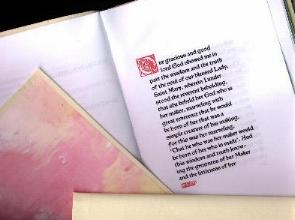 To view sample
copies, actual size, click
To view sample
copies, actual size, click