 Lecceto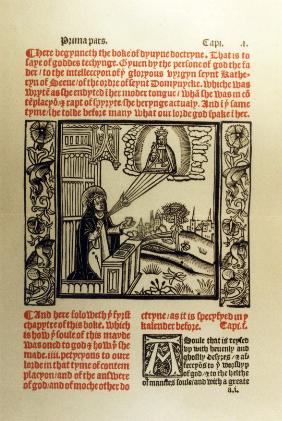
Catherine
of Siena, The
Orcherd of Syon (Dialogo), London: Wynken de Worde, 1519
 ure merciful lord god chastyseth hese childirn and
suffereth hem to ben tempted for many profytable skeles to
here soule profi3te: and þerfore ther schulde non man ne woman ben
hevy ne sory for no temptacion. For Seint Jame the apostele
thecheth vs þat
we schulden haue wery gret joy quan we ben tempted with
diuers temptacions. For as the goold is purged and pured be
fier, and a knight in hard batail is proued good but if he
suffre hym self to ben ouere come, right so is a man be
temptacion preued for good but if he suffre hym self to ben
ouere come, þat
is to seye but if he consente ther to be deliberacion.
ure merciful lord god chastyseth hese childirn and
suffereth hem to ben tempted for many profytable skeles to
here soule profi3te: and þerfore ther schulde non man ne woman ben
hevy ne sory for no temptacion. For Seint Jame the apostele
thecheth vs þat
we schulden haue wery gret joy quan we ben tempted with
diuers temptacions. For as the goold is purged and pured be
fier, and a knight in hard batail is proued good but if he
suffre hym self to ben ouere come, right so is a man be
temptacion preued for good but if he suffre hym self to ben
ouere come, þat
is to seye but if he consente ther to be deliberacion.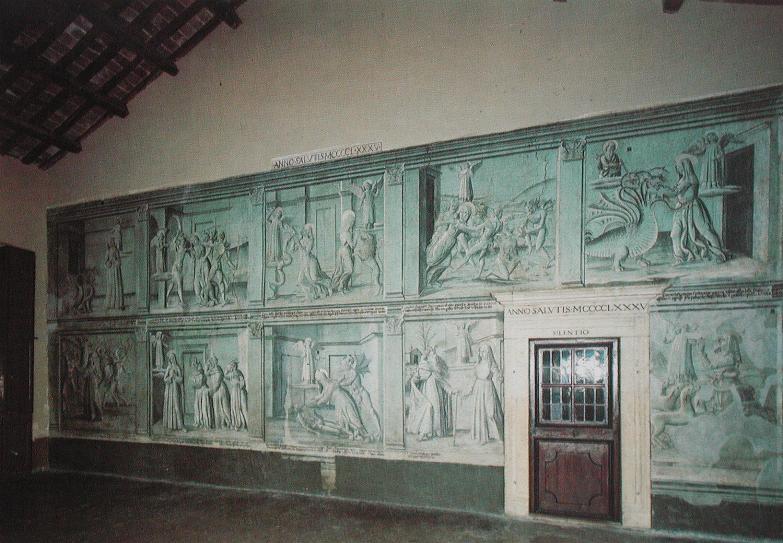
 ut
often the temptynge of þe fend, þat maketh þe soule to erre in feyth and to fantasye in
dispeir, semeth gret synne to a manis soule, and is not so.
For all holy doctoures seyn þat feith and hope ben vertues of a mannes
wil, wherfore who so wolde rightfully beleue, he is in right
beleue aforn god, and who so wold trustely hope, he is in
trusty hope aforn god, þough he be neuere so moch trauailed with
weerful thoughtes or doughteful. Þe apostle Seynt Poule seyth þat in a mannes wil is þe beleue of rightwysnes, of which wordes
seyth þe
glose þat al
only in mannes wil, which may not be constreyened, lieth
bothe meede and gylt. Þat is to seyn, a man aforn god hath neuere
meede ne gylt for no dede, but only of tho dedes þat ben don wilfully.
ut
often the temptynge of þe fend, þat maketh þe soule to erre in feyth and to fantasye in
dispeir, semeth gret synne to a manis soule, and is not so.
For all holy doctoures seyn þat feith and hope ben vertues of a mannes
wil, wherfore who so wolde rightfully beleue, he is in right
beleue aforn god, and who so wold trustely hope, he is in
trusty hope aforn god, þough he be neuere so moch trauailed with
weerful thoughtes or doughteful. Þe apostle Seynt Poule seyth þat in a mannes wil is þe beleue of rightwysnes, of which wordes
seyth þe
glose þat al
only in mannes wil, which may not be constreyened, lieth
bothe meede and gylt. Þat is to seyn, a man aforn god hath neuere
meede ne gylt for no dede, but only of tho dedes þat ben don wilfully. nd if it so be þat 3e have consentid and fallen in ony
temptacion, beth sory, and crieth god mercy þerof, and beth not discomforted þerfore. Þenke wel on the grete mercy of god, how he
forgaf Dauid his grete synnes, and Petir and Maudeleyn,
and not only hem but also alle tho þat haue be or mow be and schulen ben contrite
for here synnes and cryen god mercy.
nd if it so be þat 3e have consentid and fallen in ony
temptacion, beth sory, and crieth god mercy þerof, and beth not discomforted þerfore. Þenke wel on the grete mercy of god, how he
forgaf Dauid his grete synnes, and Petir and Maudeleyn,
and not only hem but also alle tho þat haue be or mow be and schulen ben contrite
for here synnes and cryen god mercy. nd þerfore þer schulde no man kare ne ben hevy þat he is so traueiled more þan another. Sister, alwey quan I speke of man in
þis wrytinge,
take it bothe for man and woman, for so it is ment in alle
such writinges, for al is mankende. And forthermore as
touchynge 3oure troubles, þenke 3e in alle 3oure diseses qwat troubles and
diseses goddis seruantis have suffred, what peynes and
quat tormentis þei haue had here in erthe in many sondre
maneris, and 3e schal fynden cause to suffre. Leo þe pope seith þat it falleth somtime þat goode and righteful soules ben sterd be þe fend, and somtyme be sterynge of complexion to
angres, troubles, taryenges and diseses of dredes, þat it semeth to hem her lif a torment, and here
deth an ease, in so moche þat somtyme for disese þei begynnen to dispeire both of here lyf of body
and of here soule. And thei wenen þat þei ben forsaken of god, whiche asayeth and
proveth his chosen frendes be temptacyons and angres. But
these fondynges or vyolent temptynge and angwischis ben
but purgynges and preuynges of the soule, for as I sette
and seyde at þe begynnynge of þis wrytynge, right as þe feir purgeth gold, and a knight also is preuyd
good and hardy be bataile, right so temptacions and
trubles preueth and pureth þe rightful man. This is preued wel be Thobie,
for the angel Raphael seide to Thobie thus: For as moche
as þou were
righteful to god it was nedeful þat temptacion schulde preuen thi wil.nd þerfore grutche no man a3ens the will of god, ne
merueile not of þese maner of temtacions, for the more a man or
woman is tempted in this maner or in ony other maner a3ens
here wil, and thei with stonden it, þat is to seye not with a quemeful wil
consentynge þerto, but mekely suffereth it, þe more thei ben sadded in good vertues and
profyten in the syght of god, þou3 it be hyd fro hem.nd for as myche as many men kunne not in
tyme of temptacion ne woln not see it, but ben sory and
dredeful of complexion, þerfore to alle suche men thre thynges ben
nedeful. The firste is þat thei be not myche alone. The secunde is þat thei þenke not ne seche no þing deeply, but fully reule hem, as I seyde
afore, be som good discret persone; and þou3 it come in to here herte and mynde þat þei schuld be lore or in perell, þou3 þei wold beholde here counsell, thei owen to
taken non heed to suyche þou3tis and sterynges, ne charge hem. Take thei
non heed of suyche ymagynacions or sotyl conseytes, for it
may neuere turne hem to dampnacion, the counseil of wise
men þat is 3ouen to
hem for here sauacion. God seyth in the gospel þat if þe menynge be good of a manis purpose, þe dede is good. The thredde remedy is this, þat for as myche as the fend traueileth faste to
make a man dredful and sory, þanne þat he to þe worchip of god and in troust of his helpe, and
to schame and confusion of the fend and right in dispyct
of hym, þat he
strengthe hym self to be glad and mery, þou3 it be a3ens herte. And drede no þing the fendis malice, for þe lasse gladnesse that a man fyndeth in his
herte, þe more mede he
is worthy, so þat he strengthe hym self to be glad and mery to
the worchep of god and dispitte of þe fend. For holy writ seyth þat þe aposteles 3eden awey mery and glad quan the
Jewes, goddis enemyes, hadden schamfully beten hem.lso oure olde enemy the fend and serpent is
often tymes aboute to begyle mannes soule in many sondre
maneris. He cometh somtme vndir þe colour of goodnesse to disseyuen hem þat fayn wold don wel; and specyally of the
thingis I wele speke of.
nd þerfore þer schulde no man kare ne ben hevy þat he is so traueiled more þan another. Sister, alwey quan I speke of man in
þis wrytinge,
take it bothe for man and woman, for so it is ment in alle
such writinges, for al is mankende. And forthermore as
touchynge 3oure troubles, þenke 3e in alle 3oure diseses qwat troubles and
diseses goddis seruantis have suffred, what peynes and
quat tormentis þei haue had here in erthe in many sondre
maneris, and 3e schal fynden cause to suffre. Leo þe pope seith þat it falleth somtime þat goode and righteful soules ben sterd be þe fend, and somtyme be sterynge of complexion to
angres, troubles, taryenges and diseses of dredes, þat it semeth to hem her lif a torment, and here
deth an ease, in so moche þat somtyme for disese þei begynnen to dispeire both of here lyf of body
and of here soule. And thei wenen þat þei ben forsaken of god, whiche asayeth and
proveth his chosen frendes be temptacyons and angres. But
these fondynges or vyolent temptynge and angwischis ben
but purgynges and preuynges of the soule, for as I sette
and seyde at þe begynnynge of þis wrytynge, right as þe feir purgeth gold, and a knight also is preuyd
good and hardy be bataile, right so temptacions and
trubles preueth and pureth þe rightful man. This is preued wel be Thobie,
for the angel Raphael seide to Thobie thus: For as moche
as þou were
righteful to god it was nedeful þat temptacion schulde preuen thi wil.nd þerfore grutche no man a3ens the will of god, ne
merueile not of þese maner of temtacions, for the more a man or
woman is tempted in this maner or in ony other maner a3ens
here wil, and thei with stonden it, þat is to seye not with a quemeful wil
consentynge þerto, but mekely suffereth it, þe more thei ben sadded in good vertues and
profyten in the syght of god, þou3 it be hyd fro hem.nd for as myche as many men kunne not in
tyme of temptacion ne woln not see it, but ben sory and
dredeful of complexion, þerfore to alle suche men thre thynges ben
nedeful. The firste is þat thei be not myche alone. The secunde is þat thei þenke not ne seche no þing deeply, but fully reule hem, as I seyde
afore, be som good discret persone; and þou3 it come in to here herte and mynde þat þei schuld be lore or in perell, þou3 þei wold beholde here counsell, thei owen to
taken non heed to suyche þou3tis and sterynges, ne charge hem. Take thei
non heed of suyche ymagynacions or sotyl conseytes, for it
may neuere turne hem to dampnacion, the counseil of wise
men þat is 3ouen to
hem for here sauacion. God seyth in the gospel þat if þe menynge be good of a manis purpose, þe dede is good. The thredde remedy is this, þat for as myche as the fend traueileth faste to
make a man dredful and sory, þanne þat he to þe worchip of god and in troust of his helpe, and
to schame and confusion of the fend and right in dispyct
of hym, þat he
strengthe hym self to be glad and mery, þou3 it be a3ens herte. And drede no þing the fendis malice, for þe lasse gladnesse that a man fyndeth in his
herte, þe more mede he
is worthy, so þat he strengthe hym self to be glad and mery to
the worchep of god and dispitte of þe fend. For holy writ seyth þat þe aposteles 3eden awey mery and glad quan the
Jewes, goddis enemyes, hadden schamfully beten hem.lso oure olde enemy the fend and serpent is
often tymes aboute to begyle mannes soule in many sondre
maneris. He cometh somtme vndir þe colour of goodnesse to disseyuen hem þat fayn wold don wel; and specyally of the
thingis I wele speke of.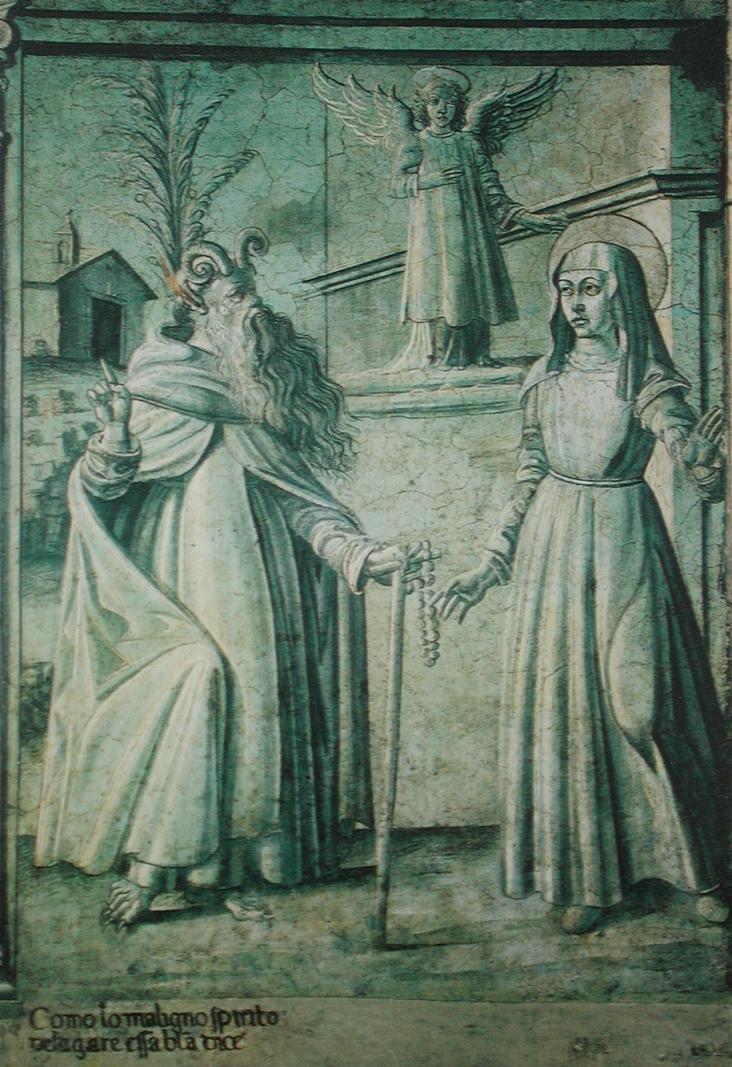 lso þe feend is ful besy to men and women of tendir
conscyens, to brynge in hem so myche errour þat thei wene þing that is no synne or parauenture is weel done
semethe to hem synne, and of a venyal synne maketh it to
seme greuouse as dedly synne, and of þing of no charge maketh it to seme as thou3 it
were don in dipiste of god or of his seyntis. And
somme the enemy the fend tarieth so gretly þat what euere thei doo or leue to do, thei ben
so byten in conscyens þat þei kan no whilte to gydir haue reste in hem
self; and alle this the fend doth þoru3 fals dreed and blynd conscyens. But þe remedy of þis temptacion and of all other is þat þei gouerne hem be here confessour, or be some
good discret persone, and rule hem fully aftir hym, and
not aftir here owne blynde mysruled consciens. For
suyche a man as is þus taryed, if he folwe his owne conscyens, it
were a gret pryde þat he wolde holden his owne wit betyr than the
trewe loore of holy cherche. Þerfore a man þat wolde don soo muste nedes fallen in to gret
errouris of þe feend and in to his handys; and if suyche an
errour of conscyence made be the enemy seye on to 3ou þat other men feele not þat þat 3e feele, and þerfore thei kunne not deme ne 3eue 3ou good
remedye þerto, and þerfore 3e muste folwe 3oure owne fantasyes, or
ellis 3e þenken that 3e
schuln be lore, take 3e non heed of this þou3t and steryng, ne of no suyche fantasyes þat comen in to 3oure herte, ne charge hem not.
But putteth awey all suyche errouris of consciens as faste
as thei comen to mende; lete him lightly go, and if ony
seye þat þei may not putten hem awey, thei seye not right,
for who so is in wil to do awey a fals conscience and
errour, to fore god it is alwey, þou3 þer leue in hym neuere so many fals domes. And
therfore þou3 a man haue
neuere so many teryenges a3ens his wil in his consciens,
he dare not drede hym, for dredeles god schal euere
comforte hym or he deye; and þe lengere that he suffereth suyche taryengis,
the more is he worthy in the syghte of god.nd þou3 the feend putte in 3ou ony þou3t of dispeir, or maketh 3ou to þenke þat in the our of death 3e schuln haue suych
yuele þou3tes and
sterynges, and þanne 3e ben but lore, beleue hem not ne charge
it not, but answere hym þus, þat 3e haue put fully 3oure trouste in oure lord
god, and þerfore þou3 he tempte 3ou with ony temptacions,
þou3 the myght
of god and merites of his passyon it schal be no perel to
3ou of soule, but to hym it schal turne to schame and
confusion. And if ony creature, man or woman, seie to 3ou
ony bytynge woord or wordes of discomfort, taketh it
mekely and paciently, and þenketh þat perauenture it is don þoru3 temptacion of the fend to distroblen 3ou
and lette 3ou, or it is a chastysyng of god for som word
or for dede þat 3e haue don or seyd. For oure lord god dooth
lyke a lovynge modir: a louynge modir that is wys and weel
tau3t, sche wole þat here childern be vertuouse and weel
norisched, and if sche may knowe only of hem with a
defau3te, sche wole 3eue hem a knocke on the heed, and if
thei don a gret defua3te, sche wole 3eue hem a buffet
vndir the chekes and if thei don a gretere trespas, sche
wole bylasche hem scharpely. Þus doth god, that is oure louynge fadir þat al vertue and goodnesse cometh fro. He wole þat his specyal and his chosen chyldern ben
vertuouse and weel tau3t in soule, and if thei don a
defaute, he wel knocke hem on the heed with suyche wordis
of displeasaunce and of discomfort. And if thei doo a gret
defaute he wole 3eue hem a buffet with gret scharpenesse
in sondry maneris, aftir þat the sundry defautys ben; and if thei don
grettere trespaces, he chastyseth hem ful scharpely with
gret duresses. And alle þis oure good lord dooth for a specyall loue, for
he hym self seyth þat tho þat he loueth he chastyseth. O treuly, and we
token good keep of these wordes, we wolden be gladdere of
his chastysyngis þan of alle the worldes cherysynges; and
if we deden soo, alle diseses and trybulacions schulden
turne to comfort and joye.
lso þe feend is ful besy to men and women of tendir
conscyens, to brynge in hem so myche errour þat thei wene þing that is no synne or parauenture is weel done
semethe to hem synne, and of a venyal synne maketh it to
seme greuouse as dedly synne, and of þing of no charge maketh it to seme as thou3 it
were don in dipiste of god or of his seyntis. And
somme the enemy the fend tarieth so gretly þat what euere thei doo or leue to do, thei ben
so byten in conscyens þat þei kan no whilte to gydir haue reste in hem
self; and alle this the fend doth þoru3 fals dreed and blynd conscyens. But þe remedy of þis temptacion and of all other is þat þei gouerne hem be here confessour, or be some
good discret persone, and rule hem fully aftir hym, and
not aftir here owne blynde mysruled consciens. For
suyche a man as is þus taryed, if he folwe his owne conscyens, it
were a gret pryde þat he wolde holden his owne wit betyr than the
trewe loore of holy cherche. Þerfore a man þat wolde don soo muste nedes fallen in to gret
errouris of þe feend and in to his handys; and if suyche an
errour of conscyence made be the enemy seye on to 3ou þat other men feele not þat þat 3e feele, and þerfore thei kunne not deme ne 3eue 3ou good
remedye þerto, and þerfore 3e muste folwe 3oure owne fantasyes, or
ellis 3e þenken that 3e
schuln be lore, take 3e non heed of this þou3t and steryng, ne of no suyche fantasyes þat comen in to 3oure herte, ne charge hem not.
But putteth awey all suyche errouris of consciens as faste
as thei comen to mende; lete him lightly go, and if ony
seye þat þei may not putten hem awey, thei seye not right,
for who so is in wil to do awey a fals conscience and
errour, to fore god it is alwey, þou3 þer leue in hym neuere so many fals domes. And
therfore þou3 a man haue
neuere so many teryenges a3ens his wil in his consciens,
he dare not drede hym, for dredeles god schal euere
comforte hym or he deye; and þe lengere that he suffereth suyche taryengis,
the more is he worthy in the syghte of god.nd þou3 the feend putte in 3ou ony þou3t of dispeir, or maketh 3ou to þenke þat in the our of death 3e schuln haue suych
yuele þou3tes and
sterynges, and þanne 3e ben but lore, beleue hem not ne charge
it not, but answere hym þus, þat 3e haue put fully 3oure trouste in oure lord
god, and þerfore þou3 he tempte 3ou with ony temptacions,
þou3 the myght
of god and merites of his passyon it schal be no perel to
3ou of soule, but to hym it schal turne to schame and
confusion. And if ony creature, man or woman, seie to 3ou
ony bytynge woord or wordes of discomfort, taketh it
mekely and paciently, and þenketh þat perauenture it is don þoru3 temptacion of the fend to distroblen 3ou
and lette 3ou, or it is a chastysyng of god for som word
or for dede þat 3e haue don or seyd. For oure lord god dooth
lyke a lovynge modir: a louynge modir that is wys and weel
tau3t, sche wole þat here childern be vertuouse and weel
norisched, and if sche may knowe only of hem with a
defau3te, sche wole 3eue hem a knocke on the heed, and if
thei don a gret defua3te, sche wole 3eue hem a buffet
vndir the chekes and if thei don a gretere trespas, sche
wole bylasche hem scharpely. Þus doth god, that is oure louynge fadir þat al vertue and goodnesse cometh fro. He wole þat his specyal and his chosen chyldern ben
vertuouse and weel tau3t in soule, and if thei don a
defaute, he wel knocke hem on the heed with suyche wordis
of displeasaunce and of discomfort. And if thei doo a gret
defaute he wole 3eue hem a buffet with gret scharpenesse
in sondry maneris, aftir þat the sundry defautys ben; and if thei don
grettere trespaces, he chastyseth hem ful scharpely with
gret duresses. And alle þis oure good lord dooth for a specyall loue, for
he hym self seyth þat tho þat he loueth he chastyseth. O treuly, and we
token good keep of these wordes, we wolden be gladdere of
his chastysyngis þan of alle the worldes cherysynges; and
if we deden soo, alle diseses and trybulacions schulden
turne to comfort and joye. his squier þat I haue named had ben a synful man, and soo at
þe laste þoru3 the beholdynge of his synnes and be the
feendes temptacions, he feel in to dispeir, soo deeply and
so greuously that he had ny lost his mynde; and thus he
was traueiled fourty dayes, þat he myght neyther slepe ne ete, but wasted
awey and was in poynt to spille hym self. But good god, þat is ful of pyte and mercy, wolde not haue hym
lore, and on a day, as he in ful grete sorwe walked in a
wode alone, an aungel came to hym in fourme of a man, and
saluted the squier ful goodly, and talked with hym. Þanne seyde the aungel to hym: Þou semest, seyde he, a man ful of heuynesse and
sorwe. Telle me, I prey the, what causeth thi disese. Nay
seyde the squier, it is not the to telle. 3is, seyde the
aungel, þou wost neuere
how weel I may helpen the and thi disese remeue. A man
schulde, sayde þe aungel, alwey in discomfort and heuynesse
discouere his hert to somme creature þat myght ese hym, for þoru3 good counsel, he myght, seyde þe aungel, recouere bothe to comfort and to
heele, or in sum wyse haue good remedy. Þe squier answarde þe aungel a3en, and seyde þat he wiste weel that he cowde not ne myght not
helpe hym, and therfore he wolde no3te telle hym. This
squier wende alwey þat this aungel hadde ben an erthely man, and he
dreede þat if he had
tolde hym, he wolde a3enward haue seyde som word þat schulde vtterly haue disesed hym; and quan
the aungel si3 þat he wolde be no weye tellen hym, he seyde to
hym in this wyse: Now, seide he, sethen þou wilt not telle me thi greuaunce. I schal
tellen it the. Þou art, seyde the aungel, in dispeir of thi
sauacion, but truste fully þou schalt be saued, for the mercy of god is so
gret þat it passeth
alle his werkes and surmounteþ all synnes. It is sooth, sayde the squier, I
wot weel þat god is
mercyful, but he is rightful also, and his rightwysnesse
must nedys punysche synne, and therfore I drede his
rightwysnesse in iugementes. The aungel answered hym a3en,
and tolde hym many exaumples, how god ful graciously is
mercyful to synners: but this squier of whom I telle was
soo deeply fallen in heuynesse and in dreed that he kowde
take no comfort of thing that he seyde. Þanne spake the aungel to hym and seyde: O, seyde
he, quat þat þou art hard of beleue; but wilt þou haue an open schewynge þat þou schalt be saued, seyde þe aungel to the
squier. I haue here thre dises þat I wole throwe, and þou schalt throwe, and who so hath most on þe dises, sekirly he schal be saued. A, seyde the
squier, how myght I in þrowynge of dyses be in certeyn of my sauacion;
and helde it but a iape. The aungel þrewe the dyses, and had on euery dee vpward
syxe; and he had þanne the squier þrowe the dyse. O, seyde he, certis þat dar I not, for I wot wel, þou3 I caste the dise, mo þanne þou hast cast schulde I not haue and if I hadde
lesse þan þou hast, I schulde vtterly falle in discomfort.
But soo þe aungel spak,
þat at þe last the squier threwe the disc, and in the þrowynge be goddis myght euery dee claf atweyne,
and on eche dee was sixe, and so he hadde the double þat þe aungel hadde. And as he merueiled vp on this,
þe aungel
vanyschid oute of his syght. Þo wiste he wel it was aungel sent of god to
brynge hym oute of his wo. And þanne he cau3te so gret comfort and ioye in þe mercy of god, and in þe goodnesse of his grace, þat alle his sorwes and dredis wenten clene awey,
and he becam þanne goddis seruaunt, and was a blissed leuere,
and quan he schulde departen fro þis world, he diuysed þat whanne he was deed, þere schulde be leid up on hym a ston wreten with
þese wordes
aboute þat folwen:
Here lieth John Homeleis, þat of þe mercy of god may seyn a largeis. I knew a
wurchipful persoone that was in the same abbey here in
Ingelond there as he lyeth, þat redde up on hym the wordes aforn seyde. 3e childern of holy cherche, þat haue for saken the world for helthe of youre
soules, and principally to plesen god, comfort 3e in in
hym whom 3e haue chosen to loue and serue, for he wole ben
to 3ou ful free and large, as 3e may see be exaumple of
Petir in the gospel, where þat he asked oure lord Iesu what reward he
schulde haue þat had forsaken alle þing to
folwe hym; and oure lord answered hym and seyde that he schulde iugen with hym þe twelue tribis or kynredis of Israel at þe day of jugement. And ferthermore oure lord
seyde also to hym þat all, not only on or too or somme, but he
seyde þat alle þo that forsaken for his loue kyn or frendes or
possessiones, þat is to seyn hous or lond or ony other worldly
good, þe schuln hauen
here in þis lyfe an
hundirt fold mede and blisse with outen ende.
his squier þat I haue named had ben a synful man, and soo at
þe laste þoru3 the beholdynge of his synnes and be the
feendes temptacions, he feel in to dispeir, soo deeply and
so greuously that he had ny lost his mynde; and thus he
was traueiled fourty dayes, þat he myght neyther slepe ne ete, but wasted
awey and was in poynt to spille hym self. But good god, þat is ful of pyte and mercy, wolde not haue hym
lore, and on a day, as he in ful grete sorwe walked in a
wode alone, an aungel came to hym in fourme of a man, and
saluted the squier ful goodly, and talked with hym. Þanne seyde the aungel to hym: Þou semest, seyde he, a man ful of heuynesse and
sorwe. Telle me, I prey the, what causeth thi disese. Nay
seyde the squier, it is not the to telle. 3is, seyde the
aungel, þou wost neuere
how weel I may helpen the and thi disese remeue. A man
schulde, sayde þe aungel, alwey in discomfort and heuynesse
discouere his hert to somme creature þat myght ese hym, for þoru3 good counsel, he myght, seyde þe aungel, recouere bothe to comfort and to
heele, or in sum wyse haue good remedy. Þe squier answarde þe aungel a3en, and seyde þat he wiste weel that he cowde not ne myght not
helpe hym, and therfore he wolde no3te telle hym. This
squier wende alwey þat this aungel hadde ben an erthely man, and he
dreede þat if he had
tolde hym, he wolde a3enward haue seyde som word þat schulde vtterly haue disesed hym; and quan
the aungel si3 þat he wolde be no weye tellen hym, he seyde to
hym in this wyse: Now, seide he, sethen þou wilt not telle me thi greuaunce. I schal
tellen it the. Þou art, seyde the aungel, in dispeir of thi
sauacion, but truste fully þou schalt be saued, for the mercy of god is so
gret þat it passeth
alle his werkes and surmounteþ all synnes. It is sooth, sayde the squier, I
wot weel þat god is
mercyful, but he is rightful also, and his rightwysnesse
must nedys punysche synne, and therfore I drede his
rightwysnesse in iugementes. The aungel answered hym a3en,
and tolde hym many exaumples, how god ful graciously is
mercyful to synners: but this squier of whom I telle was
soo deeply fallen in heuynesse and in dreed that he kowde
take no comfort of thing that he seyde. Þanne spake the aungel to hym and seyde: O, seyde
he, quat þat þou art hard of beleue; but wilt þou haue an open schewynge þat þou schalt be saued, seyde þe aungel to the
squier. I haue here thre dises þat I wole throwe, and þou schalt throwe, and who so hath most on þe dises, sekirly he schal be saued. A, seyde the
squier, how myght I in þrowynge of dyses be in certeyn of my sauacion;
and helde it but a iape. The aungel þrewe the dyses, and had on euery dee vpward
syxe; and he had þanne the squier þrowe the dyse. O, seyde he, certis þat dar I not, for I wot wel, þou3 I caste the dise, mo þanne þou hast cast schulde I not haue and if I hadde
lesse þan þou hast, I schulde vtterly falle in discomfort.
But soo þe aungel spak,
þat at þe last the squier threwe the disc, and in the þrowynge be goddis myght euery dee claf atweyne,
and on eche dee was sixe, and so he hadde the double þat þe aungel hadde. And as he merueiled vp on this,
þe aungel
vanyschid oute of his syght. Þo wiste he wel it was aungel sent of god to
brynge hym oute of his wo. And þanne he cau3te so gret comfort and ioye in þe mercy of god, and in þe goodnesse of his grace, þat alle his sorwes and dredis wenten clene awey,
and he becam þanne goddis seruaunt, and was a blissed leuere,
and quan he schulde departen fro þis world, he diuysed þat whanne he was deed, þere schulde be leid up on hym a ston wreten with
þese wordes
aboute þat folwen:
Here lieth John Homeleis, þat of þe mercy of god may seyn a largeis. I knew a
wurchipful persoone that was in the same abbey here in
Ingelond there as he lyeth, þat redde up on hym the wordes aforn seyde. 3e childern of holy cherche, þat haue for saken the world for helthe of youre
soules, and principally to plesen god, comfort 3e in in
hym whom 3e haue chosen to loue and serue, for he wole ben
to 3ou ful free and large, as 3e may see be exaumple of
Petir in the gospel, where þat he asked oure lord Iesu what reward he
schulde haue þat had forsaken alle þing to
folwe hym; and oure lord answered hym and seyde that he schulde iugen with hym þe twelue tribis or kynredis of Israel at þe day of jugement. And ferthermore oure lord
seyde also to hym þat all, not only on or too or somme, but he
seyde þat alle þo that forsaken for his loue kyn or frendes or
possessiones, þat is to seyn hous or lond or ony other worldly
good, þe schuln hauen
here in þis lyfe an
hundirt fold mede and blisse with outen ende.
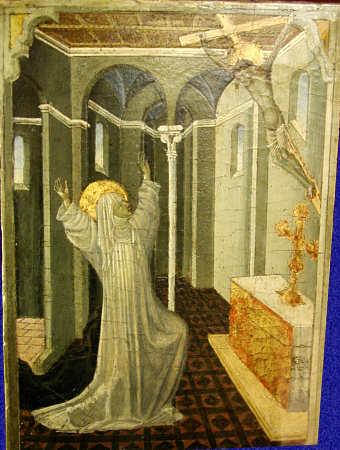
Giovanni di Paolo, St Catherine Receiving Stigmata, Santa Cristina, Pisa, Metropolitan Museum of Art
Now, see:This thesis
provides a critical edition of four Middle English versions
of De remediis contra temptaciones by William Flete,
along with an edition and modern English translation of the
Latin De remediis. De remediis is a treatise of
religious direction concerned with the spiritual temptations
of doubt and despair. Despite its wide circulation and
influence in the fourteenth, fifteenth, and sixteenth
centuries, it has received little scholarly attention. The
Latin source text and the Middle English versions ME1a,
ME1b, and ME2, each an independent translation of the Latin,
are edited here for the first time. The version ME3, an
expanded adaptation of ME2, is presented for the first time
in a critical edition with variants from all of the
witnesses. Two translations that have previously been
classified together as ‘ME1’ are here identified as
distinct. The texts are edited from the following base
manuscripts: ME1a from Oxford, Bodleian Library, MS Bodley
131; ME1b from olim Foyle MS, Beeleigh Abbey, Essex
(sold at Christie’s 11 July 2000); and both ME2 and ME3 from
Cambridge, Cambridge University Library, MS Hh.1.11.
Comprehensive variants from all of the manuscripts and
printed witnesses are recorded in the apparatus to each
edition. The Latin De remediis is edited from
Cambridge, Cambridge University Library, MS Ff.6.44, with
selected variants. The introduction discusses De
remediis and the four Middle English versions, the
treatise’s treatment of religious doubt and despair, the
fourteen manuscripts and two early printed editions of the
Middle English versions, and the textual relationships
between the witnesses.


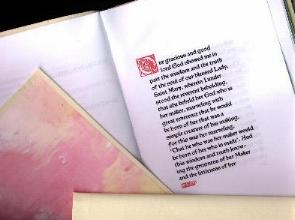
Saint Bride and Her Book: Birgitta of Sweden's Revelations Translated from Latin and Middle English with Introduction, Notes and Interpretative Essay. Focus Library of Medieval Women. Series Editor, Jane Chance. xv + 164 pp. Revised, republished, Boydell and Brewer, 1997. Republished, Boydell and Brewer, 2000. ISBN 0-941051-18-8
 To see an example of a page inside
with parallel text in Middle English and Modern English,
variants and explanatory notes, click here. Index to this book at http://www.umilta.net/julsismelindex.html
To see an example of a page inside
with parallel text in Middle English and Modern English,
variants and explanatory notes, click here. Index to this book at http://www.umilta.net/julsismelindex.html
Julian
of Norwich. Showing of Love: Extant Texts and
Translation. Edited. Sister Anna
Maria Reynolds, C.P. and Julia Bolton Holloway.
Florence: SISMEL Edizioni del Galluzzo (Click on British flag, enter 'Julian of
Norwich' in search box),
2001. Biblioteche e Archivi 8. XIV + 848 pp. ISBN
88-8450-095-8.
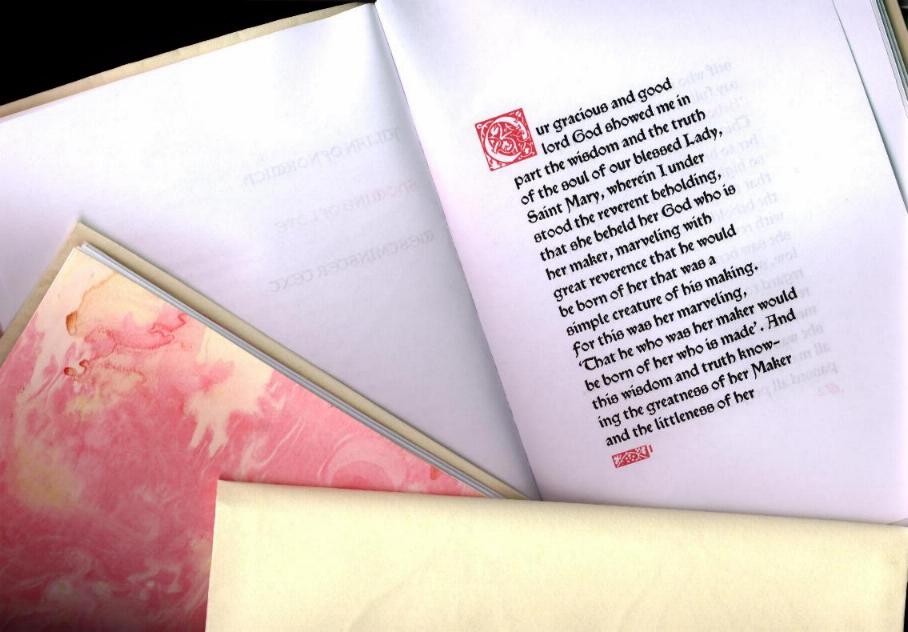
 To
see inside this book, where God's words are in red,
Julian's in black, her editor's in grey,
click here.
To
see inside this book, where God's words are in red,
Julian's in black, her editor's in grey,
click here.
Julian
of Norwich. Showing of Love. Translated, Julia Bolton
Holloway. Collegeville: Liturgical Press;
London; Darton, Longman and Todd, 2003. Amazon
ISBN 0-8146-5169-0/ ISBN 023252503X. xxxiv + 133 pp.
Index.
 To view sample copies,
actual size, click here.
To view sample copies,
actual size, click here.

'Colections'
by an English Nun in Exile: Bibliothèque Mazarine 1202.
Ed. Julia Bolton Holloway, Hermit of the Holy Family.
Analecta Cartusiana 119:26. Eds. James Hogg, Alain Girard,
Daniel Le Blévec. Salzburg: Institut für Anglistik und
Amerikanistik Universität Salzburg, 2006.

Anchoress and Cardinal: Julian
of Norwich and Adam Easton OSB. Analecta Cartusiana
35:20 Spiritualität Heute und Gestern. Salzburg: Institut
für Anglistik und Amerikanistik Universität Salzburg, 2008.
ISBN 978-3-902649-01-0. ix + 399 pp. Index. Plates.
Teresa Morris. Julian of Norwich: A
Comprehensive Bibliography and Handbook.
Preface, Julia Bolton Holloway. Lewiston: Edwin Mellen
Press, 2010. x + 310 pp. ISBN-13:
978-0-7734-3678-7; ISBN-10: 0-7734-3678-2. Maps.
Index.

Fr Brendan
Pelphrey. Lo, How I Love Thee: Divine Love in
Julian of Norwich. Ed. Julia Bolton Holloway.
Amazon,
2013. ISBN 978-1470198299

Julian
among the Books: Julian of Norwich's Theological Library.
Newcastle upon Tyne: Cambridge
Scholars Publishing, 2016. xxi + 328 pp. VII Plates,
59 Figures. ISBN (10): 1-4438-8894-X, ISBN (13)
978-1-4438-8894-3.

Mary's Dowry; An Anthology of
Pilgrim and Contemplative Writings/ La Dote di
Maria:Antologie
di Testi di Pellegrine e Contemplativi.
Traduzione di Gabriella Del Lungo
Camiciotto. Testo a fronte, inglese/italiano.
Analecta Cartusiana 35:21 Spiritualität Heute und
Gestern. Salzburg: Institut für Anglistik und
Amerikanistik Universität Salzburg, 2017. ISBN
978-3-903185-07-4. ix + 484 pp.
  |
To donate to the restoration by Roma of
Florence's formerly abandoned English Cemetery and to
its Library click on our Aureo Anello Associazione:'s
PayPal button: THANKYOU! |