AGRUSTIC SOMNACUNI || ROMANY || CRADLE || LET US PRAISE
THE ROM || CHUPPA || MEDIATHECA 'FIORETTA
MAZZEI' || 'ENGLISH'
CEMETERY || AUREO
ANELLO ||
THUNDERS OF WHITE SILENCE
CHAPTER IX: FROM GRAVES TO CRADLES
When I became custodian in 2000, now nineteen years ago, this is
somewhat what the Cemetery looked like. The photograph below was
taken twenty years ago. At least by the time I arrived a laurel
hedge had been planted which hid some of the worst of the neglect
but it was damaging tombs with its roots and its sap stained the
white marble. The thirty-years continuous use of weedkiller
likewise was damaging the cypresses of Arnold Böcklin's Island
of the Dead and also eroding the pietra serena bases of the tombs. Our
visitors expressed anger at the neglect, criticizing us for it.

Tombs had been grossly vandalized, piled one on top of the other,
particularly their crosses wilfully broken. The marble was black
with pollution. Some tombs had even been stolen, including that
for Maria Böcklin of the
'Island of the Dead'. Syringes were everywhere. There were traces
of Black Masses. The soil had been poisoned with the thirty years
of weedkiller and covered over with gravel to discourage any
greenery. Only stinging nettles flourished, so it was an agony to
walk amongst the tombs in summer in sandals. The erosion on the
hill was extremely serious from the dry wall having collapsed in
1966's heavy rains, tombs in Sectors D and E leaning
dangerously like Easter Island figures. The iron railings were
broken, rusting, many stolen. Suicides were attempted beneath its
walls. It was a place of despair and ugliness.
We placed the accounts of the tombs on the Web and descendants and
scholars came and found us, some from as far away as Africa,
Australia, New Zealand, helping us with information and donations
for the Delisser, Checcucci, Lyon Herbert, Reid, Lumley, Gough,
Logan Campbell, and Barrett Browning tombs. Maestro Franco
Zeffirelli telephoned us with his support and had the Mayor give
us a crossing and traffic lights where there had been none before.
Others encouraged us to restore the garden, Vieri Torrigiani
Malaspina, Anna Porcinai, Katherine Goldsmith, Nicholas
Dakin-Elliot. The garden now abounds with wild purple irises,
Florence's fragrant lily, with lavender, with roses, with papyri,
with myrtle, with wild strawberries, with hedges of the original
box instead of the later laurel. To do these restorations
we consulted old engravings and old photographs. The
Museo Archeologico Nazionale housing the coeval loot from the
Champollion and Rosellini Expedition to Egypt and Nubia
created an exhibition on the Egytpian motives in the English
Cemetery. The Gabinetto Viessuex held a conference on the
Cemetery, and then we held another. We gathered 6000
signatures internationally to save the Swiss-owned so-called
'English' Cemetery from closure. In 2011 we were a candidate
for UNESCO's Memory of the World. I had already spoken
of the Cemetery and the Roma at the UNESCO WSIS conference in
St Petersburg in 2005. We became a founding member of ASCE,
Association of Significant Cemeteries in Europe, and thus part
of the European Union's Cemeteries Cultural Route. Our library
with its archive was decreed a member of SDIAF. Eugenio Giani
of the City of Florence awarded us first the laurel wreath to
honour Elizabeth Barrett Browning, then even the laurel wreath
and the Gonfalone. I was invited to speak to the European
Economic and Social Committee on the Roma and the Cemetery in
Brussels in 3011, having already spoken on Roma and education
in Antwerp in 2008.
By 2012 a miracle had happened. Roma from Romania have half
restored the Cemetery and its garden. Our visitors from all over
the world no longer criticize but instead lavish praises on how
well the Cemetery is maintained. Our telling the story of how this
happened is another miracle. It educates global visitors away from
prejudice and fear to appreciation and joy, and they quickly draw
analogies: if they are Americans, to the Abolition of Slavery and
Civil Rights; if Canadians, Americans, Brazilians, and
Australians, to the Lost Generation of Native Peoples; if
Europeans, to the Holocaust, if South African, to apartheid, if
Israeli, to Palestinians. This Cemetery, this small but very
cosmopolitan island, a dream of a League of Nations, a United
Nations, filled with tombs having 'Hope' as their theme, undoes
crimes against humanity. I once had a student at Princeton who had
been selected to inherit all the Hopi sacred lore. His people
believe that their sacred mesa and its rituals are the microcosm
of the universe, this their moral responsibility toward the
cosmos. The ancient Egyptians dreamed of Paradise as a garden they
tended. Elderly ladies told me that when they were little girls
wild strawberries grew in the 'English' Cemetery. When we stopped
the weed-killing the wild strawberries came back. A garden can be
a microcosm, a dream vision. So can a cemetery. It is God's Acre,
a 'camposanto', in Italian, or 'holy field'.

The Roma from Romania started coming to Florence in 2001. The
Yugoslavian Roma were already here, refugees from their
devastating war. I had fled to Italy when Anglican bishops stole from
my convent and its nuns, who had sold land to build a
hospital, two million pounds sterling. The
bishops, who live in palaces and are driven by chauffeurs, had the
cloister, the cells, including mine, and the chapel, bulldozed,
secularizing the rest of the buildings to sell them off for money.
So I found myself in exile, living in one unheated room in the
hills above Florence, walking on foot. Once a month I would come
down to the bank for my too-small pension. One day, in the street
outside the bank, a ten-year-old Roma girl was beginning to steal
that from me. I said in a panic, in English, 'That was bad!'
Relieved a second later that I had not said 'You are evil'. And
realizing what she had tried to take was infinitely less than what
bishops had already taken. Looking into her frightened eyes, I realized she was my
sister. On that day my friendship with Roma began, dispelling the
fear I had had towards them. That night I mentioned this story on
the Thomas Merton discussion list. Chesko wrote back, 'I am glad
you were kind to my sister', he said, explaining she would have
been beaten had she not stolen, her family needing her help for
their mutual survival, also explaining that he had come from China
at twenty to America to be a Carthusian monk, then a hermit, then
married. For gypsies with their language, Romanì, are truly World
Citizens, are global, yet without an army, without a country,
without any rights. They migrated by way of Iran and Turkey from
India a thousand years ago, their Romanì language being Sanskrit,
with Persian and Turkish words added to it. Skilled with their
hands, with very strict rules about bodily cleanliness, yet
everywhere they go they are feared and rejected, forced into
atrocious poverty, denied a roof, water, light, heat.
Hedera was our first Roma mother. I used to see her when she was
pregnant with Robert, her second child, desperate, in the little
square by the Casa di Dante, near the Badia church. I used to give
her Florentine postcards and blessed bread from the Badia's Mass
for the Poor. Then she started coming to the Mass for the Poor
herself, her Italian not yet good, angry, afraid. When Robert was
born she put him in my arms, all wrapped in swaddling bands. She
became pregnant again and this time I made her a rocking cradle.

When Leonardo was born as soon as she and her baby came out
of hospital she and her husband came to our gate with him but they
would not come into the Cemetery. So I carried the cradle out to
them. They smiled seeing it but could not take it as they were
living in a camp with no room at all. Then, when Leonardo was
eight days old, on St Lawrence's day, in the midst of a tremendous
storm, Andre, her husband, telephoned, the police had bulldozed
the camp and sent them away with their new-born into the pouring
rain. I walked to the Badia with a large umbrella to persuade
Hedera and her child to come home with me. She explained it would
be too dangerous to have the unbaptized baby in a cemetery. As we
walked past the Duomo. I thought 'Can we enter there and ask a
priest to baptize the child?' But, as I knew in my hearts of
hearts, sadly, that no priest would have done so. So I said to
Hedera, 'I will baptize this child tonight'. I know that in Canon
Law baptism can be performed by any person, this Sacramant of the
seven of Catholics, or of the two of Protestants, uniquely not
needing an ordained priest to perform it. Andre came too, and we
baptized the peaceful swaddled Leonardo at my prayer table in my
cell, including in the words of the service 'Orthodox' as well as
'Catholic'. I slept on the couch that week while this young couple
with their child had my room.
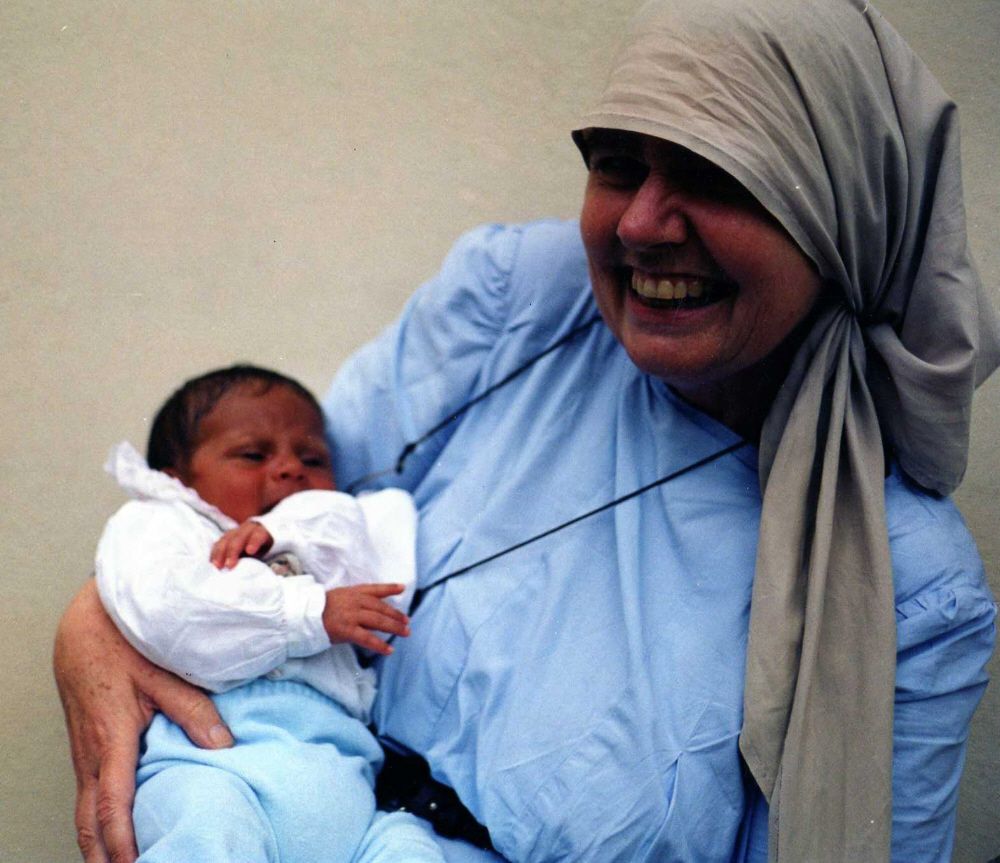
Leonardo
Hedera would sing lullabys to Leonardo of 'Alleluia' and lay
icons beside him on the bed. It was as if we were living in
Paradise. Then we helped them with the documents for returning to
Romania. But not before they all, cousins and brothers, expertly
repaired our collapsed dry wall, many metres of it, first cleaning
away everything, then, with the women, who held the baby in turns,
directing the menfolk, with the brothers and husbands throwing the
stones to each other, catching them expertly and putting them in
place in two hours. Stones that had once been in the Ghibelline
towers of pride and bloodshed, then in the Guelf city walls built
by Arnolfo di Cambio for the common defense and peace of Florence.
The hill has now held perfectly for twelve years. We have now
righted the falling Easter Island tombs. In return for this
valuable work I helped them buy their house in Buzau.
Before we could finish the dry wall we were ordered to stop. Roma
from Romania were then 'clandestini', illegal aliens. I could be
imprisoned for giving them work. Also, I asked San Lorenzo's Prior
about the baptism of the Roma child. He in turn asked the Curia. A
long discussion. No, they would not have baptized Leonardo. The
parents, poor, the mother illiterate, Romanian Orthodox, deeply
pious, would not have been prepared to raise the child Catholic.
They agreed it was a valid baptism sacramentally, but not a legal
one. There would be no paperwork done on it. In God's eyes, yes;
in men's eyes, no. I was to promise not to do this again. But I
did record Hedera singing 'Alleluia' to her child. Years later I
gave that MP2 recording to RaiUno for their Easter Sunday 2008
national broadcast where it became the background music for their
filming of the Mass for the Poor at the Badia. We also tried to
teach Hedera the alphabet and she wrote out the Lord's Prayer,
learning how to write letters but not grasping that they are
sounds, that they are building blocks for words. We taught her how
to marble paper and gave her a kit, buying her beautiful papers
sent to us from Romania.


Nadia, Leonardo, Robert in Romania with our
cradle. With
Hedera and Andre

Hedera's 'Padre nostro'
After Hedera, our next Roma family became Doina, her husband and
her baby Stefano. By now we knew we could not give work to Roma if
we did not wish to see the inside of a prison. Doina came to me,
her hospital bracelet still on her wrist, trying to tell me her
baby was being kept from her in hospital. The story was so strange
I found it hard to believe. She came again and I asked which
hospital. And went there to find four-month-old Stefano. He was
about to be put up for adoption. We arranged for Doina and Luca,
her husband, to meet with young lawyers and I then went with them
to the Tribunal for Minors, having taught them to write their
names the night before. The woman judge, hearing the story from us
as well as from Social Assistance, awarded the parents their
child. We found the necessary carrying-cradle, clothing, money for
the travel documents and tickets so they could return with Stefano
to Romania. We went with them to the hospital and on the bus to
the train station, the whole time Luca kissing Leonardo in his
carrying basket. The photograph they sent from Romania shows us
the most beautiful, clean and gorgeously happy child, completely
different from the little expressionless institutionalized baby in
the hospital.

Stefano, Buzau
Already we had helped Hedera not lose her two babies to Social
Assistance. We have now saved eighteen Roma babies for their
parents. Taking them away from their people is a form of genocide,
the 'Lost Generation' of the Native Peoples in Canada and America,
of the Aborigines in Australia, children who are robbed of their
families, their languages, their cultures and their skills for
ecological survival. We say they steal our babies. The truth is we
steal theirs. To prevent this we help with the necessary documents
and photographs, which these illiterate parents cannot manage
otherwise. And we have made sixteen cradles, keeping one in the
library to explain the project, where it is sometimes used where a
baby is present for the Alphabet School, the others being in use
in families that have returned to Romania.
These babies hardly ever cry, feeling secure in the ancestral
wisdom of being swaddled, rocked, held, nursed and sung to, and
are a joy to have under one's roof. Their parents, too, make a
room beautiful, keep everything clean and their courtesy comes
from thinking of the other more than of themselves, reading one's
mind as to what needs to be done and doing it before one asks.
They are right-hemisphere people, living in the present moment,
the past and future too dreadful to contemplate, memories of
slavery from the Middle Ages until the nineteenth century, longer
than were Blacks in America, and then the horror of the gulags in
the Ukraine, next the Holocaust, with no reparations being paid,
all put aside, loving beautiful colours, music, dance,
celebrations of funerals, weddings, christenings.

Marcella, Vandana, Maria


As models for artists
Next, Vandana, her mother, her sister and her sister-in-law, came
and gardened at the same time we persuaded the hired gardeners
that the use of weed-killer be stopped. Vandana and her sister
also built bookcases with me for the library and another cradle. With
what Vandana earned with her family gardening they bought land
for building a house, explaining they were twelve living in
one room with no windows. We asked them to show us
where they lived in Osmannoro and went there, seeing the
five rooms they had built for seven people, two of them
married couples, the food, which they ate at a table
outdoors, hanging from the tree outside, likewise water so
they could shower and drink.

Osmannoro
Later the police would bulldoze that sturdy shack as unfit
for human habitation. Our library, the Mediatheca
'Fioretta Mazzei', is hung with photographs of the Roma in
Florence, Bologna, and Romania, photographs taken by Karen
Graffeo, whose own family had been photographed by Walker
Evans in James Agee's Now Let Us Praise Famous Men.

Karen Graffeo is friends also with the Muslim Roma from former
Yugoslavia and created two chuppas for American Jewish weddings
with the help of the Roma who embroidered the ancestors' names in
gold thread on white silk. One bride said, when being told it was
Muslim Roma who were doing the embroidering with a Catholic nun
pencilling the letters of the names for the Jewish chuppa, 'Well,
I guess that's world peace'! The Romanian Roma
now became European Citizens.
I would no longer have to go to prison if I gave them
work, but I still was not allowed to employ people who had no
fixed address and who were not insured. However the Constitution
of our Aureo Anello Associazione written by our lawyer allows for
economic activity amongst its members. Thus the answer was to have
Roma become members of the association we had formed for the
library and cemetery as its readers and restorers. Many, writing
their names in our membership book, did so for the first time,
side by side with noble English descendants and international
scholars. And all our members accepted this as valid. We pay the
insurance for them. Most are still sleeping in the streets with no
fixed address. But the new system of vouchers now permits their
working legally. I am only allowed to house one person, at the
very most, three in a family working in the Cemetery where there
is an emergency with a newborn until they receive the birth
certificate needed for next getting the travel document from the
Romanian Consulate for returning home with the baby. Knowing the
baby would be taken from them by Social Assistance and put up for
adoption if they lacked a proper address for it. If they begged
with the baby in the streets of Florence for their survival they
would be imprisoned.
The following year, 2008, Vandana returned with her husband,
Daniel-Claudiu. I found this odd as she had claimed she was
unmarried and we knew Roma marry very young. They had in fact
married when they were very young. She explained later she had
lied because she thought I would not have approved. I give Roma a
test, a task, and if it is done well, following that, real work.
Syracuse University had wanted the four tombs of the two Counts
Gigliucci and their English wives restored. I asked Daniel to
conserve their rusting iron railings. He did this work by hand,
scraping off all the rust and finding there were also brass knobs
on the tops of the railings. Our restorer, Alberto Casciani, said
to now give the iron two coats of anti-rust and two coats of
enamel, and for the brass a clear varnish. The work was done so
excellently we arranged a work contract
for him with our commercialista. I gave Daniel
my electric sander and over the summer he conserved all the iron
in the Cemetery, both the wrought and the cast iron work.
Immediately it began to look better. Daniel and Vandana were commuting by bus from
outside of Florence where the Roma had built shacks to come to
work. On the first of May they even returned on my bicycle there
being no buses. It was illegal for them to stay under our roof.
Daniel and Vandana built a cradle for their not-yet-born child.


Then the carabinieri forced Vandana into their car threatening her
and she went into labour prematurely. At this point the Swiss who
own the Cemetery allowed Vandana and Daniel to have my cell with
the tiny new-born Gabriela while I slept on the couch again, as
before with Hedera, Andre and little Leonardo, and Daniel finished
working on the iron. I registered the family at the police
station, required in Italy to make their presence legal. They
cared for the little Gabriela beautifully, as had Hedera and Andre
with Leonardo. I get up
early to pray the Offices and would find Daniel in the kitchen
lovingly warming milk for the baby at four in the morning. They
studied books in the library and also while here wrote booklets
with their drawings in four languages, Romanì, Romanian, Italian
and English, a Romanì dictionary, a booklet on house building, a
booklet on solar panels, and a booklet on health care.
Daniel drew on our library table the plan for the house they
wanted to build with four windows and three rooms.

Wanting to know if their stories were true, Karen Graffeo and I
travelled to Romania and found they were. In Buzau we visited
Daniel and Vandana's family and, yes, there were twelve people
sleeping in one windowless room, who offered us a potato each of
their meal which was only potatoes. We also visited the widow
Constantsa in Ramnicu Sarat seeing her caring for ten babies in a
house whose roof leaked. We saw Hedera's beautiful three room
house we had made possible, she no longer living in a shack. In
Buzau we photographed Vandana's sister and brother-in-law holding
aloft the photograph of baby Gabriela in the flower-filled field
that was the land they had bought for building the house.

Then, when they went home, Daniel, his mother, his wife and his
in-laws built its walls.


The following year, 2009, was a disaster. Cruel, racist jealousy had arisen. We
were not allowed to have the Roma come. They needed to work to
earn the roof or the walls would be damaged. We were 'in
cantiere', the Cemetery shut down while loculi for ashes were
being built. Vandana, her sister, and Daniel-Claudiu came anyway,
showing up at the gate, having used a people smuggler who had
taken their passports until they could earn back €300,00 to pay
him. On the days when the Italians were not working I had Daniel
re-build a path destroyed by the erosion of the terraced hill
alongside the Russian and Romanian tombs and paid him the €300,00
for the work so they could have their passports and return home.
The Roma had already identified for me the tombs of the two
Romanian nobles who had owned Roma as slaves until the publication
of Uncle Tom's Cabin in Romanian. The roof did not get
built that year. Instead I sent them money for plastic to protect
the walls.
The following year, 2010, Viscount Gough wished to have his almost
ancestress' tomb restored. It was black with dirt and a large
piece broken off. I arranged for its restoration from Alberto
Casciani, one of Florence's top restorers who took Daniel on as
apprentice, teaching him how to clean it, and how to make the
mould from the opposite corner for the broken one, filling that
with epoxied marble powder. It is almost impossible now to tell
what is restored and what is original. Alberto Casciani was
content to restore just the tomb for €3000,00. Daniel, who was
only being paid €300,00, insisted on restoring the marble columns
and iron railing surrounding it as well, repairing its entirety. A
Russian tomb next to it still is black, and the difference between
the two tombs is that of night and day. Immediately afterwards
Daniel proceeded to clean tomb after tomb in the cemetery.
Meanwhile other families came into our project. Margarita would
come and garden and wash her family's clothes so her son could
attend classes to learn stonemasonry. We asked her to show us her
shack. She had had it built by another Roma for €50,00. It was
unacceptable as housing, snakes in the grass and rats everywhere
from no rubbish removal. She would borrow our sickle to cut the
grass to protect her family from the snakes.

I telephoned the Mayor's office in Sesto Fiorentino asking why
there was no rubbish removal. And got told 'They don't work, they
don't pay taxes, we won't remove their rubbish'. But they are not
allowed, by Italian law, to work, they are only allowed to beg.
Then Osmannoro, the camp where once Hedera and her family and
Vandana and her family had been, was bulldozed by the police on
the coldest day of the year, so Margarita and her family moved to
live in the street at the Santissima Annunziata. So also did
Lupascu Copalea who has TB and his family, while Nicolae and his
family who begged outside our gate were sleeping near Santa Maria
Novella Station. The police take their blankets on the coldest
nights of the year. We started Alphabet School for these families,
in the summer Lupascu teaching them under the cross by Thomas
Southwood Smith's tomb and its epitaph on the need for fresh air
and sunlight in the homes of the poor. Lupascu's family in
Constantsa are 28 to two rooms lacking windows and many under that
roof, children, adults, have TB. I have now paid for them to have
a window in their house. Windows are cheaper and better against TB
than are hospitals and medicines.


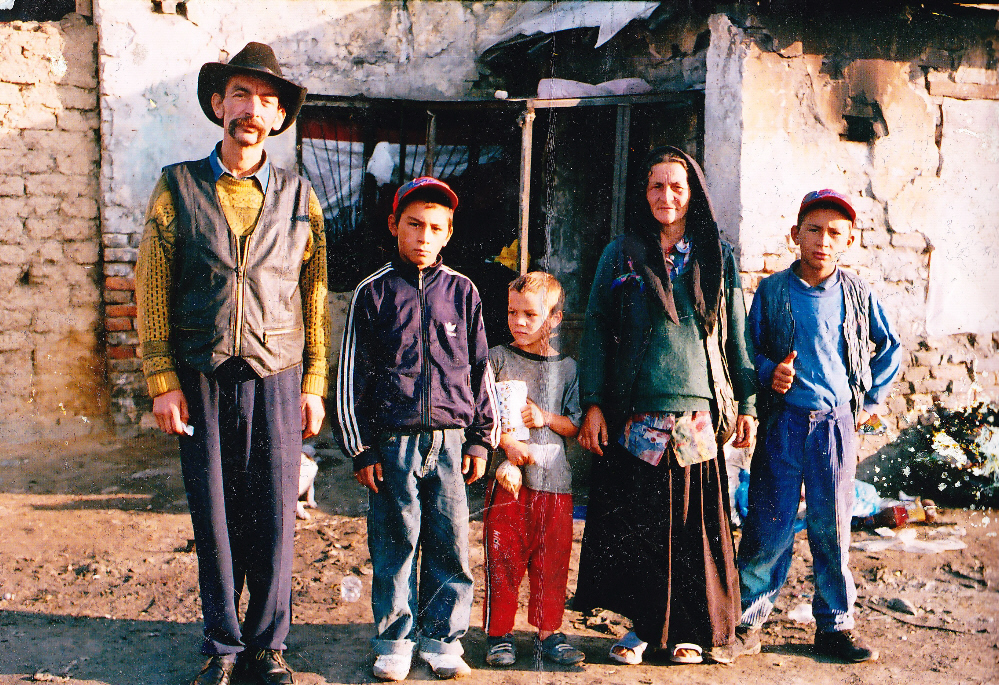
Margarita's brother George and her sixteen year old son Comitet
repaired two tombs Italian restorers said could not be repaired,
carefully fitting their pieces back together, using the letters of
the inscription, one in Russian, one in Swiss French, to match the
pieces, giving us the inscriptions and identifying the tombs that
had caused us earlier to despair. Both Gheorghe and Comitet are
illiterate. Nicolae from Ramnicu Sarat and Bancuta from Iasi
gardened in turn with each other, Margarita and her family,
threatened with imprisonment, having returned home.
Immediately after Daniel cleaned Sarah Elisabeth Gough's tomb he
also cleaned that of Sir David Dumbreck, Robin Dumbreck sending us
colour photographs of the Crimean medals gained from being head of
the hospitals there where Florence Nightingale worked, medals
which the sculptor had borrowed from the widow to sculpt in the
white marble. In that year of 2010 Daniel, under the supervsion of
the restorer, Alberto Casciani, cleaned the tombs of Goffredo
Bettini, Robina Wilson Cavalcanti, Captain James Chute, Philipina
Simons Ciampi, Arthur Hugh Clough, Saxon Crocker, Major
Michelangelo Galeazzi, James Lorimer Graham, Elizabeth Daubeney,
Robert Davidsohn, Severinus Goedke Zimbowsky, Jean David Marc
Gonin (the Cemetery's first burial), Fanny Holman Hunt, Anne
Susanna Horner, Louisa Florence Lowe, Samuel Loowe, Maria
Mercadante, Cesare Paganini, Edward Porteus, Helen Florence Oldham
(sculpted by Hiram Powers), Juyla Pulszky, Rev George Robbins,
Harriet Robbins Inghirami, Georgina Sloper, Eleanor Augusta Tulk,
Pricnipesse Laure Temple Bowdoin Pandolfian, Sophia Tennet,
Augustus Wallis, Christopher Webb Smith, Mary Young, as well as
those of Sarah Elisabeth Gough and Sir David Dumbreck, a total of
30 large marble tombs. With what he was paid he was now able to
build the wooden part of his roof, the beams that would eventually
hold the metal roof to keep off the snow. Social Assistance had
threatened to take their children from them and so this was
essential in order not to lose them.
In January 2011, I gave a presentation to the European Economic and Social Committee of
the European Commission in Brussels,
titled 'From Graves to Cradles', this at their invitation, on our
work/study project with Romanian Roma in Florence. It was very
well received, and it was said that our project was the most
concrete. Our Aureo Anello Associazione formed a twin association
in Romania, Asociatia Agrustic Somnacuni - Inel de Aur, of which
Daniel is President and Vandana, Vice-President. While ours is to
maintain the Mediatheca 'Fioretta Mazzei' and to restore the
'English' Cemetery, theirs is to preserve Roma families and the
Romanì language, while acquiring all others, through mutual house
repairing and alphabetization. Then on the 29th of June 2011 the
Comune of Florence invited all the autorità of the city and
presented us with the Gonfalone, the
great lilied banner of Florence in honour of Elizabeth Barrett
Browning and of the restoration of the Cemetery by the Roma,
Daniel taking fine photographs of the event.
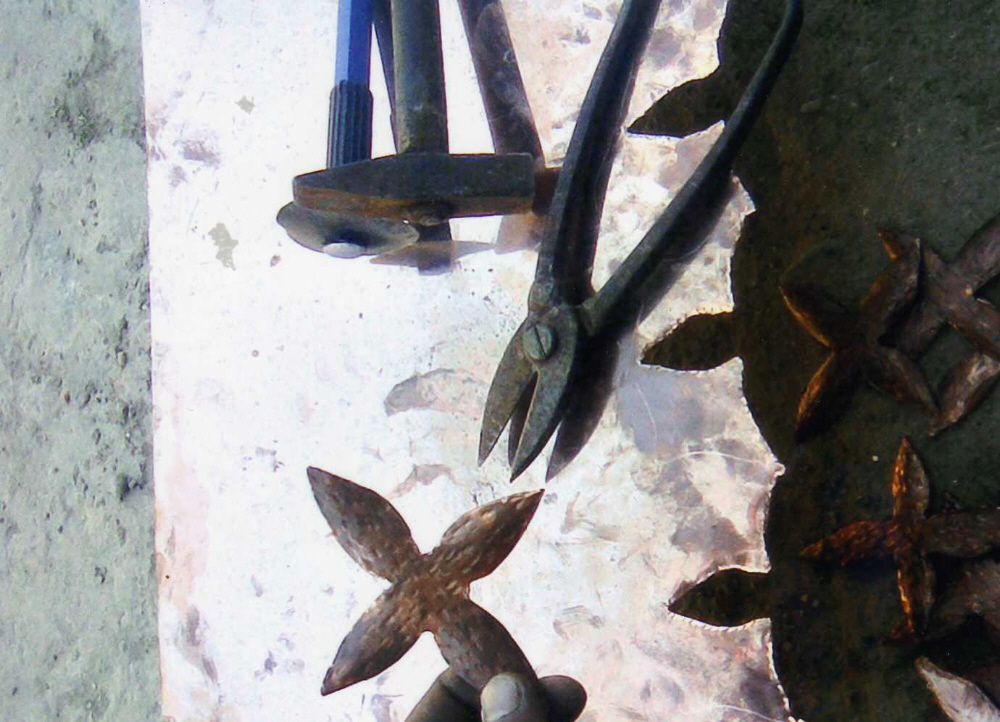

In 2011 Daniel brought his grandfather's tools he had inherited
and replaced the lead lettering that was missing on the
tombs. He also cleaned and repaired the following hundred
tombs: Jules August Aguet, Eugenij Fedorovic Allissof, Elizabeth
Barrett Browning, Vicomte Henri de la Belinaye, Edmund Bennett,
Isabella Blagden, Emile Emanuel Bosio, Marie Fanny Bosio, Eduard
Bosse, Elòise Bosse, Ernst Gotthilf Bosse, James Bourne, Edward
Brind, Beatrix Fanny Mary Campbell Spence, Katie Isabel Campbell
Spence, Vice-President Salomnon Guillaume Counis, Carlo Cuonz,
Elizabeth Craft, James Craigie, M.D., Rev George Brickdale
Crossman, Louise Laurie Sophie Alice Dalgas, Rodolphe Guillaume
Dalgas, Elizabeth Judge D'Arcy Irvine, Emily D'Arcy Irvine, James
Lukin Davis, Philippe DeLaPierre, Frederique Duplan, Salvatore
Ferretti, Eleanora Frappa, Capt. Jacob Anton Ganzoni, again Jean
David Marc Gonin, Jane Miller Dickson Gordon, Marcellina and
Veturia Vota/Greco, Rev Henry Greene, Grace Greenwood, Anne
Harris, Lieut Commander Isaac Harris, Jean Christian
Heinzmann/Gustav Hainzmann/Franz Heinzmann, Richard Hildreth,
Frances Wemyss Howe, Margaret Smith Boyle Thompson, Lucy Oliver
Ives, Constant Jaccottet, Hugh William Jones, Charles Edward
Kerrich, Dr Augustus Kirch, Frederich Adolph Kleinkauf, Arnold
Henry Savage Landor/Walter Savage Landor II, John Landor, M.D.,
Pierre de Lars, Louise LeBrun, Lessona tombs, Ivan Leontevic
Levickij, Millicent Ann Lloud, Charles Edward Lushington,
Bartolomeo Malfatti, Maria Mafatti/Luisa Malfatti, Paolo Malfatti,
Anatolij Michajlovic Maslennikov, Roland James McDouall, Hugh
MacDonell, Mary Beatrice McLeod, Monica Salvador Megatti, Jenny
Morell Walton, Elizabeth Anne Morice, Adolfo Mussafia/Regina
Mussafia, Kalima Nadezhda De Santis, Caroline Bennett Napier,
Robert Nicholson, Dott. Bartolomeo Odicini, Rev. Geroge Algernon
Peyton, an unidentified pyramid tomb, Evegenij Polyakov, Hiram
Powers, Samuel Reginald Routh, Mary Anne Salisbury, Hugen G.
Schmid, Wilhelm Philip Ludwig Schwarzenberg, John Crossley Gayle
Seymour, John Sinclair, John McHardy Sinclair, Captain Robert
George Suckling Smith, Contessa Eleanore Emilie Stenbock-Fermor,
Maria Stevens, Anna/Annina Stupani, Harriet Thompson, Robert
Vincent Thurburn, Thomas Tod, Hon. Frances Tolley, Thomas Tringham
Smith, Paul Vieusseux, Giampietro Vieusseux, John Maurice Walker,
Louisa Mary Yarnold, Edward William Young. With what he earned
this year he was able to roof his house with metal against the
snow.


The year, 2012, he continued to work with CNR 'Nello Carrara' in
their major research project cleaning the statue of Speranza/Hope
by Odouardo Fantacchiotti with lasers on the tomb of Samuel
Reginald Routh, and also he has cleaned the 38 tombs of Elisa
Maria Stisted Wood, Lydia Matilda Goff, Isabella Scott, Thomas
Tighe, Captain James Johnston McCleverty, Carl Jules
Heinzmann/Elisa Adelaide Heinzmann, Jules Friedric Genand, Thiomas
Tod, Henry Brockholst Livingston, Giovanni Stupani, Charlotte Mary
Florentia Clive, Everetta Louisa Auldjo, Arthur William
Castellani, Annie Dallas, James Robert Matthews, Mary Anne Octavia
Matthews, Florence, Frances Augustina, James Gibson Powers,
Cavalier John Hedenborg, Albert, Ernesto, Eugenio Revel, Alice
Marie Orr Slayton, Mary Isabella Jefferson Page, John Edward
Elliott, Emma Matilda Ball, Christine Temple-Bowdoin, Ann Alice
Holt, Domenica Peer, Leta, Placido Stalvies, Esther Susan Amelia
Bankes, Frances Jane Whyte Moyser, Florence Fletcher Walker Whyte,
Emil Otto Adolf Albert von Parpart, Charles Theodore Gipner, Emma
Gamgee Capei, Elizabeth Okell Grazzini, Joel Tanner Hart, Sarah
Lee, Anna Hermann, using water and small brushes. I can only say
what he is doing is miraculous. Everyone is pleased with his
careful and efficient work at the very top level, whether it be
the Opificio delle Pietre Dure or the Committee on National
Research for restoration. He and I work together on the schedatura
of the tombs for the Belle Arti, the government ministry for
monuments, he measuring and photographing each one, and also
digitizing the Swiss archives for this project. It disturbs me
greatly that he is not receiving a living wage for what he does.
€5000,00 a year of which a quarter is paid to the government in
taxes, is not enough for a family of six, soon to be seven, he,
his wife Vandana and their three daughters, Elena, Alexandra and
Gabriela, with another child coming, and the grandmother
Amanda.
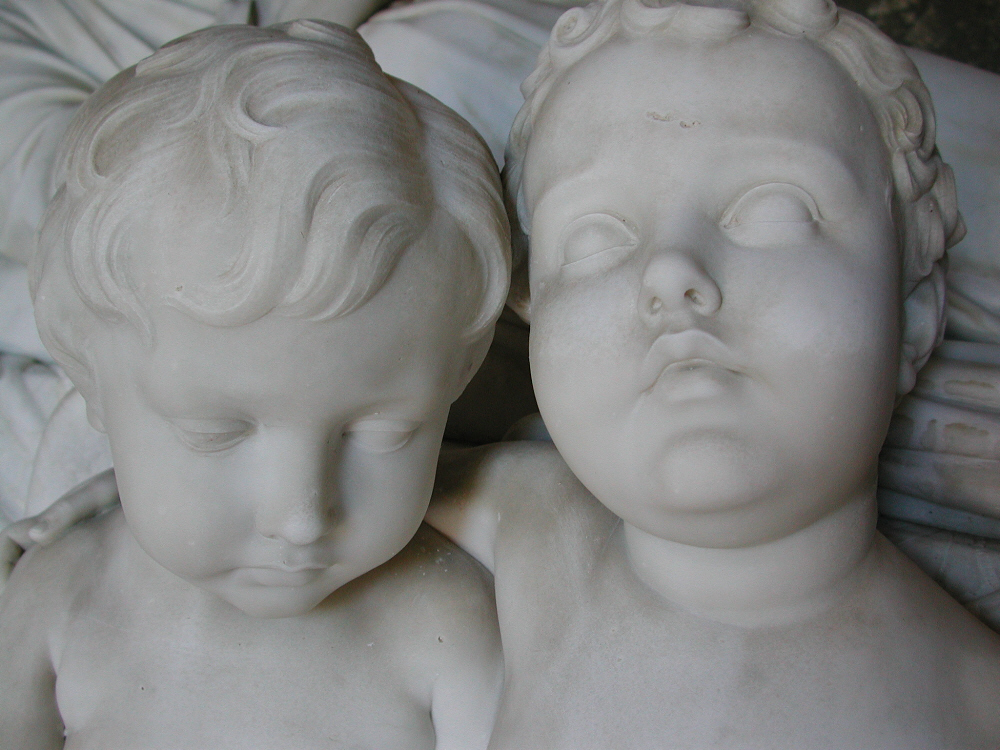
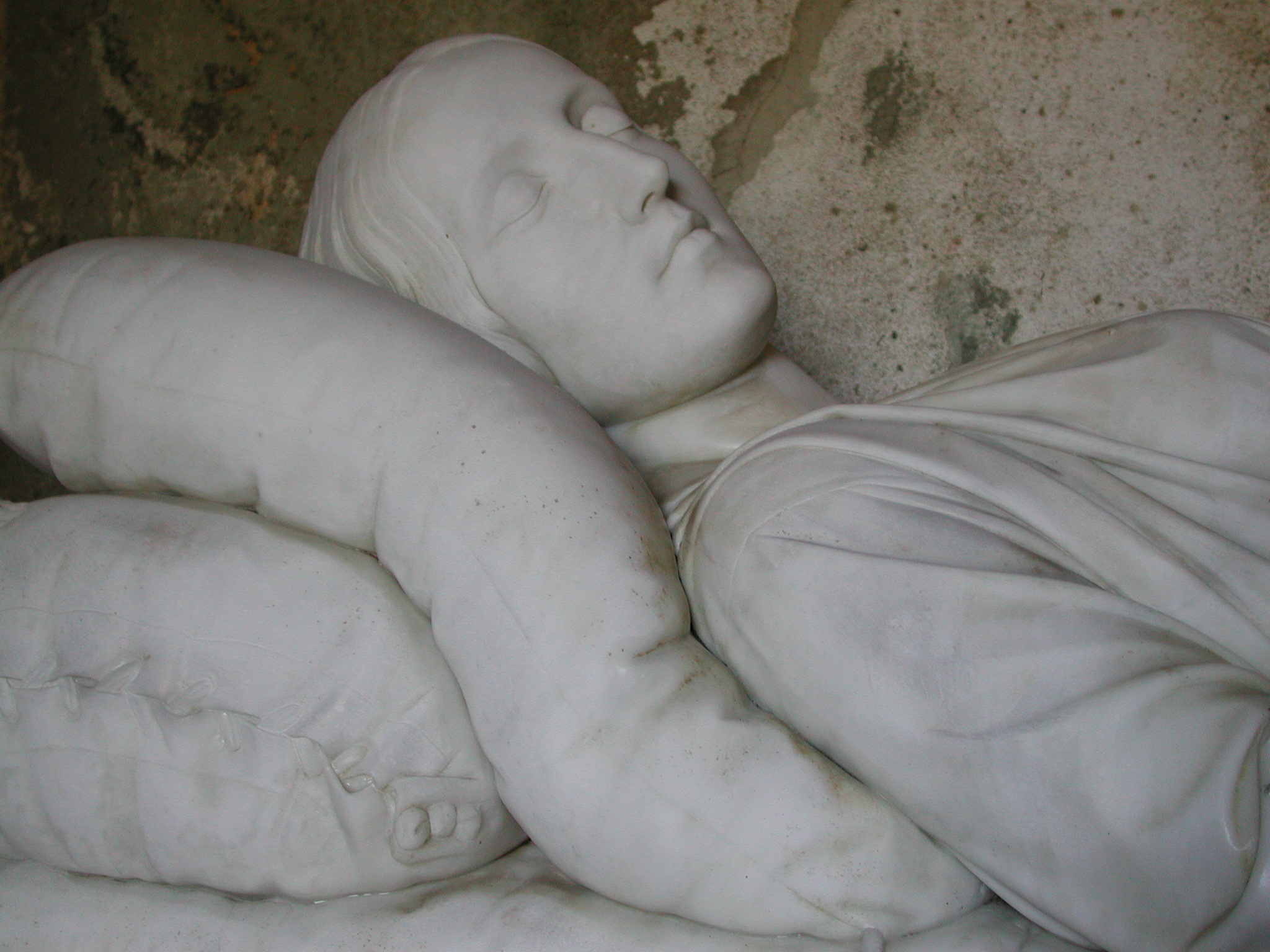
At the same time Daniel was cleaning Hope, the sculpture by
Odoardo Fantachiotti, he and I were told of another work by that
same sculptor, a tomb in chapel in Fiesole's cemetery for Teresa
Spence, that had formerly been in the Villa Medici there. It is
extraordinarily lovely but was filthy with mouse droppings, the
door broken, and the tomb's two sphinxes vandalized, broken off
and stolen. A Blundell Spence descendant encouraged us to restore
it and Daniel set to work, taking the bus up to Fiesole daily with
his tools, cleaning the marble, repairing and conserving the iron
door. I gave him my book-binding gold leaf to gild the initials on
the gate. Hebe and Agnes came and stayed with us for two weeks
teaching the Roma how to cut letters on marble for tomb
inscriptions and how to gold leaf them.
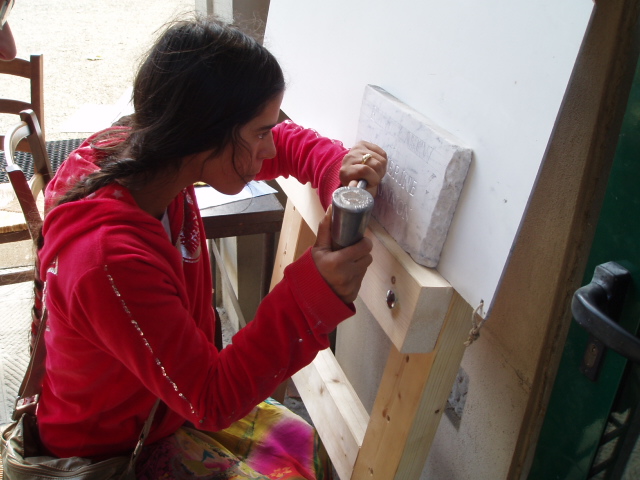
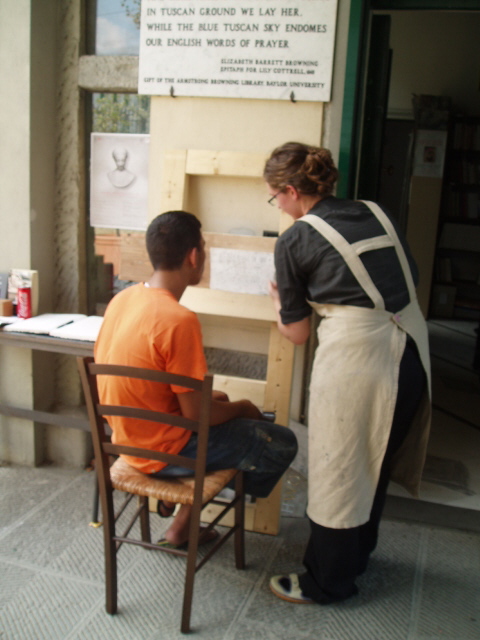
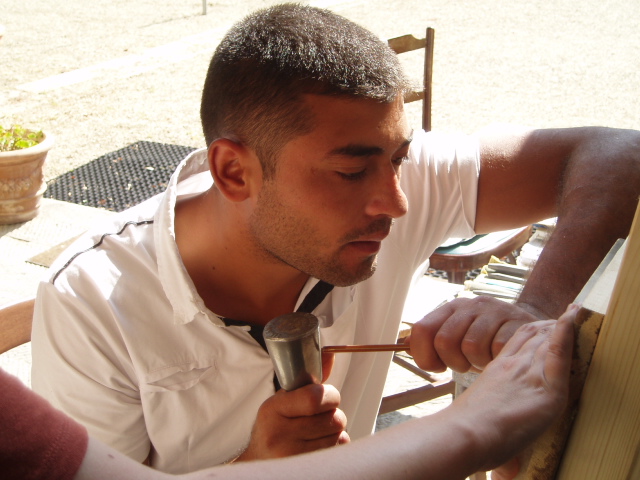
Then this year we created the facsimile of the cover of Florence's
Libro del Chiodo, the book condemning Dante to exile and death
three times and presented it to the Museo Casa di Dante to replace
the black and white flat reduced photograph of it they had
previously displayed. UNESCO next asked us to submit two
photographs of Florence to celebrate the 40 years of the UNESCO
World Monuments project. I photographed Daniel-Claudiu Dumitrescu
and Alberto Casciani in their white coats beneath the beautifully
cleaned statue of Hope and I photographed Daniel-Claudiu
Dumitrescu with Enrico Giannini and the facsimile of the Libro
del Chiodo in Enrico's Oltrarno workshop. Both photographs
were accepted by UNESCO.
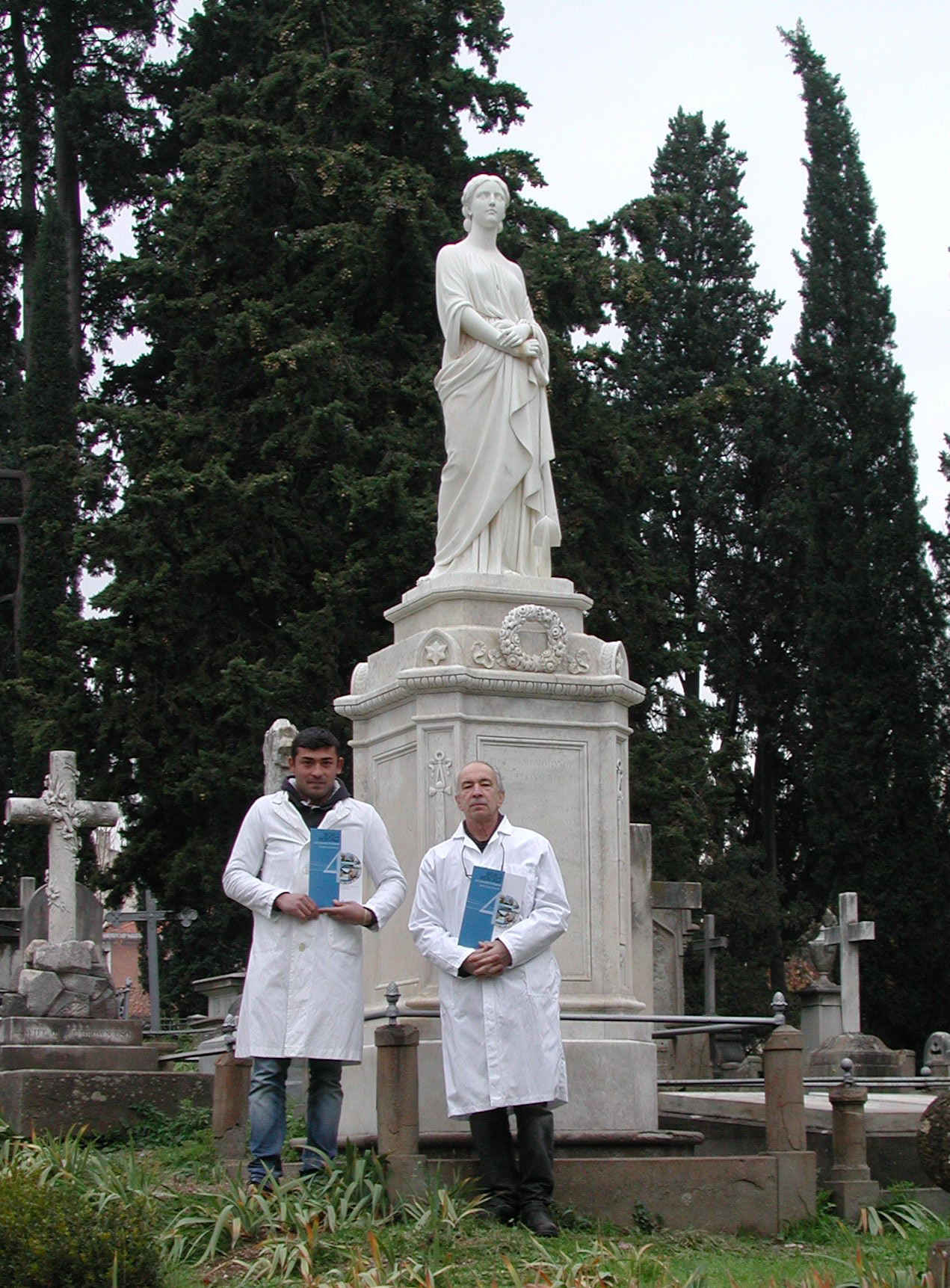
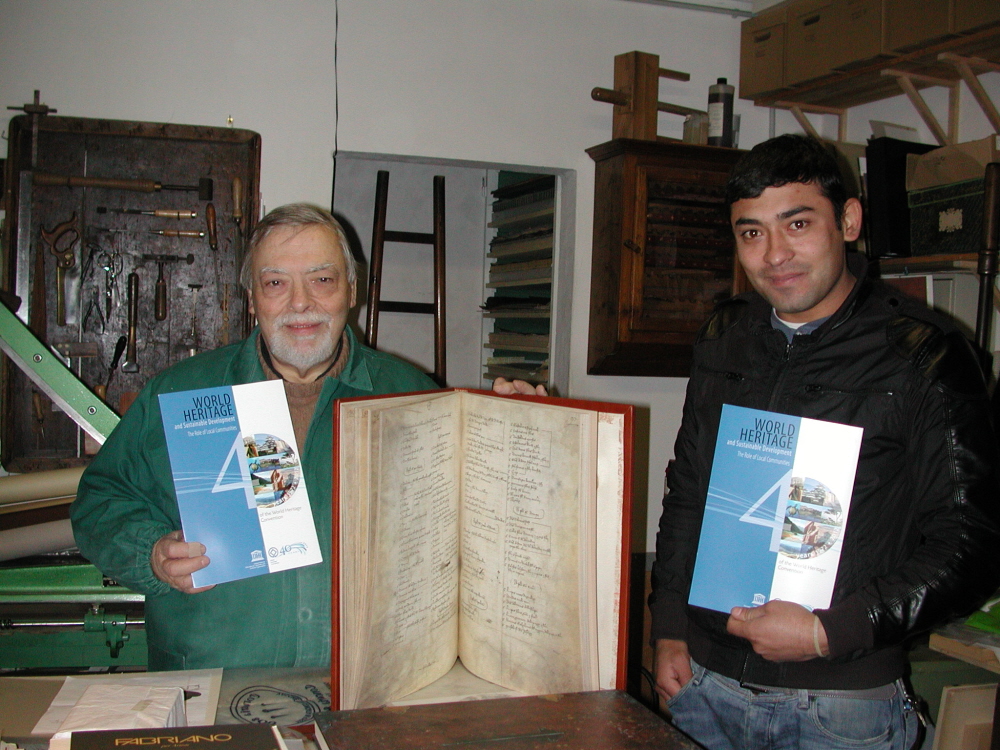
Enrico Giannini and Daniel-Claudiu Dumitrescu
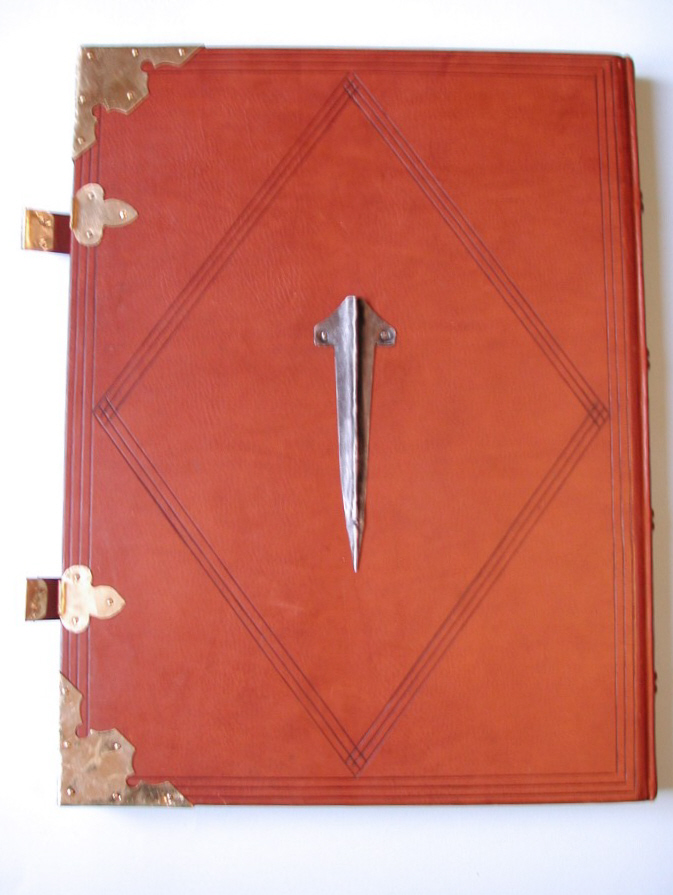
Facsimile, Libro del Chiodo, Casa di Dante Museum
The Alphabet School, held on Sundays when the Carabinieri are less
likely to come, from seeing the women's skirts, and who check all
our documents, convinced the Roma are stealing, is now
flourishing. At first I had so wanted the women to come, knowing
their acquiring literacy would reduce infant mortality and
increase the life span of both Roma men and women, but they held
back. Then Daniel explained to me that Roma women won't tolerate
being in a room with men not their husbands and that if I held the
school for the women in our library with the men outdoors at a
table under the arch the women would also participate. He was
right, widows, mothers, children now flock to attend. And when, if
it is raining, I ask if a man can join them, their chorus is
resoundingly 'No!' Roma women are very chaste, very faithful, very
strict. So I sat Nicolae down in my office, instead of in the
library. Both men and women have fine eye/hand coordination and
love copying out the alphabet's letters and the words of the
Lord's Prayer and the word 'Alleluia' in Italian which they know
orally. They are Christian, Romanian Orthodox, and yearn to
participate in churches - which they may not enter. I don't
formally teach them. I give them sheets of paper printed in reds
and blues with the Alphabet and the Lord's Prayer and 'Alleluia'.
I use ideas from St Jerome, 347-420, Galfridus Grammaticus of
Lynn, 1440, Jean-Jacques Rousseau, 1712-1778, Johann Heinrich
Pestalozzi, 1746-1827, Joseph
Lancaster, 1778-1828, Elizabeth Fry, 1780-1845, Enrico Schneider, 1817-1864,
Salvatore Ferretti, 1817-1874 (both these men buried in our
cemetery), Agnes Mason, C.H.F., 1849-1941, Maria Montessori,
1870-1952, Jean Piaget, 1896-1980, Don
Lorenzo Milani, 1923-1967, Paulo Freire, 1821-1997 (the majority's
nations fittingly being Swiss and English), and the 1960s' Black
Panthers breakfast project, in accord with the UNESCO World Open
Educational Resources (OER) Congress held in Paris in 2012. I give
them sandwiches of nourishing chicken liver paste on blessed
bread, apples, water, and two euro to each participant. They write
in joyous silence. They also love books, the engravings of
Diderot/D'Alembert's Encyclopedia, an illustrated
children's Dante, art books whose Madonnas and saints they kiss
like icons. And when they finish the children spontaneously,
without being asked, sweep the library, the widows then weed the
Cemetery, the children sharing in this, all being playful
together. They take showers, for Roma, though denied water, love
being clean. We keep all the lesson papers and pencils in the
cradle we have built, Karen's photographs and this cradle
prompting many questions and much learning by Florentines and
tourists about Roma culture and its values.
I have learned in these twelve years many lessons about Roma. I
have much more to learn. Their greatest value is the family, their
people. If one needs help another will give it, even at the cost
of losing their work. Their priorities are for humanity rather
than for wealth. From years of slavery they do not care to live in
our structures of being given orders and obeying these. I can
remember when lecturing on Dante in Attica State Prison that when
a prisoner's number was called out, that person would initially
freeze, not making any movement, giving himself a small space of
freedom, then obey because he had to. Roma are like this. Roma
will read one's mind, knowing what one needs to have done and will
have done it freely, excellently, quickly, efficiently, before
being asked. Poverty creates ingenuity. Roma have excellent
survival skills. They
will care for tools, mending them when they break. Roma are
blacksmiths, stonemasons, carpenters, gardeners, using a minimum
of machinery with a maximum of productivity. Ten-year old boys
will ask for a needle with which to mend their pants. Men
embroider, women build houses. Praise these initiatives. This is
freeing. Rejoice with them. This undoes tragedy. Roma prefer
working together in their own Sanskrit-derived language with each
other in groups. Alone, away from other Roma, they lose energy and
will leave. Do not have Roma sit in rows in school at desks;
instead they learn best together around a table. They are
collaborative, cooperative, and not competitive. Women are chaste
and will not want to study in the same room as men, or work
together unless they are in the same family. Roma women may be
destitute but they will not stoop to prostitution. Roma women
would not wear trousers, instead have full skirts, head scarves
and shawls, and in the home, beautiful aprons as well. Roma, who
marry very young, know excellently how to care for a new-born
child, having them feel secure, swaddling, rocking, nursing,
holding them, and their babies do not cry. They also know
naturally how to teach by example all their skills to children.
They do not become alarmed when a child touches dangerous tools as
they know the child will copy their own calm care and skill in
handling them. Roma are right-brained, loving colour, music,
images, dance, the present moment, being in touch with the entire
cosmos. They do not have a strong sense of ownership, of self.
Everything belongs to everybody. Roma have strict ancestral
rules about cleanliness. Two pieces of soap must be used, the one
for the top part of the body not touching the bottom and vice
versa, and they wash their hands, wrists and forearms as carefully
as do modern surgeons before operating. This prevents cholera. If
they have no access to water they will discard their dirty
clothing rather than wear it again. This prevents typhus, which is
caused by lice growing in the seams of soiled garments. Roma do
not like being forced to accept a particular garment chosen for
them by another; instead they wish to freely choose which garment
they need. Roma are like Jews, to whom we are Gentiles, to the
Roma we being the Gadge, the ones who are unclean and uncivilized.
Roma have their internal tribunals or law courts, the 'kris', and
will not as a community tolerate criminality. Roma have a
particular horror of death and a cemetery is a place for them of
danger, of both physical and spiritual pollution. It is a miracle
that this cemetery became for them a sanctuary that gives them
dignity, respect, work, education. We have built this through
mutually trusting in one another. We have much to learn from each
other, we have much to give to each other. Daniel has now finished
cleaning the formerly black and very large and beautiful sculpture
of Speranza, of Hope. She is glorious.
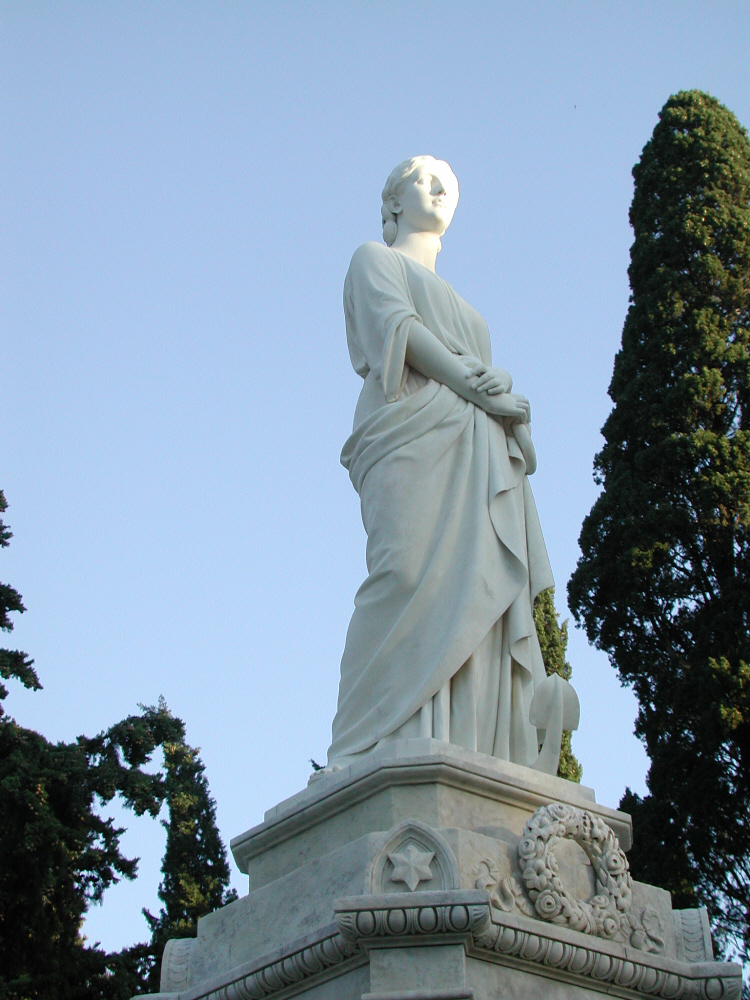
But our despair is that in the middle of the summer of 2011
Daniel's wife telephoned. The police had come to their house
saying the land was no longer theirs and that it was being taken
from them by the rich family who had possessed it before
Communism. We had already paid €1000,00 to their municipality to
register the land and the house. Now we paid €900,00 twice to
lawyers for two trials to defend their right to it. But the
wealthy have more power than the poor. Daniel and Vandana had to
dismantle their three-roomed, four-windowed house by 15 September
2012 that they had built themselves; they lost their land that
they had bought, and the six of them, with another child coming,
moved to one rented room. There was no recompense. My prayers are
that we will find some solution, some just reparation, for these
hard-working, manually-skilled, intelligent and very able people
who have contributed so much to Florence and to her global
visitors.
AGRUSTIC
SOMNACUNI || ROMANY ||
CRADLE || LET US PRAISE THE ROM || CHUPPA || MEDIATHECA
'FIORETTA MAZZEI' || 'ENGLISH'
CEMETERY || AUREO ANELLO ||